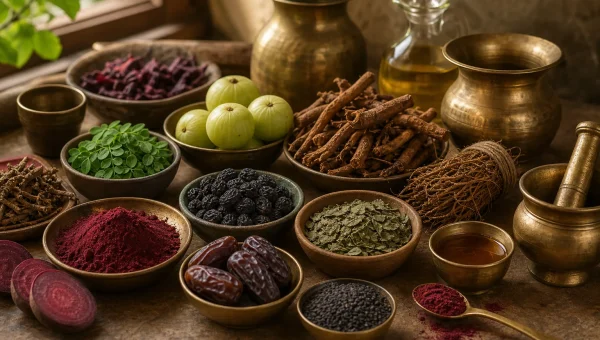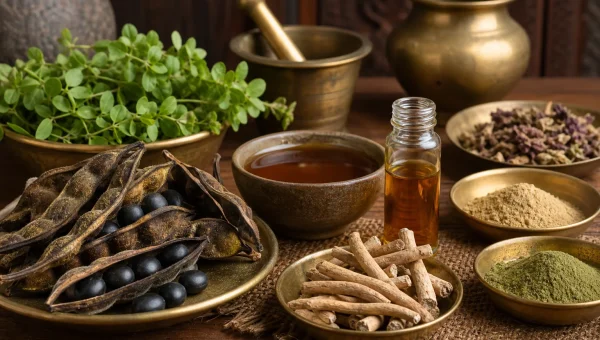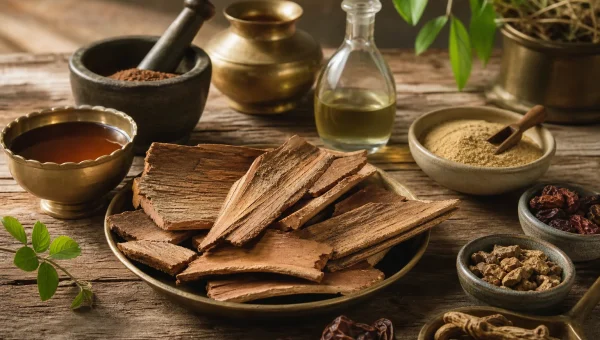
The modern interest in NAD+ precursors such as NMN and NR has created a useful but often overextended comparison with Ayurvedic Rasayana. NAD+ belongs to cellular redox metabolism and to NAD+-consuming enzymes such as sirtuins and PARPs, while Rasayana belongs to a classical Ayurvedic framework for nourishment, rejuvenation, strength, ojas, and resistance to decline. The two systems are not the same. Still, several well-known Rasayana herbs touch adjacent biological themes in contemporary pharmacology: mitochondrial function, oxidative stress control, inflammatory signaling, AMPK activity, SIRT1-related signaling, and tissue resilience.
The most accurate way to read this convergence is neither as proof that Rasayana is “Ayurvedic NMN,” nor as a dismissal of traditional rejuvenation therapy. It is a careful comparison: NAD+ research gives a molecular vocabulary for energy and repair, while Rasayana gives a clinical and dietary vocabulary for sustaining dhatu quality, agni, bala, ojas, and long-term vitality.
NAD+ Biology: A Brief Overview
Nicotinamide adenine dinucleotide, or NAD+, is an essential coenzyme in redox metabolism and an important substrate for NAD+-consuming enzymes. Its relevance to aging discussions comes from its role in mitochondrial energy production, DNA repair signaling, sirtuin activity, inflammation, and cellular stress responses. NAD+ availability can decline with aging and metabolic stress, and this decline has been linked in experimental models to impaired mitochondrial communication and reduced metabolic resilience.
- Sirtuin activity: Sirtuins are NAD+-dependent enzymes involved in metabolic regulation, stress resistance, mitochondrial function, and DNA repair signaling.
- PARP activity: Poly(ADP-ribose) polymerases use NAD+ during DNA damage responses, which can affect the cellular NAD+ pool when repair demand is high.
- Mitochondrial function: NAD+/NADH balance is central to oxidative metabolism and electron transfer, making it closely connected to ATP production and cellular energy status.
A widely cited 2013 Cell paper by Gomes and colleagues found that declining NAD+ in aged mice contributed to disrupted nuclear-mitochondrial communication and that raising NAD+ in that model improved aspects of mitochondrial dysfunction. This remains preclinical work, not proof that NAD+ precursors extend human lifespan.
The Rasayana Framework
In the Charaka Samhita, Rasayana is treated in the first chapter of Chikitsa Sthana, divided into four padas. The chapter presents Rasayana as a branch of therapy for rejuvenation, longevity, improved quality of body tissues, immune strength, and preservation of vitality. Rasayana is not limited to herbal drugs; it may include food, lifestyle, conduct, and medicines used according to the person, condition, season, digestive capacity, and clinical purpose.
The word Rasayana is commonly interpreted through rasa and ayana, meaning a path or method for the proper nourishment and refinement of rasa and the subsequent tissues. In this sense, Rasayana is not merely “anti-aging supplementation.” It is a broader discipline of maintaining tissue quality, agni, ojas, strength, complexion, memory, and resistance to disease.
Where Rasayana and NAD+ Biology Overlap
The overlap is strongest at the level of biological themes, not at the level of identical mechanisms. NAD+ precursors aim to supply or support NAD+ biosynthesis. Rasayana herbs are multi-constituent botanicals with antioxidant, anti-inflammatory, metabolic, digestive, immunomodulatory, or tissue-supportive effects. A few Rasayana herbs and formulations have been examined in cell and animal models that involve AMPK, SIRT1, mitochondrial biogenesis, insulin signaling, oxidative stress, and inflammatory pathways.
| Rasayana herb or formulation | Verified constituents or preparation | Relevant pathway theme | Evidence type | Practical interpretation |
|---|---|---|---|---|
| Amalaki / Amla (Phyllanthus emblica, syn. Emblica officinalis) | Gallic acid, ellagic acid, tannins, vitamin C-rich fruit matrix | Mitochondrial biogenesis, antioxidant systems, cellular energy support | Cell-line and preclinical data | Relevant to mitochondrial and oxidative-stress discussions, but not proven to raise NAD+ in humans. |
| Ashwagandha (Withania somnifera) | Withanolides, withanolide A, withanoside IV in studied extracts | Mitochondrial biogenesis and energetics, BDNF and SIRT1-related signaling in neuronal models | In vitro and animal data | Supports a mechanistic discussion around stress adaptation and mitochondrial resilience, not a direct substitute for NMN or NR. |
| Guduchi (Tinospora cordifolia) | Tinosporaside and other diterpenoids, alkaloids, glycosides, phenolics | Glucose utilization, PI3K and AMPK-dependent signaling in skeletal muscle models | Cell and diabetic mouse data | Relevant to metabolic signaling, but human anti-aging claims remain unproven. |
| Haritaki (Terminalia chebula) | Chebulinic acid, chebulagic acid, gallic acid, ellagic acid and related tannins | Inflammatory signaling, oxidative stress, gut barrier and AMPK/SIRT1-linked coloprotective models | Cell and animal data | Useful in the Rasayana and Triphala discussion, especially for gut-metabolic resilience. |
| Triphala | Combination of Haritaki, Bibhitaki, and Amalaki | Polyphenol-rich formulation with antioxidant, anti-inflammatory, gut and metabolic effects | Reviews, preclinical work, limited human clinical work for gastrointestinal and metabolic endpoints | Best framed as a multi-target classical formulation, not as an NAD+ precursor. |
| Pippali (Piper longum) | Piperine and other piperamides | Bioavailability enhancement, digestive and metabolic pharmacology | Pharmacological reviews and bioavailability literature | More relevant as a deepana-pachana and bioenhancing herb than as a direct mitochondrial rejuvenator. |
Triphala: A Multi-Target Rasayana Example
Triphala combines three fruits: Haritaki (Terminalia chebula), Bibhitaki (Terminalia bellirica), and Amalaki (Phyllanthus emblica). Modern reviews describe Triphala as rich in polyphenols, vitamin C, flavonoids, gallic acid, chebulagic acid, and chebulinic acid. These constituents help explain why Triphala is often discussed in relation to antioxidant and anti-inflammatory activity, gastrointestinal support, and metabolic regulation.
From an NAD+ perspective, the useful comparison is indirect. Triphala does not function as NMN or NR, and it has not been shown to directly raise NAD+ in human tissues. Its relevance lies in the way gut integrity, oxidative stress, inflammation, and metabolic signaling can influence the same biological terrain in which NAD+ biology operates.
A Scientific Reports Drosophila study found that Triphala used as a prebiotic component in a synbiotic formulation was associated with extended lifespan and improved markers of metabolic stress, oxidative stress, insulin signaling, and mitochondrial complex activity in male fruit flies. This supports mechanistic interest in Triphala, but fruit-fly lifespan extension cannot be translated into a human longevity claim.
Ashwagandha and Mitochondrial Resilience
Ashwagandha is classically used as a strengthening and rejuvenative herb, especially where weakness, stress burden, disturbed sleep, or depletion are part of the clinical picture. Modern preclinical work has added a mitochondrial dimension to that traditional use. A 2025 Molecular Neurobiology study reported that Withania somnifera root extract and a withanolide-withanoside rich fraction influenced mitochondrial biogenesis and energetics in rat cortical neurons, with BDNF and SIRT1-related signaling involved.
This supports a cautious bridge between Ashwagandha’s Rasayana reputation and contemporary language around neuroenergetics and stress adaptation. It does not justify broad claims that Ashwagandha raises NAD+ in humans, reverses aging, or should be combined casually with NAD+ precursors.
Guduchi and Metabolic Signaling
Guduchi is classically included among important Rasayana and medhya herbs, and it is widely used in Ayurveda for strength, immune resilience, and metabolic balance under practitioner guidance. In modern pharmacology, a 2023 study on tinosporaside isolated from Tinospora cordifolia found enhanced glucose uptake in skeletal muscle cells and improved glucose-related parameters in diabetic mice through PI3K- and AMPK-dependent mechanisms.
AMPK is often discussed alongside NAD+ and SIRT1 because it belongs to the broader network of cellular energy sensing. The Guduchi data therefore belongs in a metabolic resilience discussion, but it should not be stated as proof of an AMPK-NAD+-SIRT1 Rasayana axis in humans.
Haritaki, Gut Inflammation, and SIRT1-Adjacent Pathways
Haritaki is one of the central fruits in classical Rasayana formulations and in Triphala. Its fruit contains several tannin-rich constituents, including chebulinic acid, chebulagic acid, gallic acid, and ellagic acid. Contemporary work on Terminalia chebula has focused on antioxidant, anti-inflammatory, gut, hepatic, and metabolic effects.
Recent animal work has examined Terminalia chebula extracts in experimental colitis models, including inflammatory signaling and AMPK/SIRT1-related pathways. This gives Haritaki a plausible place in discussions of gut-metabolic resilience, oxidative stress, and inflammatory regulation. It does not establish Haritaki as a direct sirtuin drug or a human NAD+ booster.
Timing, Kala, and Circadian NAD+
NAD+ metabolism is connected with circadian biology, and SIRT1 participates in clock-related metabolic regulation. Ayurveda also gives importance to kala, including season, age, disease stage, time of day, digestive capacity, and the timing of medicine, food, sleep, and daily routine. These two ideas should be compared with care.
It is reasonable to say that both systems recognize timing as biologically meaningful. It is not accurate to claim that classical Rasayana dosing rules were written to match NAD+ peaks, nor that every Rasayana should be taken at dawn or bedtime. In Ayurveda, timing and vehicle are individualized. Chyawanprash, Triphala, Ashwagandha, Guduchi, and Pippali may be used differently depending on agni, bowel pattern, prakriti, season, age, strength, disease state, and the practitioner’s intent.
NMN/NR vs. Rasayana Herbs
| Parameter | NMN/NR supplementation | Rasayana herbs and formulations |
|---|---|---|
| Primary concept | Supplying NAD+ precursors or supporting NAD+ biosynthesis | Supporting rejuvenation, tissue quality, agni, bala, ojas, and resilience through multi-component interventions |
| Mechanistic focus | NAD+ metabolism, sirtuins, mitochondrial and metabolic signaling | Multiple targets including digestion, antioxidant systems, inflammatory pathways, immune modulation, and metabolic signaling |
| Human data | Growing but still limited; short-term trials show NAD+ increases more consistently than durable clinical outcomes | Variable by herb and formulation; many mechanistic data are preclinical, while clinical data are endpoint-specific rather than lifespan-focused |
| Safety profile | Short-term studies are generally reassuring, but long-term use and disease-specific use require more clarity | Traditional use is extensive, but quality, contamination, herb-drug interactions, pregnancy status, liver disease, autoimmune conditions, and individual suitability matter |
| Standardization | Single molecules with defined identity | Complex botanicals; effects depend on species identity, plant part, extraction method, dose, formulation, and manufacturer quality |
| Best use of evidence | Biomarker-focused NAD+ research | Whole-person Rasayana care with cautious integration of mechanistic pharmacology |
What the Evidence Supports
The strongest current position is that Rasayana and NAD+ biology overlap in themes of energy, repair, resilience, and aging-related decline, but they do not describe the same intervention. Rasayana herbs may influence oxidative stress, inflammatory tone, mitochondrial markers, gut-metabolic pathways, and cellular stress responses. NAD+ precursors may increase NAD+ or related metabolites in blood and some peripheral measures. Neither approach has been proven to extend human lifespan.
For Rasayana, the strongest classical claim is not a molecule-specific claim but a clinical doctrine: rejuvenation depends on proper nourishment of tissues, preservation of agni, removal of obstructive factors, appropriate conduct, and individualized use of formulations. For NAD+ precursors, the strongest biomedical claim is narrower: they can raise NAD+ measures in some human studies, while durable clinical benefits remain under active investigation.
What the Evidence Does Not Support
Current evidence does not support calling Rasayana herbs natural NMN or NR replacements. It also does not support claiming that Triphala, Ashwagandha, Guduchi, Haritaki, Amalaki, or Pippali directly increase NAD+ in human tissues. Likewise, there is no verified human evidence that combining NMN or NR with Rasayana herbs produces synergistic anti-aging effects, and there is no proof that either NAD+ precursors or Rasayana herbs extend human lifespan.
The most responsible interpretation is cautious convergence. Rasayana herbs may act on neighboring pathways relevant to cellular resilience, while NAD+ precursors act more directly within NAD+ metabolism. This distinction matters because a shared pathway vocabulary is not the same as clinical equivalence.
Practical Ayurvedic Approach
A Rasayana-oriented approach should begin with the basics of Ayurveda rather than with aggressive stacking of supplements. Digestion, sleep, bowel regularity, appetite, strength, season, age, and disease state should guide selection. For some individuals, Triphala may be chosen for bowel and gut support; Amalaki or Chyawanprash for nourishment and antioxidant-rich Rasayana support; Ashwagandha for depletion and stress-related weakness; Guduchi for metabolic or immune resilience; and Pippali where deepana-pachana and bioavailability support are desired. These are not universal prescriptions.
Quality and suitability are central. Use well-identified botanicals from reputable manufacturers, avoid unnecessary combinations, and be cautious with concentrated extracts, metal/mineral preparations, and products without testing for contaminants. People who are pregnant, trying to conceive, breastfeeding, taking prescription medicines, living with liver disease, kidney disease, autoimmune disease, cancer, diabetes, thyroid disorders, or planning surgery should consult a qualified Ayurvedic practitioner or healthcare provider before using Rasayana herbs or NAD+ supplements.
The Bottom Line
The convergence between NAD+ research and Rasayana is real enough to be intellectually useful, but not strong enough to justify marketing claims. NAD+ biology explains one important layer of cellular energy and repair. Rasayana explains a broader Ayurvedic strategy for maintaining tissue quality, strength, ojas, and resilience over time. The best future research would compare standardized Rasayana formulations with NAD+ precursors using meaningful human endpoints: metabolic health, mitochondrial biomarkers, inflammatory markers, functional capacity, sleep, cognition, frailty, quality of life, and safety over longer periods.
Until then, Rasayana should be presented as a classical rejuvenation discipline with emerging mechanistic relevance, not as a proven molecular anti-aging shortcut. The most balanced position is cautious optimism, precise language, and individualized clinical use.
Disclaimer: This article is for informational purposes only and is not a substitute for professional medical advice. Consult a qualified Ayurvedic practitioner or healthcare provider before starting any new herb, Rasayana formulation, NAD+ precursor, or supplement regimen.
References
- NAD(+) metabolism and its roles in cellular processes during ageing (2021), PubMed Central
- Declining NAD(+) induces a pseudohypoxic state disrupting nuclear-mitochondrial communication during aging (2013), PubMed
- Charaka Samhita — Rasayana Adhyaya
- Link (link.springer.com)
- Nature (nature.com)
- Amla Enhances Mitochondrial Spare Respiratory Capacity by Increasing Mitochondrial Biogenesis and Antioxidant Systems in a Murine Skeletal Muscle Cell Line (2016), PubMed
- Link (link.springer.com)
- Mdpi (mdpi.com)
- Frontiersin (frontiersin.org)
- Coloprotective effects of chebulic myrobalan extract by regulation of AMPK-SIRT1 signaling: A pharmacological and histopathological evaluation (2024), PubMed
- Molecular and pharmacological aspects of piperine as a potential molecule for disease prevention and management: evidence from clinical trials (2022), PubMed Central
- Piper longum L.: A comprehensive review on traditional uses, phytochemistry, pharmacology, and health-promoting activities (2022), PubMed
- Jstage (jstage.jst.go.jp)
- Improved Physical Performance Parameters in Patients Taking Nicotinamide Mononucleotide (NMN): A Systematic Review of Randomized Control Trials (2024), PubMed Central
- NCCIH