My uncle had stomach ulcers for eleven years. He went through three rounds of triple therapy (two antibiotics plus a proton pump inhibitor), and each time the ulcers came back within six months. It was my mother who finally convinced him to try what her grandmother had always kept in the kitchen: a small jar of Mulethi Ghrita, licorice-infused medicated ghee, taken on an empty stomach every morning.
I’m not going to tell you it “cured” him. I will tell you that after four months of consistent use alongside his maintenance PPI dose, his endoscopy came back clean for the first time in nearly a decade. His gastroenterologist was surprised. My mother was not.
Mulethi Ghrita is a classical Ayurvedic preparation described in the Sharangdhara Samhita (Madhyama Khanda, Chapter 9). It combines Yashtimadhu (Glycyrrhiza glabra, licorice root) with cow’s ghee through a slow-cooking process that extracts the fat-soluble compounds and creates a soothing, mucosal-protective medicine. Here’s how to make it at home, how to use it, and when not to.
Why Licorice Works for Ulcers
Glycyrrhiza glabra contains glycyrrhizin and its metabolite glycyrrhetinic acid, which increase prostaglandin production in the gastric mucosa. Prostaglandins protect the stomach lining by stimulating mucus and bicarbonate secretion. This is the opposite of what NSAIDs do, which is why licorice has been called “nature’s antacid” in some pharmacology texts.
Deglycyrrhizinated licorice (DGL) has been studied specifically for peptic ulcers. A clinical trial published in the British Medical Journal (1978) showed DGL healed gastric ulcers at rates comparable to cimetidine, and a more recent review in the Journal of Ethnopharmacology (2012) confirmed the gastroprotective mechanisms of Glycyrrhiza glabra (PubMed).
When licorice is processed into ghee, the fat-soluble compounds are extracted and concentrated, while the ghee itself adds its own mucosal-coating properties. This is the Ayurvedic concept of sneha (oleation) applied therapeutically to the gastrointestinal tract.
How to Make Mulethi Ghrita at Home
This is a medicated ghee preparation, or Siddha Ghrita. The process follows the classical four-part ratio described in Sharangdhara Samhita: 1 part ghee, 4 parts liquid (kasaya/decoction), and 1/4 part kalka (herbal paste).
Ingredients
- 250 grams pure cow’s ghee (homemade or organic A2 preferred)
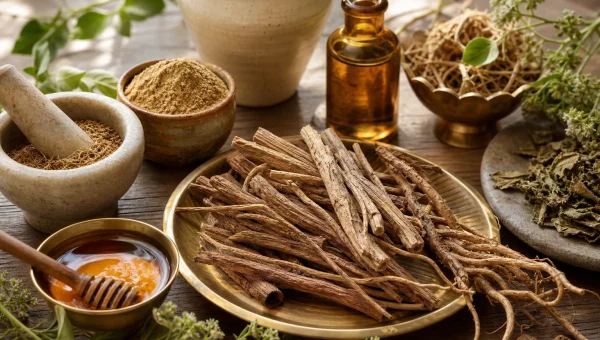
- 60 grams Yashtimadhu (Mulethi/Licorice root) coarse powder
- 1 liter water
- 15 grams Yashtimadhu fine powder (for the kalka paste)
Step-by-Step Preparation
- Make the Kashaya (Decoction): Add 60 grams of coarse Yashtimadhu powder to 1 liter of water in a stainless steel or clay pot. Boil on medium heat until reduced to 250 ml (one-quarter). Strain through a muslin cloth. Set aside.
- Make the Kalka (Paste): Mix 15 grams of fine Yashtimadhu powder with just enough water to form a smooth, thick paste. Set aside.
- Combine: Place 250 grams of ghee in a heavy-bottomed brass or stainless steel pan on the lowest possible flame. Add the kalka paste and stir for 2 minutes.
- Add Kashaya: Pour the 250 ml of Yashtimadhu decoction into the ghee-kalka mixture. Stir well.
- Slow Cook: Keep the flame at the absolute minimum. Stir every 10-15 minutes. The mixture will bubble gently as water evaporates. This takes 3-4 hours. Don’t rush it.
- Test for Doneness: The ghrita is ready when:
- All water has evaporated (no sputtering when you drop a tiny amount on a hot surface)
- The kalka residue at the bottom feels like wax when rolled between fingers
- The ghee has turned a deeper golden color with a distinct sweet, rooty fragrance
- Strain: While still warm, strain through a double layer of muslin cloth into a clean, dry glass jar.
- Store: At room temperature, away from direct sunlight. Properly made Siddha Ghrita lasts 6-12 months without refrigeration.
Dosage and Administration
| Condition | Dose | Timing | Anupana (Carrier) | Duration |
|---|---|---|---|---|
| Active gastric ulcer (adjunct to medical treatment) | 1 teaspoon (5 ml) | Empty stomach, morning | Warm water or warm milk | 8-12 weeks |
| Duodenal ulcer support | 1 teaspoon (5 ml) | Morning + 1 hour before dinner | Warm water | 8-12 weeks |
| Chronic gastritis / hyperacidity | 1/2 teaspoon (2.5 ml) | Morning, empty stomach | Room temp water | 6-8 weeks |
| Mouth ulcers / aphthous stomatitis | 1/4 teaspoon, applied directly + 1/4 tsp swallowed | After meals | Honey (1/4 tsp) | 1-2 weeks |
| General GI maintenance | 1/2 teaspoon (2.5 ml) | Morning | Warm water | 4 weeks on, 2 weeks off |
Pairing Mulethi Ghrita With Supportive Foods
Medicated ghee works best when your diet supports healing. For ulcer patients, I always recommend these kitchen strategies alongside the ghrita:
Healing Porridge (Peya)
This is the single best food for an inflamed stomach. Make it fresh each morning:
- 2 tablespoons white basmati rice
- 500 ml water
- A pinch of rock salt
- 1/4 teaspoon cumin powder
Cook until the rice completely dissolves into a thin, watery porridge. Strain if needed. Drink warm. This is light enough for even the most irritated stomach. For more traditional Kanji and Peya recipes, check out my full guide on healing rice porridges.
Shatavari-Banana Smoothie
- 1 ripe banana
- 200 ml coconut milk
- 1/2 teaspoon Shatavari (Asparagus racemosus) powder
- 1/4 teaspoon cardamom powder
- 1 teaspoon raw honey
Blend until smooth. Drink mid-morning. Banana is a natural antacid, Shatavari soothes mucosal membranes, and coconut milk provides cooling, nourishing fats.
Foods to Strictly Avoid During Ulcer Healing
- Coffee and black tea: Increase gastric acid secretion
- Chili peppers and hot spices: Direct mucosal irritation. Trikatu is off-limits during active ulcers.
- Alcohol: Damages the mucosal barrier and delays healing
- Citrus fruits on an empty stomach: Lemon water first thing in the morning is a terrible idea for ulcer patients
- Fried food: Heavy, slow to digest, increases Pitta
- Fermented foods in excess: Small amounts of yogurt at lunch are fine; large quantities of pickles, vinegar, and fermented drinks aggravate
Contraindications and Safety Warnings
This is where I need to be very clear. Mulethi Ghrita is not risk-free:
- Hypertension: Glycyrrhizin raises blood pressure by mimicking aldosterone. If your blood pressure is above 140/90, do not use Mulethi Ghrita without monitoring. A study in Hypertension Research (2017) documented the mechanism of licorice-induced pseudoaldosteronism (PubMed).
- Potassium levels: Chronic licorice use can cause hypokalemia. If you’re on diuretics (especially thiazides or furosemide), this combination is risky. Get your potassium checked monthly during use.
- Pregnancy: Avoid. Glycyrrhizin may affect cortisol metabolism in the fetus. A Finnish cohort study in American Journal of Epidemiology (2017) linked high prenatal licorice exposure to adverse cognitive outcomes (PubMed).
- Kidney disease: Fluid retention from licorice worsens edema. Contraindicated.
- Duration: Do not use continuously for more than 12 weeks without a 4-week break. Cycling prevents mineral imbalances.
The Classical Context
Yashtimadhu holds a special place in Ayurvedic pharmacology. It appears in more classical formulations than almost any other single herb. The Bhavaprakasha Nighantu describes it as madhura rasa (sweet), sheeta virya (cooling), and vata-pitta shamaka (pacifying Vata and Pitta). It’s classified as a Shothahara (anti-inflammatory) and Vranashodhana (wound-healing) herb.
The practice of infusing herbs into ghee is itself a sophisticated drug delivery system. Ghee acts as a lipid carrier, enhancing the bioavailability of fat-soluble phytochemicals and delivering them across the intestinal mucosa. Modern pharmaceutical science recognizes this principle in lipid-based drug delivery systems, and the science of Anupana in Ayurveda explains how different carriers change how herbs are absorbed and where they act.
For practitioners interested in other medicated ghee preparations, Kushmanda Ghrita for mental health conditions uses a similar preparation method with different therapeutic targets.
For clinical reference on peptic ulcer disease management, the American College of Gastroenterology provides current treatment guidelines. The Examine.com licorice supplement review offers a detailed breakdown of glycyrrhizin dosing limits. The NCCIH licorice root monograph covers safety data in detail. A review in Phytotherapy Research (2018) evaluated deglycyrrhizinated licorice (DGL) for functional dyspepsia with positive results across 3 clinical trials (PubMed). The Kottakkal Arya Vaidya Sala carries pre-made Yashtimadhu Ghritam for those who prefer a ready-made product.
My uncle still takes a half-teaspoon of Mulethi Ghrita most mornings. Not because his ulcers came back, but because his stomach hasn’t felt this good in 15 years. The jar lives next to the ghee on the kitchen shelf. It takes about 30 seconds of his morning. That’s a trade he’s happy to make.
Disclaimer: This article is for informational purposes only and not a substitute for professional medical advice. Consult a qualified Ayurvedic practitioner or healthcare provider before starting any new health regimen.