Ayurvedic Gingivitis Treatment: Rebuilding the Gum-Tooth Interface
Ayurvedic gingivitis treatment is best understood as supportive care for the danta-mula, the gum-root interface where plaque, saliva, food residue, gum tissue, and local circulation meet. Modern dentistry describes gingivitis as an early inflammatory gum condition marked by redness, swelling, and bleeding; Ayurveda looks at the same presentation through dantamula-gata disease patterns, especially Śītāda, where Kapha and Rakta disturbance produce soft, moist, foul-smelling, bleeding gums. The goal is not to replace brushing, interdental cleaning, dental diagnosis, or professional scaling, but to combine them with daily oral practices that keep the gingival margin clean and less irritated.
In this protocol, “Danta Mula Chikitsa” means an organized gum-care routine built from classical oral measures: danta-dhāvana or tooth cleaning, tongue cleaning, gandusha and kavala, gentle topical application, diet, and carefully selected internal herbs when appropriate. The emphasis is practical: remove irritants from the tooth-gum margin, avoid injuring the gums, calm heat and bleeding, and address the Pitta-Kapha-Rakta pattern that may appear as redness, tenderness, puffiness, bad taste, or bleeding on brushing.
The Four-Stage Danta Mula Care Protocol
A complete gum-care approach works in four layers: oil holding or swishing to soften oral debris, careful mechanical cleaning of the tooth-gum interface, herbal rinsing and gentle topical support, and internal diet-herb correction when the person’s constitution and symptoms call for it. Skipping mechanical plaque control weakens the whole protocol, while using harsh powders or aggressive gum massage can worsen tenderness and bleeding.
Stage 1: Gandusha and Kavala
Gandusha means holding liquid in the mouth with little or no movement; kavala uses a smaller quantity that can be moved around the mouth. A practical routine is to use warm sesame oil, hold or gently swish it for 3–10 minutes without strain, spit it out, rinse with warm water, and then brush and clean between the teeth. The oil should not be swallowed, and the practice should be avoided when it causes nausea, coughing, choking risk, or irritation.
Classical daily-regimen teaching praises oil gargling for supporting the jaw, voice, taste, oral comfort, and firmness of the teeth. For gum care, sesame oil works best as an adjunct: it may help loosen oily debris and plaque-adherent residue, but it does not replace brushing, flossing, interdental brushes, or dental treatment when tartar and pockets are present.
Stage 2: Danta Dhavana, Tongue Cleaning, and Gentle Gumline Cleansing
Classical Ayurveda recommends tooth-cleaning with suitable bitter, pungent, or astringent twigs while specifically warning that the gums and teeth should not be injured. The modern equivalent is a soft toothbrush angled gently toward the gumline, daily tongue cleaning, and careful interdental cleaning. Bleeding gums should be cleaned more gently, not ignored.
A fresh neem twig can be used when it is clean, pesticide-free, and not splintering. Chew one end until it becomes brush-like, then use light circular strokes at the tooth-gum interface and discard it after use. Neem twig cleaning should be avoided on ulcerated gums, around unstable dental work, or where the fibers catch between teeth; in those cases, a soft brush and dentist-recommended interdental tools are safer.
Stage 3: Triphala Kashaya Rinse and Danta Mula Lepa
A simple Triphala rinse can be prepared by simmering 1–2 teaspoons of Triphala powder in about 400 ml of water for 5–10 minutes, cooling it to lukewarm, straining it well, and rinsing for 30–60 seconds after brushing. A 120-person randomized multicenter trial used Triphala mouthwash for one minute twice daily for two weeks and recorded plaque and gingival-index changes comparable with 0.2% chlorhexidine in that trial setting.
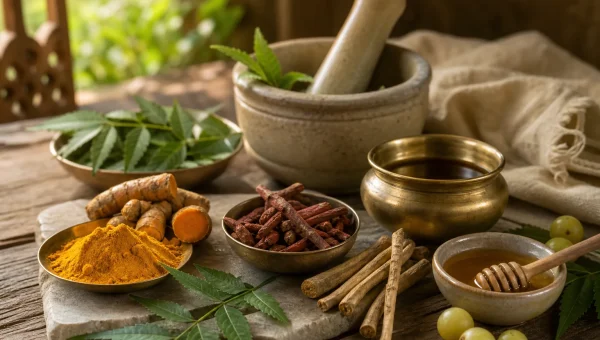
For a gentle danta mula lepa, mix fine Triphala powder with a small amount of sesame oil or clean water to make a smooth paste; Haridra may be added in a small proportion when the gums are puffy and irritated. Apply a thin layer with a clean fingertip for 1–3 minutes, then rinse. The paste should not be scrubbed into the gums, because dry powders and forceful rubbing can aggravate sensitive tissue.
Stage 4: Internal Pitta-Kapha-Rakta Support
Topical care helps the gum margin, while internal support is chosen according to the whole presentation: heat, bleeding, bitter or foul taste, bowel irregularity, heaviness, tongue coating, diet pattern, medication use, and dental findings. Internal herbs should be selected by a qualified Ayurvedic practitioner, especially when the person is pregnant, taking anticoagulants, using diabetes or blood-pressure medication, or has liver, kidney, gastrointestinal, or immune-related conditions.
| Herb | Verified Ayurvedic Profile | Use in a Gum-Care Plan |
|---|---|---|
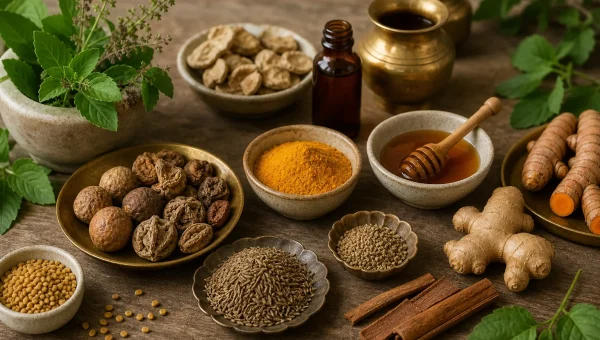
| Triphala | Classical three-fruit formulation used for digestive support and oral rinsing | Used externally as a strained rinse; internal use is practitioner-guided, especially in loose stools or depletion |
| Haridra (Curcuma longa) | Katu-Tikta rasa, Ruksha guna, Ushna virya, Katu vipaka; listed as Krimighna, Vranahara/Vrana-related, and Kaphapittanut | Used in small amounts in topical paste or food-based support when heat and Kapha signs coexist |
| Nimba (Azadirachta indica) | Tikta rasa, Laghu guna, Shita virya, Katu vipaka; listed as Kaphahara, Pittahara, Vishaghna, and Vrana Shodhana | Best used externally as twig or rinse support unless internal use is specifically prescribed |
| Manjistha (Rubia cordifolia) | Madhura-Tikta-Kashaya rasa, Guru guna, Ushna virya, Katu vipaka; listed as Kaphapitta-shamaka, Shothaghna, and Shonitasthapana | Considered when the gum picture is strongly Rakta-associated, with redness, bleeding, and congestion |
| Tila Taila (sesame oil) | API-listed sesame oil is Snigdha, Guru, Sukshma, Ushna, Madhura vipaka, and used for Snehana, Vatahara, Vranaropana, and Vrana Shodhana contexts | Used as the base for oil holding, gentle gum application, and paste preparation when tolerated |
Diet and Daily Routine for Pitta-Rakta Gingivitis
Diet matters because the mouth is repeatedly exposed to food residues, sourness, salt, heat, alcohol, and sticky sweet substances. In a Pitta-Rakta gum pattern, meals should be less sharp, less sour, less salty, and less irritating; in a Kapha-heavy pattern with puffiness and coating, the diet should also reduce heaviness, frequent snacking, and sticky foods that remain around the gumline.
- Increase: Warm cooked meals, mung dal, rice or barley preparations, cooked vegetables, fresh coriander, amalaki-based foods when tolerated, and small amounts of ghee if digestion supports it.
- Reduce: Pickles, vinegar-heavy foods, very sour chutneys, excess chilli, alcohol, deep-fried foods, sticky sweets, and repeated snacking between meals.
- Add: A warm water rinse after meals when brushing is not possible, plus nightly brushing and interdental cleaning before sleep.
- Timing: Keep the late evening light and avoid sleeping with food residue, sweet drinks, or sticky snacks on the teeth.
Good gum recovery also depends on adequate sleep, steady digestion, hydration, and professional removal of hardened deposits. Ayurveda can support the terrain of the mouth, but plaque and calculus still need direct mechanical management.
When Gingivitis Becomes Periodontitis: The Ayurvedic Red Line
Gingivitis is usually limited to gum inflammation, while periodontitis involves deeper supporting structures such as periodontal attachment and alveolar bone. Persistent periodontal pockets, clinical attachment loss, bone loss on X-ray, pus, gum recession, tooth mobility, or pain on chewing indicate that the condition has moved beyond simple gum irritation and needs dental or periodontal treatment.
Classical Ayurvedic discussion of Dantasharkara treats hardened tooth deposits as something that must be removed; this aligns with the modern need for scaling when calculus is present. Once tartar has hardened above or below the gumline, rinses, oils, and herbal pastes are only supportive. Professional scaling and root planing, periodontal review, and maintenance cleanings become the foundation.
The Two-Week Supportive Routine
A realistic two-week gum-support routine begins each morning with tongue cleaning, sesame oil kavala or gandusha, gentle brushing, interdental cleaning, and a strained Triphala rinse. A clean neem twig may be used occasionally by people who tolerate it well and have no splintering, ulcers, or unstable dental work.
In the evening, repeat brushing and interdental cleaning, use the Triphala rinse, and apply a thin Triphala-Haridra paste only when the gums tolerate it without stinging or abrasion. Internal herbs should be taken only when prescribed for the person’s constitution, digestion, medications, and gum presentation. If bleeding, swelling, bad breath, pus, or looseness persists, the routine should be paused and a dentist or periodontist should evaluate the gums.
Medical Disclaimer: This article is for educational purposes only. Gum disease requires professional dental diagnosis and treatment. Ayurvedic oral-care practices are complementary measures and do not replace brushing, interdental cleaning, professional scaling, root planing, periodontal treatment, or urgent dental care. If you notice bleeding gums, swelling, pus, pain, gum recession, or tooth loosening, consult a licensed dentist promptly. Consult a qualified Ayurvedic practitioner or healthcare provider before starting herbs, supplements, detoxes, or therapeutic protocols, especially if pregnant, managing a medical condition, or taking medication.
References
- Mayoclinic (mayoclinic.org)
- Nidcr (nidcr.nih.gov)
- Efp (efp.org)
- Easyayurveda (easyayurveda.com)
- Charaka Samhita — Matrashiteeya Adhyaya
- Effect of oil pulling on plaque induced gingivitis: a randomized, controlled, triple-blind study (2009), PubMed
- Ia800501 (ia800501.us.archive.org)
- Jpis (jpis.org)
- A randomized clinical trial to evaluate and compare the efficacy of triphala mouthwash with 0.2% chlorhexidine in hospitalized patients with periodontal diseases (2014), PubMed
- Ayurvedic Pharmacopoeia of India
- Ayurvedic Pharmacopoeia of India
- Ayurvedic Pharmacopoeia of India
- Comparative effectiveness of chewing stick and toothbrush: a randomized clinical trial (2014), PubMed Central
- Jaims (jaims.in)
- Role of Laksha Churna and Madhu Pratisarana after ultrasonic scaling in the management of Dantasharkara (dental calculus): An open-label, standard controlled randomized clinical trial (2020), PubMed Central
- Role of Laksha Churna and Madhu Pratisarana after ultrasonic scaling in the management of Dantasharkara (dental calculus): An open-label, standard controlled randomized clinical trial (2020), PubMed
- CDC
- Mouthhealthy (mouthhealthy.org)
- Mayoclinic (mayoclinic.org)