
Last month, a patient I will call Sunita sat across from me with the kind of frustration I hear often in weight-management consultations: the initial drop after a new diet plan, followed by regain, heaviness, fatigue, and the feeling that the body is resisting every effort.
For patients like this, Ayurveda does not look at weight only as a number on the scale. It looks at Meda Dhatu, Agni, Kapha, food habits, sleep, daily movement, bowel pattern, appetite, stamina, and the person’s constitutional pattern. That is why the 2025 clinical trial on Vyoshadi Guggulu and Vidanga Churna is worth examining carefully: it evaluated an Ayurvedic approach to obesity while also recording Ayurvedic clinical parameters.
The Trial: What They Actually Tested
Sanjay Kumar Giri and colleagues published a prospective, multicentre, open-label, single-arm clinical study in Global Advances in Integrative Medicine and Health in 2025. The trial evaluated the safety and efficacy of two Ayurvedic formulations, Vyoshadi Guggulu and Vidanga Churna, in individuals with obesity.
The intervention used in the trial was:
- Vyoshadi Guggulu (VSG): 1 gram three times daily after food with lukewarm water
- Vidanga Churna (VDC): 3 grams twice daily after food
The trial recruited 100 participants across two CCRAS centres, the Central Ayurveda Research Institute in Bengaluru and M.S. Regional Ayurveda Research Institute in Jaipur. Eighty-six participants completed the study, and the intervention period lasted 12 weeks, followed by a 2-week follow-up without medication.
What makes the study clinically interesting is that it did not treat obesity as only a body-weight endpoint. Ayurvedic evaluation included Prakriti, Agni, Meda Dhatu, Ahara Shakti, Satmya, Saara, Satva, and Vyayama Shakti. These are not decorative terms in Ayurveda; they shape how a practitioner understands the pattern behind excess Meda and how strongly a person can tolerate diet, exercise, and herbal intervention.
The Numbers That Matter
The trial reported statistically significant improvements in BMI, waist circumference, total serum cholesterol, and LDL cholesterol. Body weight decreased numerically, but that change was not statistically significant, and DEXA scan values did not show a statistically significant change during the study period.
| Parameter | Reported change | P-value |
|---|---|---|
| BMI | 29.99 ± 4.392 to 29.64 ± 3.228 | P = 0.016 |
| Waist circumference | 100.32 ± 7.810 cm to 97.93 ± 7.600 cm | P = 0.043 |
| Body weight | 77.93 ± 11.321 kg to 75.83 ± 10.799 kg | P = 0.113 |
| Total serum cholesterol | 176.56 ± 36.590 mg/dL to 164.71 ± 44.653 mg/dL | P = 0.002 |
| LDL cholesterol | Significant reduction | P = 0.033 |
The practical reading is important: the trial supports a favourable direction in BMI, abdominal measurement, and lipid parameters, but it does not prove major weight loss. It is best read as supportive evidence for a complementary Ayurvedic metabolic approach, not as proof that the formulations alone are a complete obesity treatment.
The safety finding is also clinically meaningful. No adverse drug reactions or adverse events were reported during the study period. At the same time, the study design was open-label and single-arm, so longer, controlled trials are still needed before making broad claims about long-term efficacy and safety.
Why These Herbs? The Ayurvedic Logic
Ayurveda describes obesity under terms such as Sthaulya, Atisthaulya, and Medoroga. In Charaka Samhita, Sutra Sthana Chapter 21, excessive obesity is included among the eight undesirable physical constitutions. Charaka describes causes such as over-nourishment, heavy, sweet, cold, unctuous diet, lack of exercise, daytime sleep, and hereditary tendency, with excess Meda becoming prominent.
Among the bodily types described in Charaka’s Ashtauninditiya chapter, the excessively obese and the excessively lean are given special attention because of their clinical consequences.
In Ayurvedic reasoning, Medoroga is not reduced to overeating alone. A person may have excess Kapha, disturbed Meda Dhatu, obstructed channels, poor daily movement, irregular appetite patterns, unsuitable diet, and impaired tissue-level transformation. A useful protocol must therefore support Agni, reduce Kapha-Meda accumulation, improve bowel and appetite patterns, and include movement appropriate to the person’s strength.
Vyoshadi Guggulu
Vyoshadi Guggulu is a classical polyherbal Guggulu formulation listed in the Ayurvedic Formulary of India and referenced in the trial as standardized according to AFI Part I and API Part II. In the trial, each dose was 1 gram, given as two 500 mg tablets, three times daily after food.
From an Ayurvedic perspective, Vyoshadi Guggulu is used where Kapha, Meda, heaviness, and sluggish metabolic function are central features. The trial article describes it as a formulation used in obesity, joint disorders, and metabolic imbalance, with traditional actions directed toward lipid metabolism, Kapha reduction, and Meda Dhatu regulation.
Vidanga Churna
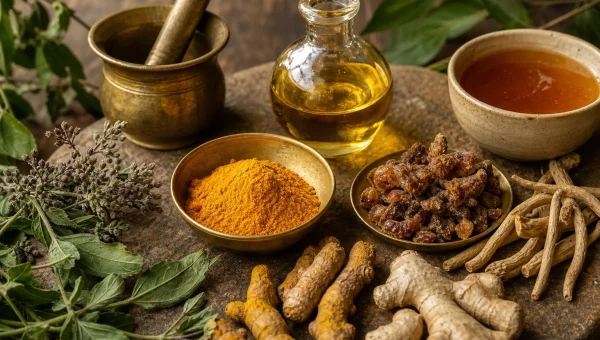
Vidanga Churna is prepared from Vidanga, identified botanically as Embelia ribes. The trial used Vidanga Churna in a dose of 3 grams twice daily after food and notes that the formulation was prepared according to the Ayurvedic Pharmacopoeia of India.
Classically, Vidanga is especially known for Krimighna action, but it is also used in digestive and metabolic contexts. In this trial, its pairing with Vyoshadi Guggulu reflects an Ayurvedic attempt to address not only stored Meda but also digestion, gut-related disturbance, and Kapha-Meda accumulation.
Shunthi and Haritaki Within the Formulation Logic
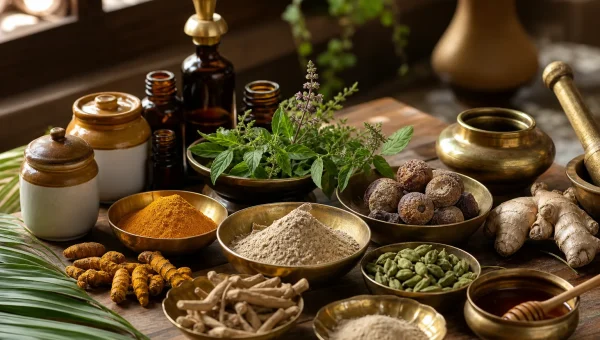
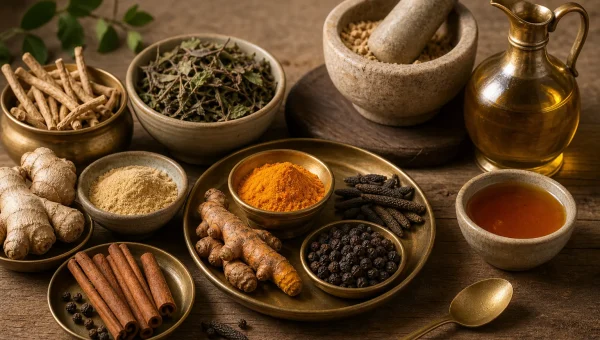
The trial article identifies Vyoshadi Guggulu as a polyherbal preparation containing ingredients such as Guggulu, Shunthi, and Haritaki. Shunthi, or dry ginger, is valued in Ayurveda for supporting Agni and clearing heaviness. Haritaki is widely used in classical practice for bowel regulation, Rasayana-oriented support, and the management of accumulated metabolic heaviness when selected appropriately.
The clinical logic is therefore not a random mixture of herbs. Guggulu-centred formulations are traditionally used where scraping, mobilizing, and Kapha-Meda reduction are needed; Shunthi supports digestive fire; Haritaki supports bowel movement and channel cleansing; Vidanga adds digestive and Krimighna-oriented support.
What This Means for Practice
One clinical trial should not be turned into a miracle claim. This trial was not placebo-controlled, not blinded, and not designed to isolate the independent effect of each herb. It also did not show statistically significant body-weight reduction, DEXA improvement, or quality-of-life improvement during the measured period.
What it does provide is a useful clinical signal: when Vyoshadi Guggulu and Vidanga Churna were given in the specified doses for 12 weeks, participants showed significant improvement in BMI, waist circumference, total cholesterol, and LDL cholesterol, with no reported adverse drug reactions or adverse events during the study period.
For an Ayurvedic practitioner, the most useful part is not only the numerical change. It is the integration of Ayurvedic assessment with measurable metabolic outcomes. Prakriti, Ahara Shakti, Satmya, Saara, Satva, and Vyayama Shakti help clarify why two people with the same BMI may need different levels of diet restriction, different exercise intensity, different herbal choices, and different follow-up intervals.
A Practical Framework With Caveats
For a Kapha-Meda-predominant presentation, a practitioner may consider a framework built around warm, light, Kapha-pacifying food, daily movement, correction of daytime sleep, and carefully selected formulations. The trial dose was Vyoshadi Guggulu 1 gram three times daily after food with lukewarm water and Vidanga Churna 3 grams twice daily after food, but this should not be copied as a self-prescription.
- Assessment first: Prakriti, Vikriti, Agni, bowel habit, appetite, sleep, waist measurement, lipid profile, blood glucose status, medications, and exercise capacity should be reviewed.
- Diet direction: Reduce heavy, oily, cold, excessively sweet foods and favour warm, freshly prepared, lighter meals suited to the person’s strength and digestion.
- Movement: Daily exercise is central in Ayurvedic weight management, but the intensity should match Vyayama Shakti and cardiovascular status.
- Monitoring: Weight, waist circumference, energy, bowel pattern, lipids, blood glucose markers, liver function, kidney function, and medication interactions should be monitored where relevant.
Important safety note: Guggulu-containing formulations may not be suitable for everyone. People taking prescription medicines, especially thyroid medicines, anticoagulants, cardiovascular medicines, diabetes medicines, or drugs metabolized through CYP pathways, should consult a qualified Ayurvedic practitioner and their healthcare provider before using these formulations. Pregnant or lactating individuals, people with significant liver or kidney disease, and anyone with complex chronic illness should not self-prescribe.
Back to the Patient Who Feels Stuck
For a patient like Sunita, the lesson is not that one pill fixes obesity. The lesson is that Ayurveda gives a framework for understanding why the body may keep storing, why appetite and fatigue may fluctuate, why waist measurement may matter as much as the scale, and why digestion, sleep, movement, and Meda Dhatu must be treated together.
The 2025 trial gives more confidence in a carefully supervised use of Vyoshadi Guggulu and Vidanga Churna as part of an Ayurvedic obesity-management plan. It does not replace individualized assessment, diet, exercise, or medical care. The best use of this evidence is thoughtful integration: classical reasoning, modern monitoring, and a plan tailored to the person rather than the supplement shelf.
Went for a consultation after reading this and the practitioner confirmed what I’d identified as my issues. Feeling confident starting treatment
Has anyone else noticed the sleep improvement you mentioned? Ive been experiencing the same thing.
I’m in my second month of trying a combination my practitioner put together and reading about the trial results helps me understand what I might be experiencing. The first few weeks I felt almost nothing and nearly stopped. Having context that metabolic changes take time makes it easier to stay with the protocol.
I liked the practical side of Herbs for Weight Loss. The examples make the advice less abstract.
as a personal trainer I get clients asking me about herbal supplements constantly and usually I have nothing credible to point them to. Seeing trial data from 2025 is genuinely useful. I’ll be curious whether the effect sizes were large enough to matter for someone already doing consistent exercise, or if the benefits are more pronounced in sedentary participants.
The Herbs for Weight Loss explanation is clearer than most short posts. I would like to know how long to try it before judging results.
I had the exact same confusion about this. Glad the article cleared it up for both of us.
What struck me reading this is that the patient stories here sound exactly like conversations in my own family. My mother has struggled with weight for fifteen years despite genuinely disciplined eating. I’d be curious whether the trial results showed any difference in outcomes between participants with metabolic issues versus those without obvious underlying conditions.
I’m going to share this comment with my skeptical partner. Exactly what I needed to articulate why this works.
the comparison of different preparation methods here matches what my grandmother described from her experience in India decades ago. This knowledge has clearly been consistent.
How long did participants in the trial need to take the herbs before results showed up? I always struggle with this because most weight-related interventions take months to show anything meaningful and it’s hard to stay consistent when you can’t tell if something is working.
I’m dealing with post-thyroid-surgery weight changes that my endocrinologist says are expected but hasn’t offered much beyond ‘wait and see.’ The idea that Ayurvedic herbs might support metabolic function during recovery is something I’d genuinely like to explore. Do the trial results say anything about populations with hormonal or thyroid-related weight issues specifically?
The dietary piece alongside the herbs is something I keep wondering about. Did the trial specify any food guidelines for participants, or were they just taking the herbal supplements? I ask because every practitioner I’ve spoken to emphasizes that herbs alone without adjusting ahara won’t do much long-term.
I tried Triphala for three months at the suggestion of a practitioner in Bangalore and noticed a real difference in how my digestion felt, but weight-wise I saw nothing. Makes me wonder whether the trial herbs work through a different pathway entirely or whether I just wasn’t on the right formula for my constitution.
As a nutrition researcher, I find it genuinely interesting that this trial chose a multi-herb formulation rather than isolating single actives. From an academic standpoint the confounding variables are trickier to manage but the outcomes are probably more representative of real-world use. Would be curious to read the full methodology if you have the PMID.
I’ve been hesitant about trying herbal weight support because every product seems to promise the same thing with no evidence behind it. The fact that there are actual 2025 trial results changes my thinking. Did the study control for diet and exercise, or were participants just adding the herbs on top of whatever they were already doing?
I came here to say exactly this and you said it better. Completely agree
The point about the body ‘not cooperating’ even when someone is doing everything right — that framing alone is worth sharing. It shifts the conversation away from blame. I’ve been reading about how Ayurvedic approaches to weight consider digestive fire and metabolism differently than calorie models. Did the 2025 trial measure anything related to metabolic rate or just weight outcomes?
The connection you made between those two things is really insightful. I hadn’t thought of it that way before
Do you know if any of the herbs from the 2025 trial are available in standardized extracts without having to go through a full Ayurvedic consultation? I’m in a smaller city and finding a qualified vaidya is not straightforward. Not opposed to the consultation route, just asking practically.
Interesting perspective, but I’ve read contradicting information from other Ayurvedic sources. How does a beginner know who to trust?
the integration of traditional explanation with modern physiological understanding is exactly what makes this content valuable. Not either/or but both together
wonderful to see someone from a medical background engaging with this content thoughtfully.
I liked the practical side of Herbs for Weight Loss. I appreciate that it does not oversell the result.
I liked the practical side of Herbs for Weight Loss. I would still ask a practitioner before changing medicines.
Thank you for asking this! I’ve been too shy to ask the same question and I really needed this answered.
This is constructive feedback we take seriously. We’ve added a note about consulting with your healthcare provider, especially if you’re on existing medications.
my practitioner recommended Panchakarma and I’ve been researching it for months. This is the clearest and most honest overview I’ve found. The expectations section especially is helpful.
three months sounds right from my experience too. Commit to that and then evaluate
I liked the practical side of Herbs for Weight Loss. The practical details matter more than people think.
That’s a really important distinction you’ve made. I think a lot of people skip the preparation phase and then wonder why results are inconsistent.
The dosha framework is interesting philosophically, but I think attributing every health issue to dosha imbalance oversimplifies complex medical conditions
The safest part of the Herbs for Weight Loss advice is keeping it simple. I appreciate that it does not oversell the result.
The safest part of the Herbs for Weight Loss advice is keeping it simple. The timing advice is the part I would start with.
I took Vrikshamla Garcinia for four months based on the widespread marketing. Zero weight change. The HCA content in commercial products is often too low and the manufacturing quality is inconsistent. The article recommends it but without quality guidance it’s hard to know what to buy.
The Kapha-reducing herb list here, Trikatu, Punarnava, Vidanga, is an internally consistent Ayurvedic selection for the metabolic heaviness pattern. Whether the individual herbs have specific weight-related mechanisms in isolation is less important than their combined Kapha-reducing action.
The safest part of the Herbs for Weight Loss advice is keeping it simple. The main idea is clear even if someone is new to Ayurveda.
The Medodhatu accumulation explanation for obesity in Ayurveda as excess unprocessed fat tissue from Agni dysfunction gives a different frame from the CICO model. Whether the mechanism differs or both are describing the same physiology in different languages, the Agni-strengthening approach is coherent.
Good reminder on Herbs for Weight Loss. This would be easier to follow with a one-week sample plan.
Appreciate you keeping us honest. We’ve noted your feedback about dosage specificity and will address it in a revised version of this article.
Been on Trikatu for eight weeks with reduced cooked grain intake. Down seven kilos. More importantly the post-meal fatigue that I had every day is gone. The Agni improvement showing up in energy is a better sign than the weight alone.
The concept is great but the execution could be better. A lot of ‘do this’ without explaining the why behind each step.
The trial results on VSG and Vidanga Churna caught my attention.
The safest part of the Herbs for Weight Loss advice is keeping it simple. I would like to know how long to try it before judging results.
The Panchakarma purification as a weight loss foundation before herbal support is classical and practical. The Ayurvedic concept is that no herb works well in an Ama-laden system. Cleaning first then supporting with herbs is more effective than herbs alone.
It’s interesting that they used Prakriti questionnaires alongside standard measures.
I want to see better clinical evidence before recommending Ayurvedic weight management herbs. Most herb trials are under eight weeks, use endpoints like cholesterol not fat mass directly, and are done in Indian populations where diet and baseline differ from Western patients. Generalizability is limited.
Based on the safety data, zero adverse reactions seems promising.
The digestive rhythm maintenance, eating at consistent times, maintaining the largest meal at midday, avoiding late eating, is doing most of the work in any Ayurvedic weight management protocol. The herbs support what the timing rules establish.
I wonder how Vidanga compares to other fat-reducing herbs in practice.
Actually, the dosage for Guggulu mentioned matches what my practitioner recommended.
Sunita’s experience after eight weeks shows real change beyond numbers.
A twelve week minimum with check ins at six week feels realistic for herbal protocols.
Sunita’s story is my story almost word for word. I lost 8 kg on keto last year and gained back 11 within five months while still eating carefully. Really hoping the 2025 trial data gives some direction on which herbs actually moved the needle — did the multi-herb formulas outperform single-herb approaches in the results?
My dermatologist was surprised by my skin improvement at the last visit. I credit the ginger root protocol partially alongside the dietary changes.
The fact that this article distinguishes between the various types of moringa preparations shows the author actually knows the subject.
The point about consistency being more important than dosage is something I’ve learned the hard way. Irregular use gets no results.
I’m a nurse and while I remain evidence-based, some of these herbs do have decent clinical data. shatavari in particular has several RCTs behind it.
The section on when to avoid these herbs was useful but I didn’t see anything about interactions with thyroid medication.
My weight management issue has been ongoing for 3 years and I’m trying the combination mentioned here as a last resort before going back to the doctor.
this is helpful but dose seems high for me. started with half and its fine 🙌
I’ve been reading about neem for acidity. How long does it typically take to notice effects?
I use a combination of amalaki and brahmi as per my Ayurvedic practitioner’s advice. The article aligns with what she told me.
I was told my cycle irregularity might be constitutionally driven. The Vata-pacifying protocol has been more effective than the generic one I tried first.
The claim about trikatu improving acidity within 4 weeks seems optimistic based on my experience and what I’ve read.
Anyone tried the combination mentioned in section 2 for specifically sleep? I’d love to hear experiences.
I was looking for a plain explanation of Herbs for Weight Loss. I would like to know how long to try it before judging results.
Glad this came up in my search. I was confused between amla and turmeric and this article clarified the difference.
My experience with amalaki has been gradual improvement over 3 months rather than a dramatic shift. Seems like that’s normal.
The combination of turmeric and dietary adjustments has made a noticeable difference for my energy over 8 weeks.
Was prescribed trikatu by an Ayurvedic doctor in Mumbai. Same dose as mentioned here. Two months later, sleep is better.
What brand of moringa do you recommend? I’m finding huge quality differences between suppliers. Late to this post but wanted to add my experience.
Going through this carefully before my next appointment with my Vaidya. Want to ask informed questions about the combinations mentioned. Reading this in 2027, is this protocol still recommended?
For anyone in a humid climate: store your churna properly. I lost a batch to moisture last monsoon season and had to start fresh.