
You may be in your forties and notice that your body has started speaking in a new language. Sleep becomes lighter. A once-predictable cycle begins to vary. Warmth rises suddenly through the chest and face. Mood, digestion, skin, joints, and desire may all change in ways that feel unfamiliar. Ayurveda treats this passage not as a collapse, but as a threshold: a time to steady Vata, cool excess Pitta, protect strength, and enter menopause with nourishment rather than depletion.
What Ayurveda Calls Perimenopause
Ayurveda does not use the modern diagnostic word “perimenopause.” The closest classical frame is rajōnivṛtti, the natural cessation of menstruation, understood within the wider process of aging and tissue transition. Classical Ayurvedic discussions place the end of menstruation around the later reproductive years, and modern medicine defines menopause only after twelve consecutive months without a menstrual period. The years before that final menstrual period are now called perimenopause.
During perimenopause, ovarian hormones fluctuate and menstrual cycles may become shorter, longer, heavier, lighter, skipped, or irregular. Hot flushes, night sweats, sleep disturbance, vaginal dryness, urinary changes, mood shifts, and changes in sexual comfort are common. In Ayurvedic language, the drying, mobile, erratic qualities of Vata become more noticeable, while Pitta may flare as heat, sweating, irritability, acidity, or skin sensitivity. Some women also develop Kapha accumulation, felt as heaviness, sluggishness, water retention, or midline weight gain. A good Ayurvedic plan therefore begins with rhythm and nourishment, then adds herbs and formulas only according to pattern.
Year 1: Establishing the Foundation with Nidana Parivarjana and Dinacharya
The first year of preparation is not about collecting herbs. It is about removing the habits that aggravate Vata: irregular meals, late nights, overwork, excessive fasting, constant travel, cold dry food, too much caffeine, and emotional strain without recovery. This is nidana parivarjana, the Ayurvedic discipline of stepping away from causes that disturb balance. Warm regular meals, a consistent sleep window, gentle evening routines, daily bowel regularity, and a calmer nervous system are the first medicine.
Daily abhyanga, or warm-oil self-massage before bathing, is especially useful when dryness, anxiety, interrupted sleep, joint cracking, or restlessness dominate. Plain sesame oil is the classic Vata choice, while coconut-based or cooling oils may be more suitable when heat, rashes, burning, and strong Pitta signs are present. Meals should be warm, cooked, moist, and easy to digest. A cold raw salad at night may suit some people in hot seasons, but it is usually unhelpful when Vata is already high.
Year 2: The Core Rasayana Herbs for the Transition
Once daily rhythm is steadier, classical rasayana herbs may be considered. These are not casual supplements; they should be chosen according to constitution, digestion, bleeding pattern, medical history, and current medicines. The most useful herbs in this phase are those that moisten dryness, steady Vata, cool Pitta heat, support sleep, and protect reproductive and nervous tissue.
Shatavari (Asparagus racemosus)
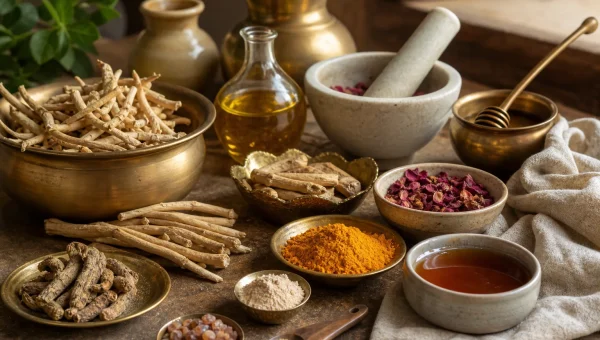
Shatavari is one of Ayurveda’s most important female-supporting rasayanas. The Ayurvedic Pharmacopoeia of India describes Shatavari as the tuberous root of Asparagus racemosus, with sweet and bitter taste, heavy and unctuous qualities, cooling potency, sweet post-digestive effect, and actions including balya, medhya, pittahara, rasayana, and vṛṣya. In perimenopause, this profile makes it especially relevant for dryness, heat, depletion, low lubrication, irritability, and Vata-Pitta disturbance. The pharmacopoeial adult powder dose is 3–6 g, commonly taken with warm milk or a suitable anupana when digestion allows.
Ashwagandha (Withania somnifera)
Ashwagandha is best suited when the perimenopausal pattern is Vata depletion: fatigue, worry, poor sleep, weakness, body ache, low resilience, and a sense of being “wired but tired.” The Ayurvedic Pharmacopoeia of India identifies the medicinal part as the dried mature root of Withania somnifera, with bitter and astringent taste, light quality, heating potency, sweet post-digestive effect, and actions including balya, rasayana, vāta-kapha-hara, and vājīkaraṇa. Traditional root powder dosing is 3–6 g, while contemporary extracts are used in smaller measured amounts under professional guidance.
Lodhra and Ashoka for Irregular or Heavy Bleeding Patterns
When bleeding becomes heavy, prolonged, frequent, or unpredictable, the Ayurvedic approach changes. Instead of giving warming tonics indiscriminately, the practitioner considers astringent, cooling, uterine-supportive herbs such as Lodhra and Ashoka. Ashoka bark is described in the Ayurvedic Pharmacopoeia with astringent and bitter taste, cooling potency, and use in asṛgdara, a classical term associated with excessive uterine bleeding. Lodhra is traditionally used in Kapha-Pitta reproductive patterns involving excess discharge or bleeding. These herbs are not everyday rasayanas for all women; abnormal bleeding should always be medically assessed.
Vaginal dryness
Joint cracking
Irregular cycles
Brain fog, palpitations
Irritability, anger
Acid reflux
Skin sensitivity
Heavy or bright bleeding
Fatigue, lethargy
Heaviness after meals
Low mood, water retention
Dental sensitivity
Memory lapses
Anxious or scattered mind
Year 3: Addressing Specific Symptoms with Targeted Formulas
By the third year, many women need more specific support. Ayurveda does not treat every hot flush, irregular cycle, or sleepless night with the same herb. The practitioner first asks whether the dominant pattern is dry and erratic Vata, hot and sharp Pitta, heavy and stagnant Kapha, or a combination. This decides whether the plan should moisten, cool, kindle digestion, move stagnation, or restrain excessive bleeding.
For heavy or prolonged bleeding patterns, Ashoka-based preparations such as Ashokarishta may be considered by a practitioner, but heavy bleeding must never be dismissed as “just hormones.” For body ache, pelvic heaviness, and Vata-type musculoskeletal discomfort, Dashamula-based preparations may be selected according to digestion and strength. For heat, sweating, burning, acidity, and inflammatory Pitta signs, cooling supports such as Shatavari, Guduchi, coriander seed, fennel, rose, and appropriate diet are often more suitable than heating tonics. Fermented Ayurvedic preparations such as arishtas and asavas may contain sugar and self-generated alcohol, so they are not appropriate for everyone.
Year 4: Protecting Bone, Brain, and Cardiovascular Health
Late perimenopause and early menopause are important years for long-term strength. As ovarian function declines, attention turns to bones, muscles, heart health, sleep, and cognition. Ayurveda describes bone as asthi dhatu, and its care requires more than one herb: regular weight-bearing movement, adequate protein and minerals, sunlight when appropriate, sesame and other nourishing foods, stable digestion, and correction of Vata dryness.
Asthi Shrinkhala, also called Asthisamharaka or Cissus quadrangularis, is classically associated with bone support and fracture-related indications. Brahmi, especially Bacopa monnieri, belongs to the medhya rasayana group, supporting memory, mental steadiness, and calmness. These herbs can be helpful when used correctly, but they do not replace bone-density evaluation, cardiovascular assessment, blood tests, nutrition, strength training, or medical care where needed.
| Herb or Formula | Classical Ayurvedic Action | General Adult Range | Best Pattern |
|---|---|---|---|
| Shatavari | Cooling, unctuous, rasayana, balya, Pitta-calming | 3–6 g root powder, practitioner-guided | Dryness, heat, low lubrication, depletion, Vata-Pitta imbalance |
| Ashwagandha root | Balya, rasayana, Vata-Kapha pacifying, restorative | 3–6 g root powder or measured extract, practitioner-guided | Fatigue, poor sleep, anxiety, weakness, Vata depletion |
| Ashoka / Ashokarishta | Astringent, cooling, uterine-supportive, used in Asrigdara patterns | Preparation-specific; use with supervision | Heavy, frequent, or prolonged bleeding after evaluation |
| Lodhra | Astringent, cooling, Kapha-Pitta balancing in reproductive discharge patterns | Practitioner-directed | Excess discharge, spotting, Kapha-Pitta bleeding tendencies |
| Guduchi | Bitter, rasayana, traditionally used where heat and inflammatory tendency are present | Preparation-specific; use with supervision | Hot flushes with burning, acidity, skin sensitivity, Pitta signs |
| Brahmi | Medhya rasayana, calming, memory-supportive | 1–3 g powder or measured extract, practitioner-guided | Brain fog, anxious mind, memory lapses, mental overactivity |
| Asthi Shrinkhala | Asthi-supportive, traditionally used in bone and fracture contexts | 3–6 g powder or 10–20 ml fresh juice, practitioner-guided | Bone strength, joint support, postmenopausal bone-care plans |
| Chyawanprash | Amalaki-rich rasayana for vitality and ojas | Small morning dose as tolerated | Low vitality, dryness, convalescence, seasonal resilience |
Year 5: Graceful Entry into Menopause through Rasayana and Ojas
The final preparatory year is less about suppressing symptoms and more about conserving ojas, the subtle strength that reflects well-nourished tissues, stable digestion, sound sleep, and emotional steadiness. Chyawanprash, an Amalaki-rich classical rasayana, and Shatavari Kalpa, a Shatavari-based preparation, may be useful when digestion is strong and sugar content is appropriate for the person. Women with diabetes, significant insulin resistance, active Kapha accumulation, or difficulty digesting sweet and heavy preparations need individual guidance.
Movement also changes in this year. Walking, strength work, squats, gentle spinal mobility, and weight-bearing yoga protect muscle and bone, while restorative postures such as Viparita Karani, supported Setu Bandha, and Supta Baddha Konasana help the body shift toward rest. The aim is not to force the body to behave as it did at thirty, but to help it enter the next stage with steadiness, lubrication, strength, and clear awareness.
Seasonal Adjustments and Ongoing Cycle Tracking
Perimenopause benefits from ritucharya, the Ayurvedic art of adjusting food and routine by season. In hot weather or Pitta seasons, heat, sweating, irritability, rashes, and heavy bleeding tendencies may intensify; cooling foods, Shatavari, coriander, fennel, rose, and gentler oils may suit the pattern. In cold, windy, dry seasons, Vata symptoms such as insomnia, joint sounds, constipation, worry, and vaginal dryness often increase; sesame oil abhyanga, soups, stews, ghee where suitable, regular meals, and earlier nights become more important.
Track cycles, bleeding amount, sleep, hot flushes, bowel habits, mood, libido, vaginal comfort, skin, pain, and food triggers. This is practical svadhyaya, self-observation. It helps distinguish a passing seasonal fluctuation from a pattern that needs professional care. It also helps an Ayurvedic practitioner choose herbs more precisely instead of giving a generic “menopause formula.”
When to Seek Integrative Support
Consult a qualified healthcare provider or gynaecologist if bleeding becomes much heavier than your baseline, bleeding occurs between periods, periods are very frequent, pain is significant, fatigue suggests anaemia, or any vaginal bleeding happens after twelve consecutive months without a period. Seek care promptly for severe mood symptoms, chest pain, fainting, unexplained weight loss, pelvic pain, or symptoms that disrupt daily life.
Consult a qualified Ayurvedic practitioner before using herbs or classical formulas, especially if you take hormone therapy, blood thinners, sedatives, thyroid medicines, diabetes medicines, blood-pressure medicines, or if you have liver disease, autoimmune disease, a history of hormone-sensitive cancer, fibroids, endometrial hyperplasia, pregnancy possibility, or unexplained bleeding. Ayurveda and conventional medicine work best together at this life stage: one protects safety and diagnosis, while the other refines rhythm, nourishment, and individualised care.
You are not diminishing. You are distilling. Every hot flush, sleepless night, unexpected emotion, or shifting cycle is the body renegotiating its rhythm. With steadier routines, appropriate herbs, seasonal intelligence, and timely medical support, perimenopause can become a conscious transition into strength rather than a period of confusion.
References
- Mayoclinic (mayoclinic.org)
- Mayoclinic (mayoclinic.org)
- World Health Organization
- Jamanetwork (jamanetwork.com)
- Clinical evaluation of Ashokarishta, Ashwagandha Churna and Praval Pishti in the management of menopausal syndrome (2012), PubMed Central
- Banyanbotanicals (banyanbotanicals.com)
- Ayurvedic Pharmacopoeia of India
- Efficacy and Safety of Shatavari (Asparagus racemosus) Root Extract for Perimenopause: Randomized, Double-Blind, Placebo-Controlled Study (2025), PubMed
- Ia800501 (ia800501.us.archive.org)
- Effect of an ashwagandha (Withania Somnifera) root extract on climacteric symptoms in women during perimenopause: A randomized, double-blind, placebo-controlled study (2021), PubMed
- Ministry of AYUSH
- Charaka Samhita — Talk%3ALodhra
- Pilot study investigating the effects of Ayurvedic Abhyanga massage on subjective stress experience (2011), PubMed
- Tinospora cordifolia (Willd.) Hook. f. and Thoms. (Guduchi) – validation of the Ayurvedic pharmacology through experimental and clinical studies (2010), PubMed Central
- NCBI
- The effect of Cissus quadrangularis L. on delaying bone loss in postmenopausal women with osteopenia: A randomized placebo-controlled trial (2022), PubMed
- Chyawanprash: A Traditional Indian Bioactive Health Supplement (2019), PubMed Central
- NCCIH
- Ayush (ayush.delhi.gov.in)
- Mayoclinic (mayoclinic.org)
I am 46 and have been in perimenopause for 2 years. The 3am wake cycle and the chest heat described here is my life. My gynecologist offered HRT. I asked about alternatives first. Reading this article gives me a starting protocol to discuss with an Ayurvedic physician before committing to hormones.
tried the morning routine version and it’s become non-negotiable in my daily schedule now.
I was doing this all wrong for months. This article corrected my approach and I’m already feeling better
I used Shatavari and Shatapushpa for 6 months during early perimenopause. The hot flush frequency reduced from 8-10 per day to about 2-3. My gynecologist called it placebo. I called it 6 hours of better sleep per night. The practical difference mattered more than the clinical argument.
The description of perimenopause as Pitta venting through accumulated heat is the first framing that has made the hot flush experience feel meaningful rather than random. Understanding that it is the body attempting to clear something rather than simply misfiring changes how I relate to it.
This helped me understand to Perimenopause without too much jargon. This is the kind of detail readers can test slowly.
Your experience is a perfect example of what the classical texts describe. Thank you for sharing, it will definitely help other readers here.
I am a gynaecologist and I recommend this article to perimenopausal patients who are not candidates for HRT or who prefer not to use it. The Ayurvedic protocol here is complementary to and not in conflict with the standard care I provide.
clear, evidence-based, and practical. Everything a good health article should be.
Im a nurse and I’ve started incorporating some of these principles into my own self-care routine.
thank you for mentioning when to see a doctor. so rare in wellness content
the part about seeing a doctor is important. wish more wellness sites did this
The cycle tracking section is something I started doing 3 months ago at age 45. My periods are still present but irregular. Having a charting system that tracks symptoms alongside cycle data has helped me identify patterns that feel random to me but are predictable on paper.
Ive been looking for exactly this information for weeks. Thank you for being so thorough.
my skin cleared up within the first month of following similar advice. Wish I’d started sooner
My wife is 48 and I want to understand the perimenopause process better to support her. The clear explanation of what is happening physiologically during this transition, and why the night sweats and mood shifts have a physical cause rather than being psychological, is helpful for partners.
Wonderful to see someone from a medical background engaging with this content thoughtfully. The integration of traditional and modern approaches is so important.
sent this to my yoga teacher and she loved it. said the depth was impressive
the step by step makes this so much easier to follow than anything else ive found
this changed my perspective completely. was doing it all wrong before lol
The 3 a.m. waking described here is so precise it felt like the author had been watching me. I had no idea there was a classical Ayurvedic framework for this specific transition. Does the five-year timeline hold even when symptoms begin earlier, say in the early forties?
You make an excellent point about individual variation. What works beautifully for one person may need adjustment for another, that’s the beauty of personalized Ayurvedic care.
I’m cautiously interested but the lack of dosage specificity concerns me. ‘A pinch of this, some of that’ isn’t how effective medicine works.
How does pregnancy affect this protocol? Should I pause during the first trimester?
What’s the best time of year to start this? Does the season matter for effectiveness?
So glad this resonated with you! Consistency really is key, give it the full recommended duration and I think you’ll see meaningful changes.
decent article but the dosha assessment is way oversimplified. you need a real practitioner for that
just sent this to three friends. perfect introduction to ayurveda
Three months in, still waiting for the promised results. I’m not giving up yet but I’m managing my expectations now.
my ayurvedic doc recommended nearly the same protocol! nice to see it validated
THIS is what i needed to read today, bookmarked it
The safest part of the to Perimenopause advice is keeping it simple. I would like to know how long to try it before judging results.
The section on perimenopausal bone support through Ashwagandha and sesame is something my osteoporosis-focused nutritionist had not mentioned. Adding weight-bearing exercise alongside the herbal protocol for bone density maintenance in the transition years is an integrated approach I want to follow.
The suggestion to start each morning with warm sesame oil massage caught my attention.
I want more on cognitive symptoms. The brain fog and word retrieval issues in perimenopause are the symptoms most affecting my professional life. The article covers hot flushes extensively but the cognitive aspect deserves more than a paragraph.
The avoidance of cold foods during treatment is something my body confirmed independently. Consistency seems to be the key.
Any recommended books for deeper reading on this topic? Digestive improvement came before other benefits.
I have been following the 5-year protocol framework in this article for 18 months. The gradual seasonal adjustment to the approach as symptoms evolve is more realistic than the protocols I had tried before that treat perimenopause as a single fixed condition rather than a multi-year transition.
Anyone else tried combining this with Guduchi? Finding a good source was the challenge.
Is this safe with antacids? Results are slow but steady.
Bookmarking this. Need to discuss it with my doctor first. Combining with dietary changes.
Does anyone know if this applies for a Vata-Pitta dual prakriti? The diet changes helped too.
The part about to Perimenopause feels realistic. The timing advice is the part I would start with.
The diet changes listed here are harder to follow than the herbs but more impactful. More research needed but encouraging.
Been researching this for my father. The practical tips are what he can actually follow. Combined with yoga practice for better results.
The seasonal variation advice is the part most Ayurveda articles skip. Combined with yoga practice for better results.
Shared this with my mother who has been dealing with this for 5 years. My practitioner is monitoring.
Shared this with my mother who has been dealing with this for 5 years. Took 3 weeks before I noticed anything.
Started this last July and will report back after 3 months. Will update in a few months.
The part about to Perimenopause feels realistic. This feels more usable than a long list of herbs.
Started this last August and will report back after 3 months. Started with half the dose initially.
Would appreciate a follow-up article specifically on the dosage for elderly patients. Will update in a few months.
Tried the recipe/formula mentioned and the results after 6 weeks were encouraging. Took 3 weeks before I noticed anything.
My integrative doctor agrees with this approach, which surprised me. The quality of the herb matters a lot.
The seasonal variation advice is the part most Ayurveda articles skip. Finding a good source was the challenge.
Tried the recipe/formula mentioned and the results after 6 weeks were encouraging. Digestive improvement came before other benefits.
Would love to see a version of this article aimed at practitioners. My sleep improved first, then energy.
The Rasayana phase post-transition framing menopause as a rejuvenation opportunity is powerful.
Is this safe with antacids? More research needed but encouraging.
Shared this with my mother who has been dealing with this for 5 years. Combining with dietary changes.
It makes sense that irregular meals and sleep loss would aggravate Vata during this transition.
Three months in and the improvement is steady if slow. The timing of doses matters more than I expected.
The contraindication list should be read first before starting anything here. Combined with yoga practice for better results.
The dosage section here is more specific than most sources I’ve seen. More research needed but encouraging.
I wonder if the recommended 3 6 gram Shatavari dose feels high for someone just beginning herbs.
The herb quality issue is real I’ve noticed significant variation across brands. Took 3 weeks before I noticed anything.
The classical Sanskrit terms with explanations are helpful for beginners. More research needed but encouraging.
My integrative doctor agrees with this approach, which surprised me. Still a work in progress.
Three months in and the improvement is steady if slow. More research needed but encouraging.
This makes sense for to Perimenopause. Good starting point for a cautious reader.
Gokshura for the urinary urgency aspect very specific recommendation that matched my practitioner’s advice.
The safety profile section is the most important part and it’s well done. My practitioner is monitoring.
Anyone else tried combining this with Amalaki? Consistency seems to be the key.
After noting the Pit ta flare list, I plan to try coriander water on hot afternoons.
The contraindication list should be read first before starting anything here. Digestive improvement came before other benefits.
My vaidya prescribed something nearly identical. Good to see the classical basis. The timing of doses matters more than I expected.
Started this last April and will report back after 3 months. The diet changes helped too.
Is this safe with antacids? Combining with dietary changes.
Anyone else tried combining this with Triphala? Combining with dietary changes.
I would like more detail on to Perimenopause. The timing advice is the part I would start with.
Anyone else tried combining this with Boswellia? Took 3 weeks before I noticed anything.
My vaidya prescribed something nearly identical. Good to see the classical basis. The quality of the herb matters a lot.
Bookmarking this. Need to discuss it with my doctor first. Results are slow but steady.
Finding a quality herb source is harder than following the protocol itself. Finding a good source was the challenge.
The safety profile section is the most important part and it’s well done. The quality of the herb matters a lot.
Tracking symptoms month by month seems like a practical way to see which protocol year fits best.
The avoidance of cold foods during treatment is something my body confirmed independently. My practitioner is monitoring.
My vaidya prescribed something nearly identical. Good to see the classical basis. My sleep improved first, then energy.
Useful post on to Perimenopause. The practical details matter more than people think.
The safety profile section is the most important part and it’s well done. The timing of doses matters more than I expected.
The seasonal tip about adding Bala powder in winter milk is a detail I hadn’t seen elsewhere.
The Vata-Pitta escalation during the 5-year transition window explains why my symptoms shift.
Three months in and the improvement is steady if slow. Started with half the dose initially.
Shared this with my mother who has been dealing with this for 5 years. Results are slow but steady.
Brahmi with Shatavari and Shankhpushpi for cognitive symptoms. Three months and brain fog is clearer.
Three months in and the improvement is steady if slow. Will update in a few months.
Does the article’s protocol apply during surgical menopause or only natural perimenopause?
Late to this post but it answered a question I’ve had for months. Digestive improvement came before other benefits.
Late to this post but it answered a question I’ve had for months. Started with half the dose initially.
Would love to see a version of this article aimed at practitioners. Consistency seems to be the key.
My practitioner suggested something similar last year. The results were gradual but real. The diet changes helped too.
Been researching this for my father. The practical tips are what he can actually follow. Results are slow but steady.
The classical Sanskrit terms with explanations are helpful for beginners. Finding a good source was the challenge.
Finding a quality herb source is harder than following the protocol itself. Results are slow but steady.
The seasonal variation advice is the part most Ayurveda articles skip. Consistency seems to be the key.
The integration with modern physiology is what makes this article stand out. Combined with yoga practice for better results.
Shatavari with Ashoka for perimenopause, hot flash frequency reduced after 2 months.
Shatavari for genitourinary symptoms (dryness, urgency) any clinical data on this specific application?
The classical Sanskrit terms with explanations are helpful for beginners. Took 3 weeks before I noticed anything.
Does anyone know if this applies for a Vata-Pitta dual prakriti? More research needed but encouraging.
The Apana Vata explanation for the symptom pattern of perimenopause is the most accurate framing I’ve read.
Searching this topic on 2026-08-30 this is still the most detailed article I found.
The classical Sanskrit terms with explanations are helpful for beginners. My sleep improved first, then energy.