
Ayurveda offers emotional intelligence as a health practice, not merely a communication skill. It treats emotional life as part of the whole person: mind, body, senses, conduct, memory, sleep, food, relationships, and daily rhythm. In the Charaka Samhita, body and mind are named as the seats of both disorder and happiness, which means emotional awareness is not separate from physical well-being.
The aim is not to suppress emotion, perform calmness, or become detached from life. The Ayurvedic aim is to cultivate Sattva: clarity, steadiness, discernment, and the capacity to respond wisely while action and rest remain available in the right measure.
The Manas Framework: Rajas, Tamas, and Sattva
Classical Ayurveda identifies two Manas Doshas: Rajas and Tamas. Sattva is not a dosha; it is the clear, balanced quality of mind. Rajas and Tamas are necessary in ordinary life, but when they dominate the mind, perception becomes colored by agitation or dullness. Emotional intelligence begins with recognizing which quality is shaping the present reaction.
- Rajas: The quality of movement, stimulation, passion, restlessness, and outward drive. In a useful measure, Rajas supports initiative, protection, achievement, and purposeful action. In excess, it appears as agitation, anger, craving, jealousy, impatience, compulsive comparison, and the inability to rest.
- Tamas: The quality of heaviness, inertia, obscuration, sleep, and resistance. In a useful measure, Tamas allows grounding, completion, sleep, and recovery. In excess, it appears as dullness, denial, avoidance, lethargy, confusion, clinging, and resistance to necessary change.
- Sattva: The quality of clarity, truthfulness, balance, memory, steadiness, and wise perception. Sattva does not erase Rajas or Tamas; it governs them so that action, rest, speech, silence, courage, and restraint arise at the right time.
In practice, a rajasic reaction asks for pause, cooling, discrimination, and restraint before speech or action. A tamasic reaction asks for light, movement, honest naming, and supportive structure. A sattvic response is marked by clean perception, proportionate action, and the absence of compulsion.
Emotions as Information: Using Navarasa Carefully
Navarasa belongs to the Indian aesthetic tradition associated with the Natyashastra, not to Ayurveda as a diagnostic system. Used carefully, however, it gives a refined vocabulary for observing emotional flavor without reducing every feeling to “positive” or “negative.” Bharata’s tradition presents eight rasas, and Shanta is commonly taught later as the ninth rasa in the expanded Navarasa model.
- Shringara: Love, beauty, attraction, and refinement
- Hasya: Laughter, joy, humor, and lightness
- Karuna: Compassion, sorrow, tenderness, and response to suffering
- Raudra: Anger, force, intensity, and confrontation
- Veera: Courage, confidence, heroic energy, and resolve
- Bhayanaka: Fear, caution, vulnerability, and protective alertness
- Bibhatsa: Disgust, aversion, rejection, and moral or sensory refusal
- Adbhuta: Wonder, awe, astonishment, and openness
- Shanta: Peace, stillness, equanimity, and settled awareness
As a reflective tool, Navarasa helps a person ask: What is the emotional flavor of this moment? What is it asking me to notice? What action would preserve clarity rather than intensify agitation or dullness? Anger may call for boundary and truth, fear may call for protection and preparation, grief may call for care and release, and wonder may open the mind to learning.
Dosha Patterns and Emotional Tendencies
The bodily doshas are not emotions, but their qualities influence the way imbalance may feel. Vata is dry, light, cold, subtle, rough, and mobile; Pitta is hot, sharp, mobile, and penetrating; Kapha is heavy, cold, soft, unctuous, stable, and cohesive. Ayurvedic emotional intelligence uses these qualities to choose opposite, balancing supports.
Vata-dominant emotional patterns: When Vata is aggravated, the mind may become restless, fearful, scattered, overactive, and unable to settle. The emotional pattern often feels quick, changeable, and difficult to complete. A Vata-style reaction benefits from warmth, steadiness, routine, grounding touch, regular meals, adequate sleep, slow breathing, and a reduction of overstimulation.
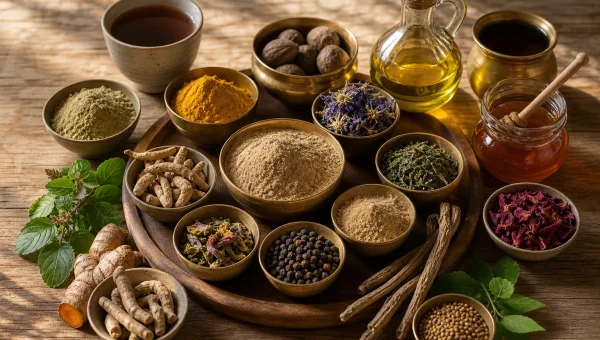
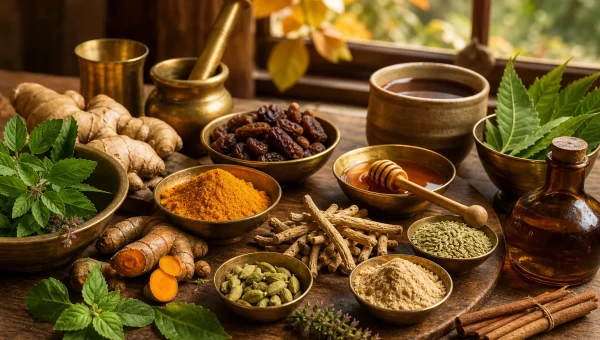
For Vata-style depletion and fearfulness, Ashwagandha is traditionally described as Balya and Rasayana, with Vata-Kapha-reducing action. The Ayurvedic Pharmacopoeia of India identifies it as the mature dried root of Withania somnifera, with Tikta and Kashaya rasa, Laghu guna, Ushna virya, Madhura vipaka, and adult powder dose guidance of 3–6 g. Because Ashwagandha is heating and may not suit every person, its use should be individualized by a qualified practitioner.
Pitta-dominant emotional patterns: When Pitta is aggravated, emotion often appears as heat: anger, criticism, irritability, competitiveness, perfectionism, sharp speech, and intolerance of ambiguity. The healthy side of Pitta is discernment, courage, and the ability to see what is not right. The work is to preserve clarity without burning oneself or others.
For Pitta-style mental heat, cooling routines, moderation in speech, time away from excessive competition, moonlight or cool nature exposure, and gentle cooling breath practices may be useful when taught properly. Brahmi is classically Medhya and cooling. The Ayurvedic Pharmacopoeia of India identifies Brahmi as the whole plant of Bacopa monnieri, with Tikta, Kashaya, and Madhura rasa, Laghu and Sara guna, Shita virya, Madhura vipaka, and traditional use in Manasavikara, with adult powder dose guidance of 1–3 g.
Kapha-dominant emotional patterns: When Kapha is aggravated, emotion may become heavy, slow, attached, possessive, withdrawn, or difficult to move. Kapha’s strength is loyalty, endurance, memory, and emotional depth. Its shadow is holding on after life has asked for movement.
Kapha-style emotional stagnation benefits from warmth, stimulation, movement, lighter food choices when appropriate, honest conversation, and gradual but consistent action. Trikatu, the classical combination of dry ginger, black pepper, and long pepper, is traditionally used for its pungent, heating, Deepana-Pachana qualities. It is not appropriate for everyone, especially those with strong heat, acidity, bleeding tendencies, pregnancy, or medication concerns, and should be used only with practitioner guidance.
Manas Prakriti: Classical Psychological Typing
Charaka does not reduce the mind to a simple personality chart. The text states that mental constitutions are innumerable, then gives sixteen illustrative Manas Prakriti patterns: seven Sattvika, six Rajasika, and three Tamasika. These are not labels for judging a person; they are teaching categories for understanding tendencies and choosing appropriate cultivation.
| Category | Classical Types | Emotional Intelligence Lesson |
|---|---|---|
| Sattvika | Brahma, Arsha/Rishi, Aindra/Indra, Yamya/Yama, Varuna, Kaubera/Kubera, Gandharva | Cultivate clarity, truthfulness, self-restraint, courage, cleanliness, steadiness, generosity, refined speech, and creative harmony. |
| Rajasika | Asura, Rakshasa, Paishacha, Sarpa, Praita/Preta, Shakuna | Watch for domination, anger, jealousy, craving, instability, suspicion, greed, harshness, and impulsive pursuit of desire. |
| Tamasika | Pashava, Matsya, Vanaspatya | Watch for dullness, excessive sleep, fearfulness, inertia, lack of discrimination, and life lived without conscious refinement. |
The practical takeaway is humility. A person may show Sattvika clarity in one area, Rajasika reactivity in another, and Tamasika avoidance in a third. Emotional intelligence is the daily cultivation of the clearer tendency.
Sattvavajaya Chikitsa: Training the Mind Away from Unwholesome Objects
Sattvavajaya Chikitsa is Ayurveda’s classical mental discipline. It is described as restraining the mind from unwholesome objects. In the same broader framework, Charaka names Jnana, Vijnana, Dhairya, Smriti, and Samadhi as means of correcting disturbed mental qualities. This makes emotional intelligence an active training in attention, memory, discrimination, and steadiness.
- Jnana: Remember the deeper purpose of life and the nature of self beyond the immediate reaction.
- Vijnana: Examine the specific situation clearly. What happened? What was assumed? What is fact, and what is projection?
- Dhairya: Practice restraint and courage. Do not let the first surge of anger, fear, craving, or grief decide the action.
- Smriti: Use memory wisely. Recall what similar reactions have produced before, and remember the values you wish to live by.
- Samadhi: Cultivate collected attention through meditation, prayer, mantra, breath awareness, or another steadying discipline taught by a competent guide.
A simple daily practice is to review one emotional reaction each evening. Name the feeling, locate its bodily quality, identify whether it was mostly rajasic, tamasic, or sattvic, and note the action it produced. Then ask what a more sattvic response would have looked like. This is not self-blame; it is the refinement of perception.
Herbal and Lifestyle Supports for Mental Clarity
Ayurvedic herbs for emotional life should be chosen according to constitution, current imbalance, digestion, age, strength, season, medicines, and diagnosis. The same herb that steadies one person may aggravate another if used without context.
Ashwagandha is classically Balya and Rasayana and may be considered where depletion, weakness, Vata aggravation, and stress-related exhaustion are prominent. Brahmi is Medhya, cooling, and traditionally used in Manasavikara. Jatamansi is described as Medhya and Nidrajanana, with traditional use in Manasaroga and Anidra. The Ayurvedic Pharmacopoeia of India identifies Jatamansi as the dried rhizome of Nardostachys jatamansi, with Tikta and Kashaya rasa, Laghu guna, Shita virya, Katu vipaka, and adult powder dose guidance of 2–3 g.
Lifestyle is not secondary in this framework. Sleep, conduct, food, companionship, sensory input, speech, and daily routine continuously shape the mind. Sadvritta and Achara Rasayana support mental clarity by refining conduct; Satsanga supports the mind through association with steadier qualities; timely sleep prevents natural rest from becoming tamasic dullness.
A Practical Ayurvedic Emotional Check-In
Use this short check-in before reacting to a difficult email, family conflict, public criticism, craving, grief wave, or sudden anger.
- Name the dominant quality: Is this moment rajasic, tamasic, or sattvic?
- Name the bodily signature: Is there heat, tightness, heaviness, dryness, trembling, sinking, or pressure?
- Name the need: Does this require protection, truth, rest, nourishment, movement, forgiveness, or clearer information?
- Choose the opposite support: Heat needs cooling; scattered movement needs steadiness; heaviness needs light and movement; harshness needs softness; dullness needs illumination.
- Act after clarity returns: Speak, pause, apologize, set a boundary, ask for help, rest, move, or let go from a more sattvic place.
The gift of Ayurveda is that emotions are neither enemies nor masters. They are movements in the field of mind and body. When seen clearly, they become signals. When governed by Sattva, they become material for wisdom.
Disclaimer: This article is educational and is not a substitute for diagnosis, psychotherapy, psychiatric care, emergency care, or medical treatment. If you are experiencing severe anxiety, depression, psychosis, thoughts of self-harm, or any urgent mental health concern, seek immediate professional help. Consult a qualified Ayurvedic practitioner and healthcare provider before using herbs, supplements, detoxes, breath practices, or therapeutic protocols, especially if pregnant, breastfeeding, managing a medical condition, taking psychiatric medicines, thyroid medicines, sedatives, liver-affecting medicines, blood thinners, or other prescription drugs. Use quality-tested products because some Ayurvedic preparations have been found to contain toxic heavy metals.
References
- Charaka Samhita — Deerghanjiviteeya Adhyaya
- Charaka Samhita — Sattva
- Nios (nios.ac.in)
- Philarchive (philarchive.org)
- Ijrti (ijrti.org)
- Charaka Samhita — Mahatigarbhavakranti Sharira
- Nootropic efficacy of Satvavajaya Chikitsa and Ayurvedic drug therapy: A comparative clinical exposition (2015), PubMed Central
- Charaka Samhita — Manovaha srotas
- Charaka Samhita — Manas
- Ia800501 (ia800501.us.archive.org)
- Ijrap (ijrap.net)
- NCCIH
- NCBI
- NCCIH
- Ayush (ayush.delhi.gov.in)
- Nimh (nimh.nih.gov)

using ancient Rasa Shastra as a primary emotional intelligence framework without critical evaluation of how it maps to modern psychological constructs is academically loose.
for the Tamas-dominant emotional patterns (depression, withdrawal), is the same Sattva-building protocol appropriate or does it need modification?
the NVC (Nonviolent Communication) parallel to Bhava-Samvaad in the article is something I hadn’t considered. the frameworks align surprisingly well.
the article conflates emotion regulation (a psychological skill) with psychological healing (a therapeutic process). they require different interventions. 🌿
the emotionsl intelligence curriculum described is this taught anywhere as a formal program or is it the author’s synthesis?
the emotional intelligence curriculum described is this taught anywhere as a formal program or is it the author’s synthesis?
the Sattva-building practices for emotional regulation (Swadhyaya, Satsang, Sattvic diet) are practical and the article explains the neurological rationale, not just the traditional one.
Noted.
Thanks!
the Rasa Shastra of the psyche as an emotional intelligence framework is genuinely unique in the Ayurveda wellness space. the Bhava classification translates beautifully to modern emotional literacy practice.
does Rasa Shastra of psychology have a specific classical text source or is this a modern synthesis? I want to read more on this.
The Manas Dosha framework really clicked for me when I read about how Rajas drives ambition but can tip into anxiety.
Makes sense.
@Lakshmi the emotional intelligence curriculum described is this taught anywhere as a formal program or is it the author’s synthesis?
Reading about the nine Rasas made me see anger as a signal rather than just a flaw.
Useful info.
The suggestion to try warm sesame oil self massage before morning practice caught my attention.
I found the link between Vata excess and catastrophic imagination especially relatable.
The part about emotional suppression in corporate environments resonating with Ayurvedic descriptions of Prajna-aparadha really struck me. I spent years in finance doing the same thing — treating feelings as noise to be filtered out. What does the Rasa Shastra framework actually prescribe for someone who has been running that pattern for a decade? Is it primarily dietary, or is there a practice component too?
After learning about Tamas type stagnation I tried a short body scan before sleep and noticed lighter mornings.
The herb Ashwagandha appears in the piece with a specific dose and a study reference that feels useful.
Framing emotions as information channels instead of problems to suppress feels refreshing.
The discussion of Kapha grief and the use of Trikatu before practice made me think about my own routines.
The concept of Rasa as emotional essence rather than just taste is something I wish I’d encountered earlier. The post frames emotional literacy as trainable through Ayurvedic practice, which feels quite different from the usual “manage your emotions” advice. Has anyone here worked with a Vaidya on this specifically, or is the emotional intelligence angle mostly self-directed through diet and routine adjustments?
Seeing the Manas Prakriti table helped me understand why some people seem naturally steady while others swing between drive and fatigue.
@Nicole the Sattva-building practices for emotional regulation (Swadhyaya, Satsang, Sattvic diet) are practical and the article explains the neurological rationale, not just the traditional one.
Integrating Sattva practices might improve teamwork in high pressure projects.
using ancient Rasa Shaatra as a primary emotional intelligence framework without critical evaluation of how it maps to modern psychological constructs is academically loose.
the emotional intelligence curriculum described is this taught anywhere as a formal prohram or is it the author’s synthesis?
Fifteen years of emotional suppression and then burnout — that arc described in the post is painfully familiar to a lot of people in high-pressure careers. What I found interesting is the suggestion that the body holds those suppressed Rasas and they show up as physical symptoms. Did anyone else find the connection between unprocessed grief or anger and specific Ayurvedic dosha imbalances convincing? 💯
the article conflates emotion regulation (a psychological skill) with psycholohical healing (a therapeutic process). they require different interventions. tbh
Doing this. ❤️ धन्यवाद
Will try! ✨