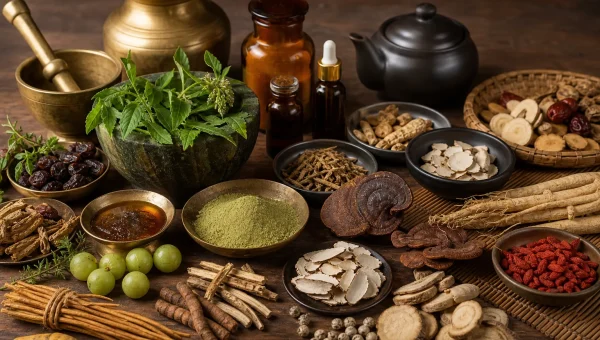
Ayurveda vs Traditional Chinese Medicine: Comparing Two Ancient Healing Systems
Ayurveda and Traditional Chinese Medicine (TCM) are long-established Asian medical systems with surviving textual, educational, and clinical traditions. Both organize...

Ayurvedic articles on research
Ayurveda and Traditional Chinese Medicine (TCM) are long-established Asian medical systems with surviving textual, educational, and clinical traditions. Both organize...
This reading list presents twenty verified papers relevant to Ayurvedic herbs, formulations, yoga, and meditation. It includes randomized trials, reviews,...
This Ayurvedic evidence atlas is a practical reference for checking how much modern human evidence supports a herb-condition pairing. It...
Using the same self-directed herbal regimen throughout the year can be inappropriate. Ayurveda describes ritucharya, the adjustment of food and...
Curcumin supplements are widely marketed for joint, digestive, and general inflammatory support, but no direct randomized trial or authoritative guidance...
The familiar “one drug, one target” model is useful, but it is not a complete description of pharmacology. Many effective...
Triphala, Ashwagandha (Withania somnifera), and turmeric-derived curcumin are widely used Ayurvedic or botanical supplements, but their evidence bases are separate...
Can an algorithm learn part of what an experienced vaidya observes during Prakriti assessment? Peer-reviewed studies now show that machine-learning...
If your joints seem more painful or stiff during spring, the experience may be genuine, but the explanation is not...
Ayurveda describes deha prakriti as an individual constitutional pattern expressed through physical structure, physiological tendencies, and psychological characteristics. Classical descriptions...