
The Standard Drug Discovery Model and Its Limitations
Conventional pharmaceutical discovery usually begins with a disease-relevant target or pathway, then moves through hit identification, lead optimization, preclinical testing, human Phase I safety, Phase II dose and preliminary efficacy, Phase III confirmation, regulatory review, and post-market surveillance. It is a long and attrition-heavy path. A widely cited DiMasi estimate placed the capitalized research-and-development cost of an approved new compound near $2.6 billion, while later economic reviews emphasize that the number varies substantially by data source, therapeutic area, and modeling assumptions. Across clinical development, roughly nine out of ten candidates that enter Phase I do not reach approval.
The difficulty is not only cost. Human disease biology rarely behaves as a single isolated receptor or enzyme. A compound may affect the intended target in a controlled assay and still fail because of toxicity, inadequate exposure, poor oral bioavailability, weak clinical benefit, or mismatch between an experimental model and the lived complexity of human illness. Reverse pharmacology is important because it begins from another kind of signal: documented human use and observed therapeutic response.
What Is Reverse Pharmacology?
Reverse pharmacology in the Ayurvedic context is a clinic-to-laboratory path. Ashok D.B. Vaidya described it as the integration of bedside documented experiential “hits” into leads through trans-disciplinary exploratory work, followed by development into drug candidates through experimental and clinical inquiry. Instead of beginning with a molecular target and searching for a molecule, it begins with a traditionally used medicine, formulation, or clinical observation, then works backward to clarify identity, quality, dose, safety, pharmacodynamics, active constituents, and mechanisms.
Vaidya described three linked domains for this approach: the experiential domain, which includes textual review, pharmacoepidemiology, and structured observational therapeutics; the exploratory domain, which includes indication-relevant in vitro and in vivo work, safety work, human pharmacology, and dose-finding; and the experimental domain, which includes planned laboratory and clinical investigation across levels of biological organization. This does not make traditional use a substitute for validation. It makes traditional use a disciplined starting point.
- Experiential domain: Classical references, physician experience, pharmacoepidemiology, and documented therapeutic observations are organized into usable leads.
- Exploratory domain: The lead is examined with relevant pharmacological models, safety screens, human pharmacology, and early dose-oriented clinical work.
- Experimental domain: Constituents, pathways, pharmacokinetics, toxicology, and clinical outcomes are investigated in a planned, trans-disciplinary way.
Case Study 1: Ashwagandha (Withania somnifera) and Stress-Strength Pharmacology
Aśvagandhā is described in the Ayurvedic Pharmacopoeia of India as the dried mature root of Withania somnifera Dunal. The pharmacopoeial profile gives its rasa as tikta and kaṣāya, guna as laghu, virya as uṣṇa, and vipaka as madhura. Its listed karmas include rasāyana, vātakaphāpaha, balya, and vājīkaraṇa, with therapeutic uses including śotha, kṣaya, daurbalya, vātaroga, and klaibya. The same monograph lists alkaloids and withanolides among its constituents.
This makes ashwagandha a strong reverse-pharmacology example because the classical profile points investigators toward strength, depletion, vāta-kapha presentations, vitality, and restorative use. Modern inquiry has mapped parts of that profile to GABAergic activity, stress-related cortisol response, withanolide chemistry, and neurite reconstruction models involving withanolide A. The herb is not reduced to a single molecule or pathway; rather, the classical dravyaguna profile provides the clinical map from which focused mechanistic questions can be asked.
Case Study 2: Guggulu (Commiphora wightii / Commiphora mukul) and Lipid-Metabolic Leads
Guggulu is described in the Ayurvedic Pharmacopoeia of India as the exudate of Commiphora wightii (Arn.) Bhand., with Commiphora mukul listed as a synonym. The pharmacopoeial profile gives rasa as kaṭu, tikta, and kaṣāya, virya as uṣṇa, and vipaka as kaṭu. Its listed karmas include rasāyana, balya, medohara, vātabalāsajit, varṇya, and bhagnasandhānakṛt, with therapeutic uses including medoroga, prameha, āmavāta, kuṣṭha, vāta-vyādhi, granthi, śopha, and gaṇḍamālā.
The word medohara gives reverse pharmacology a clear metabolic cue rather than a vague wellness cue. Indian work on guggulu helped move this traditional observation into lipid-focused pharmacology, where guggulsterones and guggulipid became central modern subjects. Mechanistic work identified guggulsterone as an antagonist ligand of the farnesoid X receptor, a nuclear receptor involved in bile-acid and cholesterol metabolism.
The guggulu example also shows why reverse pharmacology must preserve context. A randomized trial of guggulipid in adults with hypercholesterolemia in the United States did not reproduce the expected lipid-lowering outcome and reported higher LDL cholesterol relative to placebo in the treatment groups. This does not erase the classical medohara lead; it clarifies that extract type, dose, population, diet, baseline metabolic state, and formulation context matter in translation.
Case Study 3: Turmeric (Curcuma longa) and the Multi-Target Paradigm
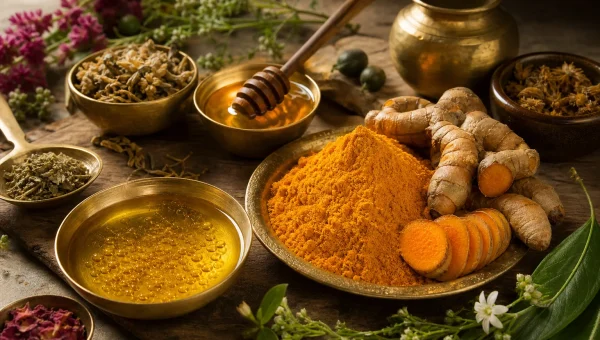
Haridrā is described in the Ayurvedic Pharmacopoeia of India as the dried and cured rhizome of Curcuma longa Linn. The pharmacopoeial profile gives rasa as kaṭu and tikta, guna as rūkṣa, virya as uṣṇa, and vipaka as kaṭu. Its listed karmas include kṛmighna, kuṣṭhaghna, varṇya, viṣaghna, kaphapittanut, and pramehanāśaka. Its therapeutic uses include pāṇḍu, prameha, vraṇa, viṣavikāra, kuṣṭha, tvagroga, śītapitta, and pīnasa. The monograph lists essential oil and curcumin among its constituents.
Turmeric is a useful example of why reverse pharmacology does not always fit a one-drug, one-target model. The pharmacopoeial actions and uses cover skin, wound, metabolic, allergic, toxic, and kapha-pitta contexts. Modern molecular work on curcumin has mapped interactions with signaling molecules and pathways relevant to inflammation and redox regulation, including NF-κB, Nrf2, COX-2-linked pathways, kinases, transcription factors, and inflammatory mediators. This broad pathway profile sits more naturally within a network model than within a single-target model.
| Ayurvedic Lead | Traditional Clinical Cue | Modern Reverse-Pharmacology Direction | Mapped Pathway or Marker |
|---|---|---|---|
| Aśvagandhā | Rasāyana, balya, vātakaphāpaha, vājīkaraṇa; daurbalya and vātaroga indications | Stress physiology, restorative strength, withanolide chemistry, and neurobiological models | GABAergic activity, cortisol response, withanolide A neurite effects |
| Guggulu | Medohara, rasāyana, balya; medoroga and prameha indications | Lipid-metabolic pharmacology and nuclear-receptor investigation | FXR antagonism and cholesterol/bile-acid regulatory pathways |
| Haridrā | Kuṣṭhaghna, varṇya, kaphapittanut, pramehanāśaka; vraṇa and tvagroga indications | Inflammatory, redox, skin, wound, and metabolic pathway mapping | NF-κB, Nrf2, COX-2-linked pathways, kinases, inflammatory mediators |
| Guḍūcī | Rasāyana, dīpana, tridoṣaśāmaka, jvaraghna; jvara, prameha, kāmalā, and vātarakta indications | Host-response, fever, hepatoprotective, and immune-modulatory investigation | Hepatoprotective and immunological activity models |
Institutional Frameworks Supporting Reverse Pharmacology in India
India has built several tools that make Ayurvedic reverse pharmacology more systematic. The Ayurvedic Pharmacopoeia of India supplies standards for identity, purity, strength, constituents, actions, therapeutic uses, and dose for official single drugs. The Traditional Knowledge Digital Library converts classical knowledge from Ayurveda, Siddha, Unani, Sowa Rigpa, and Yoga into patent-examiner-accessible formats and languages, with more than 5 lakh formulations or practices transcribed. CSIR-NMITLI work and the Advanced Centre of Reverse Pharmacology described by Vaidya brought clinicians, pharmacologists, phytochemists, toxicologists, statisticians, pharmaceutics experts, and molecular biologists into the same discovery framework.
These frameworks are useful because reverse pharmacology depends on disciplined documentation. The herb must be botanically correct, the part used must be correct, the formulation and anupāna must be recorded, the dose must be clear, and safety observations must be treated as data rather than folklore. Without this discipline, reverse pharmacology becomes only a modern label for loose herbal speculation.
Challenges and Criticisms of the Reverse Pharmacology Approach
Reverse pharmacology is strongest when it preserves both sides of the bridge: classical indication and formulation logic on one side, and careful documentation, safety assessment, pharmacology, and clinical measurement on the other. Its limitations are therefore practical and methodological, not merely philosophical.
- Traditional use is a lead, not approval: Long use may guide prioritization, but identity, quality, dose, safety, and clinical benefit still need structured evaluation.
- Formulations are complex: Ayurvedic medicines often include multiple herbs, processing methods, adjuvants, and dosing contexts. Isolating one constituent may clarify a pathway while missing the full formulation logic.
- Context affects translation: The guggulipid trial illustrates how population, extract, dose, diet, and trial setting can alter outcomes.
- Bias must be controlled: Observational leads should be followed by careful design, validated outcomes, appropriate controls, and transparent reporting.
- Regulatory pathways remain demanding: Modern approval systems still require robust quality, safety, and clinical data, even when the starting point is a traditional medicine.
The Future: Integrating Traditional Wisdom with Modern Precision
Reverse pharmacology offers a pragmatic bridge between Ayurvedic clinical knowledge and modern drug development. It respects the clinical observations of traditional practitioners while requiring those observations to pass through quality control, safety evaluation, pharmacology, and clinical measurement. Its best use is not to force Ayurveda into a single-molecule model, but to ask how classical actions, formulations, and patient contexts can be translated into testable biological questions.
The next step is deeper integration with systems biology, network pharmacology, metabolomics, pharmacogenomics, and formulation science. These tools can help describe not only one target but the broader pattern of biological response produced by a herb or formulation. In that sense, reverse pharmacology is not a shortcut around rigor; it is a way to choose better starting points for rigorous work.
Medical Disclaimer: This article is for educational purposes only and does not constitute medical advice. Reverse-pharmacology findings, classical references, and pharmacopoeial descriptions are not personal treatment recommendations. Herbs and Ayurvedic formulations should be used under the guidance of a qualified Ayurvedic practitioner or healthcare provider, especially during pregnancy, chronic illness, liver or kidney disease, or while taking prescription medicines.
References
- FDA
- Innovation in the pharmaceutical industry: New estimates of R&D costs (2016), PubMed
- Jamanetwork (jamanetwork.com)
- Why 90% of clinical drug development fails and how to improve it? (2022), PubMed Central
- Thescipub (thescipub.com)
- Ayurvedic Pharmacopoeia of India
- Direct evidence for GABAergic activity of Withania somnifera on mammalian ionotropic GABAA and GABAρ receptors (2015), PubMed
- A prospective, randomized double-blind, placebo-controlled study of safety and efficacy of a high-concentration full-spectrum extract of ashwagandha root in reducing stress and anxiety in adults (2012), PubMed Central
- Neuritic regeneration and synaptic reconstruction induced by withanolide A (2005), PubMed
- Utsouthwestern (utsouthwestern.elsevierpure.com)
- Guggulipid for the treatment of hypercholesterolemia: a randomized controlled trial (2003), PubMed
- Link (link.springer.com)
- Multitargeting by curcumin as revealed by molecular interaction studies (2011), PubMed
- Csir (csir.res.in)
- Traditional medicine-inspired approaches to drug discovery: can Ayurveda show the way forward? (2009), PubMed
understanding Samprapti as a sequence rather than a fixed state changed how I think about treatment timing. early stages are so much more tractable.
@Jessica samprapti stages are clinically useful but the attribution of specific diseases to specific stages is overly rigid in practice.
Doing this.
how does the Samprapti Ghatakas model handle autoimmune conditions where the body’s own tissues become the ‘enemy’?
at which Samprapti stage does the disease become difficult to reverse? is Vyakti the point of no return or does Bheda cross that line?
Samprapti stages are clinically useful but the attribution of specific diseases to specific stages is overly rigid in practice.
Useful info.
@Daniel understanding Samprapti as a sequence rather than a fixed state changed how I think about treatment timing. early stages are so much more tractable.
The ashwagandha section clarified how withanolide A ties into GABAergic pathways, which finally explains why I feel calmer after taking the root extract.
how does the Samprapti Ghatakas model handle autoimmune conditions where the body’s own tissuea become the ‘enemy’?
@Ravi understanding Samprapti as a sequence rather than a fixed state changed how I think about treatment timing. early stages are so much more tractable.
The bedside-to-bench framing in this article finally gives me language to explain to skeptical colleagues why traditional use data isn’t just anecdote. The Terminalia arjuna work is a good example — cardiologists were seeing results for decades before anyone mapped the mechanism. Has this reverse pharmacology approach been applied to any formulations beyond single-herb preparations?
I wonder if the FXR antagonism mechanism for guggulsterone holds up in populations with different dietary fat intake.
at which Samprapti atage does the disease become difficult to reverse? is Vyakti the point of no return or does Bheda cross that line? ❤️
Seeing turmeric linked to over a hundred targets makes the old single target mindset seem outdated.
Will try!
The case study on guggulu shows how traditional use can guide a drug lead, but the Western trial mismatch reminds us formulation context matters.
What strikes me most here is how the reverse pharmacology model could speed up validation without the billion-dollar price tag of conventional drug discovery. Starting with an already-used substance that has a centuries-long safety record changes the risk calculus completely. Curious whether regulatory bodies like CDSCO are formally recognizing this pathway or still requiring the conventional sequence.
I appreciate the breakdown of the three phases; turning bedside observation into bench work feels like a smarter way to cut attrition.
Network pharmacology framing curcumin’s broad effects could reshape how we design polyherbal formulas for complex conditions.
understandinh Samprapti as a sequence rather than a fixed state changed how I think about treatment timing. early stages are so much more tractable.
Has anyone tried standardizing ashwagandha leaf versus root extracts based on the withanolide profiles mentioned?
@Rajesh samprapti stages are clinically useful but the attribution of specific diseases to specific stages is overly rigid in practice. 🌿
how does the Samorapti Ghatakas model handle autoimmune conditions where the body’s own tissues become the ‘enemy’? tbh
The survivorship bias note is a good reminder that long standing herbs aren’t automatically the most potent, just the most culturally persistent.
how does the Samprspti Ghatakas model handle autoimmune conditions where the body’s own tissues become the ‘enemy’?
Applying omics to reverse pharmacology sounds promising, especially for mapping how multi target herbs shift disease networks.
Makes sense.
@Ravi how does the Samprapti Ghatakas model handle autoimmune conditions where the body’s own tissues become the ‘enemy’?
understanding Samprapti aa a sequence rather than a fixed state changed how I think about treatment timing. early stages are so much more tractable.
@Nandini samprapti stages are clinically useful but the attribution of specific diseases to specific stages is overly rigid in practice.
samprapti stages are clinically useful but the attribution of specific diseases to apecific stages is overly rigid in practice.
at which Samprapti stage does the disease become difgicult to reverse? is Vyakti the point of no return or does Bheda cross that line?