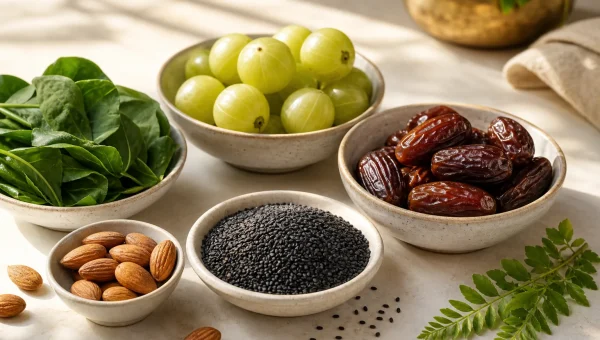
Micronutrient Deficiencies Through a Dosha Lens: B12, D3, and Iron in Ayurvedic Context
Constitutional assessment can be useful within Ayurveda, but it should not be used to predict a vitamin or mineral deficiency....

June 4, 2026
Ayurvedic articles on research
Constitutional assessment can be useful within Ayurveda, but it should not be used to predict a vitamin or mineral deficiency....
A 1998 National Institutes of Health research announcement stated that biofilms accounted for more than 80% of microbial infections in...
Stephen Porges introduced Polyvagal Theory in a 1995 paper, not in 1994. The theory proposed that different vagal pathways participate...
Ayurveda and modern gastroenterology both attend to digestion, bowel function, inflammation, nourishment and tissue integrity, but their terms are not...
AMP-activated protein kinase (AMPK) is a central regulator of cellular energy balance and an important research target in metabolic disease....
When a supplement company markets ashwagandha as “standardized to 5% withanolides,” it is making a claim about phytochemical content. But...
Computational methods now give researchers practical ways to investigate the chemical complexity of Ayurvedic plants and formulas without experimentally testing...
A 2017 paper did examine an Ayurvedic rasayana in relation to telomere biology, but a common online account of it...
A commonly repeated account says that researchers at Banaras Hindu University recruited 53 people, assigned their prakriti through three independent...
Ayurvedic genomics investigates whether measurable biological variation is associated with prakriti, the constitutional classification described in Ayurveda. A 2015 genome-wide...