
Your Pre-Workout Stack Has a Missing Ingredient from Ancient India
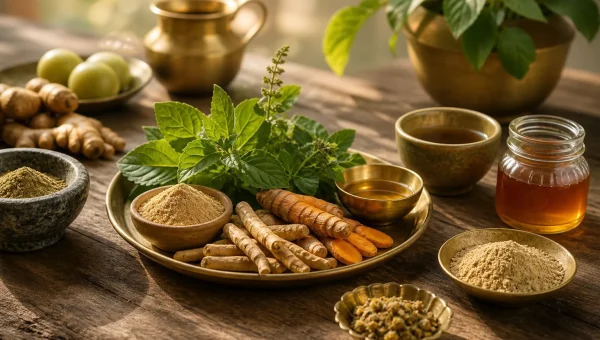
Most pre-workout thinking looks for a fast pump: raise nitric oxide (NO), open blood vessels, and improve blood flow to working muscles. Ayurveda adds a wider frame. It asks whether the heart, vessels, urinary channels, strength-supporting tissues, digestion, and recovery are being supported together. A cleaner Ayurveda-informed NO stack is therefore not one heroic powder; it is a layered protocol: beetroot for acute dietary nitrate, arjuna for daily hridya support, gokshura for vrishya, brihmana, and urinary-channel support, and dadima for polyphenol support of NO bioavailability.
This keeps the performance goal intact while placing each ingredient in its proper role. Beetroot is the acute nitrate driver. Arjuna, gokshura, and dadima are the supporting herbs and foods that make the protocol more Ayurvedic than a simple “pump” formula.
The Nitrate-Nitrite-Nitric Oxide Pathway
Dietary nitrate from beetroot is absorbed, concentrated into saliva, reduced by oral bacteria to nitrite, and then converted further to nitric oxide, especially in lower-oxygen environments such as hard-working muscle. This is why timing and oral hygiene matter: if strong antibacterial mouthwash is used around the nitrate dose, the nitrate-to-nitrite step can be weakened.
For training, use the nitrate number, not the scoop size. Practical sports protocols commonly target about 6-8 mmol nitrate, roughly 350-500 mg nitrate, about 2-3 hours before exercise. Fresh beetroot juice, concentrated shots, and powders vary widely, so a product should state its nitrate yield. A 70 mg serving of ordinary beetroot powder should not be treated as equivalent to a 6-8 mmol nitrate dose.
Arjuna: Hridya Support for the Vascular Foundation
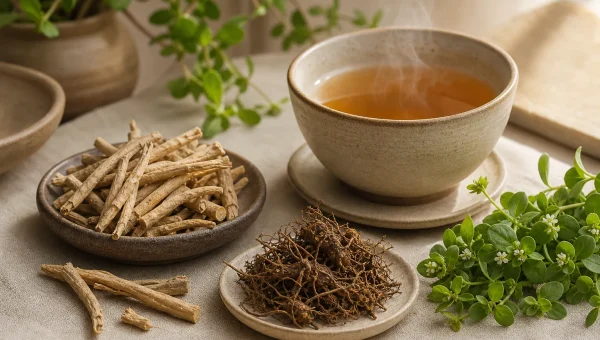
Arjuna (Terminalia arjuna) is defined in the Ayurvedic Pharmacopoeia of India as the stem bark of Terminalia arjuna. Its classical profile is kashaya rasa, ruksha guna, shita virya, and katu vipaka. Its listed actions include hridya, kaphahara, pittahara, vrananashana, and related restorative indications, with a powder dose of 3-6 g.
In this stack, arjuna is the daily vascular foundation rather than the acute nitrate source. Its bark contains tannins and triterpenes such as arjunolic acid, and it has been examined in human cardiovascular contexts involving endothelial function. For an athlete, that makes arjuna the “daily support” piece that sits beside the beetroot nitrate window, not a one-time stimulant.
Gokshura: Classical Vrishya Support and a Nitrate-Bearing Herb
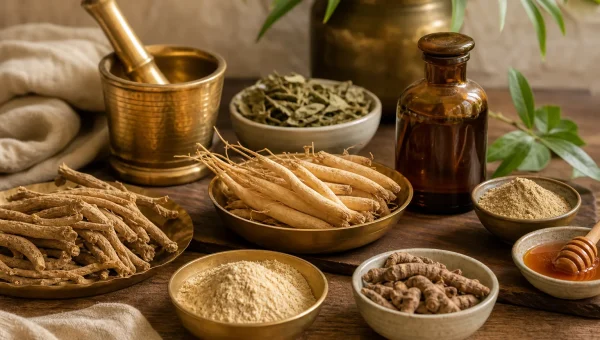
Gokshura (Tribulus terrestris) appears in the Ayurvedic Pharmacopoeia of India as both root and fruit. The root is described as madhura rasa, guru and snigdha guna, shita virya, madhura vipaka, with actions including mutrala, vrishya, vatanut, and brihmana. The fruit is also madhura, guru, snigdha, shita, and madhura vipaka; its listed constituents include potassium nitrate, sterols, and sapogenins such as diosgenin, gitogenin, and hecogenins.
This makes gokshura a sensible companion in an Ayurveda performance stack, but it should not be treated as an instant testosterone switch. Its stronger classical role is steady support for strength, urinary comfort, and vata-related recovery. The fruit powder dose listed in the API is 3-6 g, with 20-30 g for decoction; the root is listed at 20-30 g for decoction. Standardized tribulus extracts should be treated as separate products rather than automatically equivalent to the classical drug.
Dadima: Polyphenol Support for NO Bioavailability
Dadima (Punica granatum, pomegranate) is listed in the Ayurvedic Pharmacopoeia of India as fresh fruit with madhura, amla, and kashaya rasa, laghu and snigdha guna, ushna virya, and madhura vipaka. Its actions include balya, dipana, hridya, pittahara, vatahara, ruchya, shramahara, and tarpaka, with a fresh-fruit juice dose of 15-30 ml in the API.
Pomegranate’s modern fit in this stack is NO bioavailability. Pomegranate juice and extracts are rich in polyphenols, and pomegranate preparations have been examined for protecting nitric oxide from oxidative destruction, supporting endothelial NO activity, and improving blood flow and vessel diameter around exercise. In practical use, dadima is best kept as food-like vascular support: arils, unsweetened juice, or a quality pomegranate extract when used specifically before training. It does not replace beetroot for nitrate delivery.
| Ingredient | Ayurvedic Role | NO / Performance Role | Practical Amount | Timing |
|---|---|---|---|---|
| Beetroot | Food-based nitrate source | Acute dietary nitrate substrate for the nitrate-nitrite-NO pathway | Enough juice, shot, or powder to deliver 6-8 mmol nitrate, about 350-500 mg nitrate | 2-3 hours pre-workout |
| Arjuna bark | Hridya, kaphahara, pittahara | Daily cardiovascular and endothelial-support foundation | API powder dose 3-6 g; extracts only as directed by a practitioner or product standardization | Daily with food |
| Gokshura root / fruit | Vrishya, brihmana, mutrala, vatanut, vastishodhana | Classical strength and urinary-channel support; fruit contains potassium nitrate | Fruit powder 3-6 g or decoction 20-30 g; root decoction 20-30 g | Daily with food, not only pre-workout |
| Dadima | Balya, dipana, hridya, ruchya, shramahara | Polyphenol support for NO bioavailability and vascular response | Arils or unsweetened juice as food; API fresh-fruit juice dose 15-30 ml; extract per label or practitioner guidance | With meals, or 30 minutes pre-training when using a studied extract format |
The Pre-Workout Protocol: Timing Breakdown
Use the stack in two layers: a daily Ayurvedic foundation and a training-day acute nitrate window. The daily foundation is not meant to feel like caffeine. Its purpose is steady support for the cardiovascular, urinary, and strength-building side of the athlete’s routine.
Daily baseline: Use arjuna with food as the hridya herb, gokshura with food as the vrishya-brihmana and urinary-channel herb, and dadima as food-like vascular support. Keep powders and decoctions within classical dose ranges unless a qualified practitioner adjusts them. If using standardized extracts, follow professional guidance because extract strength varies.
Training-day acute window: Take beetroot in a form that clearly delivers about 6-8 mmol nitrate, roughly 350-500 mg nitrate, about 2-3 hours before the workout. Avoid strong antibacterial mouthwash around this window unless it has been prescribed, because the oral bacteria are part of the nitrate-to-nitrite conversion.
After training: Do not use the NO stack as a substitute for normal recovery. Rehydration, appropriate food, sleep, and a training plan still decide whether the vascular support turns into real adaptation.
What Not to Combine
A few errors can weaken the protocol or make it unsuitable for the wrong person. The goal is better circulation, not uncontrolled vasodilation or careless supplement stacking.
- Antibacterial mouthwash around beetroot: Strong antibacterial rinses can interfere with the oral bacteria that reduce nitrate to nitrite. Keep them away from the beetroot window unless prescribed by a dentist or physician.
- Prescription nitrates, riociguat, PDE-5 inhibitors, and blood-pressure medicines: The established medical contraindication is PDE-5 inhibitors with organic nitrates because of hypotension risk. Anyone using vasodilating medicines, erectile dysfunction medicines, or antihypertensive therapy should get medical clearance before adding an NO-oriented stack.
- Unverified extracts: Use quality-controlled products from responsible manufacturers. Some Ayurvedic products have been found to contain unsafe levels of heavy metals, and concentrated extracts are not automatically equivalent to classical powders or decoctions.
- Medical or metabolic conditions: People with heart disease, kidney disease, low blood pressure, diabetes, pregnancy, lactation, or a history of adverse reactions to herbs should not self-prescribe this protocol.
Safety and Practitioner Guidance
Disclaimer: This article is for educational purposes only and does not replace professional medical advice. Consult a qualified Ayurvedic practitioner or healthcare provider before starting beetroot nitrate loading, arjuna, gokshura, dadima extracts, or any new health regimen, especially if you take prescription medicines or have an existing medical condition.
References
- Nitric oxide in the vasculature: where does it come from and where does it go? A quantitative perspective (2008), PubMed Central
- NCBI
- Sciencedirect (sciencedirect.com)
- Beetroot juice and exercise: pharmacodynamic and dose-response relationships (2013), PubMed
- Ausport (ausport.gov.au)
- Dietary nitrate supplementation reduces the O2 cost of low-intensity exercise and enhances tolerance to high-intensity exercise in humans (2009), PubMed
- Ayurvedic Pharmacopoeia of India
- Pubs (pubs.rsc.org)
- Terminalia arjuna reverses impaired endothelial function in chronic smokers (2004), PubMed
- Ayurvedic Pharmacopoeia of India
- NCBI
- Ayurvedic Pharmacopoeia of India
- Pomegranate juice protects nitric oxide against oxidative destruction and enhances the biological actions of nitric oxide (2006), PubMed
- Pomegranate juice reduces oxidized low-density lipoprotein downregulation of endothelial nitric oxide synthase in human coronary endothelial cells (2006), PubMed
- Effects of pomegranate extract on blood flow and running time to exhaustion (2014), PubMed
- NCCIH
- Dailymed (dailymed.nlm.nih.gov)
- NCCIH
The dosing protocol (100ml beet juice + 250mg Arjuna extract standardized to arjunolic acid) is specific enough to actually implement.
What’s the nitrate content of commercial beet powder vs fresh juice? The variability seems substantial.
That variability is a legitimate concern — I’ve seen figures ranging from 250mg to over 1000mg nitrate per 100g of beet powder depending on the source and processing method. Freeze-dried seems to retain more than spray-dried, but almost no commercial products disclose the method, let alone the actual nitrate assay.
blood pressure lowering from beet-herb blends needs monitoring. for someone on antihypertensives this could cause dangerous drops.
Does beet juice interact with blood pressure medications? My father is on Amlodipine and interested in this for cardiovascular health lol
@Jason yes exactly, that was my experience as well.
Dietary nitrate from beet is well studied but the Ayurvedic herb additions haven’t been tested in combination in clinical trials. Can’t assume additive NO effect.
Can this protocol be used for hypertension management or is it primarily for athletic performance?
is there a window where no elevation is contraindicated (e.g., hypertension emergencies)?
The pre-workout framing feels like Western sports supplement marketing grafted onto Ayurvedic herbs. The classical context is being stretched here.
That’s a critique worth taking seriously. Though I’d push back slightly — the article doesn’t claim Arjuna was historically used as a pre-workout, it’s applying modern physiology to explain a mechanism that the classical use of Arjuna for hridaya (heart) already accessed. The framing might be marketing-adjacent but the underlying logic isn’t obviously wrong.
makes sense given what the article says about the Pitta component.
finally an explanation of why Punarnava and beet work synergistically from a nitric oxide perspective. My cardiologist actually approved this after reviewing the article.
Useful info.
the Ashwagandha addition for stamina is this via NO pathway or a separate adaptogenic mechanism?
Beetroot juice works best when you avoid mouthwash before drinking it, since the oral bacteria are needed to turn nitrate into nitrite.
Can this protocol be used for hypertension management or is it primarily for athletic performance? 🌿
Does beet juice interact with blood pressure medications? My father is on Amlodipine adn interested in this for cardiovascular health.
had the same experience with this.
I wonder how long it takes for arjuna bark extract to show noticeable improvements in endothelial function if taken twice daily.