
He served two tours in Afghanistan and came home to a body that felt like it no longer belonged to him. Loud noises sent him to the floor. Crowds made him feel like his skin was dissolving. Sleep was a battle zone. He had tried medication, therapy, and a support group. Progress was real but incomplete. A family member suggested he see an Ayurvedic practitioner, which he dismissed as “woo.” But desperation is a powerful motivator. The practitioner who assessed him did not begin by asking him to retell the trauma. She observed his pulse, tongue, skin, sleep rhythm, appetite, breath, posture, and the way his attention moved through the room. Her conclusion was simple: his system had lost steadiness, warmth, and grounding. In Ayurvedic language, this was a vata-dominant disturbance affecting the body, senses, sleep, and mind. The care she offered was not a replacement for PTSD therapy. It was a supportive foundation to help his nervous system tolerate healing.
Post-traumatic stress disorder is a serious mental health condition involving intrusive symptoms, avoidance, changes in mood and cognition, and heightened arousal or reactivity. Ayurveda does not offer a stand-alone cure for PTSD, and it should never be used as a substitute for trauma-focused care. What Ayurveda can offer is a coherent framework for supporting sleep, digestion, touch tolerance, breath regulation, routine, and the body’s felt sense of safety while evidence-based PTSD treatment continues.
The Ayurvedic Understanding of Trauma-Related Vata Disturbance
Classical Ayurveda does not use the modern biomedical term PTSD, but it gives a detailed language for understanding disturbances of vata, manas, indriya, prana, sleep, and bodily stability. Vata is described as dry, light, cold, rough, subtle, and mobile. When these qualities dominate the system, a person may become more irregular, restless, sleepless, sensitive to sound or touch, tremulous, constipated, easily startled, or unable to feel settled in the body.
Vata is also the dosha most closely linked with movement, sensory perception, motor activity, breath, circulation, and higher mental activity. Prana vayu is associated with respiration, sensory reception, and the coordination of mind and senses, while vyana vayu is associated with widespread movement and circulation throughout the body. In trauma-support work, an Ayurvedic practitioner may therefore view hypervigilance, shallow breathing, sleep disturbance, body tension, dissociation, and unstable routines as signs that vata needs steadiness, warmth, nourishment, and careful regulation.
Modern Nervous System Parallels
Modern descriptions of PTSD include re-experiencing, avoidance, negative changes in mood or cognition, and arousal symptoms such as being on guard, startling easily, poor concentration, irritability, and disturbed sleep. Neurobiological descriptions commonly discuss altered function in circuits involving the amygdala, hippocampus, medial prefrontal cortex, and anterior cingulate cortex. Ayurveda should not be forced into a one-to-one translation with neuroscience, but the vata lens points toward practical supportive priorities: regulate rhythm, restore sleep, reduce sensory overload, steady the breath, nourish the body, and re-establish safe contact with the present moment.
Primary Ayurvedic Therapies for PTSD Support
For a trauma survivor with vata-dominant symptoms, Ayurvedic support should begin gently. The first therapeutic principles are consent, predictability, warmth, rhythm, adequate nourishment, stable sleep timing, and coordination with the person’s physician or mental health provider. Strong cleansing protocols, intense breath retention, forceful bodywork, or emotionally overwhelming practices are not appropriate as casual self-care for someone with active hyperarousal, dissociation, panic, or severe insomnia.
Shirodhara: Steady Sensory Input for a Vata-Disturbed Mind
Shirodhara is a supervised Ayurvedic procedure in which a continuous stream of warm liquid, often oil, is poured over the forehead in a controlled manner. In vata-dominant trauma presentations, its value is not that it “treats PTSD” directly, but that it may provide warmth, repetition, stillness, and non-demanding sensory input for a system that has become over-alert. It should be performed only by a trained practitioner who can assess constitution, digestion, blood pressure, medications, dissociation risk, and tolerance for touch and stillness.
For a trauma survivor, shirodhara is usually best introduced after rapport has been established and after simpler practices such as foot oiling, regular meals, and gentle breathing are tolerated. The oil or liquid should be selected individually. Some people experience deep calm; others may feel uncomfortable lying still with eyes closed. A trauma-informed practitioner should allow the person to stop at any time, keep the setting quiet, avoid surprise touch, and integrate the session with grounding afterward. Our detailed guide on shirodhara therapy benefits covers the practice in more detail.
Abhyanga: Rebuilding Safe Contact with the Body
Trauma can disturb a person’s relationship with touch and body boundaries. The skin is the field of touch sensation, and Ayurveda gives touch a central place in embodied experience. In PTSD, touch may feel threatening, numb, absent, or overwhelming. Abhyanga, the application of warm oil with slow and predictable strokes, can be used as a gentle way to reintroduce non-threatening contact when the person is ready.
Daily self-abhyanga does not require full-body massage. For many trauma survivors, beginning with the feet, calves, hands, ears, or scalp is safer than beginning with the whole body. The key is predictability: warm oil, the same time of day, the same sequence, and permission to stop. Sesame oil is commonly used in vata-dominant care when appropriate, but the best oil depends on the person’s constitution, skin, season, and tolerance. Our guide on abhyanga benefits covers technique and oil selection.
Key Herbs for PTSD-Related Vata Disturbance
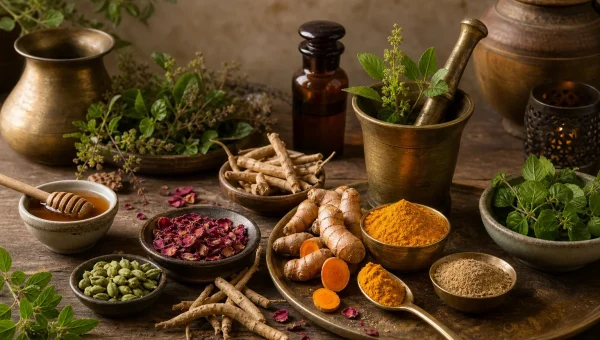
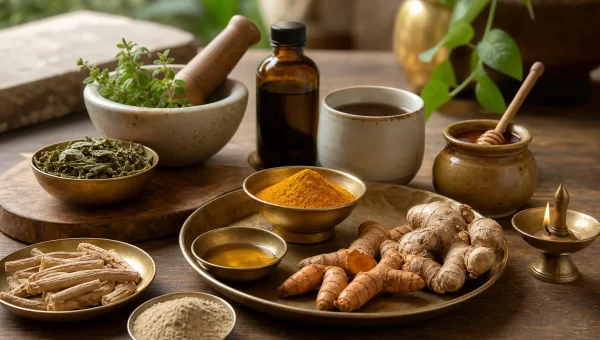
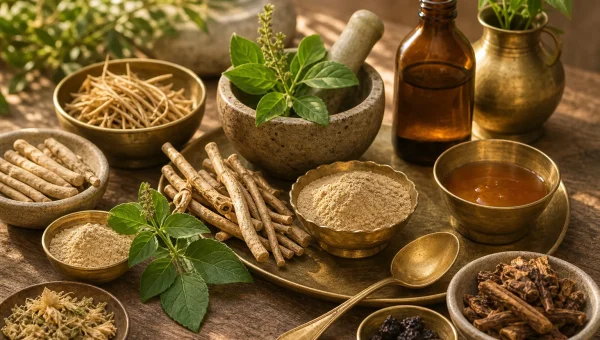
Ayurvedic herbs for trauma support should be used as adjuncts, not as substitutes for psychiatric care. The purpose is to support sleep, steadiness, cognition, and resilience according to the person’s constitution and medication profile. Doses vary by preparation, strength, age, digestion, pregnancy status, liver health, and concurrent medicines, so the ranges below are educational rather than personal prescriptions.
| Herb | Latin Name | Classical Ayurvedic Profile | Supportive Use in Vata-Dominant Trauma Care | Typical Traditional Dose Range and Safety Note |
|---|---|---|---|---|
| Ashwagandha / Asvagandha | Withania somnifera | Rasayana, balya, vata-kapha pacifying; API lists tikta-kashaya rasa, laghu guna, ushna virya, madhura vipaka. | Used when depletion, poor strength, chronic stress, disturbed sleep, and nervous exhaustion are prominent. | API powder range: 3–6 g. Avoid self-use in pregnancy, breastfeeding, liver disease, thyroid disease, autoimmune conditions, before surgery, or with sedatives, anti-seizure medicines, thyroid medicines, diabetes medicines, blood pressure medicines, or immunosuppressants unless supervised. |
| Brahmi | Bacopa monnieri | Medhya, rasayana, vatahara; API lists madhura-tikta-kashaya rasa, laghu-sara guna, shita virya, madhura vipaka. | Used for mental steadiness, attention, learning, and cognitive support when the mind feels scattered or fatigued. | API powder range: 1–3 g. Use under guidance if taking psychiatric medicines or sedatives, or if digestion is weak. |
| Jatamansi | Nardostachys jatamansi | Medhya and nidrajanana; API lists tikta-kashaya rasa, laghu guna, shita virya, katu vipaka, and use in manasaroga and anidra. | Used in carefully selected cases where insomnia, agitation, and mental exhaustion dominate. | API powder range: 2–3 g. Avoid combining with sedative medicines, alcohol, or sleep medicines without medical supervision. Avoid in pregnancy and breastfeeding unless specifically directed by a qualified clinician. |
| Shankhapushpi | Convolvulus pluricaulis | Medhya, rasayana, balya; API lists katu-tikta-kashaya rasa, sara guna, shita virya, katu vipaka, and use in manasaroga and apasmara. | Used for restlessness, mental overactivity, and support of calm cognition. | API powder range: 3–8 g. Identity of market preparations varies, so use a reliable source and practitioner guidance. |
| Vacha | Acorus calamus | Traditionally used in selected nervous system and speech-related contexts, but requires special caution. | Not a routine self-care herb for PTSD. It belongs only in practitioner-directed care when the exact plant material, processing, dose, and risk profile are known. | Do not self-prescribe. Classical processing is emphasized in Ayurvedic pharmacy discussions, and beta-asarone safety concerns make unsupervised use inappropriate, especially in pregnancy, liver disease, seizure disorders, or with psychiatric medication. |
Nasya for Head, Senses, and Breath Support
Nasya is the Ayurvedic administration of medicated oil or other substances through the nose. Classical daily-regimen texts include nasya among practices used for the head and sense organs, and Anu taila is a traditional medicated oil used for nasya. In trauma-related vata disturbance, nasya may be considered when dryness, head tension, sensory sensitivity, disturbed sleep, or unsettled breathing are prominent, but it should be introduced gently and only when the person feels safe with the practice.
For home care, a practitioner may recommend a very small amount of a suitable oil at the nostril entrance or a gentle form of pratimarsha nasya. Strong nasya, large doses, or irritating substances are not appropriate as casual self-care for someone with panic, dissociation, active sinus infection, nosebleed tendency, severe congestion, or discomfort with nasal practices. Our detailed guide on Nasya therapy covers technique and safety considerations.
Pranayama for Autonomic Steadiness
Breath practices can be valuable for trauma support, but they must be chosen carefully. A person with PTSD may feel worse with breath retention, forceful breathing, closed-eye practice, or instructions that create a sense of being trapped. The safest approach is slow, comfortable, choice-based breathing with no strain, no competition, and no forced emotional release.
- Nadi Shodhana: Alternate nostril breathing may be practiced gently for 3 to 10 minutes, without breath retention, at a consistent time of day. It is best used as a rhythm practice rather than a performance practice.
- Bhramari: Humming bee breath can be practiced for 5 to 10 soft rounds. The sound should be easy, low-pressure, and pleasant. People who feel trapped by closing the ears or eyes can keep the eyes open and hands relaxed.
- Lengthened Exhalation: A simple pattern such as inhaling comfortably and exhaling slightly longer can be useful during mild hyperarousal. Breath-holding patterns should be avoided if they increase panic, dizziness, or body alarm.
Grounding Practices for Vata-Disturbed Trauma
Ayurveda steadies vata through opposite qualities: warmth, oiliness, nourishment, heaviness, routine, and stable rhythm. For trauma support, these principles become practical daily anchors rather than dramatic interventions. The goal is to teach the body that ordinary life has predictable signals of safety.
- Consistent sleep and waking time: Irregularity aggravates vata. A steady bedtime and wake time, even before sleep is perfect, gives the nervous system a repeated rhythm.
- Warm, cooked, nourishing food: Soups, stews, cooked grains, warm milk if tolerated, ghee if suitable, and regular meals are more vata-supportive than skipping meals or relying on cold, dry, raw, or irregular eating.
- Foot oiling before bed: Warm oil on the feet and calves gives a simple sensory anchor before sleep and is easier for many trauma survivors than full-body massage.
- Bhumi sparsha: Safe contact with the earth, such as standing barefoot on clean grass or soil, can be used as a mindful grounding ritual. The value is sensory orientation, steadiness, and present-moment contact.
- Reducing abrupt stimulation: Late-night screens, excess caffeine, harsh noise, and unpredictable routines can intensify vata-like restlessness. Gentle evening repetition is more supportive than intense nighttime productivity.
Integration with Conventional PTSD Treatment
Ayurvedic support for PTSD works best as an adjunctive foundation. Trauma-focused psychotherapies such as prolonged exposure, cognitive processing therapy, and EMDR are established PTSD treatments, and medication may be appropriate when prescribed and monitored by a qualified clinician. Ayurveda can support the person’s capacity to sleep, eat, breathe, feel the body, and remain regulated enough to engage with therapy.
Yoga, pranayama, and body-based practices should be trauma-informed: the person should have choice, pacing, and permission to stop. Practices that look calming from the outside can feel overwhelming from the inside when the nervous system has learned to expect threat. The Ayurvedic practitioner, therapist, and physician should ideally know what the person is using so that herbs, oils, sleep practices, and mental health care are coordinated. See our related post on Ayurvedic anxiety remedies for broader nervous system support strategies.
Safety and Disclaimer
PTSD is a serious psychiatric condition requiring professional assessment and treatment. The Ayurvedic approaches described in this article are supportive and adjunctive; they do not replace evidence-based PTSD treatments, emergency psychiatric care, or appropriately managed medication. Anyone with active suicidal thoughts, self-harm urges, severe dissociation, violent impulses, psychosis, or inability to function should seek urgent professional help immediately.
Herbs require special caution. Ashwagandha is not appropriate for everyone and should be avoided or used only with clinician guidance in pregnancy, breastfeeding, liver disease, thyroid disease, autoimmune disease, before surgery, and when taking sedatives, anti-seizure medicines, thyroid medicines, diabetes medicines, blood pressure medicines, or immunosuppressants. Jatamansi may have sedating effects and should not be combined with sedatives, alcohol, or sleep medicines without medical supervision. Vacha should not be self-prescribed because of processing requirements and beta-asarone safety concerns. Nasya, shirodhara, and bodywork should be modified or avoided when they worsen panic, dissociation, headache, nausea, congestion, or distress. Our guide on Ayurvedic stress management covers complementary practices.
Actionable Tip: Tonight, before sleep, warm a small amount of sesame oil or another practitioner-approved oil and massage only your feet and calves for ten minutes. Keep the room quiet, keep your eyes open if that feels safer, and stop if the practice becomes uncomfortable. Put on socks afterward or wipe the feet so you do not slip. Try this for seven nights and simply observe sleep onset, body tension, and morning anxiety without forcing a result.
Nothing in this article diagnoses or treats a medical condition. Use it as educational information and consult a qualified Ayurvedic practitioner, physician, or licensed mental health professional before starting herbs, supplements, detoxes, nasya, shirodhara, or therapeutic protocols, especially if pregnant, managing a condition, experiencing severe symptoms, or taking medication.
References
- Nimh (nimh.nih.gov)
- Ptsd (ptsd.va.gov)
- Ptsd (ptsd.va.gov)
- Traumatic stress: effects on the brain (2006), PubMed Central
- Neurobiological Features of Posttraumatic Stress Disorder (PTSD) and Their Role in Understanding Adaptive Behavior and Stress Resilience (2022), PubMed Central
- Ayurveda-online (ayurveda-online.net)
- Charaka Samhita — Vata dosha
- Charaka Samhita — Dosha
- Charaka Samhita — Vatavyadhi Chikitsa
- Charaka Samhita — Neurological diseases
- Charaka Samhita — Nidra
- Charaka Samhita — Matrashiteeya Adhyaya
- Charaka Samhita — Abhyanga
- Charaka Samhita — Dinacharya
- Prevalence of touch sensation (sparshanendriya-vyapaktva) (2010), PubMed Central
- Shirodhara: A psycho-physiological profile in healthy volunteers (2013), PubMed Central
- Psychoneuroimmunologic effects of Ayurvedic oil-dripping treatment (2008), PubMed
- Ayurvedic therapy (shirodhara) for insomnia: a case series (2014), PubMed Central
- Nature (nature.com)
- Massage increases oxytocin and reduces adrenocorticotropin hormone in humans (2012), PubMed
- Ayurvedic Pharmacopoeia of India
- Ayurvedic Pharmacopoeia of India
- Role of Vacha (Acorus calamus Linn.) in Neurological and Metabolic Disorders: Evidence from Ethnopharmacology, Phytochemistry, Pharmacology and Clinical Study (2020), PubMed Central
- Ec (ec.europa.eu)
- Webmd (webmd.com)
- NCCIH
- Central nervous system depressant activity of Jatamansi (Nardostachys jatamansi DC.) rhizome (2020), PubMed Central
- Drugs (drugs.com)
- Identification and estimation of bioactive constituents Negundoside, Berberine chloride, and Marmelosin by HPLC and HPTLC for development of quality control protocols for Ayurvedic medicated oil formulation (2021), PubMed Central
- Assessment of the effects of pranayama/alternate nostril breathing on the parasympathetic nervous system in young adults (2013), PubMed Central
- Heart Rate Variability Changes During and after the Practice of Bhramari Pranayama (2017), PubMed Central
- Bhramari Pranayama – A simple lifestyle intervention to reduce heart rate, enhance the lung function and immunity (2021), PubMed Central
- Breath of Life: The Respiratory Vagal Stimulation Model of Contemplative Activity (2018), PubMed Central
- The integration of yoga breathing techniques in cognitive behavioral therapy for post-traumatic stress disorder: A pragmatic randomized controlled trial (2023), PubMed Central
- Yoga as an adjunctive treatment for posttraumatic stress disorder: a randomized controlled trial (2014), PubMed
- Yoga for posttraumatic stress disorder – a systematic review and meta-analysis (2018), PubMed Central
- Jamanetwork (jamanetwork.com)
- NCCIH
My brother served in the armed forces for 12 years and came back changed in ways that are hard to describe. The description of a body that doesn’t feel like it belongs to you is accurate. He was on three medications and still struggling. His wife found an Ayurvedic practitioner who specialized in trauma and the shift over 18 months was real. He said it was the first treatment that felt like it was building something rather than just suppressing symptoms.
some of these herbs are very strong acting. taking Jatamamsi without guidance could cause drowsiness and other effects. needs dosage caution 111
The Vata vitiation framework for trauma actually maps onto the polyvagal theory quite well. Both describe a nervous system that has been re-calibrated to threat mode and needs specific inputs to return to safety. The Abhyanga and warm food components of the Vata protocol correspond almost exactly to the somatic-anchoring techniques in trauma-informed therapy.
I am a trauma therapist and have been incorporating Ayurvedic recommendations into my practice for two years. The nervous system grounding through routine, oil, and warm food is often more immediately effective for my clients than talk-based processing in the early stages of treatment. The body needs safety before the mind can work on narrative.
I have PTSD from a road accident and the sleep fragmentation piece is the hardest part for me. My psychiatrist has tried three medications. The Brahmi oil Shirodhara that my Ayurvedic practitioner recommended helped my sleep more than anything else I have tried. I don’t understand the mechanism but the results were consistent.
My concern is that framing PTSD as Vata vitiation might minimize the seriousness of the condition for some readers. PTSD requires professional psychological treatment. While Ayurvedic support can be a complementary tool, the article should be clearer that herbs and oil massage are adjuncts to therapy, not replacements for it.
The point about the practitioner not beginning with questions about the trauma is interesting. In trauma-informed care we are taught that asking about the traumatic event too early can be retraumatizing. The Ayurvedic approach of starting with pulse, body assessment, and physiological pattern rather than event narrative is actually very consistent with current trauma therapy best practices.
I am an Ayurvedic practitioner and I have worked with several childhood trauma survivors. The combination of Ashwagandha, Brahmi, and Jatamansi that classical texts describe for Vata-type anxiety also happens to be the combination with the most clinical support for HPA axis regulation. The mechanism for trauma treatment may be partly through cortisol normalization.
The description of shirodhara as a nervous system reset made me curious about trying warm oil flow on the forehead.
I had an Ashwagandha response that was not calming but actually increased my anxiety and agitation. I later learned I may have a particular cortisol pattern where Ashwagandha is activating rather than calming. Is there an Ayurvedic differentiation for trauma patients who respond adversely to standard Vata-calming herbs?
The part about PTSD and Vata Vitiation feels realistic. The safety notes could be expanded a little.
Is there any research specifically on Shirodhara for PTSD or is the evidence mainly from general anxiety and stress? The mechanism of the warm oil stream on the forehead affecting the nervous system is interesting and I would like to see it studied specifically in trauma populations before recommending it broadly.
After reading about abhyanga restoring skin safety signaling I wonder if nightly foot massage could ease morning tension.
The description of crowds making him feel like his skin was dissolving is vivid and accurate for hypervigilance with sensory sensitivity. That particular symptom, the borderless feeling in crowds, is one that is very difficult to treat pharmacologically. The grounding and boundary-establishing work in Ayurveda, the oil, the routine, the anchoring practices, directly addresses it.
It seems plausible that nasya with Brahmi ghrita could help clear intrusive thoughts when vata accumulates in the head.
I had PTSD from a workplace accident and tried EMDR, somatic therapy, and medication. Progress was real but slow. An Ayurvedic practitioner added Jatamansi and a grounding routine to the existing treatment. The combination worked better than either approach alone. I genuinely cannot overstate how much the daily Abhyanga helped.
The Vata vitiation model for PTSD is the most coherent classical parallel in this article. The hypervigilance, sleep disruption, dissociation, and unpredictable anxiety map precisely onto extreme Vata excess.
is this suitable for childhood trauma PTSD or only adult onset
Brahmi Ghrita for 3 months alongside therapy changed the quality of my sleep after a car accident. woke up less frequently and the nightmares reduced in intensity
is Shirodhara available outside of India or only in specialized centers there
Jatamamsi (Nardostachys) for emotional memory regulation is classical for Smriti (memory) disorders. The sesquiterpene content has genuine GABA-modulating activity that is relevant to trauma-related anxiety.
Some trauma survivors find bodywork and oil massage triggering rather than soothing. The Abhyanga recommendation without this caveat could be harmful for specific individuals.
does Brahmi help with PTSD nightmares specifically or mainly daytime anxiety
The Ojas depletion model for chronic PTSD exhaustion is a useful framework. The rebuilding phase with Shatavari and Ashwagandha after initial Vata stabilization mirrors trauma recovery sequencing.
This helped me understand PTSD and Vata Vitiation without too much jargon. The article avoids making it sound like a quick fix.
PTSD is a serious psychiatric disorder and the article’s framing, while respectful, still implies Ayurvedic management can be primary. Trauma-focused therapy (EMDR, CPT) must be primary.
found this while searching for PTSD support options. the Vata framework actually makes more sense to me than clinical language. bookmarked to share with my counselor
The HPA axis dysregulation in PTSD is increasingly well-documented. The adaptogenic approach with Ashwagandha and Shatavari addresses the cortisol pattern rather than just the acute symptoms.
some of these herbs are very strong acting. taking Jatamamsi without guidance could cause drowsiness and other effects. needs dosage caution
this article needs a clearer line between what Ayurveda can support versus what needs professional mental health treatment
the Ashwagandha for PTSD, is it suitable alongside conventional SSRI treatment or should it be discussed with a psychiatrist first
the diet section for Vata-trauma, is warm food and reduced raw food genuinely therapeutic or more of a comfort protocol
One question I have is whether the recommended ashwagandha dose might cause initial anxiety for some trauma survivors.
the grounding protocols described here, particularly the Prithvi Mudra and warm sesame oil on feet, are something I use alongside my trauma therapy. my therapist supports them as between-session regulation tools
The recommendation to do the herbal protocol in conjunction with, rather than instead of, trauma-focused therapy is stated twice in the article which is appropriate given the seriousness of the condition.
The Shirodhara for hypervigilance is one of the few physical interventions with preliminary neurological research support for sympathetic nervous system downregulation.
is Shirodhara available outside of India or only in specialized centers there Has anything changed about this advice recently?
Jatamamsi (Nardostachys) for emotional memory regulation is classical for Smriti (memory) disorders. The sesquiterpene content has genuine GABA-modulating activity that is relevant to trauma-related anxiety. 413
The Ojas depletion model for chronic PTSD exhaustion is a useful framework. The rebuilding phase with Shatavari and Ashwagandha after initial Vata stabilization mirrors trauma recovery sequencing. 578
The recommendation to do the herbal protocol in conjunction with, rather than instead of, trauma-focused therapy is stated twice in the article which is appropriate given the seriousness of the condition. 189
found this while searching for PTSD support options. the Vata framework actually makes more sense to me than clinical language. bookmarked to share with my counselor 416
some of these herbs are very strong acting. taking Jatamamsi without guidance could cause drowsiness and other effects. needs dosage caution 935
the grounding protocols described here, particularly the Prithvi Mudra and warm sesame oil on feet, are something I use alongside my trauma therapy. my therapist supports them as between-session regulation tools 844
The Vata vitiation model for PTSD is the most coherent classical parallel in this article. The hypervigilance, sleep disruption, dissociation, and unpredictable anxiety map precisely onto extreme Vata excess. 294
The Shirodhara for hypervigilance is one of the few physical interventions with preliminary neurological research support for sympathetic nervous system downregulation. 580
the Ashwagandha for PTSD, is it suitable alongside conventional SSRI treatment or should it be discussed with a psychiatrist first 488
The HPA axis dysregulation in PTSD is increasingly well-documented. The adaptogenic approach with Ashwagandha and Shatavari addresses the cortisol pattern rather than just the acute symptoms. 290
PTSD is a serious psychiatric disorder and the article’s framing, while respectful, still implies Ayurvedic management can be primary. Trauma-focused therapy (EMDR, CPT) must be primary. 186
the diet section for Vata-trauma, is warm food and reduced raw food genuinely therapeutic or more of a comfort protocol 219
Sometimes I feel skeptical about blending ancient tongue observation with modern vagal tone metrics but the parallels are intriguing.
is this suitable for childhood trauma PTSD or only adult onset 183
found this while searching for PTSD support options. the Vata framework actually makes more sense to me than clinical language. bookmarked to share with my counselor 490
PTSD is a serious psychiatric disorder and the article’s framing, while respectful, still implies Ayurvedic management can be primary. Trauma-focused therapy (EMDR, CPT) must be primary. 718
Brahmi Ghrita for 3 months alongside therapy changed the quality of my sleep after a car accident. woke up less frequently and the nightmares reduced in intensity 249
does Brahmi help with PTSD nightmares specifically or mainly daytime anxiety 407
I was looking for a plain explanation of PTSD and Vata Vitiation. A few more examples would still help.
Some trauma survivors find bodywork and oil massage triggering rather than soothing. The Abhyanga recommendation without this caveat could be harmful for specific individuals. 504
this article needs a clearer line between what Ayurveda can support versus what needs professional mental health treatment 833
the diet section for Vata-trauma, is warm food and reduced raw food genuinely therapeutic or more of a comfort protocol Six months in and still helpful.
The recommendation to do the herbal protocol in conjunction with, rather than instead of, trauma-focused therapy is stated twice in the article which is appropriate given the seriousness of the condition. 563
The HPA axis dysregulation in PTSD is increasingly well-documented. The adaptogenic approach with Ashwagandha and Shatavari addresses the cortisol pattern rather than just the acute symptoms. 855
some of these herbs are very strong acting. taking Jatamamsi without guidance could cause drowsiness and other effects. needs dosage caution 212
the grounding protocols described here, particularly the Prithvi Mudra and warm sesame oil on feet, are something I use alongside my trauma therapy. my therapist supports them as between-session regulation tools 446
Jatamamsi (Nardostachys) for emotional memory regulation is classical for Smriti (memory) disorders. The sesquiterpene content has genuine GABA-modulating activity that is relevant to trauma-related anxiety. 980
The Vata vitiation model for PTSD is the most coherent classical parallel in this article. The hypervigilance, sleep disruption, dissociation, and unpredictable anxiety map precisely onto extreme Vata excess. 259
Some trauma survivors find bodywork and oil massage triggering rather than soothing. The Abhyanga recommendation without this caveat could be harmful for specific individuals. 922
Brahmi Ghrita for 3 months alongside therapy changed the quality of my sleep after a car accident. woke up less frequently and the nightmares reduced in intensity 497
My friend who served overseas found the grounding practice of walking barefoot on grass helpful for reducing hypervigilance.
is Shirodhara available outside of India or only in specialized centers there 369
the Ashwagandha for PTSD, is it suitable alongside conventional SSRI treatment or should it be discussed with a psychiatrist first 681
does Brahmi help with PTSD nightmares specifically or mainly daytime anxiety 685
The Shirodhara for hypervigilance is one of the few physical interventions with preliminary neurological research support for sympathetic nervous system downregulation. 645
The advice around PTSD and Vata Vitiation is specific enough to be useful. A few more examples would still help.
is this suitable for childhood trauma PTSD or only adult onset 913
The Ojas depletion model for chronic PTSD exhaustion is a useful framework. The rebuilding phase with Shatavari and Ashwagandha after initial Vata stabilization mirrors trauma recovery sequencing. 725
the Ashwagandha for PTSD, is it suitable alongside conventional SSRI treatment or should it be discussed with a psychiatrist first 797
PTSD is a serious psychiatric disorder and the article’s framing, while respectful, still implies Ayurvedic management can be primary. Trauma-focused therapy (EMDR, CPT) must be primary. 918
this article needs a clearer line between what Ayurveda can support versus what needs professional mental health treatment 560
The Vata vitiation model for PTSD is the most coherent classical parallel in this article. The hypervigilance, sleep disruption, dissociation, and unpredictable anxiety map precisely onto extreme Vata excess. 405
Some trauma survivors find bodywork and oil massage triggering rather than soothing. The Abhyanga recommendation without this caveat could be harmful for specific individuals. 190
is Shirodhara available outside of India or only in specialized centers there Curious if others had same experience.
Reading about vyana vayu disturbance mapping onto dissociation made me reconsider how body boundary awareness relates to PTSD symptoms.
The article’s suggestion to keep a consistent bedtime around ten p.m. feels like a simple yet potentially powerful vata stabilizing habit.
I appreciate the safety note about avoiding high dose vacha due to beta asarone concerns, especially for those pregnant.
this article needs a clearer line between what Ayurveda can support versus what needs professional mental health treatment 756
The mention of shirodhara sessions lasting seven to fourteen nights with Brahmi oil made me think about committing to a short trial.
When the practitioner described scattered vata through every channel it reminded me of feeling ungrounded after loud noises.
The Ojas depletion model for chronic PTSD exhaustion is a useful framework. The rebuilding phase with Shatavari and Ashwagandha after initial Vata stabilization mirrors trauma recovery sequencing. 715
The Shirodhara for hypervigilance is one of the few physical interventions with preliminary neurological research support for sympathetic nervous system downregulation. 991
The PTSD and Vata Vitiation angle is useful here. The practical details matter more than people think.
It would be useful to see a follow up study measuring cortisol changes after combining abhyanga, nasya, and pranayama for PTSD.
the diet section for Vata-trauma, is warm food and reduced raw food genuinely therapeutic or more of a comfort protocol 635
Brahmi Ghrita for 3 months alongside therapy changed the quality of my sleep after a car accident. woke up less frequently and the nightmares reduced in intensity 124
the grounding protocols described here, particularly the Prithvi Mudra and warm sesame oil on feet, are something I use alongside my trauma therapy. my therapist supports them as between-session regulation tools 219
is this suitable for childhood trauma PTSD or only adult onset 953
does Brahmi help with PTSD nightmares specifically or mainly daytime anxiety 242
The Shirodhara for hypervigilance is one of the few physical interventions with preliminary neurological research support for sympathetic nervous system downregulation. Curious if others had same experience.
found this while searching for PTSD support options. the Vata framework actually makes more sense to me than clinical language. bookmarked to share with my counselor 318
Jatamamsi (Nardostachys) for emotional memory regulation is classical for Smriti (memory) disorders. The sesquiterpene content has genuine GABA-modulating activity that is relevant to trauma-related anxiety. 872
The HPA axis dysregulation in PTSD is increasingly well-documented. The adaptogenic approach with Ashwagandha and Shatavari addresses the cortisol pattern rather than just the acute symptoms. 927
The recommendation to do the herbal protocol in conjunction with, rather than instead of, trauma-focused therapy is stated twice in the article which is appropriate given the seriousness of the condition. 758
found this while searching for PTSD support options. the Vata framework actually makes more sense to me than clinical language. bookmarked to share with my counselor 207
the Ashwagandha for PTSD, is it suitable alongside conventional SSRI treatment or should it be discussed with a psychiatrist first 626
The Vata vitiation model for PTSD is the most coherent classical parallel in this article. The hypervigilance, sleep disruption, dissociation, and unpredictable anxiety map precisely onto extreme Vata excess. 852
the grounding protocols described here, particularly the Prithvi Mudra and warm sesame oil on feet, are something I use alongside my trauma therapy. my therapist supports them as between-session regulation tools 372
Brahmi Ghrita for 3 months alongside therapy changed the quality of my sleep after a car accident. woke up less frequently and the nightmares reduced in intensity 293
is Shirodhara available outside of India or only in specialized centers there 227
does Brahmi help with PTSD nightmares specifically or mainly daytime anxiety 445
PTSD is a serious psychiatric disorder and the article’s framing, while respectful, still implies Ayurvedic management can be primary. Trauma-focused therapy (EMDR, CPT) must be primary. 938
Some trauma survivors find bodywork and oil massage triggering rather than soothing. The Abhyanga recommendation without this caveat could be harmful for specific individuals. 938
the diet section for Vata-trauma, is warm food and reduced raw food genuinely therapeutic or more of a comfort protocol 666
Jatamamsi (Nardostachys) for emotional memory regulation is classical for Smriti (memory) disorders. The sesquiterpene content has genuine GABA-modulating activity that is relevant to trauma-related anxiety. 707
The recommendation to do the herbal protocol in conjunction with, rather than instead of, trauma-focused therapy is stated twice in the article which is appropriate given the seriousness of the condition. 388
is this suitable for childhood trauma PTSD or only adult onset 711
Good reminder on PTSD and Vata Vitiation. The safety notes could be expanded a little.
some of these herbs are very strong acting. taking Jatamamsi without guidance could cause drowsiness and other effects. needs dosage caution 253
The HPA axis dysregulation in PTSD is increasingly well-documented. The adaptogenic approach with Ashwagandha and Shatavari addresses the cortisol pattern rather than just the acute symptoms. 751
The Ojas depletion model for chronic PTSD exhaustion is a useful framework. The rebuilding phase with Shatavari and Ashwagandha after initial Vata stabilization mirrors trauma recovery sequencing. 284