Premature Greying Ayurveda Pitta: Understanding Palitya
Premature greying in Ayurveda is discussed under palitya, and untimely greying is approached through the combined lens of heat, pitta aggravation, tissue depletion and disturbance at the hair root and scalp. In Charaka Samhita, the discussion of khalitya and palitya describes greying as a process in which body heat together with disturbed doshas affects the hair root. The practical Ayurvedic emphasis is therefore not a single “melanin herb,” but a complete pitta-calming and keshya plan: reduce heat-producing inputs, nourish the scalp with medicated oils, support rasayana-style rejuvenation, and correct patterns that overheat, dry, deplete or irritate the hair-bearing tissues.
In biomedical language, hair color depends on follicular melanocytes producing melanin and transferring pigment into the growing hair shaft. Early greying is associated with premature dysfunction or depletion of the follicle pigment unit, oxidative stress mechanisms, genetics, nutrition and underlying health factors. This does not make pitta identical to oxidative stress, but it explains why the Ayurvedic protocol focuses on cooling, nourishment, regular sleep, stress moderation and timely assessment of nutritional or thyroid factors when greying appears early.
The Pitta-Cooling and Keshya Herb Stack for Palitya Support
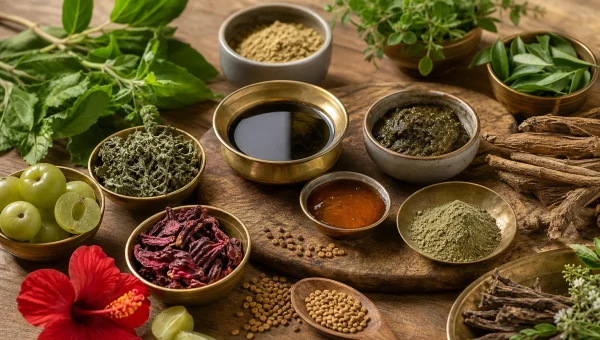
The most useful herb strategy is layered: use genuinely cooling herbs to reduce pitta load, and use keshya herbs to nourish the hair even when those herbs are not pharmacodynamically cooling. This distinction matters because Bhringaraja is the central hair herb in many Ayurvedic hair formulations, yet the Ayurvedic Pharmacopoeia of India lists it as ushna virya. It should be understood as the hair-specific anchor of the protocol, not as a simple cooling herb.
Amalaki (Emblica officinalis): Amalaki is the main cooling rasayana in this stack. The Ayurvedic Pharmacopoeia of India identifies it as the fruit of Emblica officinalis, lists shita virya, madhura vipaka, tridoshajit and rasayana actions, and notes the presence of ascorbic acid and tannins. For pitta-related palitya, amalaki is best used as a steady pitta-supportive fruit, fresh juice, powder or formulation under appropriate guidance rather than as a dramatic one-time remedy.
Bhringaraja (Eclipta alba): Bhringaraja is the primary keshya herb in the protocol. The Ayurvedic Pharmacopoeia of India identifies it as Eclipta alba and lists keshya, rasayana, tvachya and balya actions, with classical formulations including Bhringamalakadi Taila, Bhringaraja Taila and Nili Bhringadi Taila. Because it is listed as katu-tikta rasa, ruksha-tikshna guna and ushna virya, internal use should be individualized, especially in people who already show strong heat, acidity, rashes or irritability.
Brahmi (Bacopa monnieri): Brahmi belongs to the calming and rasayana side of the protocol. The Ayurvedic Pharmacopoeia of India lists Brahmi as shita virya, madhura vipaka, medhya and rasayana. In palitya care, its role is especially relevant when greying is accompanied by overwork, poor sleep, mental heat, tension and a pattern of pushing through fatigue.
Yashtimadhu (Glycyrrhiza glabra): Yashtimadhu is sweet, cooling and pitta-soothing. The Ayurvedic Pharmacopoeia of India lists it as madhura rasa, guru-snigdha guna, shita virya, madhura vipaka, vata-pittajit, varnya and raktaprasadana. Charaka’s palitya section also includes madhuka and related cooling, nourishing ingredients in head applications. Internal licorice use should be practitioner-guided, particularly for long courses, because licorice can affect blood pressure and potassium balance.
Guduchi (Tinospora cordifolia): Guduchi is an optional internal support, not a direct hair-darkening herb. It is best placed in the protocol when a practitioner sees a broader need for rasayana and immune-modulating support. Correct botanical identity matters: Guduchi in the Ayurvedic Pharmacopoeia is the stem of Tinospora cordifolia, used in dried mature pieces and also in fresh form.
| Herb | Internal Use to Discuss | Primary Ayurvedic Role | Topical Use |
|---|---|---|---|
| Amalaki | API range: 10-20 g drug or 5-10 ml fresh juice; dose should be individualized | Cooling rasayana, tridosha support, pitta moderation | In oil, paste or rinse preparations |
| Bhringaraja | API range: 3-6 ml fresh juice or 12-36 g decoction material; practitioner-guided | Keshya, rasayana, hair-formulation anchor | Primary scalp oil herb |
| Yashtimadhu | API range: 2-4 g powder; avoid long self-prescribed use | Sweet, cooling, vata-pitta pacifying, varnya | Classical head-application ingredient |
| Brahmi | API range: 1-3 g powder; practitioner-guided for extracts | Medhya, cooling rasayana, routine support | Optional in gentle paste or oil blends |
| Guduchi | Practitioner-guided; correct stem identity is essential | Rasayana and immune-modulating support | Not a primary topical hair-color herb |
The Scalp Oil Protocol: Method Matters
Charaka’s palitya treatment gives an important place to medicated oils, head applications and nasya. For home practice, stay with external scalp oiling unless a qualified practitioner specifically prescribes nasya. The oil should be comfortably warm, not hot. Warmth makes the application easier and supports gentle massage, while burnt, overheated or irritating oil aggravates the very heat pattern this protocol is trying to settle.
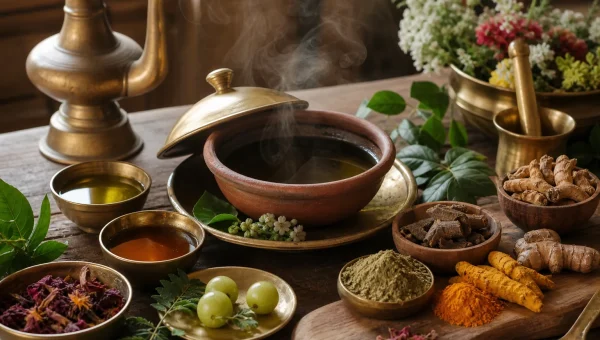
Bhringaraja-Amalaki Hair Oil Preparation (simple home infusion):
Use 250 ml of a good-quality base oil suited to your scalp, constitution and season. For a simple home infusion, combine the oil with 2 tablespoons of Bhringaraja powder and 1 tablespoon of Amalaki powder. Warm in a double boiler or on the lowest possible flame for 30-45 minutes without frying the powders. Cool, strain through a clean cloth and store in a clean glass jar. Discard the oil if it smells rancid, burnt, moldy or unusually sharp.
Apply a small amount of the oil warm to the scalp two or three times weekly. Massage gently for 5-10 minutes, especially in the areas where greying is most visible, then leave for 1-2 hours before washing. Overnight use is suitable only if it does not cause heaviness, itching, acne, sinus congestion or scalp irritation. Patch test first, and do not apply oil to broken, infected or actively inflamed skin.
Dietary Corrections for Pitta Hair
The dietary correction follows the classical pitta rule: sour, salty, pungent and hot-potency inputs aggravate pitta, while sweet, bitter, astringent and cooling inputs pacify it. In the classical autumn regimen, accumulated pitta is especially prone to aggravation, so the food rhythm should become lighter, cooler and less sharp rather than more spicy, oily, fermented or heating.
Practical translations are simple: reduce daily chillies, vinegar, excessive pickles, strong alcohol, very salty snacks, deep-fried heat-heavy foods and repeated tomato- or citrus-heavy meals when they produce acidity, heat or irritation. Build meals around simple cooked grains, mung dal, seasonal vegetables, bitter greens when tolerated, adequate hydration and cooling rasayana foods such as amalaki. These are not starvation rules; undernourishment will not support healthier hair. The aim is to cool pitta while keeping digestion steady and tissues nourished. Hair oiling approaches for all doshas are covered in our comprehensive guide to Ayurvedic hair oiling by dosha.
Setting Realistic Expectations
Palitya intervention is preservation-oriented. Newly appearing grey strands may look less obvious when overall hair quality improves or when a correctable deficiency is addressed, but long-established white hair is difficult to reliably repigment. The most realistic outcome marker is a slower appearance of new greys, a calmer scalp, less dryness or heat, and better hair texture rather than guaranteed reversal.
Follow the full routine consistently before judging it: external oiling two or three times weekly, a pitta-calming diet, sleep regularity, stress moderation and practitioner-guided internal herbs where appropriate. Track progress with monthly photographs of the same scalp area in the same light. For the broader skincare context including facial skin protocols, see our guide on Ayurvedic DIY skincare.
Medical disclaimer: This article is educational and does not diagnose, treat or cure a medical condition. Premature greying at a young age, sudden greying, hair fall, fatigue, menstrual changes, weight change or other symptoms should be assessed by a physician for nutritional status, thyroid function and other relevant causes. Consult a qualified Ayurvedic practitioner or healthcare provider before starting oral herbs, nasya, cleansing therapies or therapeutic protocols, especially if pregnant, managing a condition or taking medication. Choose reputable, tested products and avoid self-prescribed mineral or metallic preparations.
References
- Charaka Samhita — Trimarmiya Chikitsa
- Cosmoderma (cosmoderma.org)
- Charaka Samhita — Rasa Vimana
- Charaka Samhita — Dosha
- Charaka Samhita — Tasyashiteeya Adhyaya
- Ayurvedic Pharmacopoeia of India
- Ayurvedic Pharmacopoeia of India
- NCCIH
- Miracledrinksclinic (miracledrinksclinic.com)
- Impact of seasons and dioecy on therapeutic phytoconstituents of Tinospora cordifolia, a Rasayana drug (2014), PubMed Central
- A comparative review study of Sneha Kalpana (Paka) vis-a-vis liposome (2011), PubMed Central
- NCCIH