Ayurveda Gut Microbiome Grahani: Ancient Classification Meets Modern Sequencing
Ayurveda gut microbiome grahani work is best understood as a careful convergence between two different languages of gut function. In Ayurveda, grahani is described in Charaka Samhita as the seat of agni, situated above the umbilical region, holding food until it is properly digested and releasing it onward after digestion. When agni is weak, grahani releases incompletely digested material, giving rise to the pattern called grahani gada.
The classical picture of grahani includes irregular bowel function, loose or bound stool, heaviness, delayed digestion, anorexia, sour or bitter eructation, fatigue, thirst and malaise. These descriptions do not need to be forced into a single modern diagnosis, but they overlap clinically with functional digestive complaints in which motility, secretion, fermentation, pH, bile acids and microbial ecology all interact. For this reason, grahani remains a useful Ayurvedic framework for discussing the gut microbiome without reducing Ayurveda to bacterial taxonomy alone.
Prakriti and the Microbiome: What Sequencing Can Contribute
Human 16S rRNA sequencing papers have begun to examine whether Ayurvedic prakriti phenotypes correspond to measurable microbial differences. A 2018 Frontiers in Microbiology paper by Chauhan and colleagues examined healthy volunteers from a relatively homogeneous Western Indian rural cohort and reported that Bacteroidetes and Firmicutes were the dominant phyla across prakriti groups, while selected core taxa differed by prakriti and sex. The paper did not establish a simple “vata microbe,” “pitta microbe” or “kapha microbe” model; rather, it suggested that constitutional stratification may help interpret subtle microbiome variation among otherwise healthy people.
A 2019 Journal of Biosciences paper by Chaudhari and colleagues profiled gut, oral and skin microbiomes in healthy individuals classified by prakriti and described differential abundance of selected gut genera, including Bacteroides, Desulfovibrio, Parabacteroides, Slackia and Succinivibrio. A 2021 Journal of Biosciences paper on gut and oral microbiome signatures in prakriti groups similarly supported the idea that prakriti phenotyping may be useful for stratifying healthy individuals, while keeping the core microbiome shared across groups.
Grahani Dysbiosis: A Cautious Modern Parallel
No robust grahani-specific metagenomic signature should be claimed at present. The stronger and safer comparison is conceptual: classical grahani describes a failure of digestion, assimilation and regulated bowel movement, while modern gut ecology recognizes that intestinal pH, transit time, bile acids, dietary substrate and microbial metabolites shape the microbial environment. In functional bowel disorders such as IBS, reviews describe altered microbiota patterns that may include lower Lactobacillus, Bifidobacterium and Faecalibacterium in some subgroups, with substantial variation between populations and methods.
The Ayurvedic pathophysiology remains centered on mandagni, ama and disturbed movement of food through the gastrointestinal tract. In Charaka’s explanation, weak agni partially digests food; if the improperly digested material moves downward, grahani symptoms develop. This makes the microbiome a downstream expression of the digestive terrain rather than the sole cause of the disorder. The full framework for understanding srotas involvement is covered in our article on the 16-channel srotas system.
| Ayurvedic Intervention | Classical Role in Grahani-Type Care | Microbiome-Relevant Modern Finding | Practical Note |
|---|---|---|---|
| Triphala | Rasayana and bowel-supporting formulation used for digestion, elimination and gut health | Contains polyphenols such as gallic acid, ellagic acid and chebulinic acid; a small human pilot trial found individualized fecal microbiome responses and a trend toward increased Akkermansia muciniphila | Often used as churna, but dose and suitability depend on bowel pattern and constitution |
| Takra | Charaka praises buttermilk in grahani for deepana, grahi and laghu qualities | Fermented dairy can carry lactic-acid fermentation products and may fit the Ayurvedic logic of restoring digestive tone | Traditionally adjusted with spices and salt according to dosha and tolerance |
| Kanji | Traditional sour fermented beverage used as a light digestive accompaniment | Black-carrot kanji has been characterized as a lactic-acid bacterial beverage, with Pediococcus acidilactici isolated and LAB counts rising during fermentation | Fresh preparation, hygiene and individual tolerance matter more than generic “probiotic” claims |
| Peya and light foods with deepana herbs | Charaka advises light gruels and digestive-stimulating measures after clearing ama states | Light, digestible meals reduce excessive fermentable load and support steadier gut processing | Best suited when heaviness, coating, poor appetite or post-meal sluggishness dominate |
| Turmeric / curcumin | Culinary and medicinal digestive support used within broader Ayurvedic dietetics | A small randomized pilot trial using turmeric or curcumin with piperine reported highly individualized microbiome responses | Not a stand-alone grahani treatment; caution is needed with gallbladder disease, anticoagulants and high-dose extracts |
Triphala: A Microbiome-Relevant Ayurvedic Formula
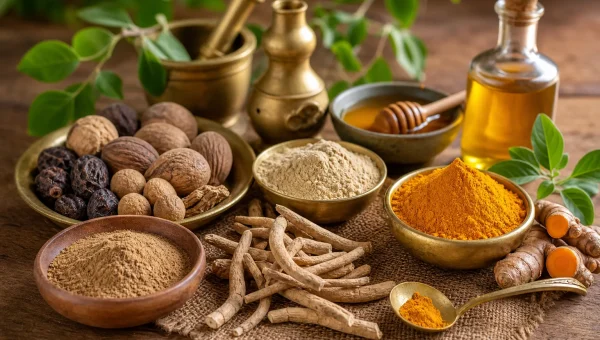
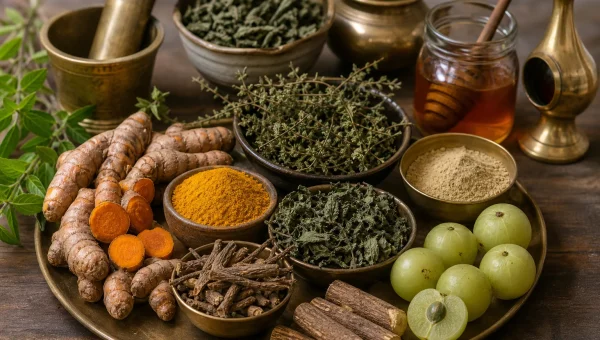
Triphala combines three fruits: Amalaki (Emblica officinalis), Bibhitaki (Terminalia bellirica) and Haritaki (Terminalia chebula). It is one of Ayurveda’s most familiar gastrointestinal formulas, valued for supporting elimination while also belonging to the rasayana tradition. Modern phytochemical review describes Triphala as a source of tannins, gallic acid, ellagic acid, chebulinic acid, flavonoids, saponins and other compounds that can interact with gut microbes.
The most useful interpretation is not that Triphala mechanically “adds good bacteria,” but that its polyphenols and tannins are part of a two-way exchange with intestinal microbes. Lactic-acid bacteria can metabolize tannins such as gallic acid, and Triphala-derived polyphenols may be transformed into metabolites such as urolithins. A small four-week randomized pilot trial of Triphala and Manjistha in healthy adults used 16S rRNA profiling and found individualized microbial responses rather than a uniform bacterial signature. The complete clinical evidence for Triphala’s gastrointestinal effects is reviewed in our article on triphala for IBS and gut research.
Fermented Ayurvedic Preparations: Takra and Kanji
Fermented preparations are relevant to grahani because Ayurveda is not only concerned with the presence of microbes but with the condition of digestion into which a fermented food is introduced. Charaka specifically praises takra in grahani because it is deepana, grahi and laghu: it supports appetite and digestive power, helps bind excessive fluidity in stool and remains relatively easy to digest. This makes takra different from a generic probiotic capsule in Ayurvedic logic.
Kanji, especially black-carrot kanji in North Indian food culture, is a lactic-acid fermented beverage. Published analysis of black-carrot kanji found lactic acid bacterial activity, declining pH during fermentation and isolation of Pediococcus acidilactici. Another kanji work reported Lactobacillus plantarum in traditional carrot or beetroot kanji and LAB counts reaching probiotic-relevant ranges under studied conditions. These findings support kanji as a microbiome-relevant traditional fermented food, while preparation hygiene and personal tolerance remain essential.
The Agni Parallel: What the Microbiome Lens Should Not Miss
A microbiome-only view can over-focus on adding bacteria while under-emphasizing the digestive environment that shapes those bacteria. Ayurveda places agni first: if the digestive process remains weak, irregular or overloaded, the same dysbiotic terrain may be recreated repeatedly. This is why grahani care classically emphasizes nidana parivarjana, light food, langhana, pachana, deepana, takra and carefully chosen formulations before heavy nourishing measures.
Modern gut physiology gives a parallel vocabulary: intestinal pH, transit time, bile acids, fermentation substrates and microbial metabolites influence microbial composition and activity. Ayurveda’s practical contribution is to organize these variables through appetite, stool pattern, heaviness, bloating, thirst, taste in the mouth, timing of digestion and dosha presentation. The foundation of agni theory and its clinical applications are detailed in our article on agni as the foundation of Ayurvedic health.
Medical disclaimer: This article presents educational information about Ayurveda, grahani and gut microbiome research. Persistent diarrhea, blood in stool, weight loss, anemia, fever, severe abdominal pain, dehydration, suspected inflammatory bowel disease, celiac disease, infection or long-standing IBS-type symptoms require evaluation by a qualified healthcare provider. Consult a qualified Ayurvedic practitioner or physician before starting herbs, supplements, fermented preparations or therapeutic protocols, especially if pregnant, breastfeeding, immunocompromised, managing a chronic condition or taking medication.
References
- Charaka Samhita — Grahani Chikitsa
- Frontiersin (frontiersin.org)
- Link (link.springer.com)
- Ias (ias.ac.in)
- Frontiersin (frontiersin.org)
- Frontiersin (frontiersin.org)
- Research (research.ucc.ie)
- SAGE Journals
- SAGE Journals
- Researchgate (researchgate.net)
- Link (link.springer.com)
- Researchgate (researchgate.net)
- Frontiersin (frontiersin.org)
- Tandfonline (tandfonline.com)