6:30 AM. Your alarm goes off. It’s December, still pitch dark outside, and every fiber of your being says “ten more minutes.” That sluggish, heavy pull toward the pillow? That’s Kapha doing what Kapha does in winter – accumulating, stagnating, dragging you down. I’ve coached dozens of Kapha-dominant men who describe the same thing: they want to train, but mornings feel like swimming through wet concrete.
Here’s the thing most Ayurvedic advice gets wrong about Kapha men and exercise. They tell you to “do more cardio” or “wake up earlier.” Generic. Useless. What you actually need is a specific bodyweight protocol that generates internal heat fast, clears lymphatic stagnation, and gets your metabolism firing before you’ve even had breakfast. I’m going to give you exactly that – a 20-minute routine you can do in your bedroom with zero equipment.
Why Kapha Men Need a Different Approach
Kapha dosha is governed by earth and water elements. In men, this often shows up as a stocky or broad build, natural strength, excellent endurance – but slow metabolism and a tendency to hold weight around the midsection and chest. A 2019 study published in the Journal of Ayurveda and Integrative Medicine (n=150) found that Kapha-dominant individuals showed significantly lower resting metabolic rates compared to Vata or Pitta types.
During late autumn and early winter, this problem intensifies. The cold, damp, heavy qualities of the season mirror Kapha’s own qualities, creating what Ayurveda calls “samanya” – like increases like. Your digestive fire might actually be strong (Hemanta Ritu supports Agni), but your body’s channels feel blocked, heavy, congested.
The 20-Minute Kapha Clearance Protocol
This routine follows a specific structure. We start explosive, stay intense, and finish with a brief standing recovery. No sitting. No lying down. Gravity is your enemy when Kapha is elevated – staying vertical keeps energy moving upward.
Phase 1: Ignition (Minutes 1-5)
Before touching a single exercise, do 30 seconds of Kapalabhati pranayama. This isn’t optional. Kapalabhati – rapid abdominal pumping breath – directly stimulates Agni and clears Kapha from the respiratory tract. Research published in the International Journal of Yoga (2014, n=60) demonstrated that Kapalabhati increased metabolic rate by 15-20% within minutes.
Then immediately transition to:
- Jump squats – 15 reps. Full depth, explosive on the way up.
- Mountain climbers – 20 reps (10 each side). Fast, driving knees to chest.
- Burpees – 8 reps. Yes, burpees. They’re the single best Kapha-clearing exercise because they move your body through every plane.
Rest 30 seconds between exercises. Not 60. Not 90. Thirty seconds. Kapha needs short rest periods – longer breaks let the lethargy creep back in.
Phase 2: Sustained Heat (Minutes 6-14)
This is where the real work happens. You’ll cycle through three movements in a circuit, three rounds total.
| Exercise | Reps | Tempo | Target |
|---|---|---|---|
| Hindu push-ups (Dand) | 12 | Controlled, 2 sec down | Chest, shoulders, spine mobility |
| Bodyweight Hindu squats (Baithak) | 20 | Fast, rhythmic | Legs, cardiovascular, Agni |
| Plank to downward dog flow | 10 | Slow, breathing coordinated | Core, lymphatic drainage |
The Hindu push-up (Dand) and Hindu squat (Baithak) are traditional Indian wrestler exercises – they’ve been used for centuries because they generate tremendous metabolic demand without any equipment. Combined with the plank-to-downward-dog flow, this circuit targets the chest, abdomen, and thighs, precisely where Kapha men hold the most congestion.
Take 45 seconds between rounds. Sip warm water with a pinch of Trikatu (a blend of black pepper, long pepper, and dry ginger) if you prepared it before starting. The standard Trikatu dose is 500 mg mixed into warm water, taken on an empty stomach. A study in Evidence-Based Complementary and Alternative Medicine (2018, n=40) showed Trikatu enhanced thermogenesis and fat oxidation in overweight subjects.
Phase 3: Upper Body Emphasis (Minutes 15-18)
Kapha accumulates heavily in the chest and upper respiratory area. These movements open that region:
- Diamond push-ups – 10 reps. Hands close together, elbows tight. This hits the triceps and inner chest hard.
- Bear crawl forward and back – 30 seconds. Knees hovering an inch off the ground. This is harder than it looks and fires up the core.
- Standing torso twists with arms extended – 20 reps. Fast rotation. This wrings out the abdominal organs like a wet towel.
Phase 4: Standing Recovery (Minutes 19-20)
Don’t collapse on the floor. Stay standing. Do 10 slow Surya Namaskar arm sweeps – raising arms overhead on the inhale, folding forward on the exhale. Finish with 1 minute of Bhastrika (bellows breath), 30 counts. You should be warm, slightly sweating, and fully awake.
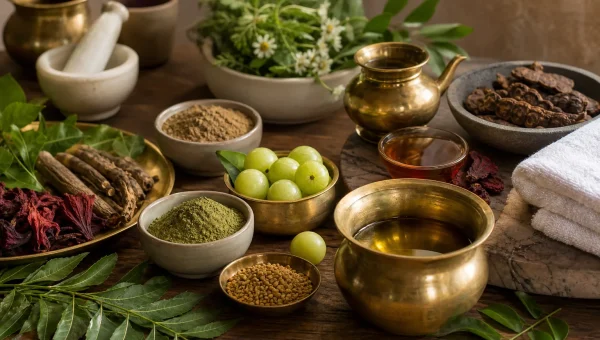
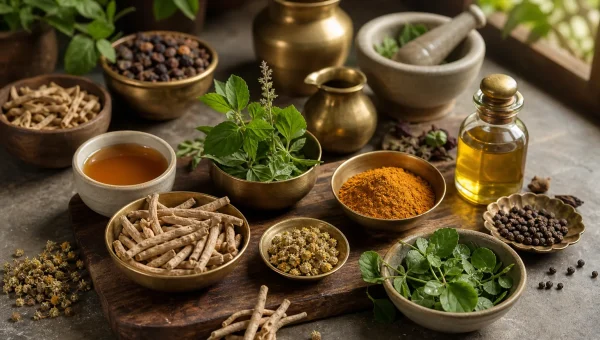
The Herbal Support Stack
Exercise alone won’t fully address Kapha stagnation in winter. Pair this routine with specific herbs that support metabolism and clear channels:
| Herb | Dose | Timing | Action |
|---|---|---|---|
| Guggulu (purified) | 250 mg twice daily | Before meals | Lipid metabolism, channel clearing |
| Punarnava | 500 mg once daily | Morning | Fluid balance, reduces water retention |
| Chitrak (Plumbago zeylanica) | 250 mg once daily | Before lunch | Agni stimulation, fat metabolism |
| Vidanga | 500 mg once daily | Morning empty stomach | Ama clearing, digestive reset |
| Shilajit | 300 mg once daily | Post-workout with warm milk | Mitochondrial support, energy |
A clinical trial in Andrologia (2016, n=96) found that purified Shilajit (500 mg/day for 90 days) significantly increased testosterone levels in healthy men aged 45-55 – directly relevant for Kapha men whose naturally lower testosterone can compound the lethargy problem.
Weekly Programming for December
Don’t do this routine seven days a week. Kapha men often make the mistake of thinking more is better. Here’s the weekly structure I recommend during December:
| Day | Activity | Duration | Intensity |
|---|---|---|---|
| Monday | Kapha Clearance Protocol | 20 min | High |
| Tuesday | Brisk walk + Kapalabhati | 30 min | Moderate |
| Wednesday | Kapha Clearance Protocol | 20 min | High |
| Thursday | Yoga flow (standing poses only) | 25 min | Moderate |
| Friday | Kapha Clearance Protocol | 20 min | High |
| Saturday | Outdoor hike or sport | 45-60 min | Moderate-High |
| Sunday | Rest + dry brush massage (Garshana) | 15 min | Low |
Garshana – dry brushing with raw silk gloves – is specifically prescribed in Ayurveda for Kapha constitutions. It stimulates lymph flow, exfoliates dead skin, and creates mild friction-heat. Do it before your morning shower on rest days. Adjusting training intensity by season is one of the most overlooked strategies in fitness for Kapha body types.
Nutrition Timing Around the Workout
Train fasted. This is non-negotiable for Kapha types. Your Agni needs to wake up through movement, not food. Post-workout, wait 20-30 minutes, then eat a warm, light breakfast. Good options:
- Warm millet porridge with cinnamon and a teaspoon of honey (add honey only after cooking, when temp drops below 40 degrees C)
- Moong dal cheela (pancake) with ginger chutney
- Roasted buckwheat upma with mustard seeds and curry leaves
Avoid cold smoothies, heavy oatmeal, or anything with excessive dairy in the morning. These feed Kapha stagnation, undoing the work you just put in. If you need a pre-workout boost, a cup of warm water with Trikatu or ginger tea 15 minutes before training is enough.
“Vyayama should be done until you reach half your capacity, as indicated by sweating on the forehead, armpits, and nose, and the need to breathe through the mouth.” – Ashtanga Hridaya, Sutrasthana 2.11
This classical guideline is often cited to mean “don’t overdo it.” For Kapha men, I’d adjust that upward. You can push to 60-70% capacity because Kapha’s inherent stamina and structural strength protect against the overexertion injuries that Vata types face. The sweating itself is therapeutic – it’s one of the primary routes for eliminating excess Kapha.
What to Watch For
If you experience sharp joint pain (not muscular soreness), excessive breathlessness that doesn’t resolve within 2 minutes of stopping, or dizziness, scale back. These are signs of Vata aggravation – even Kapha-dominant men have Vata as a secondary dosha. General exercise safety guidelines from mainstream medicine still apply.
Also track your digestion. If your appetite increases but bowel movements become irregular or hard, add 1 teaspoon of Triphala Churna in warm water at bedtime (approximately 3-5 grams). A clinical trial in Journal of Alternative and Complementary Medicine (2017, n=34) confirmed Triphala’s efficacy for improving bowel regularity without habit-forming effects. This keeps the channels clear while supporting elimination.
The Bigger Picture
This routine is a tool, not a permanent prescription. As winter deepens into January, you may need to adjust – adding more warming pranayama, shifting to slightly longer sessions, or incorporating interval-style training. The British Journal of Sports Medicine (2017) supports progressively adjusting exercise intensity with seasonal and environmental changes for optimal outcomes. The principle stays the same: short, intense, heat-generating movement done early, before Kapha time (6-10 AM) locks you into sluggishness.
The Harvard Health Blog echoes the importance of tailored cold-weather exercise protocols for different body types. I’ve seen Kapha men transform their winters with this approach. Not through willpower or forcing themselves awake, but by using the right kind of movement at the right time with the right herbal support. Your body isn’t broken. It’s responding exactly as Kapha physiology dictates. Work with that physiology, not against it.
Medical Disclaimer: This content is for educational purposes only and does not constitute medical advice. Consult a qualified Ayurvedic practitioner or physician before beginning any new exercise program or herbal supplementation, especially if you have cardiovascular conditions, joint disorders, or are on medication. Do not discontinue prescribed treatments based on this article.