
The pelvis should not be approached as a closed, isolated compartment when supporting fertility. In Ayurveda, cycle health is understood through the movement of Artava, the steadiness of Apana Vata, the quality of digestion and nourishment, and the sensitivity of the lower abdominal and pelvic marma regions. Gentle oiling, warmth, breath, and careful self-touch can be useful supportive practices when they are used conservatively, at the right time in the cycle, and alongside appropriate medical and Ayurvedic guidance.
This guide keeps the focus practical: how to use abdominal Abhyanga and marma-aware self-care as supportive fertility preparation without overstating what massage can do. It is not a replacement for evaluation of PCOS, endometriosis, fibroids, thyroid disease, recurrent miscarriage, tubal factors, male-factor infertility, diminished ovarian reserve, pelvic infection, or unexplained infertility.
Artava Vaha Srotas and Pelvic Self-Care
Artava Vaha Srotas means the channels that carry Artava, a term used for menstrual blood and, in a wider reproductive context, the female reproductive element. In the Sushruta tradition, the roots of this srotas are Garbhashaya, the uterus, and Artavavahini Dhamani, the channels or vessels associated with the movement of Artava. Disturbance or injury in this channel is classically associated with Vandhyatva, Maithuna Asahishnuta, and Artava Nasha, which correspond broadly to infertility, difficulty or pain with intercourse, and loss or disturbance of menstruation. A marma-aware abdominal routine is therefore best understood as a supportive way to keep the lower abdomen warm, unforced, well-oiled, and relaxed rather than as a direct treatment for a diagnosed infertility condition.
Apana Vata is the downward-moving aspect of Vata associated with the lower abdomen, pelvic organs, elimination, menstruation, reproductive function, and childbirth. In practical fertility care, this means that the aim of abdominal oiling is not aggressive stimulation. The aim is to encourage calm downward movement, reduce gripping or guarding in the belly, and support the daily rhythms that Ayurveda considers important for cycle regularity.
The Marma Points Used for Reproductive Support
Marma points are described as vital anatomical sites where structures such as muscle, vessels, ligaments, bones, and joints meet, and the classical lists preserve 107 such points. In therapeutic self-care, this does not mean aggressive pressure. It means respect for sensitive anatomy: light contact, warmth, oil, breath, and awareness. For fertility support, the most relevant regions for home care are Nabhi, Vitapa, and Guda, used gently and never pressed deeply.
1. Nabhi Marma, the navel region: Nabhi is the umbilical center. Sushruta places it between the stomach and large intestine and describes it as a point of origin for sira. In practice, Nabhi gives a safe starting point for abdominal oiling because touch can be broad and gentle around the navel rather than forceful into the navel. Use small clockwise circles around the umbilicus to settle the abdomen, support digestive ease, and prepare the lower belly for softer massage.
2. Vitapa Marma, the inguinal or groin region: Vitapa is classically described in the groin region. For women’s self-care, it is approached only as the right and left inguinal fold—the crease where the lower abdomen meets the upper thigh. This area contains sensitive vessels, nerves, and lymphatic structures, so the correct home technique is oil gliding and mild circular contact, not deep digging or sustained pressure. Stop immediately if there is pain, a pulse under the fingers, swelling, fever, recent surgery, hernia, or enlarged lymph nodes.
3. Guda Marma, the pelvic outlet region: Guda is described in relation to the rectum and anal passage and is functionally linked with the downward movement of flatus and stool. For fertility-oriented self-care, this region is not massaged directly. A safer approach is supported Baddha Konasana or a simple knees-bent resting posture with slow exhalation and pelvic-floor relaxation. This supports Apana-oriented awareness without applying pressure to a vulnerable marma.
A Gentle Abdominal-Oil Protocol
This routine is designed for the follicular phase: after menstrual bleeding has finished and before ovulation. For a typical cycle, that often means approximately days 6–12, but the calendar should be adjusted to the individual cycle. When trying to conceive, stop abdominal and pelvic marma work after ovulation because implantation may be possible. Use only gentle pressure; the abdomen should feel soothed, not kneaded, bruised, or “worked on.”
Oil choice: Warm sesame oil is the simplest general choice for Vata-type dryness, coldness, tension, and irregularity. Castor oil is stronger and should not be treated as a default fertility oil. Ricinoleic acid released from castor oil acts on EP3 prostanoid receptors and can stimulate uterine smooth muscle, so castor oil should be avoided in suspected pregnancy, confirmed pregnancy, after ovulation when trying to conceive, and around embryo transfer unless a qualified clinician has specifically advised otherwise.
- Warm 15–30 ml sesame oil to a comfortable body temperature. Test the oil on the inner wrist before applying it to the abdomen.
- Lie on the back with knees bent or supported by pillows. Rest one hand on the lower abdomen and breathe slowly for 1–2 minutes.
- Begin around Nabhi Marma. Make soft clockwise circles around the navel for 2–3 minutes, keeping pressure light and steady.
- Move to the lower abdomen. Use broad, slow clockwise circles across the lower belly for 3–5 minutes. Avoid pressing into painful areas, scars, masses, or the bladder.
- Glide lightly along the right and left inguinal folds for 1–2 minutes each side. Keep the fingers soft and superficial; do not press into the groin.
- Place both palms over the sacrum or lower back for 2–3 minutes to provide warmth and a sense of grounding.
- Rest for 15–20 minutes, then bathe or shower with warm water. Avoid cold exposure immediately afterward.
Frequency: Use this routine three to five times weekly after menstrual bleeding has ended and before ovulation. Those with regular cycles may use it daily during this window if it feels comfortable. Avoid abdominal massage during heavy bleeding, acute pelvic pain, fever, infection, suspected pregnancy, confirmed pregnancy, or after ovulation when trying to conceive.
Internal Herbs for Artava Vaha Srotas Support
Herbs for fertility and menstrual health should be chosen by constitution, cycle pattern, digestion, bleeding tendency, strength, and medical history. The following herbs are included because they have clear Ayurvedic identities and properties in the Ayurvedic Pharmacopoeia of India; they should not be treated as a universal fertility prescription.
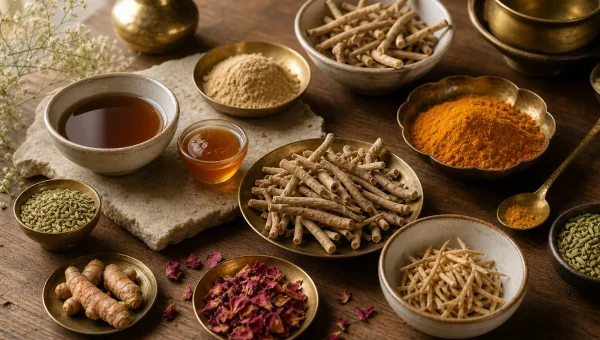
- Shatavari (Asparagus racemosus root): Shatavari is described with Madhura and Tikta rasa, Guru and Snigdha guna, Shita virya, and Madhura vipaka. Its listed actions include Rasayana, Vrishya, Shukrala, Balya, and Stanyakara. In fertility support, it is most appropriate where nourishment, dryness, depletion, heat, or Vata-Pitta aggravation are part of the presentation.
- Shatapushpa or Satahva (Anethum sowa fruit): Shatapushpa is described with Katu and Tikta rasa, Snigdha guna, Ushna virya, and Katu vipaka. Its listed actions include Dipana, Vatahara, Kaphahara, and Shulaprashamana. It is better suited to patterns involving sluggish digestion, gas, coldness, Vata-Kapha obstruction, and menstrual discomfort associated with poor movement.
- Lodhra (Symplocos racemosa stem bark): Lodhra is described with Kashaya rasa, Laghu guna, Shita virya, and Katu vipaka. Its listed actions include Grahi and Kaphapittanut, and its classical therapeutic use includes Pradara. It is not a general ovulation stimulant; it is more traditionally aligned with excess discharge, heavy or disturbed uterine bleeding patterns, and Kapha-Pitta presentations.
- Ashoka (Saraca asoca stem bark): Ashoka is described with Tikta and Kashaya rasa, Laghu and Ruksha guna, Shita virya, and Katu vipaka. Its listed uses include Asrgdara, and important formulations include Ashokarishta and Ashokaghrita. It is best understood as a uterine-support herb for bleeding and heat-related patterns, not as a stand-alone fertility cure.
Dosage and Timing Summary
The following table gives conservative educational ranges and classical crude-drug reference doses where available. Extract strength, preparation method, constitution, digestion, cycle pattern, fertility treatment timing, and pregnancy possibility can change what is appropriate.
| Intervention | Dose or Protocol | Timing | Cycle Phase or Use |
|---|---|---|---|
| Gentle abdominal Abhyanga with sesame oil | 15–30 ml warm oil, 15–25 minutes total | Evening or before warm bath | After bleeding ends and before ovulation |
| Nabhi-centered oiling | A few drops of warm oil around the navel; gentle circles only | Before bath or before sleep | Follicular phase; avoid after ovulation if trying to conceive |
| Castor oil topical use | Only with practitioner guidance | Individualized | Avoid in pregnancy, suspected pregnancy, after ovulation, and around embryo transfer unless medically approved |
| Shatavari root powder | 3–6 g crude-drug reference dose | Individualized, often with warm milk or warm water | Nourishing Vata-Pitta patterns; avoid self-prescribing in Kapha-Ama states |
| Shatapushpa or Satahva fruit powder | 3–6 g crude-drug reference dose | Individualized, often with warm water | Vata-Kapha, coldness, gas, sluggish digestion, or menstrual discomfort patterns |
| Lodhra stem bark | 3–5 g powder or 20–30 g for decoction reference dose | Individualized | Pradara, discharge, heavy or disturbed bleeding patterns under supervision |
| Ashoka stem bark decoction | 20–30 g crude drug for decoction reference dose | Individualized | Asrgdara and uterine bleeding patterns under supervision |
For related fertility guides, see our comprehensive guide to Ayurvedic fertility herbs, our piece on ovarian cyst Granthi Chikitsa, and hormone-disrupting foods in Ayurvedic texts.
Safety: Do not perform abdominal or pelvic massage with strong pressure during pregnancy, suspected pregnancy, after ovulation when trying to conceive, heavy menstrual bleeding, acute pelvic or abdominal pain, fever, active pelvic infection, unexplained bleeding, recent pelvic or abdominal surgery, painful ovarian cyst symptoms, suspected ectopic pregnancy, recent IUD placement, or around egg retrieval, insemination, or embryo transfer unless your fertility team approves. Avoid deep pressure over the groin, pulsing vessels, varicose veins, swollen lymph nodes, hernias, or painful areas. Herbs can interact with medicines and are not automatically safe in pregnancy or lactation. Consult a qualified Ayurvedic practitioner and a licensed healthcare provider before starting herbs, supplements, castor oil applications, or fertility-related therapeutic protocols, especially if you have PCOS, endometriosis, fibroids, recurrent miscarriage, thyroid disease, bleeding disorders, or are using hormonal medicines, anticoagulants, IVF, or IUI.
Nothing in this article diagnoses or treats a medical condition. Use it as educational information and seek individualized care for fertility concerns, menstrual disorders, pelvic pain, or suspected pregnancy.
References
- Easyayurveda (easyayurveda.com)
- Easyayurveda (easyayurveda.com)
- Charaka Samhita — Marma
- Easyayurveda (easyayurveda.com)
- Srisriayurvedahospital (srisriayurvedahospital.org)
- Castor oil induces laxation and uterus contraction via ricinoleic acid activating prostaglandin EP3 receptors (2012), PubMed
- Ayurvedic Pharmacopoeia of India
- Ayurvedic Pharmacopoeia of India
- Ayurvedic Pharmacopoeia of India
Same here
Will try
Useful
धन्यवाद for explaining this so clearly
Had 2 failed IVF cycles. My integrative doctor recommended this exact marma protocol alongside the next cycle.
I understand the impulse to ask here but this post is focused on fertility and ovarian health specifically — hair loss in Ayurveda tends to involve Bhrajaka Pitta and different protocols entirely. Might be worth looking for a dedicated post on that.
Hair loss is a bit of a different territory — usually addressed through scalp Pitta and Bhringaraj-based oils rather than pelvic work. This post is really focused on reproductive tissue and marma points for ovarian health, so you’d probably get more relevant answers on a separate thread. ✨
Doing this
Trying to conceive for 2 years. The Yoni Abhyanga protocol, is that safe to do during the follicular phase only?
My Ayurvedic doctor recommended the same thing last month. Good to find it confirmed here.
Two years of trying here too, so I read your question carefully. From what I understand the follicular phase is generally considered the safer window for Abhyanga in that area — avoiding it post-ovulation makes sense to not interfere if implantation is happening. But I’d really confirm with a practitioner before starting.
3rd cycle of IVF worked alongside Basti treatment. Correlation but emotionally significant.
Late to this post, found it via Google. Is this still the recommended approach in 2027? 🙌
The granthis and pelvic marma point theory is interesting but hard to verify without imaging.
That’s a fair point about verification — though I wonder if the functional evidence is more accessible than imaging. If women who receive this kind of pelvic work show measurable changes in follicular blood flow on Doppler ultrasound, that would be a meaningful proxy even without visualizing the marma points themselves.
यह सवाल इस पोस्ट के विषय से थोड़ा अलग है — यहाँ पेल्विक स्वास्थ्य और ओवेरियन फंक्शन पर ध्यान दिया गया है। फैटी लिवर के लिए Arogyavardhini या Kutki पर अलग से पोस्ट ढूंढना ज़्यादा उपयोगी रहेगा।
True, the imaging gap is real. But for me personally the more pressing question is whether the empirical outcomes — cycle regularity, follicle quality on ultrasound — improve with this approach. I’d be curious if anyone has tracked that alongside the marma work.
Just found this. Really helpful for my situation.
Castor oil packs mentioned here, do these interact with IUI timing? Concerned about timing.
The explanation of Nabhi Marma as the seat of all Srotas helped me see why navel oil might affect cycles.
I tried the gentle clockwise circles around the navel during my follicular phase and noticed less bloating.
Does the Vitapa Marma self massage really help with lymphatic drainage if I have ovarian cysts?
Castor oil packs three times a week sounded intense, but the 2023 pilot study mentioned makes it worth a try.
Found this helpful. The Fertility Massage and Marma Points section was particularly useful fpr my situation. (asking as someone dealing with this since 2021)
The idea that the pelvis responds to warmth and oil in ways that affect hormonal signaling — I used to find that hard to accept. Then I started doing castor oil packs and noticed my cycle shifted noticeably within two months. Not proof of anything, but it made me take this more seriously. 🙏
The idea that the pelvis is an open landscape of channels changed how I think about pelvic congestion.
I appreciate the caution about avoiding massage during the luteal phase when implantation is possible.
I’ve been to a gynecologist, an RE, and a naturopath — none of them mentioned anything about lymphatic flow or fascial tension in the pelvis as a factor in ovarian health. Reading this felt like someone finally named something I’d been sensing but couldn’t articulate. ❤️
Shatavari infused sesame oil seems like a nice blend for dryness, but I wonder how long the infusion should simmer.
Shared this with my sister who has been dealing with diminished ovarian reserve and she said the section on Apana Vata and downward-moving energy actually helped her understand why rest and grounding practices might matter as much as supplements. Sometimes a different framework helps things click.
The reference to Artava Vaha Srotas being obstructed in PCOS made the herbal suggestions feel targeted.
Has anyone measured follicle size after using the abdominal uterine massage protocol for a cycle?
I liked the step by step timing: begin with Nabhi, then lower abdomen, Vitapa, sacral hold.
The description of Guda Marma and Apana Vata downward movement clarified why perineal pressure might affect menstruation.
Using a rolled towel in Butterfly pose to activate the pelvic floor point sounds simple enough to try at home.
Curious if the warm castor oil in the navel needs to be washed off before bathing or can stay.
The safety note about discussing massage timing with a reproductive endocrinologist during IVF feels responsible.
The framing of the pelvis as a system of channels rather than a collection of organs is genuinely different from how most women are taught to think about their bodies. That shift in perspective alone feels valuable even before getting to the specific protocols. ✨
What I appreciate is that this doesn’t dismiss the medical side — it’s written for someone who is already working with a reproductive specialist and wants to know what else might support the process. That’s exactly where I am right now. 💯