
Complex PTSD belongs first in competent trauma care: assessment by a qualified mental health professional, and when appropriate, trauma-focused psychotherapy such as EMDR, prolonged exposure, or cognitive processing therapy. Ayurveda can still have a meaningful supportive role when it is used as an adjunct rather than a substitute. In that integrative setting, Sattvavajaya Chikitsa, daily routine, grounding body practices, and carefully selected Medhya and Rasayana herbs can help rebuild steadiness, clarity, sleep rhythm, and resilience.
This article keeps the focus on a practical Sattvavajaya-informed support protocol for complex trauma: not as a stand-alone cure, but as a traditional Ayurvedic framework that can sit beside psychotherapy, psychiatric care, yoga therapy, and somatic work.
What Sattvavajaya Actually Means
Sattvavajaya is one of the three broad treatment modalities described in Charaka Samhita, along with Daivavyapashraya and Yuktivyapashraya. Charaka defines Sattvavajaya as restraining or withdrawing the mind from harmful objects. In clinical language, this points toward training attention, conduct, memory, discrimination, and emotional response so that the mind is not repeatedly pulled into patterns that increase suffering.
Charaka also describes mental-disease care through Jnana, Vijnana, Dhairya, Smriti, and Samadhi: knowledge, discriminative understanding, courage or steadiness, memory, and contemplative absorption. For trauma support, these principles are best understood as a disciplined process of restoring orientation, meaning, inner steadiness, and wise response rather than simply “relaxing” or suppressing difficult experience.
Complex PTSD is not an Ayurvedic diagnosis. In contemporary clinical terminology, ICD-11 complex PTSD includes PTSD symptoms along with disturbances in self-organisation, such as difficulty with affect regulation, negative self-concept, and relational problems. Ayurveda should not force a one-to-one equation between cPTSD and any single classical disease category. The closer classical discussion is the broader field of Manas Roga and Unmada, where Charaka recognises mental disturbance involving intellect, memory, perception, conduct, and emotional stability, and also mentions mental trauma due to recurrent fear or intense emotional exposure among causative factors.
The Doshas in Complex Trauma Support
Ayurvedic care individualises treatment by assessing the person rather than treating the diagnostic label alone. In trauma support, Vata, Pitta, and Kapha patterns can help guide the choice of routine, food, bodywork, breathing, counselling style, and herbs. These patterns are clinical guides, not replacements for psychiatric assessment.
Vata-dominant trauma patterns often call for warmth, regularity, touch, oiling, predictable meals, and sleep protection. The presentation may include restlessness, startle, insomnia, dissociation, variable appetite, tremulousness, fearfulness, and a feeling of being ungrounded. The first therapeutic aim is containment and rhythm.
Pitta-dominant trauma patterns often call for cooling, softening, non-judgmental reflection, reduced overstimulation, and practices that transform anger, shame, and self-criticism into clarity. The presentation may include irritability, intensity, hypervigilance, heat, inflammation, acidity, headaches, or sharp intrusive recall. The first therapeutic aim is cooling and wise redirection.
Kapha-dominant trauma patterns often call for gentle activation, lightness, movement, sunlight, relational support, and gradual re-engagement. The presentation may include heaviness, withdrawal, depressive shutdown, excessive sleep, low motivation, emotional dulling, and stagnation. The first therapeutic aim is movement without force.
Most complex trauma presentations are mixed. Vata may dominate through instability and fear, Pitta may appear through anger and vigilance, and Kapha may appear through collapse and numbness. A qualified practitioner should decide which pattern is primary at a given stage of recovery.
The Sattvavajaya Protocol: Four Pillars
A useful Ayurvedic support plan for complex trauma can be organised into four pillars: Medhya-Rasayana support, Dinacharya, therapeutic speech and Buddhi integration, and long-term rebuilding of Bala and Ojas. Each pillar should be adapted to the person’s constitution, current medications, sleep state, digestion, trauma triggers, and level of psychological support.
Pillar 1: Medhya and Rasayana Herbs
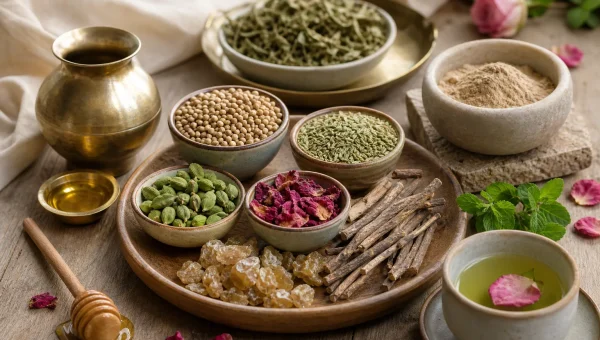
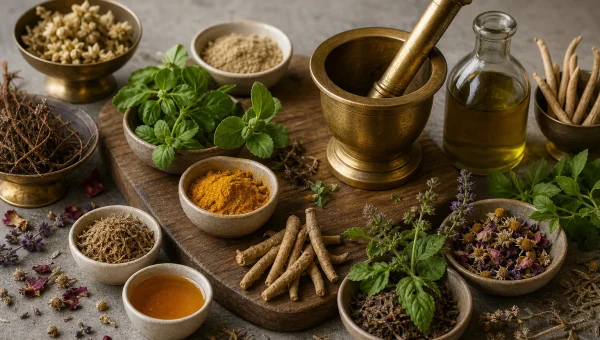
The classical Charaka group of Medhya Rasayana herbs is Mandukaparni, Yashtimadhu, Guduchi, and Shankhapushpi. This list is important because it corrects the common modern habit of mixing every “brain herb” into the same category. Bacopa monnieri, commonly called Brahmi, and Jatamansi are also important Ayurvedic mind-support herbs, but they should be presented according to their own pharmacopoeial identity and actions rather than incorrectly placed into Charaka’s four-herb Medhya Rasayana list.
Mandukaparni (Centella asiatica) is listed in the Ayurvedic Pharmacopoeia of India with Medhya, Rasayana, Smritiprada, Balya, Hridya, and related actions. In a trauma-support protocol, it fits the aim of restoring clarity, memory steadiness, and gentle rebuilding, especially when mental fatigue and scattered attention are present.
Shankhapushpi is classically included among Charaka’s Medhya Rasayana herbs. The pharmacopoeial monograph describes it as cooling, nourishing, Rasayana, Balya, Vatahara, and Pittahara. In practice, it is commonly chosen where the protocol needs a soft, cooling, stabilising Medhya support rather than a stimulating approach.
Yashtimadhu and Guduchi complete Charaka’s classical Medhya Rasayana group. They are best selected by a practitioner after assessing digestion, heat, strength, metabolic state, and contraindications, rather than being added automatically to every trauma protocol.
Brahmi (Bacopa monnieri) is listed in the Ayurvedic Pharmacopoeia of India as Medhya, Rasayana, Vatahara, Kaphahara, Matiprada, Mohahara, and related actions. It can be used within an Ayurvedic plan where the aim is clarity, steadier cognition, and Vata-Pitta calming, but dose and form should be individualised.
Jatamansi (Nardostachys jatamansi) is listed with Medhya and Nidrajanana actions, and its therapeutic uses include Manasaroga and Anidra. In a trauma-support context, it belongs most naturally where sleep, mental overactivation, and Vata-Pitta disturbance are central concerns. It should be used cautiously with sedatives and only under professional guidance.
Ashwagandha (Withania somnifera) is a Rasayana and Balya herb with Vata-Kapha pacifying action according to the Ayurvedic Pharmacopoeia of India. It is better framed as a strength-and-rebuilding herb than as a universal PTSD herb. It may suit depletion, weakness, and Vata-type exhaustion, but it is not automatically appropriate for every person with heat, agitation, pregnancy, thyroid treatment, autoimmune conditions, or psychiatric medication use.
Pillar 2: Dinacharya for Nervous System Regularity
Dinacharya gives the recovering nervous system a predictable container. Fixed waking, regular meals, gentle morning light, simple hygiene rituals, appropriate movement, and a steady sleep routine reduce the daily uncertainty that often aggravates Vata. In Ayurveda, routine is not merely organisational; it is a therapeutic rhythm for body, senses, digestion, and mind.
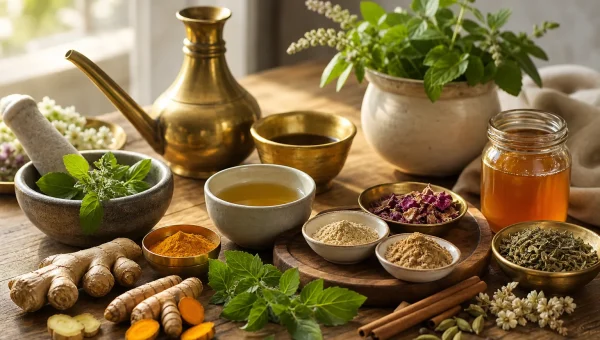
Abhyanga, or oil massage, is a classical external therapy and a central daily support for many Vata-dominant presentations. For trauma recovery, warm self-oiling can be used as a grounding practice: slow application of oil, clear boundaries, steady breath, and attention to safety in the body. Sesame oil is commonly used for Vata, while coconut or other cooling oils may be preferred when Pitta heat is prominent. The practice should be gentle, consent-based, and stopped if it increases distress.
Padabhyanga, oiling the feet before sleep, can be used as a simple evening anchor. A calm pre-sleep sequence may include dim lights, warm bathing if suitable, foot oiling, quiet breath practice, and avoiding stimulating media. The goal is not forced sleep, but repeated signalling of safety and completion to the body.
Pillar 3: Vachana, Buddhi, and Emotional Counterconditioning
Sattvavajaya is incomplete without speech, reflection, and wise guidance. Charaka’s mental-health principles include knowledge, discrimination, steadiness, memory, and contemplative stability. In practice, this means the patient should not be left with herbs and routines alone; they need skilled conversation, psychoeducation, meaning-making, and support for re-entering life with discernment.
Charaka’s Unmada Chikitsa also describes responding to grief, fear, anger, envy, greed, and other intense states through appropriate opposing or balancing influences, as well as consolation and assurance in suitable cases. In modern integrative care, this principle can sit beside trauma therapy: the therapist addresses trauma processing, while the Ayurvedic clinician supports lifestyle, sleep, digestion, sensory regulation, and the cultivation of steadier mental habits.
Pillar 4: Ojas, Bala, and Long-Term Rebuilding
Long trauma recovery is not only about reducing symptoms; it is also about rebuilding vitality. Ayurveda describes Ojas as the essence connected with strength, vitality, stability, and resilience. A person emerging from chronic fear, grief, overwork, or repeated shock often needs a slow Rasayana approach: nourishing food, digestible protein, healthy fats, stable sleep, relational safety, moderated work, and herbs only when Agni and constitution allow them.
For Vata depletion, warm cooked meals, ghee where suitable, soups, milk preparations where tolerated, gentle oiling, and restorative routine may be central. For Pitta depletion, cooling nourishment, reduced intensity, non-competitive practice, and compassion-based reflection may be more useful. For Kapha shutdown, the rebuilding plan may need lighter food, movement, sunlight, and gradual activation before heavier Rasayana measures are introduced.
Classical Dose Notes
The table below uses pharmacopoeial-style crude-drug dose notes where they are clearly available. Standardised extracts, capsules, tinctures, and proprietary formulas are not automatically equivalent to these classical dose ranges, so dosing should be decided by a qualified Ayurvedic practitioner or prescribing healthcare provider.
| Herb | Verified Ayurvedic Status | Classical/API Dose Note | Protocol Role |
|---|---|---|---|
| Mandukaparni (Centella asiatica) | Charaka Medhya Rasayana; API lists Medhya, Rasayana, Smritiprada, Balya | 3-6 g powder | Clarity, memory steadiness, gentle rebuilding |
| Shankhapushpi | Charaka Medhya Rasayana; API lists Rasayana, Balya, Vatahara, Pittahara | 3-6 g powder | Cooling, nourishing Medhya support |
| Yashtimadhu | Charaka Medhya Rasayana | Practitioner-selected | Nourishing Medhya-Rasayana support when appropriate |
| Guduchi | Charaka Medhya Rasayana | Practitioner-selected | Rasayana support when digestion and constitution allow |
| Brahmi (Bacopa monnieri) | API lists Medhya, Rasayana, Vatahara, Kaphahara, Matiprada | Practitioner-selected | Cognitive steadiness and Vata-Pitta calming support |
| Jatamansi (Nardostachys jatamansi) | API lists Medhya and Nidrajanana; used in Manasaroga and Anidra | 2-3 g powder or 5-10 g decoction | Sleep support and calming of overactivation |
| Ashwagandha (Withania somnifera) | API lists Rasayana, Balya, Vatakaphapaha, Vajikarana | 3-6 g powder | Strength, depletion, and Vata-type rebuilding |
How to Use This Alongside Trauma Therapy
A practical sequence is to stabilise first, process second, and rebuild continuously. Stabilisation includes sleep rhythm, food rhythm, sensory safety, predictable routine, and reducing substances or habits that destabilise the mind. Trauma processing belongs with a trained therapist. Rebuilding includes Rasayana, strength, relationships, meaningful work, and a return to ordinary life without forcing speed.
For many people, the most useful Ayurvedic starting point is simple: fixed wake time, warm breakfast, daily Abhyanga or foot oiling if tolerated, regular meals, reduced evening stimulation, a short breath practice, and one practitioner-selected Medhya support. More complex formulas and stronger herbs should come later, once sleep, digestion, medications, and mental health care are clearly understood.
Safety disclaimer: Complex PTSD is a serious mental health condition. Ayurvedic care should be used as supportive adjunct care and not as a replacement for psychiatric evaluation, psychotherapy, emergency care, or prescribed medication. Anyone with suicidal thoughts, self-harm urges, severe dissociation, psychosis, substance dependence, or unsafe living conditions should seek urgent professional help. Herbs such as Jatamansi, Ashwagandha, Brahmi, Shankhapushpi, Guduchi, and Yashtimadhu should be used only with guidance from a qualified Ayurvedic practitioner and healthcare provider, especially during pregnancy, while breastfeeding, in children, in chronic disease, or when taking psychiatric, sedative, thyroid, immune, blood pressure, or seizure-related medicines.
References
- Charaka Samhita — Tistraishaniya Adhyaya
- Charaka Samhita — Unmada Chikitsa
- Ptsd (ptsd.va.gov)
- Ptsd (ptsd.va.gov)
- Ptsd (ptsd.va.gov)
- Nootropic herbs (Medhya Rasayana) in Ayurveda: An update (2012), PubMed Central
- Ayurvedic Pharmacopoeia of India
- Ayurvedic Pharmacopoeia of India
- Ayurvedic Pharmacopoeia of India
- Charaka Samhita — Matrashiteeya Adhyaya
- Charaka Samhita — Ojas
the grounding protocol (Abhyanga, root foods, Ashwagandha, Brahmi) has made my EMDR therapy sessions more tolerable. I’m more regulated going in and integrate better after.
does Ayurvedic Sattvajaya overlap with Internal Family Systems (IFS) or somatic therapy? the ‘parts’ concept in IFS seems to have some parallel.
On the somatic therapy side especially — the article’s discussion of Vata derangement causing the body to stay locked in threat response maps really well onto what somatic practitioners call a dysregulated nervous system. The Abhyanga recommendation isn’t just symbolic; there’s a bottom-up logic to it that somatic therapists would probably recognise. I wonder if any clinical psychologists in India are actively researching this crossover.
That parallel is worth exploring seriously. The IFS model’s idea of exiled parts holding trauma does seem to rhyme with Sattvajaya’s approach to working with disturbed mental impressions rather than suppressing them. What I find interesting is that both approaches resist the idea of just “removing” the trauma — it’s more about changing the relationship to it. Has anyone here worked with a therapist who integrates both frameworks?
for complex PTSD with dissociation, is the grounding protocol the same as for hyperarousal or does dissociative presentation need a different approach?
complex PTSD requires trauma-specialized psychological treatment. the article doesn’t adequately state that Sattvajaya is adjunctive to, not a replacement for, evidence-based trauma therapy.
the interaction between Medhya herbs (Brahmi, Shankhapushpi) and psychiatric medications commonly used in PTSD (prazosin, SSRIs, benzodiazepines) isn’t addressed.
the article distinguishes simple PTSD from complex PTSD. does the Sattvajaya approach change structurally for c-PTSD or is it the same framework with longer timelines?
complex PTSD requires trauma-specialized psychological trearment. the article doesnt adequately state that Sattvajaya is adjunctive to, not a replacement for, evidence-based trauma therapy.
complex PTAD requires trauma-specialized psychological treatment. the article doesnt adequately state that Sattvajaya is adjunctive to, not a replacement for, evidence-based trauma therapy. tbh
the Sattvajaya framing for complex PTSD is more nuanced than the single-incident PTSD articles Ive found. the chronic Vata dysregulation from sustained trauma exposure matches my lived experience.
Makes sense.
complex PTSD requires trauma-specialized psychological treatment. the article doesnt adequately state that Sattvajaya is adjunctive to, not a replacement for, evidence-based trauma therapy.
the grounding protocol (Abhyanga, root foods, Ashwagandja, Brahmi) has made my EMDR therapy sessions more tolerable. im more regulated going in and integrate better after. tbh
Thanks!
complex PTSD needs very gentle language like this. simple grounding is safer than pushing deep trauma work
the Sattvajaya framing for complex PTSD is more nuanced than the single-incident PTSD articles I’ve found. the chronic Vata dysregulation from sustained trauma exposure matches my lived experience.
The breakdown of the four pillars really clarified how herbal support can sit alongside EMDR and somatic work.
@Vinay does Ayurvedic Sattvajaya overlap with Internal Family Systems (IFS) or somatic therapy? the ‘parts’ concept in IFS seems to have some parallel.
complex PRSD requires trauma-specialized psychological treatment. the article doesnt adequately state that Sattvajaya is adjunctive to, not a replacement for, evidence-based trauma therapy.
complex PTSD requires trauma-specialized psychological teeatment. the article doesnt adequately state that Sattvajaya is adjunctive to, not a replacement for, evidence-based trauma therapy.
I appreciated the dosage table; seeing exact milligrams for Brahmi and Shankhpushpi makes it easier to discuss with my practitioner.
Helpful.
Reading this at 2am after another bad night. The section on hypervigilance being a Vata excess pattern — that framing actually gave me something to work with emotionally in a way that clinical language sometimes doesn’t. I’ve been in therapy for two years and this was the first time I read something that made me feel like the nervous system response wasn’t just broken but had a logic to it. Thank you for writing this.
Does the Dinacharya recommendation about fixed wake time still help if sleep quality remains poor after trauma?
complex PTSD requires trauma-specialized psychological treatmemt. the article doesnt adequately state that Sattvajaya is adjunctive to, not a replacement for, evidence-based trauma therapy. 🌿
for complex PTSD with dissociation, is the grounsing protocol the same as for hyperarousal or does dissociative presentation need a different approach?
The explanation of Sattvajaya as restraint of the mind through wisdom and memory felt like a fresh angle on mindfulness training.
@Sanjay the Sattvajaya framing for complex PTSD is more nuanced than the single-incident PTSD articles I’ve found. the chronic Vata dysregulation from sustained trauma exposure matches my lived experience.
I wonder how the Ojas rebuilding herbs like Ashwagandha interact with common antidepressants in practice.
Seeing the dosha patterns laid out for Vata Pitta and Kapha presentations helped me recognize my own nighttime agitation as more Pitta driven.
The reference to Charaka Samhita chapter eleven gives a concrete source for those who want to look up the original Sanskrit wording.
the Sattvajaya framing for complex PTSD is more nuanced tjan the single-incident PTSD articles ive found. the chronic Vata dysregulation from sustained trauma exposure matches my lived experience. 🙌
I found the caution about Jatamansi potentiating sedatives useful; it reminds me to check with my doctor before adding any new herb.
The section on Vachana and Buddhi integration made me think about how talk therapy could be enriched by Ayurvedic conceptual framing.