
What Is Nasya Therapy?
Nasya is an Ayurvedic nasal-therapy procedure in which medicated oil, ghee, fresh juice, decoction, or fine herbal powder is administered through the nostrils. It is counted among the therapies of Panchakarma and is especially used for disorders of the region above the clavicle, including the nose, sinuses, throat, head, neck, and sense organs.
The Ashtanga Hridaya explains this principle with the well-known line nasa hi shiraso dwaram: the nose is the gateway to the head. In Ayurvedic reasoning, medicines placed through the nostrils act on the channels and tissues of the head and neck. From a biomedical viewpoint, the nasal route is also used for local nasal treatment, systemic delivery, and selected nose-to-brain drug-delivery approaches through olfactory and trigeminal pathways.
Disclaimer: Clinical Nasya, strong purificatory Nasya, and Nasya for neurological, chronic sinus, migraine, or post-stroke conditions should be done only under the guidance of a qualified Ayurvedic practitioner and, when needed, a healthcare provider. This article is educational and is not a substitute for diagnosis or medical care.
Classical Types of Nasya
The Ashtanga Hridaya first describes Nasya in three main therapeutic actions: Virechana or Shodhana for expelling aggravated dosha, Brimhana for nourishing and strengthening, and Shamana for pacifying. It also describes practical subtypes based on dosage and material, such as Marsha, Pratimarsha, Avapeeda, and Dhmana.
| Classical Type | Usual Material | Classical Action | Typical Ayurvedic Use |
|---|---|---|---|
| Virechana / Shodhana Nasya | Strong medicines, powders, juices, or processed preparations | Purificatory and dosha-expelling | Kapha-dominant disorders of the head, heaviness, chronic rhinitis-type conditions, and obstructive head-neck complaints |
| Brimhana Nasya | Unctuous and nourishing preparations such as medicated oils or ghee | Nourishing, strengthening, Vata-pacifying | Vata-type headache, dryness of nose or mouth, difficulty in speech, hoarseness, stiffness, and weakness-type presentations |
| Shamana Nasya | Pacifying liquids such as medicated oils, milk-based preparations, or water-based preparations chosen by the physician | Soothing and balancing | Pitta-associated discoloration, hair and eye complaints, and milder head-region disorders |
| Marsha Nasya | Medicated oil or ghee in a larger measured dose | Stronger unctuous Nasya | Clinical use under supervision, with diet and activity precautions |
| Pratimarsha Nasya | A very small dose of medicated oil | Gentle daily oil Nasya | Daily nasal lubrication, Dinacharya, dryness, and maintenance of nasal comfort in suitable persons |
| Avapeeda Nasya | Expressed juice, paste-derived liquid, or decoction | Stronger head-clearing action | Selected clinical use where a physician wants a sharper effect |
| Dhmana / Pradhamana Nasya | Fine herbal powder blown into the nostrils | Strong purificatory powder Nasya | Kapha-dominant congestion and chronic rhinitis-type presentations under professional care |
In contemporary practice, oil-based Nasya is the form most people encounter, especially Anu Taila or similar medicated oils. Powder-based and strong purificatory forms are more intensive and should not be attempted as home self-care.
When Nasya Therapy Is Traditionally Considered
Classical Ayurveda places Nasya in the management of urdhvajatrugata vikara, disorders located above the clavicle. The choice of oil, powder, dose, season, time of day, and preparatory procedures depends on the person’s constitution, dosha state, strength, age, and disease stage.
Sinus Congestion, Rhinitis, and Kapha Heaviness
Classical texts include pīnasa and head heaviness among conditions where purificatory Nasya may be used. In practice, Kapha-dominant presentations may involve heaviness of the head, thick discharge, blocked nasal passages, reduced smell, and dull headache. A published clinical trial in Ayu evaluated Pradhamana Nasya with Trayodashanga Kwatha in Dushta Pratishyaya, a chronic sinusitis-type condition, and reported symptomatic improvement after treatment.
Headache and Migraine-Type Presentations
Ayurveda describes different headache patterns, including shirahshula and suryavarta, and assigns Nasya differently according to dosha. Brimhana Nasya is classically linked with Vata-type headache, dryness, voice weakness, and related head-neck symptoms, while purificatory Nasya is used when Kapha obstruction is prominent. Modern clinical publications on migraine and Ayurveda include Nasya protocols such as Anu Taila Nasya, but these treatments should be individualized rather than applied as a generic migraine cure.
Neck, Shoulder, Jaw, and Voice Complaints
The Ashtanga Hridaya mentions conditions such as manyastambha (neck stiffness), svarakshaya (voice weakness), difficulty in speech, and dryness of the nose and mouth in its Nasya discussion. A randomized clinical trial in Ayu assessed Nasya as an add-on intervention in cervical spondylosis and found better outcomes than conventional Ayurvedic management alone in that small study.
Neurological and Facial Conditions
Nasya is used in Ayurvedic practice for selected head and facial conditions such as Ardita (facial paralysis-type presentations), but it should be treated as a supervised clinical therapy. Reviews of Taila Nasya in Ardita describe encouraging but low-level clinical evidence, so it is best considered as part of an individualized plan rather than a stand-alone neurological treatment.
Hair, Sense Organ, and Preventive Uses
Classical Nasya passages mention effects on the sense organs, hair, eyes, teeth, neck, shoulders, face, and chest. These benefits are described in the language of Ayurvedic health maintenance and should be understood as traditional claims attached to correct, long-term, suitable use, not as a guarantee of cosmetic or medical reversal.
Anu Taila: A Classical Nasya Oil
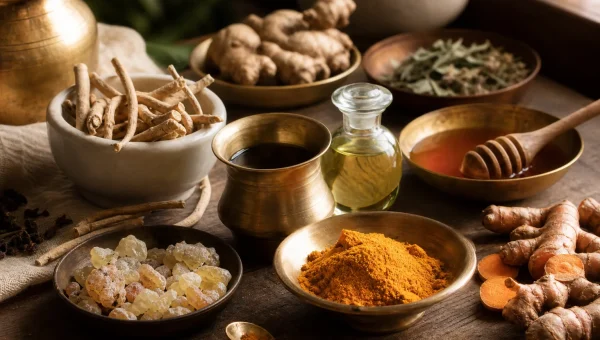
Anu Taila is a classical medicated oil used for Nasya. In the Ashtanga Hridaya, it is prepared from a decoction of many herbs processed repeatedly with sesame oil and finally with goat milk. It is especially associated with nasal application and daily or clinical head-region care when suitable.
Classical ingredients listed for Anu Taila include:
- Jivanti
- Devadaru
- Tvak and Patra from cinnamon-group aromatics
- Ela / Truti from cardamom-group aromatics
- Darvi / Daruharidra
- Madhuka
- Agaru
- Shatavari
- Bilva
- Utpala
- Vidanga
- Renuka
- Kamala
- Bala
- Tila Taila as the oil base
- Aja Dugdha, goat milk, added in the final stage of preparation
Because Anu Taila is a complex classical formulation, its suitability depends on the person and the condition. People with sesame allergy, active nasal bleeding, acute infection, strong burning sensation, or unusual reactions after use should avoid self-use and seek professional advice.
Step-by-Step Clinical Nasya Procedure
A full clinical Nasya procedure follows the classical sequence of preparation, main administration, and after-care. The details vary by formulation and purpose, but the broad structure is consistent across traditional practice.
Purvakarma: Preparation
Before clinical Nasya, the person attends to natural urges and oral hygiene, then the head, face, neck, and shoulder region are prepared with gentle oil massage and mild fomentation. This preparation softens the region and supports the movement of dosha before the nasal medicine is given.
- Face and neck oiling: Warm oil is applied gently to the face, forehead, neck, and shoulder area.
- Mild fomentation: Gentle warmth is applied to the head-neck region without excessive heat or strain.
- Positioning: The person lies on the back in a room protected from wind, with the head slightly extended.
Pradhanakarma: Main Administration
During the main procedure, the medicine is warmed mildly and introduced into each nostril in the dose chosen by the practitioner. The opposite nostril may be closed while the medicine is administered, and the surrounding areas are gently massaged afterward.
- The patient lies supine with the head slightly lowered or extended in a comfortable position.
- The practitioner warms the medicated oil or liquid indirectly in warm water.
- The prescribed dose is instilled into one nostril and then the other.
- The nasal bridge, forehead, cheeks, ears, palms, soles, neck, and shoulder region may be massaged gently.
- The patient remains still briefly so the medicine can settle and then drain appropriately.
Paschatkarma: After-Care
After Nasya, classical after-care includes spitting out drained medicine and secretions, cleansing the throat with warm gargling, and avoiding exposure that may disturb the treatment effect. Medicated smoke is mentioned in classical post-procedure care, but it should be used only when clinically appropriate and not as casual self-practice.
- Sit up slowly and spit out oil or secretions that drain into the throat.
- Gargle with lukewarm water to clear the throat.
- Avoid cold air, cold water, dust, smoke, heavy meals, and strenuous activity for a short period after treatment.
- Follow the practitioner’s restrictions on food, sleep, travel, and exposure.
For related Panchakarma therapies, see our guide on Basti therapy and our overview of Shirodhara for anxiety.
Home Nasya: Gentle Pratimarsha Practice
Pratimarsha Nasya is the gentle low-dose form of oil Nasya described for broad daily use. The Ashtanga Hridaya gives its dose as two bindu, commonly rendered in practice as about two drops, and presents it as milder and less restrictive than Marsha Nasya.
When Home Nasya May Be Appropriate
Gentle oil Nasya may be considered for adults who need nasal lubrication, especially when the nasal passages feel dry or irritated by wind, travel, dust, or indoor heating. It is not a substitute for medical care in chronic sinusitis, severe allergy, infection, asthma flare, neurological symptoms, or persistent headache.
- Dry nasal passages
- Seasonal dryness or mild nasal irritation
- Daily Dinacharya care in suitable adults
- Supportive nasal lubrication during dry weather
Simple Home Nasya Steps
Use only clean, good-quality oil recommended by a practitioner, and keep the dose small. Stop if there is burning, coughing, choking, rash, bleeding, headache worsening, fever, or breathing discomfort.
- Wash hands and use a clean dropper.
- Lie down or sit with the head gently tilted back.
- Place about 2 drops of suitable oil, such as Anu Taila when appropriate, into each nostril.
- Inhale gently without forceful sniffing.
- Rest briefly, then spit out any drainage that reaches the throat.
- Avoid cold exposure, dust, smoke, and heavy food immediately afterward.
For a full morning routine that includes Nasya, see our Dinacharya protocol guide.
When to Seek Professional Treatment Instead
Home Pratimarsha is not a replacement for clinical Nasya. Stronger forms, larger doses, powder Nasya, purificatory Nasya, and Nasya for chronic disease require assessment by a trained practitioner.
- Chronic or recurrent sinusitis
- Nasal polyps, deviated septum, or structural obstruction
- Frequent migraine or severe headache
- Facial weakness, numbness, paralysis, tremor, or post-stroke symptoms
- Persistent hoarseness, swallowing difficulty, or unexplained throat symptoms
- Symptoms with fever, infection, bleeding, or breathing difficulty
- Any condition requiring Pradhamana, Avapeeda, Virechana, or Marsha Nasya
Contraindications and Cautions
Nasya is not appropriate at all times. Classical passages caution against Nasya immediately after food, water, alcohol, bathing, bleeding, purification procedures, and in acute rhinitis-type illness, dyspnoea, cough, and certain vulnerable states. Age, strength, pregnancy status, disease stage, and formulation strength must be considered.
- Immediately after meals
- Immediately after drinking water or alcohol
- Immediately after bath or when about to bathe
- Active nasal bleeding or recent significant bleeding
- Acute nasal infection, acute rhinitis, fever, or severe congestion
- Acute cough, dyspnoea, asthma attack, or respiratory distress
- Immediately after Vamana, Virechana, or Basti
- Pregnancy unless specifically supervised by a qualified practitioner
- Children under 7 years for regular Nasya, except highly specialized practitioner-directed care
- Adults over 80 years for regular clinical Nasya, unless carefully supervised
- Known allergy to sesame oil or any ingredient in the Nasya formulation
Clinical Literature Snapshot
Modern human literature on Nasya is still relatively small, with many studies having modest sample sizes and varied protocols. The best way to understand Nasya is as a traditional Ayurvedic procedure with some emerging clinical literature, not as a universal cure.
Published work includes an Ayu study on Pradhamana Nasya with Trayodashanga Kwatha in chronic sinusitis-type Dushta Pratishyaya, a randomized clinical trial of Nasya as an add-on therapy in cervical spondylosis, migraine-related Ayurvedic literature that includes Nasya protocols, and a review of Taila Nasya for Ardita. These publications support continued clinical interest while also underscoring the need for individualized treatment and better-designed trials.
Separate from Ayurveda-specific trials, biomedical literature on intranasal drug delivery describes nasal administration for local rhinitis treatment, systemic absorption, and selected nose-to-brain delivery strategies. This modern pharmacological interest helps explain why the nasal route remains clinically important, while the Ayurvedic use of Nasya still requires proper formulation, dose, indication, and supervision.
Key Takeaways
Nasya therapy is a classical Ayurvedic nasal procedure used for head, neck, sinus, throat, and sense-organ care. The most accessible form is gentle Pratimarsha Nasya, while Marsha, Virechana, Avapeeda, and Pradhamana Nasya are clinical therapies. Anu Taila is a major classical oil for nasal application, prepared with sesame oil, herbal decoctions, and goat milk. For chronic sinus problems, migraines, neurological symptoms, respiratory illness, pregnancy, children, older adults, or anyone taking regular medications, Nasya should be started only after consultation with a qualified Ayurvedic practitioner and appropriate healthcare provider.
References
- Development of a Nasya fitness form for clinical practice (2014), PubMed Central
- Ahsutrasthana (ahsutrasthana.blogspot.com)
- Intranasal drug delivery: an efficient and non-invasive route for systemic administration: focus on opioids (2012), PubMed
- Intranasal drug delivery: opportunities and toxicologic challenges during drug development (2022), PubMed Central
- Role of Pradhamana Nasya and Trayodashanga Kwatha in the management of Dushta Pratishyaya with special reference to chronic sinusitis (2010), PubMed
- Role of Pradhamana Nasya and Trayodashanga Kwatha in the management of Dushta Pratishyaya with special reference to chronic sinusitis (2010), PubMed Central
- A randomized controlled clinical trial to assess the efficacy of Nasya in reducing the signs and symptoms of cervical spondylosis (2012), PubMed
- A randomized controlled clinical trial to assess the efficacy of Nasya in reducing the signs and symptoms of cervical spondylosis (2012), PubMed Central
- Ayurveda for management of migraine: A narrative review of clinical evidence (2022), PubMed Central
- Research (research.sahmri.org.au)
- Management of Nasya-induced pyrexia in a patient with refractive error and migraine: a case report (2023), PubMed Central
- Clinical consensus statements on Marsha Nasya – A feasibility study towards developing clinical practice guidelines of therapeutic procedures in Ayurveda (2026), PubMed Central
the integration of traditional explanation with modern physiological understanding is exactly what makes this content valuable. Not either/or but both together.
the comparison of different preparation methods here matches what my grandmother described from her experience in India decades ago. This knowledge has clearly been consistent
your experience with the diet changes mirrors mine almost exactly. Week two is when it clicks.
The advice around Nasya Therapy is specific enough to be useful. Would be useful to see a short checklist next.
The description of how the different therapies work together as a system was new information for me. I’d been thinking of them as standalone treatments rather than an integrated protocol.
Three months sounds right from my experience too. Commit to that and then evaluate.
the section on post-treatment care is critical and often missing from other articles. What you do after matters just as much as the treatment itself.
I was nodding along reading your comment. Exactly my experience too
I was looking for a plain explanation of Nasya Therapy. This feels more usable than a long list of herbs.
Your comment prompted me to finally try this. Thank you for the push!!
I went through a full Panchakarma program last year and this article accurately describes what to expect. The preparation phase is often underemphasized elsewhere, glad you highlighted it.
Went for a consultation after reading this and the practitioner confirmed what I’d identified as my issues. Feeling confident starting treatment.
The advice around Nasya Therapy is specific enough to be useful. The timing advice is the part I would start with.
Im recovering from surgery and my integrative medicine team has incorporated some gentle Ayurvedic therapies into my rehabilitation. Seeing real results
This is so helpful to read. I’m just starting out with this and hearing positive experiences helps me stay motivated.
As a massage therapist with interest in Ayurvedic bodywork, this is a fascinating read. The theory behind the techniques is something I’m actively studying to integrate into my practice.
I had chronic sinusitis for three years and tried everything Western medicine offered with limited success. A friend mentioned Nasya and I dismissed it until I read about the anatomical reasoning behind it. Booked a consultation after reading this. The link to the nervous system via the nasal passage was genuinely new information for me.
The contraindications section is important and responsible. I wish more Ayurvedic content was this thoughtful about who these treatments are and aren’t appropriate for
my practitioner recommended Panchakarma and I’ve been researching it for months. This is the clearest and most honest overview I’ve found. The expectations section especially is helpful.
The discussion of how classical and modern approaches to these therapies compare and contrast was particularly interesting from an academic standpoint
Interesting perspective, but Ive read contradicting information from other Ayurvedic sources. How does a beginner know who to trust?
Appreciate you keeping us honest. We’ve noted your feedback about dosage specificity and will address it in a revised version of this article.
I was nervous about anything going near my sinuses but the clinical explanation here made the process feel much more straightforward than I expected. Had my first Pratimarsha Nasya session last week using the Anu taila my practitioner recommended. The sinus pressure I’ve had for years was noticeably lighter the next morning.
Has anyone else noticed the sleep improvement you mentioned? I’ve been experiencing the same thing
decent article but the dosha assessment is way oversimplified. you need a real practitioner for that
I was looking for a plain explanation of Nasya Therapy. This would be easier to follow with a one-week sample plan.
Your persistence through the adjustment period is inspiring. I’m currently in it and your comment helps
Can you recommend how to find a qualified Panchakarma practitioner? There seem to be so many clinics claiming expertise but very different quality levels.
Great question, I’ve been wondering the same thing. Following this thread for the answers.
I was looking for a plain explanation of Nasya Therapy. I would like to know how long to try it before judging results.
For Nasya Therapy, consistency seems like the hard part. This is the kind of detail readers can test slowly.
I’ll be honest, I spent quite a bit on the recommended herbs and supplements with minimal results. Buyer beware
I was looking for a plain explanation of Nasya Therapy. The examples make the advice less abstract.
Thank you for the honest feedback. You’re absolutely right that individual responses vary, and we should emphasize that more. We’ll update the article to include stronger caveats about individual variation.
I traveled to Kerala specifically for Panchakarma treatment and everything described here matches my experience. Would absolutely recommend the in-depth preparation they do
The combination approach you described is exactly what my practitioner recommended too. Validation always feels good.
For Nasya Therapy, consistency seems like the hard part. The article avoids making it sound like a quick fix.
the lifestyle changes recommended here are excellent. The supplement recommendations, less so. Hard to know what dose actually works.
My ENT suggested I continue Nasya after my endoscopic sinus surgery as a maintenance protocol. He was open to it but had no specific guidance. The Ayurvedic guidance here is more detailed than anything he could offer about the post-surgical maintenance application.
Is Nasya contraindicated after a large meal? The article says to do it in the morning on empty stomach but does not explain whether the restriction is physiological or purely traditional. I sometimes have time to do it only at lunch.
I started Nasya specifically for migraine prevention after a practitioner suggested it. The first 2 weeks were uncomfortable with more congestion initially. At week 5 I had my first month in 3 years with zero migraines. I do not know if this is the Nasya or coincidence but I am continuing.
I tried a drop of sesame oil each morning and noticed my nostrils feel less dry during winter.
I am a bit concerned about the recommendation to tilt the head back and instill oil drops without more specific guidance on volume and head positioning. Getting oil into the throat and swallowing it would be unpleasant. More detail on technique would help people avoid common mistakes.
For Nasya Therapy, consistency seems like the hard part. The main idea is clear even if someone is new to Ayurveda.
How often should someone with seasonal allergies do the full Nasya procedure versus the light Pratimarsha version?
The description of Anu Taila’s ingredients makes me wonder if the goat milk really changes the oil’s texture.
It seems logical that nasal delivery could reach the brain faster, but I would like to see more long term safety data.
The step by step guide mentions warming the oil to body temperature; does a regular kitchen thermometer work for that?
Reading about Virechana Nasya with strong herbal powders makes me cautious; I’d only try that under a practitioner’s supervision.