
My wife was 14 weeks pregnant when she first asked me to cook dinner. Not because she could not cook, but because the smell of almost everything made her nauseous, including the kitchen itself. I opened the Ashtanga Hridaya expecting to find a detailed protocol for the father. It does not provide one. The classical discussion of Garbhini Paricharya is centred primarily on the pregnant woman’s diet, conduct, comfort and clinical care. It does, however, give the husband a clear responsibility: he and the other attendants should behave affectionately and gently, and the woman should be pleased with things she desires when those things are wholesome. That is less elaborate than a modern “father’s wellness protocol,” but it is practical and important.
This article is therefore not a classical prescription of herbs for every expectant father. It is a corrected guide to applying the verified household principles of Garbhini Paricharya without turning them into unsupported supplement claims. The father’s most useful roles during an established pregnancy are to reduce avoidable burdens, help the mother follow her antenatal plan, maintain his own health, prepare for the postpartum period and know when professional care is needed.
Understanding Garbhini Paricharya in Its Proper Context
Garbhini Paricharya means the care or regimen of the pregnant woman. Material attributed to the Charaka Samhita, Sushruta Samhita, Ashtanga Sangraha, Ashtanga Hridaya and later texts discusses diet, daily conduct, mental well-being, comfort and month-wise care. The sources verified for this article do not support describing it as a separate, herb-based protocol for expectant fathers, nor do they supply a trimester-by-trimester supplement programme for men.
The household nevertheless has a defined supportive function. Ashtanga Hridaya, Sharira Sthana 1/43 is cited for affectionate and gentle conduct by the husband and attendants, together with satisfying the pregnant woman’s wholesome desires. Other prenatal passages emphasise maintaining her comfort and pleasant state of mind. These instructions should be read as traditional caregiving principles, not as proof that a husband’s mood mechanically determines the child’s character.
Modern research does associate substantial prenatal maternal stress with some adverse pregnancy and developmental outcomes, but the relationships are complex, influenced by many biological and social factors, and do not prove that an isolated disagreement directly alters fetal development. A responsible interpretation is straightforward: avoid intimidation, persistent conflict and preventable stress; listen seriously to symptoms; share practical work; and help the pregnant woman obtain appropriate medical and social support.
Beeja Shuddhi Belongs to Preconception Care
Ayurvedic discussions of beeja shuddhi concern the health or preparation of the prospective parents before conception. They should not be presented as a classical instruction that every man must begin a fixed 90-day detoxification or herbal programme. No verified classical passage was found for the original article’s precise “at least 90 days” rule.
Once conception has occurred, attempts to increase the father’s sperm count or motility cannot improve the sperm contribution to that established pregnancy. The father’s health still matters, but for different reasons: he needs enough physical and emotional capacity to cook, attend appointments, manage work and household responsibilities, respond to emergencies and participate in newborn care. Men planning another pregnancy can discuss preconception health, fertility concerns, medications, smoking, alcohol use, occupational exposures and genetic history with qualified clinicians before trying to conceive.
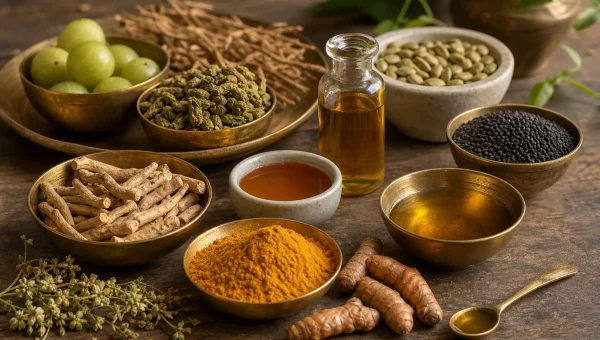
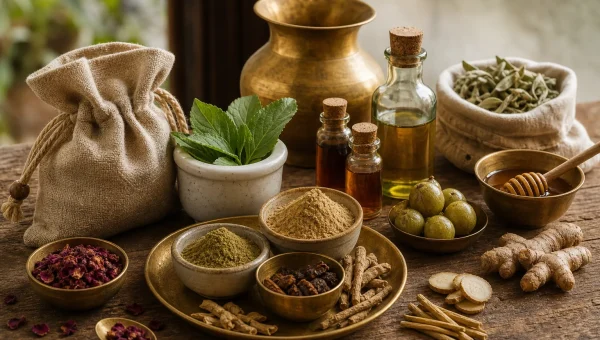
Herbs and Supplements: No Universal Expectant-Father Stack
The classical and pharmacopoeial material reviewed does not establish a routine combination of Ashwagandha, Shatavari, Shilajit, Kapikacchu and Brahmi for all expectant fathers. Nor does it support assigning one of these substances to each trimester of a partner’s pregnancy. Ayurvedic medicines are traditionally selected according to the individual, indication, formulation, dose, digestive capacity, constitution and accompanying conditions rather than solely because a man’s partner is pregnant.
The studies and PMIDs in the original article did not substantiate its claims. Several cited PubMed identifiers referred to unrelated subjects such as cervical-screening preferences, cardiovascular signalling, oncology anxiety, ophthalmology and laser treatment. Some genuine studies have examined Ashwagandha, Shilajit or Mucuna pruriens in particular groups, including men with infertility, but those findings do not establish a safe or useful regimen for healthy expectant fathers, and they cannot be transferred automatically between extracts, powders and commercial products.
A father who is considering an Ayurvedic medicine should consult a qualified Ayurvedic practitioner and disclose the product to his physician or pharmacist, especially if he has thyroid, liver, kidney, autoimmune, psychiatric, cardiovascular or fertility conditions, or takes regular medication. Government AYUSH guidance discourages self-medication because the medicine suitable for one person may not suit another. Product quality also matters: some Ayurvedic preparations have been found to contain potentially toxic metals, particularly when sourcing and manufacturing controls are inadequate.
Nutritional Support During the Pregnancy
The father’s diet does not directly nourish an already-conceived fetus, but his food habits can affect his energy, health and ability to prepare suitable meals. More importantly, he can make it easier for his partner to follow the plan provided by her obstetrician, midwife or dietitian. Classical pregnancy diets were individualised according to factors such as season, locality, digestive capacity and stage of pregnancy; they should not be converted into a universal menu without considering allergies, intolerances, diabetes, hypertension, anaemia, nausea and other clinical needs.
| Stage | Common Practical Challenge | Useful Role for the Father | Food Approach |
|---|---|---|---|
| Early pregnancy | Nausea, vomiting and smell aversion | Take over cooking, ventilate the kitchen and remove triggering smells | Offer small, frequent portions of plain food and fluids as tolerated; cold food may be easier when hot-food smells trigger nausea |
| Middle pregnancy | Regular meals, appointments and increasing nutritional needs | Shop, prepare balanced meals and help organise prescribed supplements | Use the clinician-approved plan, including appropriate protein foods, grains, vegetables, fruits and dairy or suitable alternatives |
| Late pregnancy | Fatigue, reflux, reduced meal capacity and preparation for birth | Handle heavier chores, prepare freezer meals and organise transport and hospital items | Offer smaller comfortable meals and adequate fluids according to medical advice; do not self-prescribe “edema” or labour-inducing herbs |
For mild nausea, recognised guidance includes avoiding provoking smells, eating small and frequent meals, choosing plain foods and sipping fluids little and often. Ginger in ordinary food or drink may help some women, but concentrated ginger supplements should still be discussed with a pharmacist or maternity clinician. Persistent vomiting, dehydration, weight loss or inability to retain fluids requires medical assessment rather than repeated home remedies.
A Sustainable Daily Routine for the Expectant Father
Dinacharya is general Ayurvedic guidance for an orderly daily regimen; it is not a pregnancy-specific prescription for the father. Its most useful application here is regularity. Consistent meals, movement, sleep and work boundaries can help a man remain dependable as responsibilities increase. There is no verified classical rule that every expectant father must wake at 6 AM, drink ginger water or perform sesame-oil massage to lower cortisol.
Movement: Maintain an amount of activity appropriate to your health rather than abandoning exercise or training to exhaustion. General public-health guidance for adults recommends at least 150 minutes of moderate-intensity aerobic activity each week and muscle-strengthening activity on two days, with modification when a medical condition, injury or clinician’s advice requires it. Walking together can provide movement and conversation, but the pregnant partner should follow her own maternity team’s exercise guidance.
Sleep: Adults aged 18 to 60 are generally advised to obtain at least seven hours of sleep. A regular bedtime, a quiet and cool room, reduced late caffeine and limiting screens before bed are more defensible recommendations than attributing an exact seven-to-eight-hour rule to an Ayurvedic verse. Fathers who snore heavily, repeatedly stop breathing during sleep or remain severely sleepy despite adequate time in bed should seek medical assessment.
Work and preparation: Decide in advance who will handle transport, meals, medicines, bills, visitors, night duties and communication with relatives. Prepare essential phone numbers and keep the pregnant woman’s records accessible with her consent. These ordinary tasks often provide more meaningful support than adding an unproven tonic to the father’s routine.
Emotional Preparation and Shared Responsibility
The best-supported classical instruction for the husband is simple: behave gently and affectionately and support wholesome needs. In practice, this means listening without dismissing symptoms, avoiding ridicule or coercion, sharing decisions, respecting consent and asking what assistance is actually useful. It does not mean controlling the woman’s diet, conduct or medical choices in the name of Ayurveda.
Useful involvement can include attending appointments when invited, learning the maternity team’s contact instructions, discussing birth preferences without treating them as guarantees, arranging help for the first weeks after delivery and learning basic newborn care. Observational research suggests that constructive partner involvement can accompany better use of maternal health services and healthier behaviours, but the evidence should not be overstated as proof that any single bonding ritual prevents depression or pregnancy complications.
Expectant fathers can also experience anxiety, depressed mood, irritability, relationship strain and fear about finances or parenting. Persistent hopelessness, uncontrollable anger, inability to function, escalating substance use or thoughts of self-harm require professional help. Seeking support is part of responsible fatherhood, not a failure to remain calm or “sattvic.”
Safety and Knowing When to Seek Care
An expectant father should know which maternity service to contact, where the hospital is, how transport will be arranged and which symptoms require urgent attention. Seek prompt medical care for vaginal bleeding or fluid leakage, severe or persistent abdominal pain, severe vomiting with inability to retain fluids, breathing difficulty, chest pain, fainting, fever, a severe or worsening headache, major visual changes, extreme swelling of the face or hands, or a noticeable reduction in fetal movement after movements have become established. Follow the pregnant woman’s own clinician’s instructions because individual risks differ.
Actionable tip: Set aside 10 minutes each evening for a simple check-in. Ask, “Which symptom or task was hardest today?”, “What can I take over tomorrow?” and “Is there anything we need to ask the doctor or midwife?” Then complete one agreed practical task. This is a modern communication exercise consistent with the classical emphasis on gentle, attentive support. It should not be labelled a classical practice called Sattvic Sevana, and no verified evidence shows that this exact ritual produces a measurable fall in maternal cortisol.
References
- Charaka Samhita — Prenatal care %28garbhini paricharya%29
- Charaka Samhita — Sharira
- Effects of prenatal stress on pregnancy and human development: mechanisms and pathways (2013), PubMed Central
- Male involvement and maternal health outcomes: systematic review and meta-analysis (2015), PubMed Central
- Ayush (ayush.delhi.gov.in)
- NCCIH
- NHS
- CDC
- CDC
- Tommys (tommys.org)
- CDC
- Exploring factors associated with preferences for human papillomavirus (HPV) self-sampling among racially- and ethnically-diverse women in Minnesota: A cross-sectional study (2023), PubMed
- Pubmed (pubmed.ncbi.nlm.nih.gov)
- Increased CaMKII activation and contrast changes of cardiac β1-and β3-Adrenergic signaling pathways in a humanized angiotensinogen model of hypertension (2023), PubMed
- Effect of 650 nm laser photobiomodulation therapy on the HT-7 (shenmen) acupoint in the Mus musculus model of Parkinson’s disease (2023), PubMed
- Anxiety in oncology outpatients is associated with perturbations in pathways identified in anxiety focused network pharmacology research (2023), PubMed
- Differential Diagnosis of Changes in Intraocular Lenses (2023), PubMed

The image of standing at the stove with a wooden spoon and the Ashtanga Hridayam is one I relate to completely. My wife’s second trimester nausea was severe and I became the sole cook for about six weeks. Nothing in any pregnancy prep class prepared me for that specific practical challenge.
The section on environmental factors and Sattvic environment is interesting but vague. What does a Sattvic household environment actually look like practically? Less noise, less technology? More greenery? I’d benefit from specific changes rather than the concept.
My wife’s OB and her Ayurvedic practitioner have been working together through this pregnancy which has been a genuine blessing. The section on what the father’s role is in Garbhini Paricharya surprised me because I had assumed the classical texts would focus entirely on the mother. The dietary support role described here is something I’m actively trying to do. One practical question: the recommended ghee-based preparations, do they need to be made fresh or do they keep for a week if stored properly?
I liked the practical side of Father’s. The safety notes could be expanded a little.
The Garbhini Paricharya section for partners is essentially missing from every pregnancy book I’ve read. They’re all focused on the mother’s experience and leave the partner with nothing to do except ‘be supportive.’ This gives actual actionable guidance.
As a first-time father-to-be reading this, I find the Ashwagandha recommendation for the partner interesting. Does it interfere with sperm quality or production if the pregnancy is already established and you’re still trying to support fertility for future children?
I tried cooking bland rice and steamed veggies for my wife when her nausea hit at week 14 and it really helped keep the kitchen smells low
My husband made this article required reading for himself during my pregnancy. He actually followed most of it and our experience was noticeably better than friends who described their partners as useless throughout pregnancy. The Ayurvedic framework gives men something specific to do rather than just watching.
I liked the practical side of Father’s. I would like to know how long to try it before judging results.
What about partners who are dealing with their own stress during pregnancy? My wife’s pregnancy was high-risk and I was managing fear daily in addition to everything else. The partner’s mental health during a complicated pregnancy is never discussed anywhere.
Does the article mention any specific Ayurvedic texts that talk about the husband’s role beyond affectionate behavior
My practitioner in Pune has been doing this for 30 years and confirms everything here. The pregnancy protocol for this condition has solid traditional backing.
My practitioner wants to use classical alongside pregnancy. Is this a common combination or is the article’s protocol more commonly used in isolation?
I appreciated the reminder that beeja shuddhi is preconception so I won’t push a detox after conception
The tip about a ten minute evening check in feels doable I’ll ask about the hardest symptom and what I can take over tomorrow
The emotional environment emphasis in classical texts is something western obstetrics has started to take seriously only recently through epigenetics research. The classical understanding that the mother’s emotional state affects fetal development was written into the Sushruta Samhita thousands of years ago.
It’s useful to see that the father’s diet matters for his energy not for directly feeding the fetus
This works in theory but practically very hard to source authentic herbs.
tried this for 6 weeks and saw no difference, maybe i’m applying it wrong
Does the nutritional guidance change by trimester or is it the same throughout pregnancy?
tried the morning routine from this article and noticed a difference by day 5
just found this post, the section 3 protocol seems intensive for a beginner, any lighter version? धन्यवाद
Late to this but wanted to ask, do these recommendations still hold in 2027?
My husband tried some of this during my pregnancy. The kitchen management was the most impactful change, keeping smells minimal, using only mild spices, timing cooking when I was napping. The herbal teas he prepared were sometimes too strong though and I had to ask him to halve the concentrations.
I wondered if the classical sources really give a month wise care plan for the mother as the article says they do
is this suitable for pitta dominant people or mainly vata?
This feels a bit generic, most of the recommendations are just general healthy eating dressed in Ayurvedic language.
This is the article I didn’t know I needed. I’m currently at week 11 of my wife’s pregnancy and I’ve been flailing in the kitchen. The Garbhini Paricharya framework gives me something to actually organize around. The nausea phase has made cooking feel like a minefield. Did you find that the sour and cold food aversions shifted at a certain trimester, or did you have to keep adjusting the approach all the way through?
Would this protocol work if I travel frequently and can’t maintain a fixed routine.
my vaidya recommended something similar last month, good to see the reasoning explained
The part about avoiding concentrated ginger supplements unless a pharmacist approves caught my attention
Tried the morning routine for 2 months, gave up the timing is impossible with kids and a job.
my constitution is vata-pitta, the article seems focused on one or the other
this feels a bit generic, most of the recommendations are just general healthy eating dressed in ayurvedic language
my wife and i both appreciated the inclusion of the partner’s role, most resources focus only on the mother ✨
reading this after finding it on google, is this dosage still recommended?
followed teh dosage table for 10 days and my sleep improved, will continue 🙏
some of these claims r very strong for what is essentially anecdote-level evidence
does teh nutritional guidance change by trimester or is it the same throughout pregnancy?
bookmarked this to share with my mother who has been struggling with teh same issue
my functional medicine doctor mentioned something similar, helpful to have the ayurvedic framing too
The article mentions Shatavari for the mother are there equivalent herbs the father should be taking?
i couldn’t find any studies specifically on ayurvedic protocols for expectant fathers, the evidence is thin
been following this for 3 weeks and my energy levels are much better, the protocol described here really clicked for me
the part about fathers’ diet affecting sperm quality even after conception was new information for me
packaging this as science when most of it is tradition makes me skeptical 💯
the specific morning timing recommendation is practical, most articles skip that detail
@Karthik My constitution is Vata-Pitta, the article seems focused on one or the other.
Appreciate that this goes into contraindications, most blog posts skip that part.
Good info
Useful post on Father’s. Good starting point for a cautious reader.
quick question: does teh dosage change if someone is also on other medication?
the part about adjusting based on prakriti was exactly what i needed
I liked the practical split of chores by trimester especially handling heavier chores in late pregnancy
Just started exploring Ayurveda after years of allopathy, still a lot to absorb.
packaging this as science when most of it is tradition makes me skeptical
as an expectant father this was exactly the kind of practical guide i was looking for, especially the ojas support section
The dosage here seems higher than what my Ayurvedic doctor recommended. 🙏
The Pitta protocol here caused a lot of heat and skin irritation for me.
quick question: does the dosage change if someone is also on other medication?
where r the actual clinical trials? i need rct data before trying anything
the pitta protocol here caused a lot of heat and skin irritation for me
how long before seeing results? teh article mentions 4 to 6 weeks but is that for everyone
Is there any guidance on how to talk with the maternity team about birth preferences without treating them as guarantees
Starting this next week, will report back in about a month.
Just found this post, the section 3 protocol seems intensive for a beginner, any lighter version?
where can you source the herbs in india outside of major cities? im in a tier-2 town
The part about adjusting based on prakriti was exactly what I needed. 🙏
Useful post
Reading this later and the Father’s advice still feels relevant. A few more examples would still help.
does the nutritional guidance change by trimester or is it the same throughout pregnancy? ✨
is ashwagandha safe for the father to continue taking during his partner’s pregnancy?
Been following this for 3 weeks and my energy levels are much better, the protocol described here really clicked for me.
I couldn’t find any studies specifically on Ayurvedic protocols for expectant fathers, the evidence is thin.
The part about fathers’ diet affecting sperm quality even after conception was new information for me.
Reading this later and the Father’s advice still feels relevant. I would still ask a practitioner before changing medicines.
how long before seeing results? the article mentions 4 to 6 weeks but is that for everyone
where are the actual clinical trials? i need rct data before trying anything 🌿
The reminder to seek professional help for persistent hopelessness or anger is important for expecting dads
The part about adjusting based on prakriti was exactly what I needed.
@Nicole my wife and i both appreciated the inclusion of the partner’s role, most resources focus only on the mother
appreciate that this goes into contraindications, most blog posts skip that part
My wife and I both appreciated the inclusion of the partner’s role, most resources focus only on the mother.
Tried the morning routine from this article and noticed a difference by day 5.
bookmarked this to share with my mother who has been struggling with the same issue
where can you source the herbs in india outside of major cities? im in a tier-2 town ❤️
I found the discussion about herb quality and toxic metals a good reason to talk to an Ayurvedic practitioner before trying anything
The article clarified that there’s no universal herb stack for expectant fathers which saved me from buying a random combo
Keeping the pregnant woman’s records accessible with her consent seems like a simple but meaningful task
followed the dosage table for 10 days and my sleep improved, will continue 🙏
would this protocol work if i travel frequently and cant maintain a fixed routine
I’m going to try walking together for movement but I’ll let my wife follow her own maternity team’s exercise advice
starting this next week, will report back in about a month
Some of these claims are very strong for what is essentially anecdote-level evidence.
Thanks!
the sourcing section was a surprise, didnt know the extract grade mattered this much
Where are the actual clinical trials? I need RCT data before trying anything.
tried this for 6 weeks and saw no difference, maybe im applying it wrong
The specific morning timing recommendation is practical, most articles skip that detail.
just started exploring ayurveda after years of allopathy, still a lot to absorb
would this protocol work if i travel frequently and can’t maintain a fixed routine
The Father’s explanation is clearer than most short posts. I would like to know how long to try it before judging results.
tried the morning routine for 2 months, gave up the timing is impossible with kids and a job
Is this suitable for Pitta dominant people or mainly Vata? धन्यवाद
the dosage here seems higher than what my ayurvedic doctor recommended
Bookmarked this to share with my mother who has been struggling with the same issue.
some of these claims are very strong for what is essentially anecdote-level evidence
as an expectant father this was exactly teh kind of practical guide i was looking for, especially the ojas support section
this works in theory but practically very hard to source authentic herbs
I liked the practical side of Father’s. This would be easier to follow with a one-week sample plan.
Followed the dosage table for 10 days and my sleep improved, will continue 🙏.
Tried this for 6 weeks and saw no difference, maybe I’m applying it wrong.
the article mentions shatavari for the mother are there equivalent herbs the father should be taking? ✨
Same here
where can you source the herbs in india outside of major cities? i’m in a tier-2 town
My vaidya recommended something similar last month, good to see the reasoning explained.
The safest part of the Father’s advice is keeping it simple. The article avoids making it sound like a quick fix.
Just started exploring Ayurveda after years of allopathy, still a lot to absorb. 🌿
I couldn’t find any studies specifically on Ayurvedic protocols for expectant fathers, the evidence is thin. ✨
is this suitable for pitta dominant people or mainly vata? 🙌