
Ayurvedic Travel Guide: How to Stay Balanced When You’re on the Road
Travel is one of the most Vata-provoking activities in modern life because it combines movement, dryness, irregular meals, unfamiliar surroundings, and disrupted sleep-wake timing. In Ayurveda, Vata is associated with air and space and is described as dry, light, cold, rough, subtle, and mobile; travel repeatedly exposes the body and mind to these same qualities.
This guide keeps the focus practical: how to prepare before a trip, what to carry, how to manage digestion and sleep while moving, and how to restore steadiness after returning home. The aim is not to replace medical care, but to use classical Ayurvedic principles—warmth, oiliness, regularity, grounding, and digestibility—to reduce common travel discomforts.
Why Travel Aggravates Vata Dosha
Vata increases when daily rhythm becomes irregular and the body is exposed to repeated movement, dryness, coldness, light meals, skipped meals, and overstimulation. Long drives, flights, trains, airports, hotel rooms, and late-night arrivals all disturb the stable routines that normally protect digestion, sleep, elimination, and mental calm.
Air travel adds a special layer of dryness: aircraft cabin humidity is commonly much lower than ordinary indoor humidity. Long-distance travel across time zones also disturbs circadian timing, which is why sleep, appetite, bowel movements, and energy can feel out of sync for a few days after arrival.
Through the Ayurvedic lens, common travel complaints such as constipation, gas, dry skin, dry nasal passages, light sleep, fatigue, anxious restlessness, and stiffness are not random inconveniences. They are signs that Vata needs steadiness, warmth, lubrication, routine, and gentle digestive support.
The Ayurvedic Travel Toolkit: What to Pack
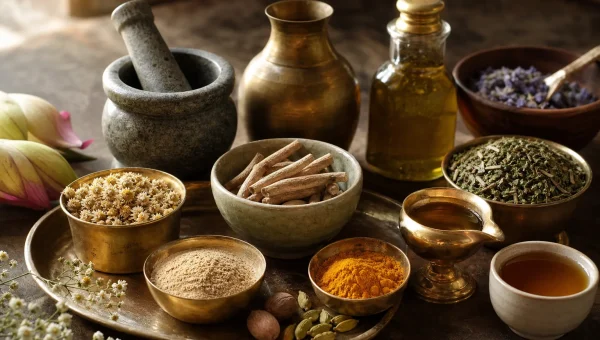
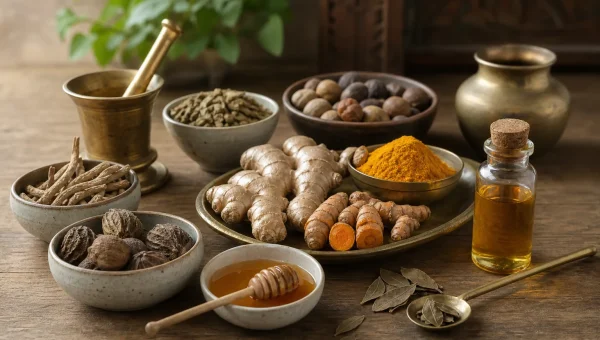
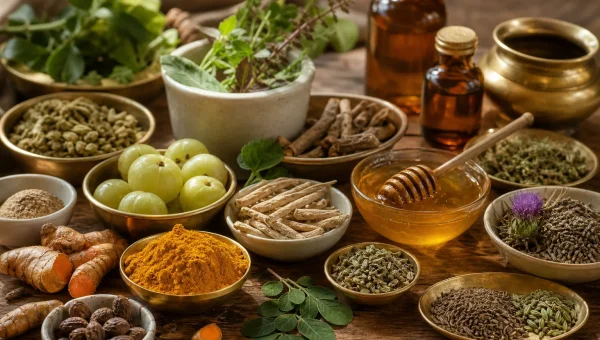
A compact travel kit should be simple, safe, and familiar. Pack only herbs and oils you have already tolerated at home, use them according to the product label or a practitioner’s direction, and avoid starting strong new formulas during the trip itself.
- Triphala: A classical three-fruit Ayurvedic formula made from Amalaki, Haritaki, and Bibhitaki. It is traditionally used to support bowel regularity and is a common choice when travel causes dry, sluggish elimination.
- Trikatu: A warming formula of dry ginger, black pepper, and long pepper. It is traditionally used to kindle Agni when digestion feels cold, heavy, slow, or Kapha-like. Avoid casual use if you have active acidity, ulcers, burning sensations, or strong Pitta symptoms unless guided by a practitioner.
- Ginger: Fresh ginger tea bags, dried ginger, or ginger candy are convenient for mild nausea, throat comfort, and appetite support. Ginger is warming, so use it moderately if you are prone to heat, reflux, or burning.
- Avipattikar Churna: A classical Ayurvedic formulation commonly used for Amlapitta-type acidity and sour/burning digestion. It is best used under practitioner guidance, especially for people taking medicines or managing chronic digestive disease.
- Ashwagandha: A traditional Rasayana and stress-support herb. It may be useful for people who already tolerate it well, but it should be avoided during pregnancy and breastfeeding and used cautiously with thyroid disease, liver disease, sedatives, autoimmune conditions, or ongoing medication.
- Jatamansi: A traditional calming herb used in Ayurveda for sleep and nervous-system support. Because it may add to sedative effects, it should not be combined with alcohol, sleep medicines, anti-anxiety medicines, or sedating herbs unless supervised.
- Tulsi tea: A portable option for warmth, throat comfort, and travel-season resilience. Tulsi is convenient as tea bags and can be used when the body feels cold, dull, or Kapha-heavy.
- Sesame oil: A small leak-proof bottle of sesame oil can be used for foot massage and a very light application just inside the nostrils when dryness is present. Do not pour oil deeply into the nose, and avoid nasal oiling if you have active sinus infection, bleeding, choking risk, or have not been taught the method.
Common Travel Problems, Doshic Patterns, and Portable Remedies
The following table gives a practical Ayurvedic way to match common travel discomforts with likely doshic patterns. It is a self-care guide for mild, familiar symptoms only; severe, persistent, infectious, or unusual symptoms need medical assessment.
| Travel Problem | Likely Doshic Pattern | Portable Support | Practical Protocol |
|---|---|---|---|
| Constipation | Vata dryness and irregular rhythm | Triphala, warm water, oilier warm meals | Use Triphala only if already tolerated; sip warm water; choose soups, stews, rice, ghee, and cooked vegetables. |
| Bloating and gas | Vata with weak or irregular Agni | Ginger tea, cumin-fennel-coriander tea, light warm meals | Avoid cold drinks, large raw salads, carbonated drinks, and eating while rushing. |
| Heavy indigestion | Kapha-type sluggish Agni | Trikatu or ginger, if suitable | Use warming digestive herbs only in small amounts and avoid them if acidity or burning is present. |
| Heartburn or sour belching | Pitta-type Amlapitta pattern | Avipattikar Churna under guidance, cooling food choices | Avoid alcohol, excess chilli, late heavy meals, fried foods, and long gaps followed by overeating. |
| Mild nausea or motion discomfort | Vata disturbance from movement | Ginger candy, light snacks, hydration | Look toward the horizon, eat lightly, limit alcohol and caffeine, and use medicines when needed under healthcare guidance. |
| Jet lag and light sleep | Vata rhythm disruption | Local meal timing, morning light, warm foot massage | Align with local time as soon as practical; get daylight exposure; keep the evening warm, quiet, and low-stimulation. |
| Dry nasal passages and dry skin | Vata dryness | Sesame oil externally, warm fluids, humidified room when available | Apply a thin film of oil to dry skin or feet; use nasal oil only lightly and only if appropriate for you. |
| Anxiety or overwhelm | Vata overstimulation | Slow breathing, warm drink, routine, quiet pause | Practice five minutes of alternate-nostril breathing or gentle humming breath; reduce screens and rushing. |
| Cold, damp heaviness | Kapha accumulation | Tulsi tea, ginger tea, light warm food | Keep moving gently, avoid oversleeping, and choose warm, spiced, freshly cooked meals. |
Pre-Trip Preparation: The 3-Day Grounding Protocol
Beginning three days before departure helps reduce the abrupt shock of travel. The emphasis is on oiliness, warmth, routine, bowel regularity, calm sleep, and avoiding last-minute depletion.
- Three days before travel: Start or resume gentle Abhyanga with warm sesame oil, especially on the feet, ears, joints, and lower back. Eat warm, cooked, lightly oily foods and reduce dry snacks, raw salads, late nights, excess caffeine, and unnecessary fasting.
- Two days before travel: Keep meals regular and easy to digest. Use Triphala at night only if it is already part of your routine and suitable for you. Practice slow breathing for 5-10 minutes and finish major packing early to reduce Vata-provoking stress.
- One day before travel: Eat an early, warm, simple dinner. Avoid experimenting with unfamiliar foods or herbs. Sleep early, pack medicines and supplements in labeled containers, and keep travel clothes comfortable, layered, and non-restrictive.
Jet Lag Protocol Using Ayurvedic Principles
Jet lag is a rhythm disturbance: the inner clock, light-dark exposure, meal timing, bowel rhythm, and sleep timing are temporarily misaligned. Ayurveda approaches this by re-anchoring the body through light, food rhythm, warmth, grounding touch, and a steady bedtime routine.
Eastward Travel
Eastward travel often feels harder because the body has to advance its clock and sleep earlier than it naturally wants to. On arrival, shift gently but firmly toward local time: eat small warm meals at local mealtimes, seek morning daylight, avoid long daytime naps, and make the evening quiet and low-light.
At local bedtime, use non-forceful grounding measures: a warm shower, warm milk or herbal tea if suitable, sesame oil foot massage, and slow breathing. If using sleep-support herbs such as Jatamansi, use only products you already tolerate and avoid combining them with alcohol or sedatives.
Westward Travel
Westward travel usually requires delaying sleep. Stay awake until a reasonable local bedtime with gentle stimulation such as walking, conversation, unpacking, or light stretching. Avoid using heavy meals, alcohol, or intense screen exposure to push through fatigue, because these can disturb both sleep and digestion.
In the evening, choose a warm but light dinner and keep the bedtime routine familiar. A brief oil foot massage, slow breathing, and a dark room help signal safety and steadiness to Vata.
Digestive Tips for Travel
Digestion is easily disturbed by time pressure, unfamiliar foods, irregular mealtimes, cold drinks, and nervous excitement. The most reliable Ayurvedic travel strategy is to make food warm, simple, cooked, moderate in quantity, and eaten at regular times.
Preventing Traveler’s Diarrhea
Traveler’s diarrhea prevention begins with food and water safety. In places where hygiene or water safety is uncertain, avoid tap water, ice of uncertain origin, raw salads, uncooked vegetables, unpeeled fruits, unpasteurized juices, and undercooked meat, seafood, or eggs. Prefer hot, freshly cooked food and sealed bottled or properly treated water.
Ayurvedic support can include warm water, ginger tea in small amounts, and simple foods such as rice, cooked vegetables, thin khichdi, or soups. Seek medical care promptly for blood in stool, high fever, severe dehydration, persistent vomiting, severe abdominal pain, or diarrhea that does not improve.
Appetite Management Across Time Zones
Appetite often becomes irregular when the body clock shifts. Ayurveda places strong emphasis on Agni, the digestive fire, and favors the main meal around midday when digestion is generally strongest. During the first days after arrival, eat smaller warm meals until appetite becomes natural again.
Avoid forcing a large meal just because food is available. If hungry at an unusual time, choose something light and warm, such as soup, porridge, rice, cooked fruit, or herbal tea, then return to regular local meal timing at the next opportunity.
Adapting Dinacharya on the Road
A complete Dinacharya may not fit into a hotel morning, but a shortened routine can preserve the most important travel-balancing principles: regular waking, warm hydration, gentle cleansing, breath regulation, and grounding touch.
The 15-Minute Travel Dinacharya:
- Wake at a consistent local time and avoid immediately checking stressful messages.
- Drink warm water, especially after flights or late nights.
- Wash the face, mouth, and eyes; scrape the tongue if that is already part of your routine.
- Apply a small amount of sesame oil to the feet or ears, or use a very light nasal application only if suitable and familiar.
- Practice five minutes of Nadi Shodhana, Bhramari, or simple slow breathing.
- Sit quietly for three to five minutes before starting the day.
Hydration Strategies for Air Travel
Aircraft cabins are typically dry, which can aggravate Vata dryness in the skin, lips, throat, eyes, and nasal passages. Dry cabin air does not automatically mean clinically significant dehydration in healthy travelers, but sipping fluids and protecting mucous membranes can improve comfort.
- Sip water regularly rather than drinking excessive amounts all at once.
- Choose warm water or warm herbal tea when available, especially for Vata-prone travelers.
- Limit alcohol and excess caffeine, both of which can disturb sleep and aggravate dryness or restlessness.
- Use electrolytes when sweating, recovering from diarrhea, or traveling in hot climates.
- Apply lip balm and an oil-based skin moisturizer before long flights.
- Move the ankles, stand when safe, and walk periodically on long flights to reduce stiffness.
Seasonal Travel Considerations
Ritucharya, the Ayurvedic seasonal routine, applies strongly to travel because a destination’s climate may be very different from the climate the body has recently adapted to. Adjust food, clothing, herbs, activity, and rest to the place you are actually in, not only the season at home.
Hot, humid destinations: This setting can aggravate Pitta and damp heaviness. Favor cooling but digestible foods, coconut water where safe, sweet ripe fruits, bitter greens, rice, and moderate spices. Avoid excess chilli, alcohol, fried food, and harsh midday sun.
Cold, dry destinations: This setting strongly aggravates Vata. Prioritize warm layers, sesame oil massage, soups, stews, ghee, cooked grains, root vegetables, and warm drinks. Avoid cold smoothies, dry crackers, raw salads, and skipping meals.
Cold, damp destinations: This setting tends to increase Kapha with Vata. Favor ginger, Tulsi tea, black pepper in food, warm light meals, movement, and early rising. Avoid heavy dairy, excess sweets, deep-fried foods, and oversleeping.
Travel-Specific Food Strategies
The best travel foods are warm, simple, easy to digest, and not excessively dry. When only packaged or airport food is available, a small amount of planning can prevent Vata from rising through hunger, dryness, and irregular eating.
- Soaked almonds and dates: Nourishing, sweet, and grounding when eaten in small amounts. Soaked almonds are gentler for many people than dry roasted nuts.
- Ginger candies or ginger tea: Useful for mild nausea, throat comfort, and appetite support, especially during cold or damp travel.
- Herbal tea bags: Tulsi, ginger, fennel, or cumin-coriander-fennel tea can make hotel and airport hydration warmer and more Vata-friendly.
- Ghee packets: When available and travel-safe, a small amount of ghee can make plain rice, porridge, or khichdi more nourishing and grounding.
- Instant porridge or khichdi packets: A simple warm meal option can be valuable when late-night arrivals or airport delays make proper food difficult.
Managing Resilience During Travel
Travel exposes the body to crowds, irregular sleep, unfamiliar food, climate shifts, and stress. Ayurveda supports resilience through Ojas-preserving habits: adequate sleep, regular warm meals, moderate activity, calm breathing, and avoiding overexertion before and after travel.
Tulsi tea is a practical choice when the throat feels cold or irritated, while Chyawanprash is a classical Rasayana-style preparation often used before travel or during colder seasons. Because Chyawanprash is sweet, dense, and semi-liquid, it may not suit everyone, especially those with blood sugar concerns, strong Kapha, or strict baggage limits.
Ashwagandha may support stress adaptation in some adults, but it is not a universal travel supplement. Use it only when suitable for your constitution and health status, and avoid it during pregnancy, breastfeeding, liver disease, or when taking medicines that may interact.
Post-Trip Recovery Protocol
Returning home is also a transition. After travel, Vata may remain high for several days, especially after red-eye flights, time zone changes, long drives, cold weather, or work stress immediately after arrival.
- Arrival day: Take a warm shower or bath, apply warm sesame oil to the feet or body if appropriate, eat a simple warm dinner such as khichdi or soup, and sleep early.
- Days 2-3: Resume a normal waking time, warm meals, gentle movement, and breathing practice. Continue Triphala or other herbs only if already part of your safe routine.
- Days 4-5: Gradually return to normal exercise, work intensity, and dietary variety. Keep meals warm and regular until sleep, appetite, and elimination feel steady again.
The key principle of post-trip recovery is not to treat arrival as the end of travel. Give the body a short landing period: warmth, oil, sleep, simple food, and routine restore the steadiness that travel temporarily disperses.
This article is for general Ayurvedic education and is not medical advice. Consult a qualified Ayurvedic practitioner or healthcare provider before starting herbs, supplements, nasya, strong breathing practices, or new health protocols, especially if you are pregnant, breastfeeding, elderly, giving herbs to children, taking medication, or managing a chronic condition.
References
- Ayurveda-online (ayurveda-online.net)
- Dabur (dabur.com)
- NCCIH
- NCBI
- Caa (caa.co.uk)
- Sleepfoundation (sleepfoundation.org)
- Sleep (sleep.hms.harvard.edu)
- Advancing circadian rhythms before eastward flight: a strategy to prevent or reduce jet lag (2005), PubMed Central
- A comprehensive metabolome profiling of Terminalia chebula, Terminalia bellerica, and Phyllanthus emblica to explore the medicinal potential of Triphala (2024), PubMed Central
- Therapeutic Uses of Triphala in Ayurvedic Medicine (2017), PubMed Central
- An Ayurvedic formulation ‘Trikatu’ and its constituents (1992), PubMed
- Evaluation of anti-secretory and anti-ulcerogenic activities of avipattikar churna on the peptic ulcers in experimental rats (2013), PubMed Central
- NCCIH
- Wwwnc (wwwnc.cdc.gov)
- A prospective, randomized double-blind, placebo-controlled study of safety and efficacy of a high-concentration full-spectrum extract of ashwagandha root in reducing stress and anxiety in adults (2012), PubMed
- NCCIH
- Anxiolytic actions of Nardostachys jatamansi via GABA benzodiazepine channel complex mechanism and its biodistribution studies (2018), PubMed
- Double-blinded randomized controlled trial for immunomodulatory effects of Tulsi (Ocimum sanctum Linn.) leaf extract on healthy volunteers (2011), PubMed
- The Clinical Efficacy and Safety of Tulsi in Humans: A Systematic Review of the Literature (2017), PubMed Central
- Chyawanprash: A Traditional Indian Bioactive Health Supplement (2019), PubMed Central
- Ayurvaid (ayurvaid.com)
- Nasal application of sesame oil-based Anu taila as ‘biological mask’ for respiratory health during COVID-19 (2023), PubMed Central
- Banyanbotanicals (banyanbotanicals.com)
- Breathing Practices for Stress and Anxiety Reduction: Conceptual Framework of Implementation Guidelines Based on a Systematic Review of the Published Literature (2023), PubMed Central
- Effect of Bhramari Pranayama intervention on stress, anxiety, depression and sleep quality among COVID 19 patients in home isolation (2022), PubMed Central
- CDC
- Wwwnc (wwwnc.cdc.gov)
- Physiological aspects of Agni (2010), PubMed Central
- Timing Matters: The Interplay between Early Mealtime, Circadian Rhythms, Gene Expression, Circadian Hormones, and Metabolism-A Narrative Review (2023), PubMed Central
- Openresearch (openresearch.surrey.ac.uk)
- Ritucharya: Answer to the lifestyle disorders (2011), PubMed Central
- NCCIH
I work 60-hour weeks and keeping any consistent routine felt impossible. The minimal viable version of Dinacharya described here is exactly what I needed to start.
I’ve been trying to establish a morning routine for years and this is the first framework that’s actually stuck. Three months in and I can’t imagine starting the day differently
Useful post on Travel. Good starting point for a cautious reader.
Useful post on Travel. The practical details matter more than people think.
The grandmothers always knew! I keep finding that traditional knowledge holds up to modern scrutiny.
Useful post on Travel. Small daily changes are easier to follow than a perfect plan.
it’s wonderful to see both believers and skeptics engaging respectfully in the comments. That’s how we all learn
I travel for work constantly and maintaining wellness while traveling felt impossible. The travel protocol here has genuinely helped. The portable practices especially.
I travel 4 days a week for work and the Vata aggravation is something I feel but could not name. Dry skin, anxiety, irregular digestion, sleep difficulty in hotels. Having a framework for this and a portable kit based on it is more useful than any business travel advice I have read.
After years of intensive exercise I switched to the constitution-appropriate movement described here. My recovery is better, my mood is more stable, and I feel less depleted
Thank you so much for sharing your experience! It’s really encouraging to hear from others on this journey.
this gives me a compassionate framework for understanding why my anxiety spikes at certain times of year and what to do about it. So much more useful than generic advice.
The mental wellness components often get left out of physical health articles. The integration here, treating mind and body as inseparable, is the Ayurvedic strength.
Useful post on Travel. A few more examples would still help.
The combination approach you described is exactly what my practitioner recommended too. Validation always feels good.
even doing just three of the practices recommended here made a noticeable difference. Sometimes it’s the basics done consistently that create the biggest shifts.
My partner and I both changed our evening routines based on this. Our sleep quality has improved and honestly our relationship has too, we’re less depleted and irritable.
I had a very similar experience! The first few weeks are the adjustment period, it really does get better
The logic of matching lifestyle to constitution rather than following generic wellness advice is something I wish I’d understood years ago. Tailored approaches just work better.
Same here! The practitioner recommendation made all the difference for me. Don’t try to do this without guidance.
I appreciate that this includes a reminder that perfection isn’t the goal. A consistent imperfect practice beats a perfect one that never actually happens
I’ve been using it for a year and can confirm, the results you’re describing are consistent with my longer-term experience.
The connection between daily rhythm and long-term health makes so much intuitive sense. We evolved within consistent cycles and modern life pulls us away from them constantly
I implemented one change per week rather than trying to do everything at once. Three months later and Ive built a sustainable routine. The pacing made all the difference.
As a sleep researcher I find the Ayurvedic approach to sleep hygiene fascinating. The emphasis on regularity and wind-down time is well supported by chronobiology.
Your experience with the diet changes mirrors mine almost exactly. Week two is when it clicks.
I printed this out and put it on my bathroom mirror. The morning routine checklist is now just part of my day without having to think about it
The breath practices described here have become my anchor for stressful workdays. Five minutes at my desk and my whole mental state shifts. Simple and powerful.
The section on digital overwhelm and Vata aggravation perfectly described my current state. Implementing the sensory rest practices this week.
The small bottles of sesame oil and Triphala as the core of an Ayurvedic travel kit is practical and genuinely what I bring now. The article is right that sesame oil applied to feet and scalp in a hotel room before sleep changes the whole quality of hotel rest.
What is the protocol for crossing multiple time zones? The jet lag component of Vata disruption is the hardest to manage. The article mentions meal timing anchoring but does not address how to handle the 12-hour sleep schedule inversion that comes with international travel.
Parts of this are genuinely brilliant, particularly the section on timing. Other parts read like they were copied from every other Ayurveda blog.
Appreciate you keeping us honest. We’ve noted your feedback about dosage specificity and will address it in a revised version of this article.
I wanted this to work so badly, but after 8 weeks of strict adherence I gave up. Sometimes modern medicine is just more effective.
I travel to India frequently and the transition both ways disrupts my digestion for a week in each direction. The Triphala before and after travel as a preventive measure is something I started this year. The digestive adjustment on both sides of the trip has been smoother.
The airplane cabin air section is the most practically useful. Nasal membrane dryness is the main vector for travel illness in my experience. The ghee or sesame oil nasal application described here, while unconventional, has the right physiological logic.
The information is presented confidently but where are the sample sizes? A study with 20 participants doesn’t prove much.
I backpack for extended periods in South and Southeast Asia and the local food and water exposure pattern makes the Agni-supportive approach described here much more relevant than conventional traveler health advice which focuses entirely on what to avoid.
The section on cabin humidity really made me reconsider how I hydrate on flights.
For Travel, consistency seems like the hard part. The article avoids making it sound like a quick fix.
Thank you for sharing your experience, it’s important that readers see the full range of outcomes, not just success stories. Not every approach works for everyone.
The road trip version of this protocol, specifically the recommendation to stop every 2 hours and walk, do gentle movement, and eat at regular times rather than grazing while driving, improved a 14-hour drive I did last month more than anything else I had tried.
I am skeptical of the claim that Vata aggravation from flight travel can be meaningfully reduced by a small bottle of oil applied before boarding. The disruption from a 10-hour flight involves serious circadian, postural, and hydration stressors. Sesame oil seems like a minor countermeasure.
Do you think taking Triphala before bed actually helps with constipation after long haul?
The Travel section feels grounded enough to try carefully. Good starting point for a cautious reader.
I found the tip about warm oil foot massage useful for grounding during layovers.
The advice to avoid raw foods in questionable water areas seems practical for preventing traveler’s diarrhea.
Has anyone tried Jatamansi for jet lag and noticed a difference in sleep quality?
Packing sesame oil for nasya feels like a small habit that could make a big difference in dry air.
The explanation of Vata qualities linking to travel discomfort helped me understand why I feel anxious after flights.
I wonder if the Ayurvedic morning routine can really be shortened to fifteen minutes without losing benefits.
Using ginger candies for nausea seems like an easy remedy to keep in a carry on.
The post trip recovery protocol suggests a gradual return to normal eating, which sounds sensible.
Do the seasonal considerations really change which herbs you should pack for a humid destination?
I appreciated the reminder to layer clothing when heading to cold, dry climates.
The table linking travel problems to doshic imbalances made the remedies feel targeted.
Anyone else tried combining this with Boswellia? Consistency seems to be the key.
The climate change adaptation section explains why I always get sick after long flights.
My practitioner suggested something similar last year. The results were gradual but real. The quality of the herb matters a lot.
Seeing altitude changes linked to Vata’s cold and light qualities was interesting.
Finding a quality herb source is harder than following the protocol itself. More research needed but encouraging.
The seasonal variation advice is the part most Ayurveda articles skip. Results are slow but steady.
Started this last March and will report back after 3 months. Still a work in progress.
The diet changes listed here are harder to follow than the herbs but more impactful. Digestive improvement came before other benefits.
Tried the recipe/formula mentioned and the results after 6 weeks were encouraging. Took 3 weeks before I noticed anything.
The contraindication list should be read first before starting anything here. Combining with dietary changes.
The seasonal variation advice is the part most Ayurveda articles skip. Still a work in progress.
The integration with modern physiology is what makes this article stand out. Results are slow but steady.
Printing the emergency kit list before my 3-month backpacking trip.
I would like more detail on Travel. The practical details matter more than people think.
Triphala for travel constipation is more effective than Senna and gentler.
The herb quality issue is real I’ve noticed significant variation across brands. Will update in a few months.
Would appreciate a follow-up article specifically on the dosage for elderly patients. Combined with yoga practice for better results.
My integrative doctor agrees with this approach, which surprised me. My sleep improved first, then energy.
Is it OK to skip morning dinacharya during travel or is there a minimal essential version?
My practitioner suggested something similar last year. The results were gradual but real. My practitioner is monitoring.
My practitioner suggested something similar last year. The results were gradual but real. Results are slow but steady.
For Kapha types traveling to cold climates does the warming protocol override usual Kapha restrictions?
My practitioner suggested something similar last year. The results were gradual but real. Digestive improvement came before other benefits.
I’ve tried multiple approaches before landing on what the article recommends. The timing of doses matters more than I expected.
Bookmarking this. Need to discuss it with my doctor first. Digestive improvement came before other benefits.
The dosage section here is more specific than most sources I’ve seen. Consistency seems to be the key.
Been using this for 4 weeks and noticed a real difference. Took 3 weeks before I noticed anything.
My integrative doctor agrees with this approach, which surprised me. Combined with yoga practice for better results.
Just found this via Google on 2026-09-03 is this dosage still recommended?
Any recommended books for deeper reading on this topic? The quality of the herb matters a lot.