
Cellulite is a very common, harmless skin texture in which the skin looks dimpled or uneven, most often around the thighs, hips, buttocks, and abdomen. It is not a flaw or a sign that the body is unhealthy. Modern anatomy describes it as a structural interaction between fat lobules, skin, and fibrous connective bands beneath the skin. Because that structure cannot be erased by a scrub, cream, or massage alone, Udwarthanam is best understood as a supportive Ayurvedic body ritual: it can polish the skin, create warmth, reduce the feeling of heaviness, and support local circulation, but it should not be presented as a cure for cellulite.
Udwarthanam, also written as Udvartana or Udvarthanam, is the Ayurvedic practice of rubbing the body with herbal powders or pastes using firm, upward, counter-hair strokes. Classical Ayurveda values this therapy especially where Kapha qualities such as heaviness, oiliness, stagnation, and softness are prominent. For someone who feels dull, heavy, puffy, or sluggish in the thighs and hips, Udwarthanam offers a practical way to bring heat, friction, and movement to the skin and superficial tissues.
What Is Udwarthanam, and Why Is It Used?
In Ashtanga Hridaya, Udwarthanam is described as kaphahara, reducing Kapha, medasaḥ pravilayanam, acting on Meda, and as a therapy that supports firmness of the limbs and clarity or radiance of the skin. In practice, this means that dry or mildly oily herbal powders are rubbed over the body with purposeful friction rather than the smooth, oil-rich strokes used in Abhyanga. The traditional direction is pratiloma gati, against the direction of hair growth, which is why the strokes usually move upward on the legs and arms.
From an Ayurvedic perspective, cellulite-like heaviness and soft uneven texture are commonly interpreted through the lens of Kapha, Meda dhatu, excess moisture or kleda, and sluggish movement through the channels. Meda dhatu is the body tissue traditionally associated with fat and unctuous tissue, and Kapha carries qualities such as heaviness, coolness, steadiness, softness, and moisture. Udwarthanam uses opposite qualities: dryness, roughness, warmth, motion, and friction. This is why it is traditionally better suited to Kapha-Meda patterns than to very dry, depleted, inflamed, or highly sensitive constitutions.
The Three Herbal Powder Blends
The powder should be chosen according to the person, the season, and the skin’s tolerance. A home blend should feel stimulating but never burning, scratching, or inflaming. Always use finely sieved powders, avoid harsh granules, and patch test a new blend on the inner arm before applying it to a large area.
Blend 1: Mild Triphala-Besan Blend for General Use
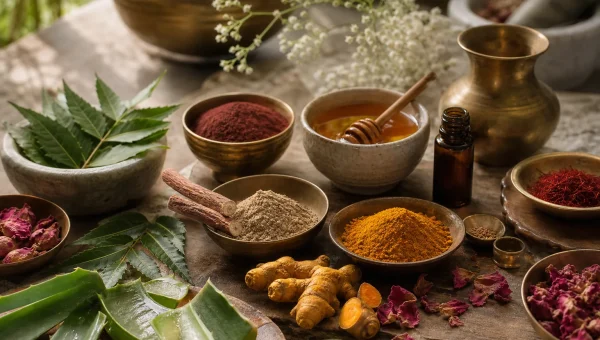
This is a balanced starting blend for people who are new to Udwarthanam and want a gentle but effective dry massage. Triphala is a well-known Ayurvedic formulation made from three fruits: Haritaki, Bibhitaki, and Amalaki. Besan and rice flour provide the main polishing texture, while a very small amount of dry ginger may be added only when the skin is not sensitive and Kapha-type heaviness is prominent.
- 2 tablespoons Triphala powder
- 2 tablespoons chickpea flour, also called besan
- 1 tablespoon fine rice flour
- 1 teaspoon sandalwood powder or dried rose petal powder, optional
- 1/4 teaspoon dry ginger powder, optional for non-sensitive Kapha-type skin
Mix thoroughly and store in an airtight jar. This blend is best used on normal or slightly oily skin. If turmeric is added, keep it to a small pinch because it can stain the skin, towels, and bathroom surfaces.
Blend 2: Kolakulathadi-Based Blend for Kapha-Meda Heaviness
Kolakulathadi churna is a traditional Ayurvedic powder used externally in body therapies including Udwarthanam. Classical and pharmacy versions commonly include ingredients such as Kola, Kulattha, Devadaru, Rasna, Masha, Atasi, Kushta, Vacha, Shatahva, Yava, and Eranda-related material, though the exact ingredient list can vary by manufacturer. This blend is stronger and more stimulating than a kitchen-flour blend, so it is best used with practitioner guidance, especially when the skin is reactive.
- 3 tablespoons Kolakulathadi churna from a reputable Ayurvedic pharmacy
- 1 tablespoon fine barley flour, also called yava flour
- 1 tablespoon fine horse gram powder, also called kulattha powder
Use this blend only if it feels warm and energizing, not sharp or irritating. Do not add mustard powder, black pepper, or large amounts of heating spices at home unless a qualified Ayurvedic practitioner has specifically advised it for you.
Blend 3: Gentle Snigdha Blend for Dry or Vata-Prone Skin
When the skin is thin, dry, rough, easily irritated, or Vata-prone, a fully dry and vigorous powder massage may aggravate the skin. In that case, the powder can be softened with a few drops of oil. This is closer to the idea of a gentler, snigdha powder massage rather than a strongly drying ruksha Udwarthanam.
- 3 tablespoons fine rice flour
- 1 tablespoon sandalwood powder
- 1 teaspoon licorice powder, also called mulethi or yashtimadhu
- 1 teaspoon Triphala powder, optional
- 5 to 10 drops warm sesame oil, just enough to soften the texture
The finished powder should still move easily over the skin. It should not become a sticky paste. This version is better for gentle exfoliation and skin care than for strong Kapha-Meda reducing work.
Step-by-Step Udwarthanam Technique at Home
For home practice, keep the method simple, clean, and moderate. Udwarthanam is traditionally done before bathing, often after the body is already warm. Choose a warm room, use an old towel, keep the floor dry enough to prevent slipping, and avoid practicing immediately after a heavy meal.
Before You Begin
Place the measured powder in a bowl and keep a towel nearby. Remove jewelry, tie up long hair, and make sure the skin is dry unless you are intentionally doing the gentle oil-softened version. The powder should be fine enough that it glides with friction rather than scratching the skin.
Step 1: Warm the Skin
Rub the palms together and briskly stroke the legs, arms, hips, and abdomen for one or two minutes. A soft natural-bristle brush may be used as a brief pre-step, but skip brushing if the skin is sensitive, inflamed, sunburned, or prone to irritation.
Step 2: Apply the Powder
Begin at the feet and legs. Take a small handful of powder and press it onto the skin so it does not fall immediately to the floor. Work section by section: feet, calves, thighs, hips, buttocks, abdomen, arms, shoulders, and back as reachable.
Step 3: Use Upward, Counter-Hair Strokes
On the legs, stroke from ankle toward thigh. On the arms, stroke from wrist toward shoulder. On the thighs and hips, use alternating upward strokes with both hands, followed by firm circular movements that still finish upward. On the abdomen, keep the pressure lighter and use slow clockwise circles. The pressure should feel firm, warm, and awakening, but it should not cause pain, burning, bruising, or broken skin.
Step 4: Spend Extra Time on Heavy Areas
Cellulite-prone areas such as the outer thighs, backs of thighs, and buttocks can receive a little more time, but intensity matters less than consistency and skin tolerance. For a home session, 15 to 30 minutes for the whole body is enough. Stop earlier if the skin becomes red in an angry way, itchy, hot, or uncomfortable.
Step 5: Rest Briefly, Then Rinse
After massaging, let the powder remain on the skin for a few minutes while you stand or sit on the towel. Then rinse with warm water. Use only a mild cleanser where needed, because the powder itself has already lifted sweat, surface oil, and dead skin cells.
Step 6: Finish According to Skin Type
If the skin feels dry, apply a very thin layer of warm sesame oil or a light body oil while the skin is still slightly damp. If the skin is naturally oily or Kapha-dominant, keep the finish minimal and avoid heavy oiling immediately after the session.
Frequency and Realistic Expectations
For home use, one to three sessions per week is a reasonable rhythm for most people with healthy, non-sensitive skin. A stronger Kolakulathadi-based routine should be individualized by a practitioner. More frequent or more aggressive rubbing does not necessarily create better results and may irritate the skin.
Expect smoother-feeling skin, a sense of warmth, lightness, and improved body awareness. Some people may notice a temporary improvement in the appearance of uneven texture because massage can move fluid and improve surface circulation for a short time. However, cellulite is partly structural, so Udwarthanam should not be promised as a permanent cellulite-removal treatment. Its deeper value is that it turns body care into a steady, embodied practice rather than a battle against the skin.
When Not to Practice Udwarthanam
Skip Udwarthanam over cuts, wounds, burns, sunburn, rashes, active infection, inflamed skin, unexplained lumps, bruises, or painful areas. Do not rub directly over varicose veins. Avoid strong dry massage during pregnancy unless a qualified maternity-trained practitioner and healthcare provider have cleared it for you. People with diabetes-related neuropathy, bleeding disorders, fragile skin, recent surgery, active skin disease, or significant chronic illness should seek professional advice before trying it.
If any powder causes burning, itching, wheals, rash, swelling, dizziness, or breathing discomfort, wash it off immediately and discontinue use. Essential oils are not necessary for Udwarthanam and can increase the risk of irritation when combined with friction.
Nothing in this article diagnoses or treats a medical condition. Use it as educational information and consult a qualified Ayurvedic practitioner or healthcare provider before starting herbs, supplements, detoxes, or therapeutic protocols, especially if pregnant, managing a condition, taking medication, or dealing with a skin or vascular condition.
References
- Mayoclinic (mayoclinic.org)
- Treatment for cellulite (2019), PubMed Central
- Cellulite: Current Understanding and Treatment (2023), PubMed Central
- Mayoclinic (mayoclinic.org)
- Astanga Hrudaya — Sutra Sthana 2.11-15
- Blog (blog.theayurvedaexperience.com)
- Ijmhsjournal (ijmhsjournal.in)
- Jaims (jaims.in)
- Webprod (webprod.hc-sc.gc.ca)
- Ayurmedinfo (ayurmedinfo.com)
- Thevaidyar (thevaidyar.com)
- Health (health.clevelandclinic.org)
- Sharedfiles (sharedfiles.mayoclinic.org)
- Mayoclinic (mayoclinic.org)
I had the same bag of creams situation before my first Udwarthanam treatment in a Kochi spa three years ago. The powdered herb massage is nothing like what I expected. It actually does something different to the tissue that no cream replicates.
Can this be done at home with a dry powder or does it require a trained therapist? The treatment seems technique-sensitive.
The understand your body framing rather than fix your body is actually something that changes how the treatment feels. I’ve had Udwarthanam at two places. The Ayurvedic practitioner who framed it as constitutional work versus the spa that sold it as cellulite reduction produced very different experiences.
The Kapha reduction rationale is more useful for understanding this treatment than the cellulite marketing around it. Cellulite is normal tissue. Kapha stagnation is a functional pattern that can be addressed.
I do a simplified home version with roasted chickpea flour and mustard oil. Not the full therapy but the lymphatic drainage component seems to work similarly. My legs feel lighter after.
How frequently should Udwarthanam be done to see results? The article describes the treatment but doesn’t specify duration of protocol.
The description of Meera’s grocery bag full of creams really resonated; it’s easy to fall into that cycle of trying topical fixes.
The difference between this and dry body brushing that’s popular in wellness circles is worth clarifying. Is the herb-specific component doing something the brushing alone doesn’t do?
I wonder if the Triphala blend would feel too rough on my sensitive skin; has anyone tried a patch test first?
The powder formulation matters a great deal. I had Udwarthanam at two different clinics with very different results. The one that used Triphala and Kollu churna was dramatically more effective.
The explanation of Kapha and Meda dhatu helped me see cellulite as a structural issue rather than a personal flaw.
I’ve had this treatment 6 times over 3 months. The skin texture change is real and measurable. The cellulite itself is maybe 20% improved which is more than any cream produced in two years.
Did the author mention how long the powder should sit before rinsing? I saw five minutes in the steps.
I appreciate the honesty about Udwarthanam not erasing cellulite completely; focusing on circulation feels more realistic.
The Kolakulathadi blend sounds intense; I’d be cautious about the mustard and black pepper causing heat.
Has anyone noticed improved skin texture after a few weeks of doing the upward strokes on thighs?
The tip about avoiding soap right after the massage makes sense; letting the water work first seems gentle on the skin.
unrelated question but has anyone found a good Ayurvedic practitioner in Hyderabad
Really useful breakdown of how Udwarthanam differs from regular massage. I had it done once at an Ayurvedic spa but the therapist didn’t explain the mechanics at all — just told me it was a detox treatment. Understanding that the coarse powder is working against hair growth direction and stimulating lymphatic drainage changes how I think about why it felt so different from a regular massage. Is the treatment effective if done monthly or does it need to be more frequent to see lasting results?
For Body Contouring, consistency seems like the hard part. The article avoids making it sound like a quick fix.
tried the DIY bath bomb recipe 2, got a skin reaction from the triphala content. patch test should be emphasized
For Body Contouring, consistency seems like the hard part. The examples make the advice less abstract.
for combination skin where T-zone is Pitta but cheeks are Vata dry, which face mist formulation is better
Reading this later and the Body Contouring advice still feels relevant. The timing advice is the part I would start with.
Reading this later and the Body Contouring advice still feels relevant. This feels more usable than a long list of herbs.
🙌 tried the DIY bath bomb recipe 2, got a skin reaction from the triphala content. patch test should be emphasized
winter body oil routine following this guide. sesame base with ashwagandha infused oil works beautifully asked this just now
The Body Contouring explanation is clearer than most short posts. The safety notes could be expanded a little.
tried the DIY bath bomb recipe 2, got a skin reaction from the triphala content. patch test should be emphasized asked this last week
winter body oil routine following this guide. sesame base with ashwagandha infused oil works beautifully asked this earlier
the Udwarthanam massage for cellulite, how many sessions before you see results typically
tried the DIY bath bomb recipe 2, got a skin reaction from the triphala content. patch test should be emphasized asked this recently
udwarthanam powder massage once a week for 6 weeks. the skin texture difference is real and my esthetician noticed
for combination skin where T-zone is Pitta but cheeks are Vata dry, which face mist formulation is better asked this recently
winter body oil routine following this guide. sesame base with ashwagandha infused oil works beautifully asked this recently
the Udwarthanam massage for cellulite, how many sessions before you see results typically asked this recently
This helped me understand Body Contouring without too much jargon. A few more examples would still help.
for combination skin where T-zone is Pitta but cheeks are Vata dry, which face mist formulation is better asked this earlier
Udwarthanam powder massage once a week for 6 weeks. the skin texture difference is real and my esthetician noticed asked this earlier
the Udwarthanam massage for cellulite how many sessions before you see results typically
This helped me understand Body Contouring without too much jargon. The main idea is clear even if someone is new to Ayurveda.
This helped me understand Body Contouring without too much jargon. Good starting point for a cautious reader.
the Udwarthanam massage for cellulite, how many sessions before you see results typically asked this earlier
winter body oil routine following this guide. sesame base with ashwagandha infused oil works beautifully asked this last week
I was looking for a plain explanation of Body Contouring. The practical details matter more than people think.
I was looking for a plain explanation of Body Contouring. This is the kind of detail readers can test slowly.
tried the DIY bath bomb recipe 2, got a skin reaction from the triphala content. patch test should be emphasized asked this earlier
I was looking for a plain explanation of Body Contouring. The examples make the advice less abstract.
for combination skin where T-zone is Pitta but cheeks are Vata dry, which face mist formulation is better asked this just now
Udwarthanam powder massage once a week for 6 weeks. the skin texture difference is real and my esthetician noticed asked this last week
tried the DIY bath bomb recipe 2, got a skin reaction from the triphala content. patch test should be emphasized asked this just now
the Udwarthanam massage for cellulite, how many sessions before you see results typically asked this just now