
If your skin feels greasy by noon, congested around the nose and chin, or suddenly breakout-prone after a quiet winter, your routine may simply be too heavy for spring. The rich creams, balms, and facial oils that protected dry winter skin can feel occlusive once warmth, humidity, sweat, and natural oiliness increase.
This spring transition keeps the original goal simple: lighten the routine without shocking the skin. Over two weeks, you will reduce winter-weight products, introduce a gentle Ayurvedic powder cleanser or ubtan, choose lighter hydration, and use classical herbs in a measured, skin-safe way.
Why Your Winter Routine Is Now Working Against You
Cold, low-humidity weather can leave skin drier and more vulnerable, so heavier moisturizers and occlusive balms often feel appropriate in winter. As the season warms, facial oiliness can rise and sweat becomes more noticeable. If the same heavy layers stay in place, they may leave the skin feeling greasy, trap debris, and contribute to clogged-looking pores, especially in the T-zone and along the jawline.
Ayurveda approaches this seasonal change through Vasanta Ritucharya, the spring regimen. Classical teaching describes Kapha accumulated in the cold season becoming more mobile in spring. For skincare, that means reducing heaviness, excess oil, and stagnation while still protecting the skin barrier. The spring goal is not harsh stripping; it is lighter cleansing, gentle exfoliation, and breathable hydration.
The 2-Week Spring Skincare Transition Schedule
Do not replace every product on the same day. A gradual two-week change gives the skin time to adjust and makes it easier to identify which product is helping or clogging.
Week 1: Reduce and Replace
The first week is about removing winter heaviness. Keep your routine familiar, but make each layer lighter and simpler.
Days 1-3: Cleanser swap
- Replace a heavy balm, cream cleanser, or oil cleanser with a gentle gel, light lotion cleanser, or simple non-scrubbing powder cleanser.
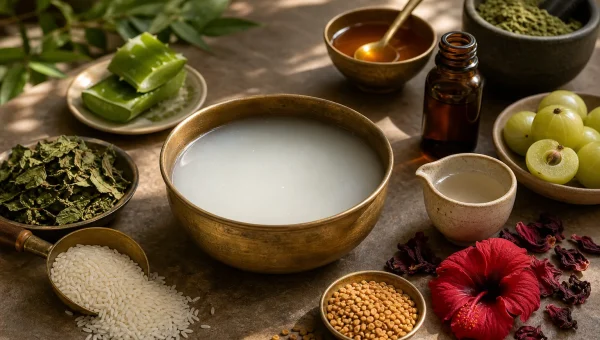
- Ayurvedic option: mix 1 tablespoon gram flour with a very small pinch of Haridra (turmeric) and enough rose water, plain water, or aloe gel to make a soft paste. Massage lightly on damp skin and rinse well. Avoid the eye area, do not scrub, and use very little turmeric because it may stain.
- For oily, congested skin, a small pinch of Nimba leaf powder may be added occasionally. Keep the paste mild; more herb powder does not make the cleanser better.
Days 4-5: Moisturizer downgrade
- Switch from a heavy night cream, shea-butter balm, or layered facial oil to a lightweight lotion, gel-cream, or aloe-based moisturizer.
- Apply moisturizer to slightly damp skin so the skin receives hydration without needing a thick occlusive layer.
- If you use facial oil, pause it for two nights. If the skin feels comfortable, reintroduce only 1-2 drops on damp skin rather than a full layer.
Days 6-7: Introduce spring exfoliation
- Use a mild ubtan once during the first week. If your skin is resilient and oily, use it twice. If you are dry, sensitive, peeling, or using strong actives, keep it to once weekly or skip it until the skin is calm.
Week 2: Add Active Spring Care
Once the heavy winter layers are reduced, the second week adds gentle seasonal support: a mild herbal mask, regular but restrained exfoliation, and a stable daily routine.
Days 8-10: Add an Amalaki mask
- Mix 1 teaspoon Amalaki powder with rose water, plain water, or aloe gel. Apply a thin layer for 5-8 minutes, then rinse gently.
- Use once every three days at most. Do not combine it on the same night with strong exfoliating acids, retinoids, scrubs, or irritated skin.
- Amalaki is classically described as cooling, light, dry, and Rasayana. In skincare language, it suits spring when the goal is freshness without adding oiliness.
Days 11-14: Establish your spring routine
- Morning: gentle cleanse, light moisturizer only if needed, and sunscreen.
- Evening: cleanse after sweat, pollution, or sunscreen; moisturize lightly; use ubtan or an herbal mask only on scheduled nights.
- At day 14, assess the skin. If congestion is improving, continue. If the skin feels tight, reduce exfoliation. If breakouts are inflamed, painful, cystic, or worsening, stop experiments and seek professional care.
The Ubtan: Ayurveda’s Spring Powder Cleanse
Ubtan is a powder-paste cleansing and exfoliating practice related to Ayurveda’s broader use of dry and paste-based body care. For spring, it works best when kept gentle: fine powders, light pressure, short contact time, and no aggressive scrubbing.
Spring Ubtan Recipe for Face and Body:
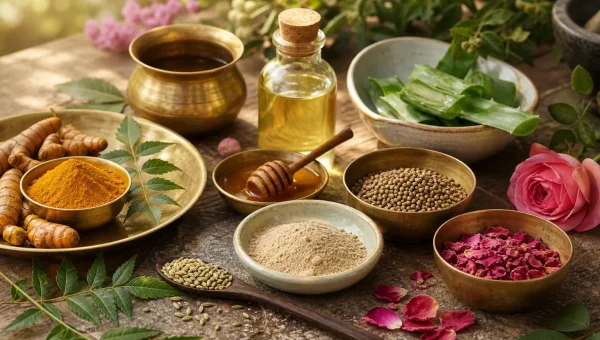
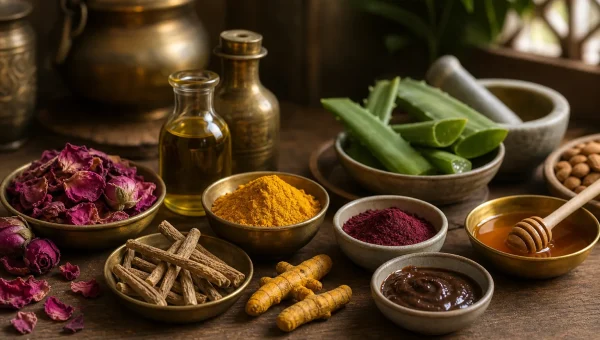
- 4 tablespoons gram flour
- 1 tablespoon finely powdered rice flour for oilier skin, or finely powdered oats for more sensitive skin
- 1/8 to 1/4 teaspoon Haridra powder
- 1/4 teaspoon Lodhra powder, optional
- 1/4 teaspoon Manjistha powder, optional
- Liquid: rose water for oily or combination skin, plain water for sensitive skin, or aloe gel for dehydrated skin
Preparation and use:
- Mix the dry ingredients and store the base in an airtight jar.
- Before each use, take 1-2 tablespoons of the dry mix and add liquid until it becomes a soft paste.
- Apply to damp skin with light circular movements. On the face, use very gentle pressure and avoid the eye area. On the body, use slightly firmer pressure but do not scrape the skin.
- Leave on for 3-5 minutes on the face or up to 10 minutes on the body.
- Rinse with lukewarm water. Stop immediately if there is burning, itching, or prolonged redness.
Frequency: Use once or twice weekly on the face and weekly on the body. Oily, thick, resilient skin may tolerate the higher end; sensitive, dry, acne-inflamed, rosacea-prone, or eczema-prone skin should use it rarely or not at all.
Spring Face Oils: Lighter Is Better
You do not have to abandon facial oils if your skin genuinely likes them. The spring adjustment is about reducing dose and heaviness. Use fewer drops, apply only at night, and stop any oil that makes the skin look bumpy or congested.
| Winter Layer | Spring Adjustment | Why It Fits Spring |
|---|---|---|
| Sesame oil used generously on the face | Pause facial use or use only 1-2 drops at night | Sesame oil is traditionally warming and substantial; spring care favors lightness. |
| Almond oil or thick facial oil | Try jojoba oil in a very small amount, or skip oil and use a gel-cream | Jojoba is a liquid wax rich in wax esters and often feels lighter than many plant oils. |
| Shea butter, cocoa butter, or rich balm | Use aloe gel under a light moisturizer | This gives hydration without the heavy, sealed-in feeling of a butter-based balm. |
| Rich night cream plus oil | Choose one light moisturizer layer | Spring skin usually does better with fewer layers and less occlusion. |
Kumkumadi Taila deserves careful handling. Classical and traditional formulas vary, but Kumkuma and sesame oil are common elements in reviewed formulations. Because it is still an oil-based preparation, use only 1-2 drops on damp skin at night, two or three times weekly, and skip it during active congestion or acne flare-ups. Buy from a reputable manufacturer and check the ingredient list, especially if you avoid mineral, animal-derived, or strongly fragrant ingredients.
Spring-Specific Concerns and Solutions
Most spring skin complaints come from the same mismatch: warmer weather and more oiliness meeting a routine built for winter dryness. Correct the mismatch first before adding more products.
Spring Acne Flare-Ups
If breakouts appear with greasiness and closed bumps, simplify for two weeks. Stop heavy facial oils, butter-based balms, overnight masks, and repeated exfoliation. Cleanse gently, moisturize lightly, and avoid picking. For spot care, use only a brief turmeric-water or turmeric-honey paste for 10-15 minutes, then rinse; do not leave raw turmeric on overnight. A properly diluted, low-strength tea tree product may suit some oily skin, but undiluted essential oil should not be applied directly to the face.
Under-Eye Puffiness
Spring puffiness fits the broader Kapha pattern of heaviness and fluid retention, but the eye area is delicate. Use a cool compress or chilled cucumber slices for 5-10 minutes, keep liquids out of the eyes, and avoid vigorous rubbing. If swelling is persistent, painful, one-sided, or linked with allergy symptoms, seek medical advice.
Dull, Winter-Fatigued Skin
For dullness, choose mild renewal rather than sharp acids. Use the Amalaki mask once weekly, or apply a simple honey and rose-water mask for 10 minutes before rinsing. Avoid lemon juice on the face, especially before sun exposure or on sensitive skin, because it can irritate and increase photosensitivity.
A Simple Daily Spring Routine
Keep spring skincare clean and repeatable. In the morning, cleanse gently or rinse with lukewarm water, apply a light moisturizer if needed, and use sunscreen. In the evening, cleanse after sweat, sunscreen, pollution, or makeup, then apply one light hydrating layer. Use ubtan or an herbal mask only on selected nights rather than turning every evening into a treatment.
When to Hold Back
Do not exfoliate over cuts, sunburn, active infection, painful acne, eczema flares, rosacea flares, or recently treated skin. Patch-test herbal powders and oils on a small area first. Stop any product that causes burning, swelling, itching, or persistent redness. Herbs, essential oils, and classical oils are still active substances and should be treated with respect.
Spring skin usually does not need punishment; it needs a wardrobe change. Lighten the cleanser, reduce heavy moisturizers, use ubtan gently, and choose breathable hydration. By the end of two steady weeks, oily congestion should feel easier to manage without stripping the skin.
Nothing in this article diagnoses or treats a medical condition. Use it as educational information and consult a qualified Ayurvedic practitioner, dermatologist, or healthcare provider before starting herbs, medicated oils, supplements, detoxes, or therapeutic protocols, especially if pregnant, managing a skin condition, or taking medication.
References
- Regional and seasonal variations in facial sebum secretions: a proposal for the definition of combination skin type (2005), PubMed
- Onlinelibrary (onlinelibrary.wiley.com)
- NCBI
- Aad (aad.org)
- Charaka Samhita — Tasyashiteeya Adhyaya
- Ritucharya: Answer to the lifestyle disorders (2011), PubMed Central
- Ayurvedic Pharmacopoeia of India
- Ayurvedic Pharmacopoeia of India
- Ayurvedic Pharmacopoeia of India
- Jojoba Oil: An Updated Comprehensive Review on Chemistry, Pharmaceutical Uses, and Toxicity (2021), PubMed Central
- Efficacy and safety of Melaleuca alternifolia (tea tree) oil for human health-A systematic review of randomized controlled trials (2023), PubMed Central
- Ijdvl (ijdvl.com)
- Ijapr (ijapr.in)
- Honey in dermatology and skin care: a review (2013), PubMed
- Healthline (healthline.com)
- Allure (allure.com)
- NCCIH
The forehead and cheek breakout pattern in spring is exactly what I get every March. I never connected it to my heavy winter moisturizer. Switched to a lighter Neem and aloe base this week and the congestion is already clearing.
The two-week transition checklist is the kind of practical structure I have been looking for. Most skincare articles describe the seasonal shift conceptually. Actually telling me which product to remove first and in what order is much more useful.
I live in a climate with very short spring. We go from cold to humid hot in about 3 weeks. The gradual 2-week transition described here is not realistic for everyone. How do you handle a very abrupt seasonal shift?
Is there a meaningful difference between switching to lighter products all at once versus gradually phasing them out? I’m worried about shocking my skin by going from a thick winter cream straight to a water-based moisturizer in one step.
This resonates so much. I have a Pitta constitution and my skin goes haywire every March without fail — suddenly the rich cream that was perfect in December starts causing congestion and little bumps around my chin. Switching to a lighter gel moisturizer and dropping the facial oil has been the single biggest spring change for me.
I have oily skin year round and this article suggests light products in spring. But my skin actually needs more hydration in spring than summer because of the dehumidifier I use at home through winter. Does the seasonal advice here assume a particular indoor environment?
Switched from my winter rosehip oil routine to a lighter niacinamide serum two weeks ago and my skin finally stopped feeling congested by midday. The timing matched almost exactly with what you describe. What I’m still figuring out is whether to keep a small amount of facial oil for evenings only through spring, or whether even that is too much once the humidity starts climbing.
My dermatologist has never mentioned seasonal skincare adjustment. She gives me the same prescription year round for my seborrheic dermatitis. After reading this I am wondering whether the spring flares I get every year are a Kapha response rather than a random fluctuation.
The suggestion to swap cream cleanser for a neem or turmeric gel makes sense for spring humidity.
The connection between internal diet changes and skin transition is the part most people miss. Switching to lighter food alongside lighter skincare in spring makes the transition smoother. I tried the skincare change alone last year with modest results. This year I did both and the difference was significant.
The Kapha dosha explanation for why skin gets congested and dull in spring is a more satisfying framework than just saying your pores are clogged. Understanding why the body shifts toward accumulation in late winter helps me address the cause rather than just treat the symptom.
Question: does the Ubtan recipe work if I only have chickpea flour instead of gram flour?
Noticing my T zone gets shiny by midday, reducing occlusive balms helped a bit.
The two week transition schedule feels realistic without overwhelming the skin barrier.
Has anyone tried the amalaki pulp mask and seen a difference in breakouts?
Switching from sesame oil to jojoba at night kept my skin from feeling heavy.
Appreciating the tip about using raw milk for dry skin and rose water for oily zones.
The explanation about Kapha aggravation clarified why my jawline breaks out in March.
Trying the chilled cucumber trick for under eye puffiness gave me a quick refresher.
Wondering if the light moisturizer downgrade should happen before or after exfoliation.
tried the DIY bath bomb recipe 2, got a skin reaction from the triphala content. patch test should be emphasized
The article’s link between winter sebum drop and spring oil increase matches what I’ve read elsewhere.
for combination skin where T-zone is Pitta but cheeks are Vata dry, which face mist formulation is better
for combination skin where T-zone is Pitta but cheeks are Vata dry, which face mist formulation is better asked this last week
I liked the practical side of Spring Skincare Revolution. I would like to know how long to try it before judging results.
winter body oil routine following this guide. sesame base with ashwagandha infused oil works beautifully
Needs more proof ❤️
does the rose water need to be double-distilled or is commercial rose water okay for the hydration mist
winter body oil routine following this guide. sesame base with ashwagandha infused oil works beautifully asked this recently
the Udwarthanam massage for cellulite, how many sessions before you see results typically asked this last week
the Udwarthanam massage for cellulite, how many sessions before you see results typically
This helped me understand Spring Skincare Revolution without too much jargon. This would be easier to follow with a one-week sample plan.
This helped me understand Spring Skincare Revolution without too much jargon. The examples make the advice less abstract.
does the rose water need to be double-distilled or is commercial rose water okay for the hydration mist asked this last week
tried the DIY bath bomb recipe 2, got a skin reaction from the triphala content. patch test should be emphasized asked this last week
does the rose water need to be double-distilled or is commercial rose water okay for the hydration mist asked this earlier
the Udwarthanam massage for cellulite, how many sessions before you see results typically asked this earlier
I was looking for a plain explanation of Spring Skincare Revolution. I appreciate that it does not oversell the result.
switched to a rose water base face mist with brahmi extract and my Pitta skin redness reduced within 10 days
does the rose water need to be double-distilled or is commercial rose water okay for the hydration mist asked this recently
for combination skin where T-zone is Pitta but cheeks are Vata dry, which face mist formulation is better asked this just now
does the rose water need to be double-distilled or is commercial rose water okay for the hydration mist the timing matters here
The advice around Spring Skincare Revolution is specific enough to be useful. The safety notes could be expanded a little.
winter body oil routine following this guide. sesame base with ashwagandha infused oil works beautifully asked this last week
for combination skin where T-zone is Pitta but cheeks are Vata dry, which face mist formulation is better asked this earlier
Good reminder on Spring Skincare Revolution. I would still ask a practitioner before changing medicines.
for combination skin where T-zone is Pitta but cheeks are Vata dry, which face mist formulation is better asked this recently
switched to a rose water base face mist with brahmi extract and my Pitta skin redness reduced within 10 days asked this earlier
No results for me
ठीक है। the Udwarthanam massage for cellulite, how many sessions before you see results typically