
Reading the descriptions of unmada in the Charaka Samhita can produce a sense of clinical recognition. The text records disturbed speech, inappropriate laughter or weeping, agitation, withdrawal, impaired memory and intellect, altered conduct, and difficulty regulating behaviour. These observations overlap with phenomena seen in modern psychiatry, including psychosis, mania, severe mood disturbance, catatonia, delirium, and some neurological or substance-related states. However, unmada is a classical Ayurvedic syndrome, not an ancient synonym for schizophrenia, bipolar disorder, or any single present-day diagnosis. Responsible comparison requires attention to similarities without claiming one-to-one equivalence.
Classical Definition and Scope
Charaka Samhita, Nidana Sthana 7 and Chikitsa Sthana 9 describe unmada as a broad disorder in which the functions of mind, intellect, memory, awareness, preferences, character, activity, conduct, and behaviour become disturbed. The online critical translation renders the term as frenzy, madness, or mental derangement and stresses that it represents a group of major mental disorders rather than one disease. The frequently quoted definition belongs to this classical framework; it should not be described as anticipating modern “multi-axis” diagnosis, because contemporary psychiatric systems use different concepts, criteria, and methods.
The Five Types Described by Charaka
Charaka Samhita, Nidana Sthana 7.3 lists five types: vata-dominant, pitta-dominant, kapha-dominant, sannipataja arising from the combined disturbance of all three doshas, and agantuja associated with exogenous causes in the classical worldview. These categories organise signs, causation, and treatment according to Ayurvedic theory. They are not validated substitutes for a psychiatric examination, medical work-up, toxicology assessment, or neurological evaluation.
Vataja Unmada
The classical description of vataja unmada includes constant wandering, irregular movements of the eyes and limbs, continuous irrelevant or incoherent speech, inappropriate smiling, laughing, dancing, singing or weeping, roughness, emaciation, and aggravation from factors considered to increase vata. This may resemble modern states marked by psychomotor agitation, disorganisation, mania, intoxication, delirium, or excited catatonia, but the signs are not specific enough to establish any of those diagnoses. Charaka’s treatment chapter begins the management of a vata-dominant presentation with unctuous measures and then modifies the plan according to obstruction, strength, digestion, and the patient’s overall condition.
Pittaja Unmada
Pittaja unmada is described with inappropriate anger, intolerance, agitation, threatening or assaultive behaviour, running about, bodily heat, a desire for shade, cold water or cooling food, and altered coloration of the eyes or complexion. The verse supports describing an activated, heated, irritable, and potentially dangerous presentation; it does not support equating pittaja unmada specifically with bipolar I disorder or substance-induced psychosis. In modern care, sudden aggression, severe insomnia, confusion, fever, intoxication, or a change in consciousness requires urgent assessment for psychiatric and medical causes.
Kaphaja Unmada
Kaphaja unmada includes immobility or remaining in one place, little speech, reduced movement, loss of appetite, preference for isolation, drowsiness or excessive sleep, salivation or nasal discharge, aversion to cleanliness, facial swelling, and dull or soiled-looking eyes. Some features may superficially resemble psychomotor slowing, depressive withdrawal, negative symptoms, medication effects, stupor, or catatonia. These similarities are descriptive only. A person with mutism, stupor, inability to eat or drink, marked drowsiness, or a rapid decline in self-care needs prompt clinical evaluation rather than dosha-based self-treatment.
Sannipataja Unmada
Sannipataja unmada presents with features of all three doshic types together. Nidana Sthana 7.7 states that this combined form is considered asadhya, and Chikitsa Sthana 9.15 describes it as severe and difficult to treat because the therapeutic principles may conflict. The text does not say that early cases are reliably curable, nor does it identify this category with schizoaffective disorder or “rapid cycling.” Those modern labels require their own diagnostic criteria.
Agantuja Unmada
Agantuja unmada is defined in the diagnostic chapter as having causes, prodromal signs, symptoms, distress, and responses to treatment that differ from dosha-origin unmada. Charaka discusses it through the religious and cultural language of deva, gandharva, yaksha, rakshasa, pishacha, ancestors, vows, conduct, and prajnaparadha. It is historically inaccurate to translate this entire category directly as trauma, infection, intoxication, or metabolic encephalopathy. A modern clinician should instead assess new psychotic or behavioural symptoms for psychiatric illness, medication effects, sleep deprivation, alcohol or drug use, neurological disease, infection, endocrine or metabolic disturbance, and other medical causes.
Comparison with Modern Psychiatry
The most defensible comparison is phenomenological: both systems notice changes in speech, perception, activity, sleep, emotional expression, memory, self-care, and social conduct. Modern psychosis is a collection of symptoms involving some loss of contact with reality and may occur in schizophrenia, bipolar disorder, severe depression, substance-related conditions, neurological disease, or other medical illness. The table therefore shows broad areas of overlap rather than diagnostic equivalence.
| Classical Type | Verified Classical Features | Possible Modern Observations | Important Limitation |
|---|---|---|---|
| Vataja | Wandering, irregular movement, incoherent or irrelevant speech, inappropriate laughter, singing or weeping | Agitation, disorganisation, mania, delirium, intoxication, or excited catatonia | No one-to-one diagnosis |
| Pittaja | Anger, agitation, threatening or assaultive behaviour, heat, desire for cooling | Severe mood activation, psychotic agitation, intoxication, or medical delirium | Urgent risk and medical assessment may be needed |
| Kaphaja | Reduced speech and movement, isolation, excessive sleep, poor appetite, salivation | Depressive slowing, negative symptoms, sedation, stupor, or catatonia | Mutism or stupor is a medical priority |
| Sannipataja | Combined features of all three doshic types | Complex or mixed presentations | Not equivalent to schizoaffective disorder |
| Agantuja | Classically framed exogenous presentations with distinctive causes and signs | Prompts a broad differential diagnosis in modern practice | Classical spirit-language should not be relabelled as biomedical causation |
What the Classical Treatment Chapter Actually Contains
Charaka Samhita, Chikitsa Sthana 9 presents an extensive, individualised programme rather than a simple herb list. It includes yukti-vyapashraya treatment selected according to dosha and patient strength, along with supportive or consoling measures, mental guidance associated with sattvavajaya, and religious practices appropriate to the text’s historical setting. The chapter also describes oleation, fomentation, emesis, purgation, basti, nasya, medicated ghee, massage, bathing, dietary progression after purification, and numerous specialised preparations. Several procedures are invasive, irritant, or otherwise unsafe outside trained clinical practice and should never be attempted at home.
Purification and Medicated Ghee
The treatment sequence is conditional, not universal. Charaka describes unctuous treatment for vata-dominant illness, emesis for selected kapha-dominant cases, and purgation for selected pitta-dominant cases, followed by a graded post-procedure diet. Formulations recorded in the chapter include Kalyanaka Ghrita and other medicated ghees. Their presence in a classical text verifies historical use; it does not establish efficacy for schizophrenia or acute psychosis by current clinical-trial standards. Panchakarma in a confused, medically unstable, dehydrated, restrained, pregnant, elderly, or heavily medicated patient may carry substantial risk and requires direct supervision by a qualified Ayurvedic physician working with the psychiatric team.
Brahmi: Correct Identity and Classical Properties
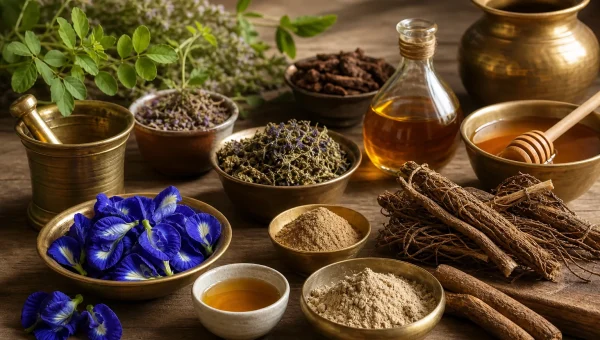
The Ayurvedic Pharmacopoeia of India, Part I, Volume II identifies Brahmi as the dried whole plant of Bacopa monnieri. Its monograph gives madhura, tikta and kashaya rasa; laghu and sara guna; shita virya; madhura vipaka; and actions including medhya and rasayana. It lists manasavikara among therapeutic uses and gives 1–3 g as the powder dose for the pharmacopoeial crude drug. This does not verify the original claims that Brahmi is the principal treatment for every unmada subtype, that 5–10 g powder or 20–30 ml juice twice daily is a standard psychiatric dose, or that 300 mg twice daily is a universally appropriate extract dose. Product strength and extract standardisation vary, and Brahmi should not be presented as an antipsychotic.
Shankhapushpi: Identity Matters
The same pharmacopoeial volume identifies Shankhapushpi as the whole plant of Convolvulus pluricaulis. It records katu, tikta and kashaya rasa; sara guna; shita virya; katu vipaka; and actions including medhya, rasayana, pittahara and kaphahara. The monograph lists manasaroga and apasmara as therapeutic uses and a powder dose of 3–8 g. It also notes that Clitoria ternatea and Evolvulus alsinoides are used as Shankhapushpi in some regions, making botanical identification important. No verified classical citation supports calling it the premier remedy specifically for vataja and pittaja unmada, and human evidence does not establish it as a treatment for psychosis.
Jatamansi, Ashwagandha and Guduchi
The online commentary accompanying Unmada Chikitsa includes Jatamansi and Ashwagandha in a compiled list of single drugs discussed in relation to unmada, but a compiled list is not proof that either herb treats modern psychosis. No verifiable classical passage or pharmacopoeial monograph was found supporting the original article’s precise claims about GABA modulation, rebound-free sedation, cortisol reduction in acutely agitated psychosis, or Guduchi as a specific remedy for pittaja unmada. Exact bedtime and twice-daily doses have therefore been removed. In psychosis, any herb should be selected only after reviewing the diagnosis, botanical identity, formulation, pregnancy, relevant liver or thyroid concerns, and possible interactions with antipsychotics, mood stabilisers, sedatives, anticonvulsants, and other medicines.
Diet and Supportive Care
Charaka includes dietary planning and a graded return from lighter to heavier food after purification. The treatment chapter specifically mentions cooling, sweet, and light food and drink in pitta-dominant management, while broader Ayurvedic practice individualises food according to digestion, strength, season, and dosha. The original rigid menu of warm-oily food for every vata presentation, coconut and bitter greens for every pitta presentation, and dry-pungent food for every kapha presentation was not supported by a cited verse and has been removed. In current care, regular meals, adequate fluids, sleep restoration, avoidance of alcohol and recreational drugs, and monitoring for inability to eat or drink are more immediately important than a dosha menu.
What Modern Research Can and Cannot Show
Human research on these herbs does not validate the classical subtypes or establish an Ayurvedic cure for psychosis. Systematic reviews of Bacopa monnieri have mainly examined memory and attention in adults without major cognitive impairment; they do not demonstrate antipsychotic efficacy. A small 12-week randomised placebo-controlled adjunctive study of a standardised Withania somnifera extract in people with schizophrenia reported signals for some symptoms, and a secondary analysis reported possible improvement in depression and anxiety scores. These early findings concern a particular extract used alongside standard treatment and are not grounds for replacing antipsychotic medication or generalising to all Ashwagandha products.
Mechanistic findings from cells or animals—such as effects on neurotransmitters, inflammation, or oxidative pathways—cannot by themselves prove clinical benefit in schizophrenia, bipolar mania, delirium, or acute psychosis. The original statements that Brahmi and Shankhapushpi act on central psychiatric drug targets, that Guduchi’s alkaloids “clear” pittaja psychosis, and that neuroinflammation forms a validated bridge between dosha theory and schizophrenia were overstated and have been removed.
Safety, Referral and Ethical Use
Psychosis may involve delusions, hallucinations, incoherent speech, disorganised behaviour, severe withdrawal, impaired self-care, or difficulty recognising reality. It can arise from psychiatric illness, sleep deprivation, prescribed medicines, alcohol or drugs, neurological disease, and other medical causes. Early assessment matters. Current evidence-based treatment commonly includes antipsychotic medication and may also include psychotherapy, family education, case management, supported work or education, and coordinated specialty care. Ayurvedic care, when desired, should be complementary and coordinated with a psychiatrist or other qualified mental-health professional.
Do not stop antipsychotics, mood stabilisers, benzodiazepines, anticonvulsants, or other prescribed medicines abruptly. Ashwagandha may cause drowsiness and gastrointestinal effects, has been linked rarely with liver injury, and may interact with sedatives, anticonvulsants, thyroid medicines, immunosuppressants, and medicines for diabetes or blood pressure. Safety data for many multi-herb and herbo-mineral products are limited, and product quality varies. Consult a qualified Ayurvedic practitioner and the treating healthcare provider before adding any herb or classical formulation.
Practical guidance: Do not begin a “Brahmi tea” routine as treatment for psychosis. A safer supportive action is to help the person obtain prompt professional assessment, keep the environment calm, reduce noise and confrontation, support regular food, fluids and sleep where possible, document all medicines and substances used, and remain alert for immediate danger. Seek emergency care when there is risk of self-harm or harm to others, extreme agitation, inability to eat or drink, severe confusion, fever, seizure, collapse, rapidly changing consciousness, or suspected overdose.
References
- Charaka Samhita — Unmada Nidana
- Charaka Samhita — Unmada Chikitsa
- Ayurvedic Pharmacopoeia of India
- The cognitive-enhancing effects of Bacopa monnieri: a systematic review of randomized, controlled human clinical trials (2012), PubMed
- Meta-analysis of randomized controlled trials on cognitive effects of Bacopa monnieri extract (2014), PubMed
- Adjunctive Use of a Standardized Extract of Withania somnifera (Ashwagandha) to Treat Symptom Exacerbation in Schizophrenia: A Randomized, Double-Blind, Placebo-Controlled Study (2018), PubMed
- Effects of a standardized extract of Withania somnifera (Ashwagandha) on depression and anxiety symptoms in persons with schizophrenia participating in a randomized, placebo-controlled clinical trial (2019), PubMed
- Nimh (nimh.nih.gov)
- World Health Organization
- NCCIH
I’m a psychiatry resident and this is one of the more intellectually honest Ayurveda articles I’ve encountered. The comparison of unmada classifications with modern nosology is done carefully without claiming exact equivalence where none exists.
The description of Kapha-type unmada with its slow, apathetic presentation maps almost exactly onto what we now recognize as negative-symptom schizophrenia. The Ayurvedic texts may have been observing the same clinical phenomenon with different explanatory frameworks.
This makes sense for Unmada (Psychosis) in Ayurvedic Texts. Good starting point for a cautious reader.
My uncle was diagnosed with bipolar 1 last year. His mother, my dadima’s generation, would have called what he experienced ‘pitta going to the head during summer.’ The observational accuracy is striking even if the mechanism was different.
The treatment protocols described for Vata-type unmada Mastishka Basti, specific oils are these still used at specialized Ayurvedic psychiatric facilities? I’ve heard of places in Kerala that treat mental illness but couldn’t find reliable information.
The section on nutritional causes of unmada is ahead of its time in terms of observational acuity. The classical texts linking diet, seasonal changes, and psychotic presentation that’s essentially what the nutritional psychiatry field has been trying to validate for the last decade.
The explanation of vataja unmada made me think about how agitation shows up in everyday stress.
Is there a currently practicing Ayurvedic psychiatrist who has published their clinical approach to acute psychosis management? The article provides historical framework but I’d want to know what contemporary integrative practitioners actually do when someone is in crisis.
I have bipolar disorder and I’ve tried integrating Ayurvedic herbs under supervision alongside my mood stabilizers. The Brahmi and Jatamansi helped significantly with the anxiety component. I’m careful not to overstate this medication compliance was my foundation.
I wonder how practitioners decide which of the five types fits a patient when symptoms overlap.
The Pitta-dominant unmada mapped onto mania description is clinically plausible the excess heat, movement, the inability to slow down. But linking this to modern biochemistry without addressing the neurotransmitter models feels incomplete.
I work in a mental health NGO in Hyderabad. The stigma around mental illness is still severe and many families in rural areas turn to traditional practitioners first. Understanding how Ayurvedic systems categorized and treated these conditions helps us bridge that gap.
The part about sannipataja being labeled asadhya caught my attention; it seems serious.
The claim that Ayurvedic anti-psychotic herbs like Sarpagandha (Rauwolfia) laid the foundation for modern antipsychotics is well established in the pharmacology literature. Reserpine was the first antipsychotic and came directly from this plant. So at least that claim has concrete historical backing.
Reading about agantuja unmada made me consider external factors like sleep loss more carefully.
I appreciated the caution against equating pittaja unmada directly with bipolar disorder.
The article should address more clearly whether Ayurvedic treatment can be used during acute psychosis versus as maintenance support. Those are very different clinical situations and conflating them could lead to dangerous decisions.
The description of kaphaja unmada reminded me of how lethargy can look like depression.
It’s interesting that the text stresses unmada as a group of disorders rather than one disease.
I found the table comparing classical features to modern observations useful for quick reference.
Would this protocol work if I travel frequently and can’t maintain a fixed routine.
The classical protocol here matches what worked for my mother after two years of trying other approaches. The timeline was similar too, about 10 weeks.
where can you source the herbs in india outside of major cities? im in a tier-2 town
the dosage here seems higher than what my ayurvedic doctor recommended, a bit concerned
off topic but has anyone here tried this approach for hair loss? curious if similar principles apply
The part about kapha-unmada describing a kind of withdrawn, stuporous state is interesting to me because it challenges the popular image of psychosis as always being loud or agitated. I’d be curious whether Ayurvedic physicians historically distinguished unmada from apasmara in cases where the presentation was mainly dissociative rather than openly manic.
Will try this
Appreciate that this goes into contraindications, most blogposts skip that part.
I would like more detail on Unmada (Psychosis) in Ayurvedic Texts. This is the kind of detail readers can test slowly.
The note about Brahmi not being an antipsychotic is important for anyone considering herbs.
The recipe proportions seem higher than what I see in other sources, is the difference intentional.
Starting this next week, will come back to report results in about a month.
what would the western equivalent supplement be for someone who cant get the herb locally
bookmarked this to share with my mother who has been struggling with the same issue for years
Shankhapushpi’s variable identification across regions shows why botanical accuracy matters.
reading this after finding it on google, has the recommended dose changed since 2026?
just found this post, the section 3 protocol seems intensive for a beginner, any lighter version
The parallel between the Charaka description of Vataja unmada and what we now recognize as a manic episode with psychomotor agitation is striking. I work in mental health and have wondered whether any comparative clinical studies exist mapping these classical subtypes to modern DSM categories. Has this been attempted formally, or is the literature still mostly theoretical?
the table in the middle of the article was very clear but i couldn’t figure out the seasonal column
Not sure I trust the quality of supplements available online, too many adulterated products out there.
How does this compare to the classic Ashtanga Hridayam recommendation on the same topic.
Late to this but wanted to ask, do these recommendations still hold or has newer research changed anything. ठीक है
This works in theory but practically very hard to source authentic herbs in most parts of India.
Just started exploring Ayurveda after years of allopathy, this is helpful as an intro but still a lot to absorb.
The warning about trying Panchakarma at home without supervision feels necessary.
the section on quality sourcing was a surprise, didnt know the extract grade mattered this much
tried this for 6 weeks and saw no difference, maybe im applying it wrong but nothing changed for me 🙏
Where are the actual clinical trials for this? referencing classical texts is fine but I need RCT data before trying.
Been following this for 3 weeks now and my energy levels are much better, the protocol you described really clicked for me. 🙏
What strikes me reading the Charaka Samhita descriptions here is how precisely the vata-unmada type maps onto what we’d now call disorganized schizophrenia. The restless movement, the incoherent speech, the self-neglect — the clinical overlap is genuinely hard to dismiss as coincidence. Has anyone found modern psychiatric literature that actually engages with these classical categories rather than just noting superficial parallels?
I liked the reminder to keep environment calm and monitor food intake when someone is unwell.
Useful post on Unmada (Psychosis) in Ayurvedic Texts. The article avoids making it sound like a quick fix.
how does this compare to the classic ashtanga hridayam recommendation on the same topic
This is the kind of content that makes people delay real medical care, that concern is valid.
is this suitable for pitta dominant people or mainly vata? i get confused about the cross-dosha applications
some of these claims are very strong for what is essentially anecdote-level evidence
what brand of the extract do you personally use or recommend? the market is full of fake products
The section on Guduchi made me realize how specific claims need solid evidence.
is there a hindi or regional language resource you’d recommend alongside this for my parents
Feels like a lot of the advice is very general, my case is quite specific and this didn’t really address it.
Useful post on Unmada (Psychosis) in Ayurvedic Texts. The examples make the advice less abstract.
Seeing the treatment steps like oleation and fomentation helped visualize the classical approach.
how do i know if im seeing genuine results vs just placebo? any markers to watch
my constitution is vata-pitta, the article seems to focus on one or the other, any advice
Quick question: does the dosage change if someone is also on metformin? asked my doc but he wasn’t sure.
packaging this as science when most of it is tradition makes me skeptical, need more rigorous sourcing
can pregnant women follow this or are there modifications? the article doesn’t address that specifically
@Aman Been eating the kitchari variation from this post 4 days a week, feels lighter in the mornings.
Tried the morning routine from this article and noticed a difference by day 5, not placebo I think. धन्यवाद
anyone know if this is okay for kids or only adults? my 14 year old has similar symptoms
how do i know if im seeing genuine results vs just placebo? any markers to watch धन्यवाद
The article’s emphasis on coordinating Ayurvedic care with psychiatry feels responsible.
How long before seeing results typically? the article mentions 4 to 6 weeks but is that for everyone.
i have low agni according to my vaidya, does that change which phase to start with
started teh triphala protocol you described in teh third section, two weeks in and digestion is noticeably smoother
quick question: does the dosage change if someone is also on metformin? asked my doc but he wasn’t sure
the science section feels thin, i’d want to see more than cell studies before calling something proven
the herb combination you suggested 600mg ksm-66 morning worked well alongside my usual churna
finally someone explains the theory behind it and not just the recipe, this made sense to me
tried the morning routine for 2 months, gave up. the timing is impossible with a 9 to 5 job and kids
Two months in and my symptoms are actually slightly worse, stopping and going back to basics.
the part about adjusting based on prakriti was exactly what i needed to understand, thanks
The specific morning timing recommendation is practical, most articles skip that detail entirely.
been using ayurvedic protocols for 2 years and this is one of the more accurate breakdowns ive seen
Where can you source the herbs in India outside of major cities? I’m in a tier-2 town. 🌿
This helped me understand why my previous attempt at this didn’t work, I was doing the timing wrong 🙏.
just started exploring ayurveda after years of allopathy, this is helpful as an intro but still a lot to absorb
Reading this later and the Unmada (Psychosis) in Ayurvedic Texts advice still feels relevant. Would be useful to see a short checklist next.
Reading this later and the Unmada (Psychosis) in Ayurvedic Texts advice still feels relevant. This is the kind of detail readers can test slowly.
starting this next week, will come back to report results in about a month
where are the actual clinical trials for this? referencing classical texts is fine but i need rct data before trying
My constitution is Vata-Pitta, the article seems to focus on one or the other, any advice.
Makes sense
took notes on the part about seasonal adjustments, adding that to my practice now
how long before seeing results typically? the article mentions 4 to 6 weeks but is that for everyone
my functional medicine doctor had mentioned something similar, good to have the ayurvedic framing too
feels like a lot of the advice is very general, my case is quite specific and this didnt really address it ✨
how long before seeing results typically? teh article mentions 4 to 6 weeks but is that for everyone
followed the dosage table exactly for 10 days and my sleep improved, will continue
read this twice and took notes, the distinction between shamana and shodhana applications is really helpful
packaging this as science when most of it is tradition makes me skeptical, need more rigorous sourcing ✨
my vaidya recommended something similar last month, good to see the science backing it up here
Anyone know if this is okay for kids or only adults? my 14 year old has similar symptoms.
The Unmada (Psychosis) in Ayurvedic Texts explanation is clearer than most short posts. The article avoids making it sound like a quick fix.
Some of these claims are very strong for what is essentially anecdote-level evidence. 🙏
The Unmada (Psychosis) in Ayurvedic Texts explanation is clearer than most short posts. This would be easier to follow with a one-week sample plan.
The Unmada (Psychosis) in Ayurvedic Texts explanation is clearer than most short posts. The safety notes could be expanded a little.
shared this wth my sister who is a yoga teacher and she said the dosing info was spot on
can pregnant women follow this or are there modifications? the article doesn’t address that specifically ✨
Packaging this as science when most of it is tradition makes me skeptical, need more rigorous sourcing.
late to this but wanted to ask, do these recommendations still hold or has newer research changed anything
the science section feels thin, i’d want to see more than cell studies before calling something proven 🙌 धन्यवाद
Will try this 🙏
would this protocol work if i travel frequently and can’t maintain a fixed routine
this is the kind of content that makes people delay real medical care, that concern is valid ✨
The dosage here seems higher than what my Ayurvedic doctor recommended, a bit concerned.
Late to this but wanted to ask, do these recommendations still hold or has newer research changed anything.
Doing this
Been following this for 3 weeks now and my energy levels are much better, the protocol you described really clicked for me.
would this protocol work if i travel frequently and cant maintain a fixed routine
The herb combination you suggested 600mg KSM-66 morning worked well alongside my usual churna. ❤️
Off topic but has anyone here tried this approach for hair loss? curious if similar principles apply.
The safest part of the Unmada (Psychosis) in Ayurvedic Texts advice is keeping it simple. The practical details matter more than people think.