Ayurvedic Herbs and Autophagy: Do Traditional Fasting Herbs Activate Cellular Cleanup?
Cellular Housekeeping and the Ayurvedic Lens When Yoshinori Ohsumi received the 2016 Nobel Prize in Physiology or Medicine for discoveries...

August 25, 2026
PhD in Pharmacognosy with a focus on Ayurvedic botanicals. Has published peer-reviewed research on herbal medicine efficacy. Bridges traditional Ayurveda and modern biomedical research with rigorous evidence-based analysis.
Cellular Housekeeping and the Ayurvedic Lens When Yoshinori Ohsumi received the 2016 Nobel Prize in Physiology or Medicine for discoveries...
Challenging the “Women’s Herb” Narrative Shatavari (Asparagus racemosus) is often presented in contemporary wellness culture as a “women’s herb,” mainly...
Ancient Metal Processing Meets Modern Analytical Chemistry Rasa Shastra is the Ayurvedic pharmaceutical discipline that includes the processing and therapeutic...
A Classical Polyherbal Formulation Under the Research Lens Ashwagandhadi Lehyam, also written Aśvagandhādi Lehya or Aswagandhadi Lehyam, is a classical...
Trikatu Safety Profile: Piperine Interactions, Gastric Effects, and Dose Boundaries Trikatu, literally “three pungents,” is the classical combination of Maricha...
Thermoregulation and Dosha: How Vata, Pitta, and Kapha Bodies Handle Heat and Cold One of the most immediately observable differences...
Ayurvedic Wound Healing Herbs: Comparing Vrana Ropana Agents in Modern Studies Wound care is one of the most developed branches...
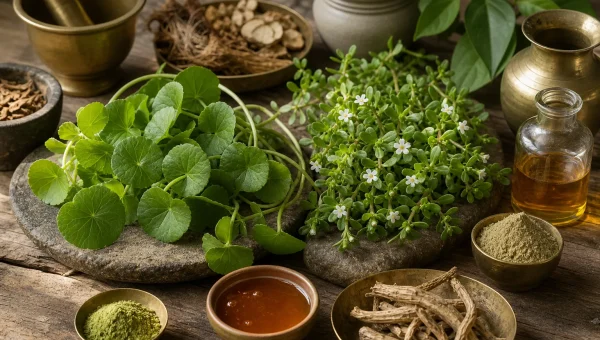
Mandukaparni (Centella asiatica) vs Brahmi: Resolving the Identity Confusion in Ayurveda Few naming problems in Ayurvedic pharmacognosy are as persistent...
Multi-Omics Approaches to Validating Rasayana: Genomics, Proteomics, and Metabolomics Rasayana is the rejuvenative branch of Ayurveda concerned with longevity, strength,...
Turmeric and Curcumin for Depression: Systematic Review of Antidepressant Trials Curcumin, a major biologically active polyphenol in turmeric (Curcuma longa),...