
Cellular Housekeeping and the Ayurvedic Lens
When Yoshinori Ohsumi received the 2016 Nobel Prize in Physiology or Medicine for discoveries on the mechanisms of autophagy, a cellular recycling process became widely discussed outside cell biology. Autophagy is the cell’s regulated system for enclosing selected intracellular material in autophagosomes and delivering it to lysosomes, where the contents are degraded and reused.
Ayurveda approaches bodily maintenance through a different language: agni, ama, langhana, upavasa, shodhana, and rasayana. These terms should not be treated as literal equivalents of autophagy. Ama is an Ayurvedic concept linked with impaired digestion and metabolic residue, while autophagy is a measurable cellular pathway. Still, both frameworks give importance to periodic clearing, metabolic discipline, and renewal.
This article reviews the most relevant bridges between Ayurvedic herbs, Ayurvedic fasting logic, and modern autophagy biology. The practical conclusion is cautious: some herbal constituents show meaningful activity in cellular models, fasting has the strongest mechanistic fit, and no herb should be presented as a guaranteed human autophagy activator at ordinary household doses.
Autophagy 101: The Molecular Machinery
Autophagy is regulated by nutrient sensing, cellular stress, lysosomal activity, and autophagic flux. A single marker is rarely enough to prove that cellular cleanup is complete; LC3-II may indicate autophagosome formation, while p62/SQSTM1 trends and flux assays help clarify whether cargo is actually being degraded.
| Pathway/Protein | Role in Autophagy | Interpretation | Common Physiological or Botanical Contexts |
|---|---|---|---|
| mTOR | A nutrient-sensitive kinase complex that suppresses autophagy when growth signals are abundant. | Lower mTOR activity generally permits autophagy initiation. | Fasting, nutrient restriction, AMPK activation, selected polyphenols in cellular models. |
| AMPK | An energy sensor activated during low-energy states. | AMPK can promote autophagy partly by relieving mTOR-mediated inhibition and acting on ULK-related signaling. | Exercise, fasting, metabolic stress, curcumin and resveratrol models. |
| Beclin-1 | Participates in autophagosome nucleation. | Higher Beclin-1 can support autophagy initiation, but it must be read with downstream markers. | Several stress-response and phytochemical models. |
| LC3-II | Associated with autophagosome membranes. | An increase may indicate more autophagosomes, but by itself does not prove completed degradation. | Used widely in autophagy assays involving fasting, drugs, and phytochemicals. |
| p62/SQSTM1 | A cargo receptor that helps deliver material to autophagosomes. | A fall in p62 can suggest autophagic flux when interpreted with other markers. | Flux assays often combine p62, LC3, and lysosomal inhibitors. |
| SIRT1 | A deacetylase linked with nutrient status and stress responses. | SIRT1 can regulate autophagy-related proteins and connect autophagy with caloric-restriction biology. | Fasting-related pathways and resveratrol models. |
| TFEB | A transcription factor connected with lysosomal biogenesis and autophagy-related gene expression. | TFEB activation can expand the cell’s lysosomal-autophagy capacity. | Curcumin models involving lysosomal pathway activation. |
Curcumin (Haridra): The Clearest Herbal Signal
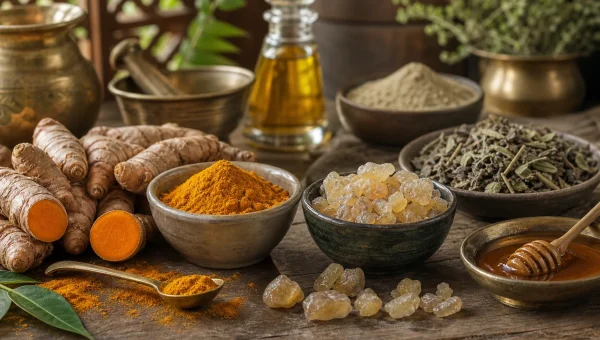
Haridra, the rhizome of Curcuma longa, is one of the most discussed Ayurvedic botanicals in modern molecular pharmacology. In Ayurvedic practice it is commonly used in kapha-pitta, skin, wound-support, and metabolic contexts; in modern laboratory work, its principal yellow constituent curcumin has one of the stronger preclinical autophagy profiles among Ayurveda-associated compounds.
Curcumin has been reported to increase LC3-II formation and autophagic flux in human colon cancer cell models while acting through the TFEB-lysosome pathway. In a cellular Parkinson’s disease model involving A53T alpha-synuclein, curcumin was associated with recovery of macroautophagy through downregulation of mTOR/p70S6K signaling. These findings make curcumin a legitimate autophagy candidate in mechanistic discussion, especially for gut and cellular stress contexts.
The major limitation is delivery. Curcumin is poorly water soluble, rapidly metabolized, and generally produces low plasma levels after ordinary oral intake. Enhanced formulations and combination with piperine can increase measured bioavailability, but the presence of a stronger pharmacokinetic profile does not automatically mean that a culinary dose of turmeric produces a clinically meaningful autophagy effect throughout the body.
Triphala: Digestive Rasayana, Polyphenols, and a More Cautious Autophagy Link
Triphala is the classical three-fruit combination of Amalaki (Phyllanthus emblica), Bibhitaki (Terminalia bellirica), and Haritaki (Terminalia chebula). Ayurveda uses it widely as a digestive, bowel-regulating, and rasayana formulation, and modern analyses describe it as rich in phenolic compounds such as gallic acid, chebulinic acid, chebulagic acid, and related tannins.
The strongest responsible link between Triphala and autophagy is indirect: Triphala belongs to the Ayurvedic digestive-cleaning and rasayana tradition, while some of its constituent phenolics are plausible modulators of oxidative stress, AMPK-related signaling, and cellular stress adaptation. Finished Triphala should therefore be framed as a digestion-centered polyphenol formula with possible relevance to cellular housekeeping, not as an established autophagy drug.
This distinction matters because Triphala is often taken daily and is generally discussed in Ayurveda through agni, mala regulation, bowel rhythm, and rasayana support. Translating that whole-practice use into a single molecular claim would oversimplify the formulation. Its most practical place in this review is as a traditional digestive rasayana whose chemistry makes autophagy-related investigation reasonable.
Resveratrol and Draksha (Vitis vinifera)
Draksha refers to grape or raisin from Vitis vinifera. In Ayurvedic usage it is generally understood as nourishing, sweet, and cooling rather than pungent or scraping. Its relevance to autophagy comes mainly through resveratrol, a stilbene found in grapes, especially in skins, and studied widely in nutrient-sensing and stress-response pathways.
Resveratrol has been associated with AMPK, SIRT1, and autophagy signaling in cellular models, including models of neurodegenerative stress. In Parkinson’s disease cell models, resveratrol promoted autophagy-related degradation of alpha-synuclein in a manner linked with AMPK and SIRT1 signaling.
The practical caution is dose and form. Draksha as a food or Ayurvedic dietary substance is not equivalent to a high-dose resveratrol supplement, and resveratrol itself has low oral bioavailability because of rapid metabolism. Draksha can remain a valuable Ayurvedic food-herb in its own right, but its autophagy relevance should be discussed through the narrower lens of resveratrol pharmacology.
Withaferin A and Ashwagandha: Proteostasis Rather Than Simple Clean-Up
Ashwagandha (Withania somnifera) is classically valued as a rasayana and balya herb. Its steroidal lactones, especially withanolides such as withaferin A, have been explored in cellular stress, inflammation, cancer biology, and proteostasis models.
Withaferin A should not be presented as a simple universal autophagy activator. In breast cancer cell lines, it has been associated with autophagosome formation, unfolded protein response, and disruption of autophagy flux. This places withaferin A in the category of context-dependent proteostasis modulation rather than everyday “cellular cleanup” support.
For Ayurvedic interpretation, this distinction is important. Ashwagandha’s traditional use as a strengthening rasayana is broader than withaferin A pharmacology. The herb, the whole extract, and the isolated constituent should not be treated as interchangeable, and cancer-cell stress findings should not be generalized to routine wellness use.
Piperine, Pippali, and Maricha: Bioavailability First
Piperine is an alkaloid associated with black pepper (Piper nigrum, Maricha) and long pepper (Piper longum, Pippali). In Ayurveda, pungent digestive spices are often used to support agni and formulation performance; in modern pharmacology, piperine is best known for altering absorption and metabolism of co-administered compounds.
Direct autophagy-related findings exist for piperine in selected experimental models, including a rotenone-induced Parkinson’s disease model and prostate cancer cell lines. These findings are mechanistically interesting, but they are not the strongest practical reason piperine appears in this discussion.
The stronger bridge is bioavailability. Piperine has been shown to increase curcumin bioavailability in a human pharmacokinetic study, which supports the traditional habit of combining warming digestive spices with heavier or less absorbable botanicals. This same property also creates safety concerns because piperine can alter drug handling; it should be used cautiously with prescription medicines, anticoagulants, antidiabetic drugs, anticonvulsants, and other narrow-therapeutic-index medications.
Langhana and Upavasa: The Practice With the Strongest Mechanistic Fit
Among all Ayurveda-related interventions discussed here, langhana and upavasa have the clearest conceptual fit with autophagy. Charaka Samhita, Sutra Sthana 22, describes langhana as lightening therapy and includes upavasa among its methods. This places fasting and digestive restraint inside a larger clinical logic, not as a one-size-fits-all wellness trend.
Modern autophagy biology also places nutrient withdrawal near the center of autophagy activation. When nutrient and growth signals fall, mTOR activity can decrease and autophagy-permissive pathways can become more active. This does not mean every person should fast aggressively; Ayurvedic langhana is traditionally selected according to strength, dosha, disease state, season, age, and digestive capacity.
For practical use, short digestive rest, lighter meals, and clinician-guided fasting are more consistent with Ayurvedic reasoning than extreme fasting performed without assessment. People with diabetes, pregnancy, eating disorders, frailty, active infection, serious chronic illness, or medication schedules that require food should avoid unsupervised fasting.
Evidence Assessment Summary
The most balanced view is that Ayurveda offers a lifestyle and formulation context that overlaps with modern cellular housekeeping biology, while the strongest herb-specific claims remain preclinical. Fasting and metabolic rhythm have the most direct mechanistic alignment; individual herbs and isolated compounds are better described as candidates with context-specific molecular actions.
| Herb/Practice | Most Relevant Autophagy Link | Current Position | Main Limitation |
|---|---|---|---|
| Curcumin / Haridra | TFEB-lysosome pathway, LC3-II/autophagic flux, mTOR/p70S6K signaling in cellular models. | One of the clearest Ayurveda-associated preclinical signals. | Low oral bioavailability and uncertain whole-body translation at ordinary doses. |
| Triphala | Polyphenol-rich digestive rasayana with plausible AMPK/oxidative-stress relevance through constituents. | Best framed as indirect and formulation-level. | Finished Triphala has much thinner direct autophagy-specific human data than isolated compounds. |
| Resveratrol / Draksha-associated compound | AMPK-SIRT1-autophagy signaling in cellular neurodegeneration models. | Strong mechanistic candidate as an isolated compound. | Low bioavailability; Draksha as food is not equivalent to high-dose resveratrol. |
| Withaferin A / Ashwagandha constituent | Proteostasis, unfolded protein response, autophagosome formation, and flux disruption in cancer cells. | Context-dependent cellular stress modulator. | Not a simple general autophagy enhancer; isolated withaferin A cannot be equated with whole Ashwagandha use. |
| Piperine / Pippali-Maricha constituent | Selected direct autophagy models and strong bioavailability-enhancing relevance for curcumin. | Most useful in formulation and absorption discussion. | Drug-interaction potential and dose-dependent pharmacological effects. |
| Langhana / Upavasa | Nutrient withdrawal, reduced growth signaling, and autophagy-permissive metabolism. | Strongest practice-level bridge between Ayurveda and autophagy biology. | Must be individualized; unsuitable for some people and medical conditions. |
What This Means Practically
The most useful takeaway is not “take this herb to switch on autophagy.” A better Ayurvedic interpretation is that cellular housekeeping is supported by digestive clarity, appropriate lightening when indicated, good meal rhythm, suitable herbs, and avoidance of chronic overload.
- Langhana and upavasa provide the strongest bridge because nutrient sensing is central to autophagy regulation.
- Curcumin and resveratrol have meaningful cellular autophagy signals, but dose, tissue exposure, metabolism, and formulation matter.
- Triphala is best understood as a classical digestive rasayana with polyphenol chemistry, not as a proven autophagy-specific supplement.
- Piperine’s main relevance is bioavailability enhancement, which is useful but also creates interaction risks.
- Withaferin A findings belong mainly to cellular stress and cancer-model biology, not routine rejuvenation claims.
- More autophagy is not automatically better; autophagy is a regulated process that varies by tissue, disease state, age, and metabolic context.
For a practical Ayurvedic routine, the safest starting point is usually regular meals, avoidance of constant snacking, lighter dinners when appropriate, seasonal digestive support, and practitioner-guided herb selection. Strong fasting protocols, concentrated extracts, and piperine-enhanced formulas should be treated as interventions rather than casual wellness habits.
Future Research Directions
The most useful next step is to evaluate traditional Ayurvedic interventions with biomarkers that distinguish autophagosome formation from completed autophagic flux. Whole formulations and practice patterns deserve attention, because Ayurveda rarely uses isolated molecules in isolation from diet, timing, constitution, and digestive status.
- Human studies measuring autophagy-related markers before and after properly characterized Ayurvedic formulations.
- Studies comparing whole Triphala, turmeric preparations, and isolated constituents rather than assuming equivalence.
- Pharmacokinetic work measuring tissue exposure, not only plasma levels, for curcumin, resveratrol, piperine, and withanolides.
- Clinical studies that pair langhana-style dietary timing with safety screening and individualized Ayurvedic assessment.
- Protocols that include p62, LC3, lysosomal markers, and flux-sensitive interpretation instead of relying on one marker.
The intersection of autophagy and Ayurveda is promising when handled with precision. Ayurveda contributes a long-standing clinical language of lightening, digestion, cleansing, and renewal; molecular biology contributes tools for measuring cellular degradation and recycling. The bridge is strongest when neither system is forced to say more than it actually says.
References
- NobelPrize.org
- Role of AMPK-mTOR-Ulk1/2 in the regulation of autophagy: cross talk, shortcuts, and feedbacks (2012), PubMed Central
- Monitoring and Measuring Autophagy (2017), PubMed Central
- A role for the NAD-dependent deacetylase Sirt1 in the regulation of autophagy (2008), PubMed Central
- Curcumin targets the TFEB-lysosome pathway for induction of autophagy (2016), PubMed Central
- Curcumin ameliorates the neurodegenerative pathology in A53T α-synuclein cell model of Parkinson’s disease through the downregulation of mTOR/p70S6K signaling and the recovery of macroautophagy (2013), PubMed
- Improving Curcumin Bioavailability: Current Strategies and Future Perspectives (2021), PubMed Central
- Recent developments in delivery, bioavailability, absorption and metabolism of curcumin: the golden pigment from golden spice (2014), PubMed Central
- Therapeutic Uses of Triphala in Ayurvedic Medicine (2017), PubMed Central
- Insights into the potential benefits of triphala polyphenols toward the promotion of resilience against stress-induced depression and cognitive impairment (2023), PubMed Central
- Ayurvedic Pharmacopoeia of India
- Resveratrol-activated AMPK/SIRT1/autophagy in cellular models of Parkinson’s disease (2011), PubMed
- Resveratrol: A Double-Edged Sword in Health Benefits (2018), PubMed Central
- Withaferin A: From Ancient Remedy to Potential Drug Candidate (2021), PubMed Central
- Withaferin A induced impaired autophagy and unfolded protein response in human breast cancer cell-lines MCF-7 and MDA-MB-231 (2017), PubMed
- Oncotarget (oncotarget.com)
- Piperine inhibits the proliferation of human prostate cancer cells via induction of cell cycle arrest and autophagy (2013), PubMed
- Bioenhancers: Revolutionary concept to market (2010), PubMed Central
- Charaka Samhita — Langhanabrimhaniya Adhyaya
- System-wide Benefits of Intermeal Fasting by Autophagy (2017), PubMed Central
- NCCIH
does the autophagy benefit require fasting to be combined or can the herbs work standalone
Good question. From what I’ve read elsewhere, the herbs seem to have some standalone effect but the synergy with a fasting or caloric restriction window appears to amplify the signal considerably.
what’s the source text for this recommendation Charaka Samhita or Ashtanga Hridayam ठीक है
I dug into this after reading the post. Most of the classical fasting herb references appear to come from Charaka Samhita, specifically the Sutrasthana sections on Langhanam. Ashtanga Hridayam echoes similar principles but with different herb emphasis.
the preparation method described here is exactly what my grandmother used to make. brings back memories.
thanks for sharing that, useful to know
Same. What got me was the distinction between herbs that merely support digestion during fasting versus those that seem to genuinely upregulate cellular cleanup pathways. That’s a meaningful difference.
finally an article that explains the classical text basis rather than just listing herbs.
what’s the source text for this recommendation Charaka Samhita or Ashtanga Hridayam
not disputing Ayurveda has value but articles like this sometimes overstate efficacy.
is there a simplified version for beginners who dont have access to all these herbs
Probably depends on your location, but triphala and ashwagandha are fairly accessible even in smaller towns. If you can only get two things from this article those would be my starting picks before trying the full protocol.
That’s a fair point actually — constitution probably determines how well these fasting herbs trigger autophagy. A kapha type doing extended fasting with triphala might see very different results than someone vata-dominant. Has your experience been consistent with your dosha?
Actually quite relevant here since autophagy dysregulation has been linked to chronic fatigue presentations. The ashwagandha and triphala protocols mentioned in the article are actually used in fatigue cases too from what I know.
The section on curcumin’s TFEB activation caught my attention.
does this protocol change during monsoon season? I’ve heard Ayurvedic timing is seasonal
yes but results vary a lot from person to person
True, and the article acknowledges that variability. With autophagy-supportive herbs the window of the day you take them might matter as much as dose, at least according to some of the circadian biology research.
Good point, the article doesn’t address that
the article would be stronger with a clear ‘when to see a doctor’ section. some of these conditions need medical clearance. ❤️
how long before results become noticeable with this protocol? my patience has limits tbh ✨ नमस्ते
great to see peer-reviewed studies referenced alongside classical texts. makes it easier to trust.
I find the dosage guidance vague. ‘appropriate amount’ is not helpful for someone measuring at home.
i had the same question
which ayurvedic herbs showed the most promising autophagy data in the studies cited neem or triphala
not disputing Ayurveda has value but articles like this sometimes overstate efficacy. नमस्ते
respectfully, most of these claims need larger RCTs before we can say they’re validated.
how do I source quality herbs for this? most local shops sell low-grade material.
can someone with a strong Pitta constitution follow this or are modifications needed
how long before results become noticeable with this protocol? my patience has limits tbh
is there a dose threshold below which the autophagy effect doesn’t activate
Curcumin’s bioavailability gap makes me wonder if regular turmeric in food does anything for autophagy.
I worry about this kind of content encouraging people to over-fast while taking herbs. caloric restriction has real risks.
tried a similar protocol 6 months back. results were modest at best and I was consistent.
gta 5 buy modded account ps5 gta5 money mod
u mention this is safe but what about drug interactions with common meds like bp tablets
That’s a really important point and honestly the article should have flagged it. Some of the herbs discussed here, particularly those with CYP450 interactions, could absolutely affect BP medication metabolism. Worth raising with your prescribing doctor before starting.
how do I source quality herbs for this? most local shops sell low-grade material. 🙌
implemented the morning routine from this article for 3 weeks. energy is much steadier throughout the day. 🙏
Triphala’s gut-specific autophagy effect seems like a neat link to its traditional use as a digestive cleanser.
shared this with my Ayurveda practitioner and she confirmed the approach is sound.
Thanks!
what’s the source text for this recommendation Charaka Samhita or Ashtanga Hridayam 🙌
my practitioner said something similar
the autophagy research on herbs is mostly cell culture and rodent data. the translation to humans needs more evidence.
It would be interesting to see a study measuring LC3-II after an ekadashi fast combined with triphala.
how long before results become noticeable with this protocol? my patience has limits tbh ठीक है