Yoga Men Over 40 Injury Prevention: Building the Right Foundation
Yoga for men over 40 is not about becoming more flexible than you were at 25. That target is usually the wrong one. Chasing extreme range of motion too quickly can turn yoga into another source of strain, especially for men with old sports injuries, desk-related stiffness, heavy training history, or years of uneven movement patterns. The better foundation is steady strength, controlled mobility, breath-led pacing, and enough recovery for the practice to nourish rather than deplete.
In classical Ayurveda, vata is associated with later life and with qualities such as dryness, mobility, lightness, and irregularity. A man in his 40s is not necessarily in the classical old-age stage, but many men at this age begin to notice vata-type patterns in the body: stiffer mornings, less forgiving joints, more sensitivity to poor sleep, and slower recovery after strain. A useful yoga approach for this group is therefore warm, stable, progressive, and unforced. It is closer to brimhana yoga – a nourishing and strengthening approach – than to performance yoga.
Ojas is described in Ayurveda as the refined essence of the dhatus and is closely linked with resilience, steadiness, strength, and recovery. For practical purposes, an ojas-supporting yoga session should leave the practitioner calmer, steadier, and more integrated than before practice. The goal is not to collapse from effort or display extreme poses. The goal is a practice that builds usable capacity while protecting the joints, nervous system, and long-term enthusiasm for yoga.
The Four Problems Men Over 40 Bring to the Mat
Four common realities determine injury risk and the most appropriate yoga approach for this age group. They do not make yoga unsafe; they simply require intelligent sequencing, honest self-assessment, and a willingness to use props and modifications.
1. Vata-type stiffness in joints and connective tissue: Years of seated work, heavy lifting, driving, old injuries, and repetitive movement can reduce comfortable range in the hips, thoracic spine, shoulders, ankles, and hamstrings. In Ayurvedic language, the practice should counter dryness, irregularity, and excessive strain with warmth, steadiness, lubrication, and gradual movement. In practical terms, this means preparing the joints before loading them, entering poses slowly, and never treating pain as a sign of progress.
2. Reduced recovery margin: Recovery capacity varies widely, but age-related hormonal and tissue changes make it sensible for many men over 40 to build gradually. Testosterone tends to decline slowly after about age 40, and growth hormone secretion also declines with age. These facts do not mean a man cannot build strength, mobility, or stamina; they mean the practice should respect recovery. A challenging yoga session may need a lighter day afterward, especially when introducing new poses, longer holds, deeper stretches, or pranayama.
3. Prior injury load: Many men over 40 bring shoulder, knee, neck, or lower-back history onto the mat. Yoga can help restore awareness and balanced movement, but it can also expose compensations if poses are forced. A knee that dislikes deep rotation, a shoulder that lacks overhead mobility, or a lumbar spine that reacts to aggressive forward bending should be treated as useful information. The practice should be adapted to the body present today.
4. Ego-driven practice: Competitive comparison is a major hidden injury factor. Group classes can tempt men to chase depth, speed, or intensity because the person beside them appears more flexible. The safer rule is simple: the pose should serve the body, not the other way around. A modified pose performed with clean alignment and steady breathing is more advanced than a dramatic pose held with strain, joint compression, or breath-holding.
The Core Sequence: 45 Minutes That Build and Protect
This sequence is intended for men over 40 with no acute injury and no medical restriction against exercise. It should be learned with a qualified teacher when possible, especially for men with neck, back, knee, shoulder, cardiovascular, blood pressure, balance, or eye-pressure concerns. Move slowly, breathe through the nose when comfortable, and keep every pose below the threshold of sharp pain or joint instability.
Opening phase (10 minutes) – joint preparation:
Begin on the back with relaxed nasal breathing for 1 minute. Add gentle ankle circles, knee bends, hip circles, shoulder rolls, and wrist movements. Practice a gentle supine spinal twist for 60-90 seconds on each side without forcing the knees to the floor. Use a strap or belt for supta padangusthasana (reclined leg stretch), holding each side for 60-90 seconds while keeping the lower back broad and the breath smooth. Finish with apanasana (knees-to-chest) for 1-2 minutes, moving gently with the breath. The purpose of this phase is not deep stretching; it is to prepare the joints and tissues for load.
Standing phase (18-20 minutes) – functional strength:
Stand in tadasana for 1-2 minutes and establish even weight through both feet. Practice virabhadrasana I (Warrior 1) for 30-45 seconds per side, keeping the stance shorter if the lower back or Achilles tendon feels strained. Move to virabhadrasana II (Warrior 2) for 45-60 seconds per side, tracking the front knee toward the second toe rather than allowing it to collapse inward. Add trikonasana (Triangle) with a block under the lower hand, keeping the spine long rather than reaching for the floor. If lunges are included, keep them supported and moderate. This phase builds leg strength, hip stability, postural awareness, and shoulder opening without requiring extreme range.
Hip and spine phase (10 minutes):
Use a supine figure-four stretch or a supported pigeon variation for 1-2 minutes per side. If pigeon causes knee discomfort, replace it with the supine version immediately. Practice setu bandhasana (Bridge Pose) dynamically for a few rounds, then rest in a supported bridge with a block under the sacrum at a comfortable height for 1-2 minutes. Finish with 15-20 slow rounds of cat-cow, linking movement with breath and keeping the neck relaxed. This phase should feel spacious, not aggressive.
Closing phase (5-7 minutes):
End with savasana for at least 5 minutes. This is not optional rest; it is the integration phase of the practice. From an Ayurvedic point of view, the nourishing effect of yoga depends not only on movement but also on assimilation. A practice that ends abruptly can feel stimulating but incomplete. A practice that ends with stillness supports steadier breath, calmer nerves, and the ojas-oriented purpose of the session.
| Phase | Duration | Key Poses/Practice | Injury Prevention Focus |
|---|---|---|---|
| Joint preparation | 10 min | Supine twists, reclined leg stretch, gentle joint circles | Warmth, lubrication, awareness before loading |
| Functional strength | 18-20 min | Tadasana, Warriors I-II, Triangle, supported lunges | Knee tracking, hip stability, moderate progressive loading |
| Hip and spine release | 10 min | Supine figure-four or supported pigeon, bridge, cat-cow | Props, slow entry, no forcing into end range |
| Restoration | 5-7 min | Savasana | Ojas-oriented integration and nervous system settling |
Building the Ojas Dimension
Standard yoga instruction often focuses on movement, alignment, and breath coordination. The ojas dimension adds one more question: does this practice leave the body more stable and nourished, or more depleted and agitated? For men over 40, that question matters. Brimhana practice emphasizes steadiness, strength, restoration, and appropriate nourishment. It is not lazy practice; it is intelligent practice that avoids wasting vitality through unnecessary strain.
Use slow, even breathing. Keep the breath smooth and unforced throughout the session. A slightly longer exhalation can be calming when it arises naturally, but it should not become a rigid ratio or a breath-holding exercise. If the breath becomes rough, the pose is too intense. In this style of practice, breath quality is the first measure of whether the body is ready for more depth.
Keep pranayama separate from difficult asana. Anulom vilom or simple alternate nostril breathing may be practiced for 5-10 minutes before or after the asana sequence. It should be gentle, without forceful retention, especially for beginners or anyone with hypertension, cardiovascular disease, dizziness, anxiety sensitivity, or respiratory issues. The complete pranayama guide can be used as a companion, but therapeutic pranayama is best learned from a qualified teacher.
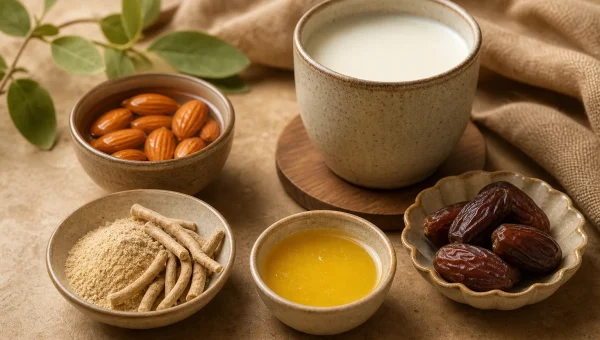
Nourish after practice. After a morning or evening session, choose warm, digestible food and adequate hydration rather than immediately rushing into stimulants, screens, or another workout. If an Ayurvedic practitioner recommends ashwagandha, the Ayurvedic Pharmacopoeia of India lists the dried mature root of Withania somnifera as rasayana, balya, vajikarana, and vatakaphapaha, with tikta and kashaya rasa, laghu guna, ushna virya, and madhura vipaka. It should not be treated as a universal post-yoga requirement, and men taking medication or managing thyroid, autoimmune, liver, blood pressure, sleep, or blood sugar concerns should use it only with professional guidance.
What to Skip or Modify
Some poses are not “bad,” but they carry disproportionate risk when attempted without the required preparation. For men over 40, the safest approach is to treat advanced shapes as optional outcomes, not milestones. A pose that compresses the neck, twists the knee, strains the lower back, or forces the breath is not appropriate simply because it appears in a class sequence.
Full lotus (padmasana) without long hip preparation: Full lotus requires substantial hip external rotation. If the hips do not provide that rotation, pressure often moves into the knees. Men with knee history, meniscus sensitivity, or tight hips should use sukhasana (simple cross-legged seat), a supported kneeling position, or a chair for seated practice. Half-lotus should also be used only when the knees remain completely comfortable.
Headstand and shoulderstand without qualified supervision: Sirsasana and sarvangasana place meaningful demand on the neck, shoulders, core, and balance. They are not necessary for a strong yoga practice. Men with cervical stiffness, high blood pressure, glaucoma, balance issues, or shoulder limitations should avoid them unless a qualified teacher and healthcare provider have cleared the practice. Legs-up-the-wall and supported restorative inversions are safer alternatives for most household routines.
Deep forward folds with a rounded, strained lower back: Forward bending should begin from the hips, with the knees bent as needed and the hands supported on blocks, thighs, or a chair. The goal is not to touch the toes; the goal is to lengthen the back body without aggravating the spine. If the lower back feels pulled, compressed, or nervy, reduce the depth immediately.
Fast, hot, or competitive classes before the foundation is built: Vigorous yoga can be useful for some men, but only after basic alignment, joint awareness, and breath control are established. Heat, speed, and fatigue can make it harder to notice when a joint is being forced. Men returning to movement after a long gap should spend several weeks with slower, prop-supported practice before increasing intensity.
Forceful breathing and breath retention: Strong pranayama techniques should not be added casually to a demanding asana practice. For men over 40, especially those with blood pressure, heart, anxiety, or dizziness concerns, gentle breathing is safer than forceful breathing. Breathwork should create steadiness, not pressure in the head, chest, eyes, or nervous system.
How Often to Practice
Two to four sessions per week is a sustainable range for many men over 40. Beginners may start with two 30-45 minute sessions plus short daily mobility work. More experienced practitioners can add a third or fourth session when sleep, appetite, mood, and joint comfort remain steady. In Ayurvedic terms, the right dose of yoga should support bala, agni, steadiness, and ojas; the wrong dose creates fatigue, irritability, disturbed sleep, soreness that lingers, or aversion to practice.
Progress should be judged by practical markers: easier movement on waking, less fear around bending or squatting, steadier balance, calmer breathing under effort, improved sleep quality, and fewer flare-ups after activity. The body over 40 does not need to be pushed into a younger template. It needs a practice that respects its history and builds the next decade of strength from the ground up.
The shukra dhatu and reproductive vitality connection can also be understood through this same Ayurvedic lens. Excess strain, poor sleep, nervous system agitation, and depleted recovery are not supportive of vitality. A steady yoga routine, nourishing food, proper rest, and appropriate rasayana guidance are more consistent with long-term strength than extreme flexibility goals. Men with fertility concerns, hormonal symptoms, pain, or chronic fatigue should seek individualized assessment rather than relying on yoga alone.
Medical Disclaimer: This content is for educational purposes only and does not constitute medical advice. Men with pre-existing joint conditions, recent surgeries, cardiovascular disease, uncontrolled hypertension, glaucoma, balance problems, chronic pain, or neurological symptoms should consult a qualified healthcare provider before beginning or changing a yoga practice. Yoga should be learned from a qualified instructor who can assess individual limitations. If any movement causes sharp pain, numbness, dizziness, chest discomfort, or joint instability, stop immediately and seek medical evaluation.
Nothing in this article diagnoses or treats a medical condition. Use it as educational information and consult a qualified Ayurvedic practitioner or physician before starting herbs, supplements, detoxes, pranayama, or therapeutic protocols, especially if managing a condition or taking medication.
References
- Charaka Samhita — Dosha
- Charaka Samhita — Brimhana
- Charaka Samhita — Langhanabrimhaniya Adhyaya
- Jaims (jaims.in)
- NCCIH
- Adverse events associated with yoga: a systematic review of published case reports and case series (2013), PubMed
- Injuries and other adverse events associated with yoga practice: A systematic review of epidemiological studies (2018), PubMed
- Arthritis (arthritis.org)
- Hyaluronan and synovial joint: function, distribution and healing (2013), PubMed Central
- Mayoclinic (mayoclinic.org)
- NCBI
- Influence of alternate nostril breathing on heart rate variability in non-practitioners of yogic breathing (2012), PubMed Central
- Ayurvedic Pharmacopoeia of India
- NCCIH
- NCBI