A competitive athlete who is truly overtrained does not usually describe ordinary soreness. The pattern is deeper: performance falls despite effort, sleep no longer restores, motivation disappears, small infections become more frequent, and the nervous system feels stuck in a state that is neither ready to train nor able to recover. Modern sports medicine calls this overtraining syndrome when the decline persists for weeks to months and does not resolve with a brief deload.
Ayurveda does not use the modern diagnostic term “overtraining syndrome,” but it has a clear way to understand the pattern. Excessive exertion beyond one’s bala can aggravate Vata, disturb digestion and sleep, and consume the reserves that Ayurveda describes through ojas and bala. The practical recovery approach is therefore not stimulation. It is stopping the leak first, then rebuilding through rest, warm nourishment, sleep, oiling, and carefully selected Rasayana support.
The Physiology of Overtraining: Modern and Ayurvedic
Modern descriptions of overtraining syndrome include a sustained performance decrement, altered mood, poor recovery, autonomic imbalance, hypothalamic-pituitary-adrenal disruption, immune changes, and the need to exclude other medical causes of fatigue. Reduced heart-rate variability may appear during overreaching or overtraining, but HRV is a readiness signal rather than a stand-alone diagnosis.
The Ayurvedic model begins with ati-vyayama, exertion beyond capacity. Classical guidance around exercise emphasizes assessing strength, season, age, food, and capacity, and stopping before depletion rather than chasing exhaustion. When training repeatedly exceeds recovery, Vata becomes provoked by excessive movement, irregularity, dryness, inadequate rest, and nervous system strain. Over time this weakens agni, interrupts tissue nourishment, and diminishes the reserves described as ojas.
Ojas is classically described as the refined essence connected with the nourishment of the dhatus and with bala, the body’s strength and resistance. In an athlete, this can be understood practically as the reserve that supports stable energy, immunity, enthusiasm, sleep, tissue repair, and resilience under load. When that reserve is being spent faster than it is rebuilt, the correct strategy is not to push harder. It is to protect what remains and rebuild from the foundation.
Phase 1: Immediate Stabilization (Weeks 1-2)
The first phase is a training stop or a medically supervised reduction to true recovery activity. If overtraining syndrome is suspected, intense training, competition simulation, heavy lifting, high-intensity intervals, and “test” workouts should be removed. Gentle walking, restorative yoga, relaxed breathing, Yoga Nidra, and extended Shavasana are appropriate only when they leave the athlete feeling calmer and more restored afterward.
Core Rasayana Support
The herbs below are not a substitute for diagnosis, nutrition, sleep, and load reduction. They are best used as supportive Rasayana measures under a qualified practitioner, especially when the athlete is taking medication, has thyroid disease, autoimmune disease, liver disease, psychiatric illness, hormone-related concerns, or recurrent infections.
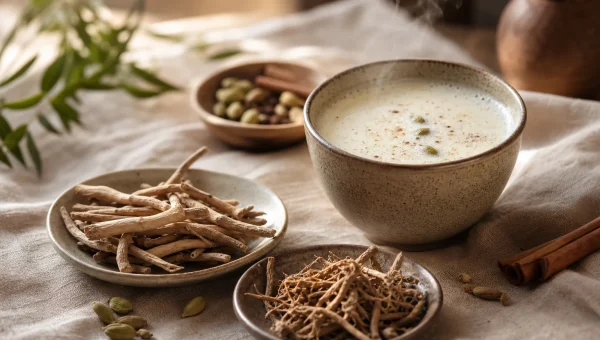
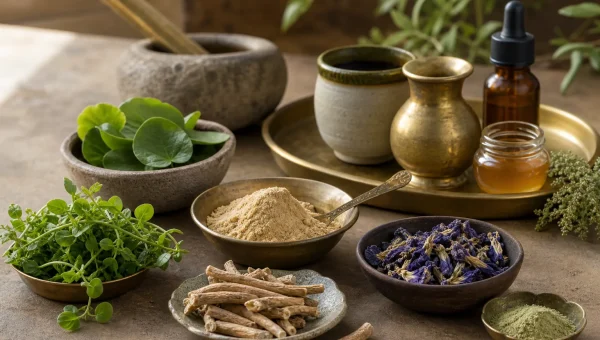
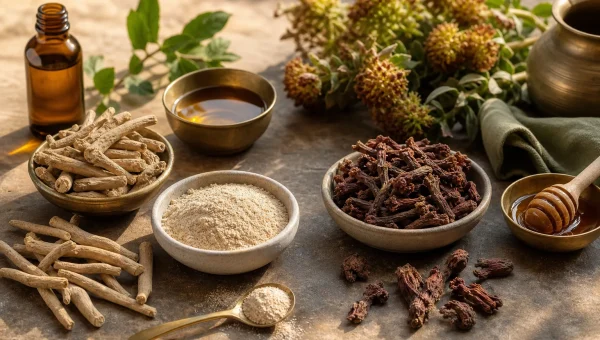
Ashwagandha is one of the most relevant Rasayana herbs for a depleted, Vata-aggravated athlete. The Ayurvedic Pharmacopoeia of India lists Ashwagandha root as tikta and kashaya in rasa, laghu in guna, ushna in virya, and madhura in vipaka, with actions including rasayana, balya, vajikarana, and vata-kapha-hara. Classical crude-root dosing is 3-6 g of powder; standardized extracts are often used in smaller modern doses. It is best taken with food or warm milk when digestion allows.
Shatavari is especially valuable when dryness, poor sleep, irritability, heat, hormonal depletion, or undernourishment are present. The Ayurvedic Pharmacopoeia of India describes Shatavari root as madhura and tikta in rasa, guru and snigdha in guna, shita in virya, and madhura in vipaka, with actions including shukrala, balya, rasayana, vrishya, and Vata-Pitta pacifying support. In a recovery plan it is traditionally suited to warm milk, ghee, or nourishing foods when these are tolerated.
Guduchi is useful when the overtrained pattern includes recurrent illness, low resilience, lingering inflammation, or poor recovery after minor infections. The Ayurvedic Pharmacopoeia of India describes Guduchi stem as tikta and kashaya in rasa, laghu in guna, ushna in virya, and madhura in vipaka, with actions including rasayana, balya, dipana, tridosha-shamaka, and jvaraghna. It should be used cautiously in complex immune or liver conditions unless supervised.
Amalaki is a steady daily Rasayana for athletes rebuilding from oxidative load, heat, irritability, digestive disturbance, or tissue strain. The Ayurvedic Pharmacopoeia of India describes Amalaki as having five tastes except salty, with shita virya, madhura vipaka, and actions including rasayana, tridoshajit, vrishya, and chakshushya. It can be used as fresh amla, powder, or a practitioner-selected preparation.
Purified Shilajit may be considered only when the source is tested, purified, and practitioner-approved. It has a long Rasayana reputation in Ayurveda, but raw or poorly tested mineral products are not appropriate for athletes because contamination and adulteration are real concerns. Avoid using unverified resin, powders, or marketplace products without heavy-metal and quality testing.
Phase 1 Diet
Food is the main Rasayana in the first two weeks. Many depleted athletes under-eat because appetite drops, training-culture restriction becomes habitual, or carbohydrate and fat are cut too aggressively. Recovery should begin with regular meals that meet energy needs, and many athletes require a supervised increase in intake while training load is removed.
- Build from warm, cooked meals: rice, oats, mung dal, kitchari, soups, stews, sweet potato, cooked vegetables, and adequate salt and fluids.
- Restore carbohydrates: glycogen depletion and low carbohydrate availability worsen fatigue and recovery problems, so carbohydrate restriction is not appropriate during true depletion.
- Add Ojas-building foods: pasteurized full-fat milk if tolerated, ghee, soaked almonds, dates, sesame preparations, mung dal, rice, and fresh seasonal foods cooked with digestive spices.
- Include adequate protein: dairy, legumes, eggs, fish, meat, or other appropriate protein sources according to diet, constitution, and medical needs.
- Avoid further depletion: no fasting, aggressive cutting, ice-cold smoothies, stimulant dependence, alcohol, or very dry raw-food meals during the stabilization phase.
Phase 2: Tissue Rebuilding (Weeks 3-6)
The second phase begins only when sleep, appetite, mood, and morning readiness are improving. This is not the time to return to intensity. It is the time to deepen tissue nourishment, repair digestion, and reintroduce movement in a way that confirms recovery rather than tests it.
Additional Support in Phase 2
Additional herbs can be considered after the basic foundation is stable. The purpose is not to force performance back quickly, but to support mind, tissue, motivation, and resilience while the athlete remains below the threshold that caused depletion.
Kapikacchu should be treated as a clinician-supervised herb rather than a casual sports supplement. Mucuna seeds naturally contain L-DOPA, so this herb is not appropriate for self-use with Parkinson’s medicines, MAO inhibitors, antipsychotics, dopaminergic drugs, or significant psychiatric conditions. In Ayurveda, Atmagupta/Kapikacchu is classically associated with balya, brimhana, vrishya, and vajikarana actions, but its use in a depleted athlete should be individualized.
Brahmi may be appropriate when brain fog, poor concentration, restless sleep, or mental fatigue remain after food and sleep have improved. It is best positioned as medhya support rather than as a stimulant. Use it gently and avoid stacking many nervous-system herbs at once.
Phase 2 Training Reintroduction
Movement should return as a recovery signal, not a performance test. Begin with walking, relaxed mobility, easy cycling, restorative yoga, and unloaded movement patterns. The rule is simple: the session should finish with the athlete feeling better than at the start, and the next morning should not show worse sleep, worse mood, higher resting heart rate, or a clear HRV drop.
- Weeks 3-4: walking, mobility, breath-led yoga, and no loaded intensity.
- Week 5 onward: light body-weight patterns, easy technique work, and short sessions with generous rest.
- No high-intensity intervals, maximal lifts, competition pacing, or “benchmark” testing in this phase.
- Stop immediately if motivation crashes, sleep worsens, appetite drops, or the athlete feels wired and exhausted after easy work.
Phase 3: Return to Performance (Weeks 7-12)
Structured training can return only when the athlete has stable sleep, improving mood, consistent appetite, no recurrent infection pattern, and a readiness trend that remains steady under light training. The Ayurvedic principle is still bala pariksha: assess capacity before prescribing exertion. The modern version is the same: do not load a body that is still failing to recover.
| Pre-Training | Post-Training | Daily Maintenance |
|---|---|---|
| Check sleep, mood, appetite, soreness, resting heart rate, and HRV trend before loading. | Eat a warm meal with protein and carbohydrate within the recovery window that suits digestion. | Keep a consistent sleep schedule with enough time in bed to wake naturally restored. |
| Use a 15-20 minute warm-up and stop if the body feels unstable, flat, or unusually strained. | Use warm sesame oil abhyanga or local oiling when Vata signs, stiffness, dryness, or nervous agitation are present. | Continue practitioner-selected Rasayana support rather than adding many supplements at once. |
| Limit hard work to one demanding session in a day, and separate intensity days with true recovery. | Choose warm milk with Shatavari and ghee only when dairy is tolerated and appropriate for constitution. | Keep at least one full rest day weekly, even after performance begins to return. |
| Avoid stimulants as a way to override poor readiness. | Prioritize down-regulation: slow breathing, gentle walking, warm bathing, and early sleep. | Review training load weekly and reduce volume before symptoms accumulate. |
The HRV Readiness Rule
HRV is useful when it is interpreted as a trend alongside symptoms, not as a single number. The athlete should compare HRV to their own baseline, then combine it with sleep quality, mood, appetite, resting heart rate, soreness, and desire to train.
- HRV near personal baseline with good sleep and mood: complete the planned session at the current rebuilding stage.
- HRV mildly below baseline or resting heart rate elevated: reduce load, remove intensity, and keep the session easy.
- HRV clearly below baseline with poor sleep, low mood, illness signs, or heavy fatigue: rest or use only active recovery.
- HRV declining for three consecutive days: take a full rest day and review training, food, stress, and sleep before resuming.
This framework fits the Ayurvedic logic of bala pariksha. A depleted body should not receive the same training load as a restored body, just as a depleted patient should not receive the same intervention as a strong one.
When to Seek Medical Care
Overtraining syndrome requires medical evaluation because anemia, hypothyroidism, depression, infection, low energy availability, REDs, medication effects, sleep disorders, and other conditions can look similar. Persistent fatigue, unexplained performance decline, menstrual disruption, loss of libido, recurrent infections, chest symptoms, fainting, severe mood changes, or rapid weight change should be assessed by a healthcare provider.
This protocol is educational and supportive. It does not replace clinical diagnosis, sports-medicine care, nutrition care, or individualized Ayurvedic treatment. Consult a qualified Ayurvedic practitioner and healthcare provider before beginning herbs or supplements, especially if you take medication, are pregnant or trying to conceive, have liver disease, thyroid disease, autoimmune disease, psychiatric conditions, hormone-sensitive conditions, or use performance-enhancing drugs.
References
- Diagnosis and prevention of overtraining syndrome: an opinion on education strategies (2016), PubMed Central
- Overtraining syndrome: a practical guide (2012), PubMed Central
- Prevention, diagnosis, and treatment of the overtraining syndrome: joint consensus statement of the European College of Sport Science and the American College of Sports Medicine (2013), PubMed
- Hypothalamic-Pituitary-Adrenal (HPA) Axis Functioning in Overtraining Syndrome: Findings from Endocrine and Metabolic Responses on Overtraining Syndrome (EROS)-EROS-HPA Axis (2017), PubMed Central
- Beyond physical exhaustion: Understanding overtraining syndrome through the lens of molecular mechanisms and clinical manifestation (2025), PubMed Central
- Overtraining, excessive exercise, and altered immunity: is this a T helper-1 versus T helper-2 lymphocyte response? (2003), PubMed
- Heart Rate Variability Applications in Strength and Conditioning: A Narrative Review (2024), PubMed Central
- 2023 International Olympic Committee’s (IOC) consensus statement on Relative Energy Deficiency in Sport (REDs) (2023), PubMed
- Carbohydrate Availability and Physical Performance: Physiological Overview and Practical Recommendations (2019), PubMed Central
- The Potential Role of Nutrition in Overtraining Syndrome: A Narrative Review (2023), PubMed Central
- Charaka Samhita — Vyayama
- Ijhsr (ijhsr.org)
- Blog (blog.mygov.in)
- Ayurvedic Pharmacopoeia of India
- Ayurvedic Pharmacopoeia of India
- P01.36. Assessment of commercial formulations of mucuna pruriens seeds for Levodopa (L-DOPA) content (2012), PubMed Central
- HPLC analysis and standardization of Brahmi vati – An Ayurvedic poly-herbal formulation (2013), PubMed Central
- NIH Office of Dietary Supplements
- NCCIH
Not sure how relevant ancient dosage guidelines are for modern bodies with different baseline health.
That’s a fair point, but I’d push back a little — the dosage principles seem less like fixed numbers and more like proportional guidelines. Practitioners I’ve spoken to do adjust for modern lifestyle factors like chronic stress and poor sleep, which arguably depletes Ojas faster than ancient texts anticipated.
I’m not sure this is the right thread for that — this post is specifically about overtraining recovery. That said, Nasya and Neti are usually the first things Ayurvedic practitioners mention for recurring sinus issues, in case that helps you start somewhere.
spoke to two Vaidyas and neither confirmed this exact protocol. Where does it come from?
@Christopher Not everyone responds the same way to this herb. The article could use more nuance on individual variation.
Totally agree on the nuance point. My experience with Ashwagandha specifically has been very different from my training partner’s even though we follow the same protocol. I wonder if dosha type plays a bigger role in response variation than the article suggests.
That’s a real concern at any age honestly. Even in my 40s I’ve found that the standard dosages in these protocols feel like too much initially. Starting at half and gradually increasing made a noticeable difference in tolerability for me.
I’d really recommend asking your prescribing doctor before combining anything here with Amlodipine. Some of the adaptogenic herbs used in Ojas protocols can have mild effects on blood pressure, so it’s worth checking for interactions specifically.
Some of the Mahanarayan and Bala oil preparations are available through Ayurvedic suppliers online — Kerala Ayurveda and Kottakkal both carry them. Homemade is considered superior in classical texts but the commercial versions are a practical starting point.
Good question on the medication front. For what it’s worth, I’d flag the same concern to your prescribing doctor rather than just the Ayurvedic practitioner — they’re better positioned to spot interactions from the allopathic side.
Been following the Overtraining Syndrome in Athletes approach for 6 weeks and genuinely notice the difference.
Six weeks is actually pretty solid progress to notice something. What markers are you tracking — HRV, sleep quality, motivation levels? I’m at week four and starting to see small changes in resting pulse but not much else yet.
That’s actually my concern too with the Amlodipine question. Ashwagandha in particular has some documented mild hypotensive effects, so stacking it with a calcium channel blocker without medical oversight feels risky to me.
The 10ml dose mentioned in the article works well for me, started seeing changes around week 3.
Week 3 matches my experience too. The first two weeks I felt nothing and was ready to give up. Did you make any dietary changes alongside the protocol or just the supplementation?
Agreed, and that variation in response time seems especially pronounced with the adaptogenic herbs in this protocol. I took 10 weeks to see anything meaningful while a friend responded within three. Individual constitution probably matters a lot here.
That tracks — the ghee combination seems to be a recurring theme across practitioners, not just this article. My Vaidya said it helps with absorption and also buffers the heating quality of some of the herbs used in recovery protocols.
The fact that you addressed both classical text references and modern usage gaps is what i needed.
Same here.
Same here as in you’re also dealing with overtraining symptoms? I’ve been wondering whether the Ojas restoration protocol described here scales differently for endurance athletes versus strength training — curious what context you’re coming from.
Same situation, or are you saying the Ashwagandha-based approach worked for you too? Asking because I’ve seen big variation in how people respond and I’m trying to understand if training modality changes anything about which part of the protocol matters most.
I found the explanation of Ojas depletion really clear, especially how it links to the seven dhatus.
The HRV data point in this article hit close to home. My numbers dropped similarly during a heavy training block last year and I had no framework for understanding what was happening. Wish I’d known about the Ojas depletion angle then.
How long did it take before you noticed the improvement? I’m a runner dealing with what sounds like a similar pattern — deep tiredness that rest isn’t fixing — and I’m trying to get a realistic sense of the timeline before committing to a protocol.
Has anyone tried the ashwagandha dosage they mentioned, six hundred mg daily, and noticed a change in HRV?
The case study here with the CrossFit athlete really illustrates the difference between peripheral muscle fatigue and this deeper systemic exhaustion. What I found interesting is how the HRV data mapped onto what the classical texts describe as Ojas depletion — the correlation wasn’t something I expected to be that clean.
the overtraining protocol with Ashwagandha + Shatavari + adequate Ama-clearing diet helped me break through a performance plateau that lasted 5 months.
The part about avoiding raw salads and cold smoothies during phase one makes sense for digestion.
what does Ojas depletion actually feel like symptom-wise? Trying to identify if that’s my issue honestly
From what I understand — and I’m not a practitioner — Ojas depletion tends to feel like fatigue that doesn’t lift with sleep, loss of enthusiasm for things you usually enjoy, and a kind of dryness both physically and mentally. The athlete story at the start of the article describes it well.
From what I’ve read, traditionally prepared bilona ghee is preferred because the process is said to preserve more of the beneficial properties. But honestly any high-quality grass-fed ghee is probably fine to start with — the herb combination matters more than the brand.
That’s not a bad idea regardless, especially if you’re planning high doses or have any pre-existing liver considerations. The protocol here doesn’t mention it explicitly but baseline bloodwork before starting any herbal protocol seems like reasonable precaution.
Good question — I cut back to one cup of coffee in the morning rather than eliminating it entirely and it seemed fine. The article’s emphasis is more on avoiding stimulants that prevent deep rest, so timing probably matters as much as quantity. ✨
for overtraining syndrome, how do you distinguish it from under-fueling (RED-S)? the protocols would be different.
Thanks!
I wonder if the shilajit recommendation would interact with common blood pressure meds, should ask a doctor.
resting pulse staying high is practical advice, but tracking symptoms should be mentioned too
Completely agree. Resting pulse is one signal but tracking things like mood stability, sleep depth, and motivation alongside it gives a much clearer picture of whether recovery is actually happening or just masking the depletion.
Reading about the athlete’s HRV dropping from seventy two to thirty one made me check my own tracker.
followed the protocol as described and had digestive upset for the first three weeks. 🙏
Been following the Overtraining Syndrome in Athletes approach for 3 weeks and genuinely notice the difference.
Digestive upset in the first few weeks happened to me too. I found breaking the dose into smaller amounts with warm water helped a lot — took about ten days before my gut adjusted. Did it settle for you eventually?
Useful info.
The suggestion to stop training completely for the first two weeks feels extreme but understandable.
I like how they tie modern hormonal markers to Ayurvedic concepts like Vata aggravation.
how many Panchakarma sessions would complement this oral protocol typically? 🙏
Good question. My practitioner said one full Panchakarma before starting the oral protocol really accelerates the Ojas rebuilding — something about clearing the channels first so the herbs actually reach the deeper tissues. But I imagine that varies a lot by individual.
Bought a well-known brand of this herb and noticed no effect. Quality standardization is inconsistent. ❤️
i’m Pitta-Kapha dominant, does the dosage for this condition change significantly tbh 🙌
Makes sense.
Three months of consistent Abhyanga after hard training is a serious commitment — that’s what makes the result credible to me. The post’s point about recovery being an active process rather than passive rest lines up with what you’re describing.
Would the kapikacchu dose be safe for someone not on any medication?
Doing this.
The preparation method described requires equipment most people don’t have. Not practical.
The diet advice to increase calories by twenty five percent seems tough, maybe start with ten percent.
The section on circadian timing, is that strictly necessary or is approximate timing sufficient?
For what it’s worth, I got reasonably good results without being exact to the minute, but I did stick to the general morning/evening windows. My understanding is that the circadian alignment helps the herbs work with your body’s natural rhythms rather than against them, so rough timing probably still matters more than ignoring it entirely.
Seeing the athlete qualify for regionals after four months gives hope that the protocol works.
Reading this in 2026, is the dietary protocol still the same or has it been updated?
The article’s point about Ojas being depleted by chronically high cortisol stuck with me. As a competitive cyclist I recognize that pattern — the kind of tiredness where more sleep doesn’t actually help. Does anyone know if the protocol differs meaningfully for aerobic athletes versus strength-based ones?
What stood out to me in this post is the emphasis on rebuilding rather than just resting. The Shatavari + Ashwagandha combination is something I’d heard of for general fatigue but never in the specific context of overtraining recovery. Has anyone had their practitioner adjust ratios based on Prakriti?
The post specifically answered a question I had about Vata-Pitta constitution adjustments.
The side effects section is too brief. I had insomnia on this herb that isn’t mentioned here.
I had the same low HRV + unrefreshing sleep pattern the athlete in the case study described. Turned out I was underestimating cumulative load from back-to-back training weeks. Curious whether anyone here has tracked HRV through the Ashwagandha + diet protocol to see how quickly numbers recover.
the explanation around HRV dropping for days was better than most quick reels on this topic
Completely agree, most content out there reduces HRV to a simple number without explaining what the drop actually represents physiologically. The connection to Ojas depletion here made it click for me in a way those reels never did.
what are the signs that Ama is being cleared successfully with this protocol tbh
how does the dosage vary between male and female patients for this specific condition? ❤️
The diet restrictions here are extensive. Most people can’t maintain this alongside a work schedule r u?
Honestly I had the same concern. What I ended up doing was prepping a couple of the key items on weekends and keeping them ready — it cut the daily effort down a lot. The full ideal version is hard, but even 70% of it made a difference for me.
eight weeks in, no change. The article should mention that individual variation is significant tbh
The distinction between ordinary tiredness and what the post calls Ojas depletion is one I hadn’t seen explained this clearly before. That description of waking up after 9 hours still exhausted — I’ve been there after peak training weeks and always chalked it up to overreaching without understanding the deeper mechanism.
The detail about HRV dropping from 72 to 31 in three weeks is striking. I track mine and never knew what threshold to use as a signal to actually pull back. Did the post give any guidance on numbers, or is that something practitioners assess individually?
The Ayurvedic classification of this condition, is it consistent across Charaka and Sushruta texts?
That’s a genuinely interesting question. From what I’ve read, there are some variations in how Charaka versus Sushruta frame exhaustion and vital essence, but the core principle of overexertion depleting Ojas seems consistent across both. Worth asking a classical Ayurveda scholar though — this article doesn’t go that deep into the textual sources.
the explanation of why Vata types need higher fat anupana clicked for me after reading this tbh
My Ayurveda teacher pointed me to this article specifically. The dosage chart is useful.
reading this in 2026, is the dietary protocol still the same or has it been updated tbh 🙏
Not sure if the dietary side has been updated since this was written, but the herbs and timing sections seem consistent with what practitioners are still recommending. Has your training load changed much? I’m curious whether the protocol alone was enough or if you had to also pull back on volume.
i liked this one, mainly because deload week wasnt treated like a miracle
The traditional vs modern standardization point you made is something practitioners argue about a lot r u?
the article gives a range, is the lower end sufficient for mild presentations?
I started this protocol after about six months of progressive overtraining — my HRV had tanked and I couldn’t recover between sessions no matter how much sleep I got. Three months in and my morning readings are finally creeping back up. The Ojas rebuilding aspect took longer than I expected but the direction is right.
That’s encouraging to hear given how long you dealt with it. Did the digestive element sort itself out on its own or did you make adjustments to that part of the protocol specifically? Asking because I’m about six weeks in and still noticing some inconsistency there.
Good to know it stabilized after 8 months — that kind of persistence takes commitment. Did you find you needed to modify anything during the summer months? I started in winter and noticed things shifted a bit once Pitta season kicked in.
needed this one on overtraining and ojas
soreness that never clears was the only part i was looking for. got the answer
good to see the contraindication list included. Knew about 3 of them but not the this herb one.
Same — I was aware of most of the obvious ones but that particular herb interaction was news to me. I had actually been combining it with something I shouldn’t have for a couple of weeks before reading this. Glad the author included it rather than leaving it to the reader to discover separately.
I had the same thought after reading that contraindication. Did the post clarify whether the listed doses apply to extract or whole herb? I assumed extract but wasn’t fully confident about that.
That case of the CrossFit athlete resonated because the ‘not physically tired — something deeper’ description is almost word for word what I said to my coach eight months ago. Took a long time to get back to baseline. Wish this framework had been available then.
The framing of overtraining as Ojas depletion rather than just muscle fatigue changes how I think about periodization. Makes the case for building recovery phases into the training calendar as seriously as the hard blocks — not just lighter workouts but genuinely restorative practices.
the anupana (carrier) detail you included here is what most online resources miss completely tbh 🙏
Is there a specific time of day that works best for this herb for sleep versus energy benefits?
I have been asking my Vaidya about this exact approach for years and she disagrees with the sequence.
The way you broke down the Samprapti stages for this condition made the treatment logic clear.
How does the frequency of bowel movements factor into this protocol adjustment? ✨
Been folowing the Overtraining Syndrome in Athletes approach for 4 months and genuinely notice the difference r u?
Fair point that the focus here is systemic recovery rather than acute injury, but I think that’s actually what makes it useful — most content covers the injury side and skips the burnout pattern entirely. Would be a good companion post though, especially for the Shallaki and Guggulu side of things.
the post is organized by dosha which is more useful than most single-protocol articles.
The article references a specific classical formula. Is that available in standard pharmacies in India?
In my experience, the classical formulas tend to be stocked at larger Ayurvedic pharmacies in cities — places like Baidyanath or Kottakkal have fairly wide distribution. Smaller towns might require ordering directly. Worth calling ahead rather than assuming they’ll carry it.
I have autoimmune issues, are there any herbs in this list I should avoid?
the overtraining protocol with Ashwagandha + Sjatavari + adequate Ama-clearing diet helped me break through a performance plateau that lasted 5 months. tbh
Five months is a long plateau to push through — glad the protocol helped shift it. Did you follow the Ama-clearing diet strictly throughout, or did you find the herbal component alone was doing most of the work? Asking because the dietary piece seems hardest to sustain consistently.
how long does a typical course run before someone would expect to see meaningful results tbh 💯
Does the protocol differ for someone who has already done Shodhana (purification therapy) recently?
The this herb + ghee combination approach you described aligns with what my practitioner suggested.
That’s reassuring when practitioner advice aligns with what’s written here. Did yours say anything about adjusting the ghee ratio depending on how depleted you were at the start? Mine seemed to suggest a higher initial amount and then tapering, which isn’t exactly what the article describes.
is there a difference in outcome between using the tablet form versus the churna form r u?
for overtraining syndrome, how do you distinguish it from under-fueling (RED-S)? the protocols woild be different. 🙌
Does the environmental toxin exposure factor mentioned here require additional chelation support?
my practitioner approved this protocol and said the 250mg dose is appropriate for my weight honestly
Following the 6 months course you described, finished last week and planning to continue maintenance r u?
is the protocol appropriate for someone who has just completed chemotherapy tbh
That’s an important question and probably one where you’d really need a practitioner’s guidance rather than a general protocol. Post-chemo recovery is a very different starting point — the Ojas depletion mechanism might be similar but the body’s capacity to handle some of these herbs could be quite different. I’d be cautious about self-directing in that situation.
is there a specific guidance for those living at high altitude where digestion behaves differently?
the first half covers theory well but the practical protocol section felt rushed honestly
Reading this I kept thinking about how much of overtraining is invisible until it’s severe. The athlete’s account of his coach telling him to push through is so common — having the Ojas framework gives you something concrete to point to when arguing for a recovery period.
my Vaidya in Chennai suggested a slightly different sequence. Regional variation in practice?
The article assumes readers have a nearby Vaidya for supervision. That’s not always the case.
the warning about not combining this with blood thinners is something many herb sellers don’t mention.
Exactly — that kind of safety information should be standard and it almost never is. I’ve seen people assume that because something is herbal it won’t interact with medications. The blood thinner warning especially is not something to discover the hard way.
Is this safe for someone who has had kidney stones? The herb list mentions some diuretics.
the preparation method you described, can it be adapted for someone who can’t tolerate ghee honestly
Tried the 2 months regimen exactly as described, my Vaidya noted improvement at the follow-up. 🌿
my practitioner approved this protocol and said the 1g dose is appropriate for my weight.
The specific prepartion method for this herb described here is different from general churna usage, helpful ngl
The article is useful as a starting point but needs more referencing before I’d act on it.
Fair point. The article reads more like a confident overview than a clinically referenced guide. For something like overtraining recovery where you’re dealing with measurable physiological markers like HRV, I’d want to see at least some sourcing before modifying a training protocol around it.
My doctor is skeptical about combining this with my current prescription. Who takes responsibility?
My practitioner suggested this herb but didn’t specify the form. What would you recommend based on this?
Anyone combined this with intermittent fasting? Any interactions to be aware of?
This is the first article I’ve come across that actually frames overtraining through the Ojas lens rather than just recommending rest and nutrition. The HRV connection in particular was something I hadn’t seen explained this way before. Useful starting point even if it’s not exhaustive.
Is this article based on classical texts, clinical experience, or modern research, or a mix?
The first half covers theory well but the practical protocol section felt rushed.
That’s my read too. The explanation of why Ojas depletes under sustained training stress was thorough, but when it got to the actual protocol the dosing rationale and sequencing felt like it was compressed. Would have appreciated more specificity on how to progress through the phases.
The section on diet modifications, is that specific to this condition or general Ayurvedic eating?
not everyone responds the same way to this herb. The article could use more nuance on individual variation honestly
The first section mentions a specific quality marker for this herb. Where can I verify this at purchase?
The post’s description of Ojas as the body’s deepest reserve of vitality — distinct from glycogen or electrolytes — is actually a useful mental model for understanding why standard sports nutrition doesn’t address this kind of burnout. Curious whether anyone has seen research connecting Ojas markers to measurable biomarkers beyond HRV.
does this protocol require a complete break from coffee and black tea tbh
is this suitable for someone who is vegetarian and avoids dairy entirely tbh
Is there a maintenance dose after the initial 4 months course finishes?
The section on Overtraining dosage, is that daily or divided into two doses?
how do you determine whether to use the Kashayam versus the Churna form for this condition?
The Ojas-building dietary suggestions here overlap well with what my nutritionist already advised.
the protocol is well-documented but the expected timeline is unrealistic for a chronic condition.
Can children below 8 use a milder version of this or should they avoid it entirely?
appetite going weird is useful, but please add contraindications too
Good point on the contraindications — I was wondering the same thing. Especially for athletes who are still in-season and can’t fully rest, would ashwagandha or the heavier rasayanas still be appropriate or do they need to wait until the off-season?
for real readers, ojas depletion idea is the question that comes up first
Can this protocol be followed alongside standard medication for hypothyroidism?
The protocol mentions taking this herb with milk, is that flexible or is the timing critical?
how many Panchakarma sessions would complement this oral protocol typically tbh
the article mentions combining with ghee. Can I use any quality brand or is there a specific one tbh
what would be the signs that this protocol isn’t suitable for a particular individual?
That’s actually a really important question. I’d guess if someone’s HRV keeps dropping even after two weeks on the protocol, or sleep quality doesn’t shift at all, those might be red flags that it’s not the right fit — but would love a more specific answer from the author.
good reminder actually. training through fatigue is easy to ignore until it gets worse
is this protocol appropriate for someone on Metformin for Type 2 diabetes?
is this article based on classical texts, clinical experience, or modern research, or a mix tbh
i was expecting fluff, but resting pulse staying high was actually specific
That opening case study hit close to home — I had almost the exact same drop in HRV after a heavy training block last winter and kept dismissing it as just fatigue. Seeing overtraining framed through Ojas depletion actually makes a lot of sense to me as someone who trains six days a week.
good breakdown of which symptoms respond faster and which need the longer 2 weeks course tbh
is this suitable for someone who is vegetarian and avoids dairy entirely? ✨
What’s the difference between the formulation for acute versus chronic presentations ngl 🌿
how does the Doshic imbalance from this condition typically present in blood work?
for overtraining syndrome, how do you distinguish ut from under-fueling (RED-S)? the protocols would be different.
Would appreciate a clearer explanation of why the Vata-Pitta constitution adjustment is so different. 💯
Can someone combine this protocal with a standard multivitamin without interaction r u?
the protocol is well-documented but the expected timeline is unrealistic for a chronic condition tbh
The post made me reconsider how I interpret fatigue signals during training. I always assumed persistent tiredness after adequate sleep meant I needed more carbohydrates, but the Ojas depletion angle suggests the issue might be more about recovery quality and nervous system load than fuel.
Curious whether this protocol has been adapted for endurance athletes like marathon runners, or is it primarily designed around high-intensity sports like CrossFit? The Ojas restoration piece sounds applicable but the training context seems different.
can this be taken during a juice fast or does it need solid food to absorb properly?
the HRV dropping for days advice is okay, but timing and dose still matter a lot
Just found this through a Google search. Is this the most current version of the protocol?
Good question on whether it’s the most current version — I’d also like to know if there have been any updates to the Ojas restoration timeline since this was first posted. The HRV benchmarks mentioned in the article, are those still the markers being used?
Useful.
What would be the first signs that someone’s constitution is shifting after following this protocal?
I don’t see how this is different from generic Ayurveda advice you can find anywhere.
What I appreciate about the protocol described here is that it doesn’t treat rest as the only intervention. The combination of specific herbs, diet adjustments, and reduced training load feels more actionable than just being told to take two weeks off, which rarely addresses whatever created the depletion in the first place.
The HRV drop described in that opening story is exactly what happened to me after my third marathon in four months. I wish I had known about Ojas depletion then instead of just grinding through another training block.
the section on diet modifications, is that specific to this condition or general Ayurvedic eating tbh 🙏
Will try!
just found this through a Google search. Is this the most current version of the protocol honestly
This resonates so much. I overtrained badly last year and my coach kept telling me to push harder. The idea that rest itself is part of the protocol — not laziness but actual medicine — is something I really needed to read.
The article reads like an ad for Ayurveda generally, not a balanced assessment of this specific condition. 🙏
is there a difference in outcome between using the tablet form versus the churna form honestly
The description of that athlete’s symptoms — waking up exhausted after nine hours of sleep, HRV cratering — that’s exactly what happened to me two seasons ago. I just pushed through like the coach said and ended up sidelined for three months. Wish I had framing like this earlier.
The section on sleep quality as a marker for Ojas depletion was really eye-opening. I always assumed more sleep would fix overtraining but the point about waking unrefreshed being a distinct signal — that reframes how I track my own recovery now.
The preparation method you described, can it be adapted for someone who can’t tolerate ghee?
Is there any specific preparation guidance for someone who is fasting during Navratri?
The homemade preparation method here is simpler than I expected. Made my first batch yesterday.
the article is useful but deload week needs a stronger warning, people may self treat too much thats the hard part
the first section mentions a specific quality marker for this herb. Where can I verify this at purchase tbh
Does anyone know if this kind of Ojas depletion pattern looks different in women athletes vs men? The case in the article is a male CrossFit athlete but I’m wondering how hormonal cycles factor into the assessment and recovery timeline.
Is there a maintenance dose after the initial 2 weeks course finishes?
saying ‘research supports’ without linking a single study doesn’t help readers verify anything honestly
following the 3 weeks course you described, finished last week and planning to continue maintenance.
Quick question, is the 250mg dose you mentioned for the extract form or the raw powder?
is there a specific guidance for those living at high altitude where digestoin behaves differently?