
Epigenetics and Ayurveda: How Lifestyle Choices Influence Gene Regulation
Identical twins begin life with nearly the same DNA sequence, yet their biological characteristics and health can diverge over time. A landmark study of monozygotic twins found greater differences in DNA methylation and histone acetylation among older pairs, particularly when their lifestyles and medical histories had diverged. Epigenetics helps explain how cells sharing the same genome can maintain different patterns of gene activity. Diet, physical activity, sleep, stress, aging, medicines, pollutants, and disease can be associated with epigenetic variation, although inherited sequence, developmental history, tissue type, and chance also remain important.
Modern authors have proposed parallels between epigenetics and Ayurveda because Ayurveda gives sustained attention to constitution, food, conduct, daily routine, season, age, and environment. This comparison is best understood as a contemporary interpretive bridge. Classical Ayurvedic texts did not describe DNA methylation, histones, or molecular genetics, and the two systems should not be treated as scientifically interchangeable.
The Epigenetic Mechanism: A Brief Scientific Overview
Epigenetic regulation influences how genomic information is used without altering the underlying DNA sequence. Some marks can be copied when cells divide, whereas others are transient, tissue-specific, or responsive to changing conditions. Three broad regulatory categories are commonly discussed:
- DNA methylation: Methyl groups are added mainly to cytosine residues. Depending on their genomic location and biological context, these modifications can alter transcription. Promoter methylation is frequently associated with reduced gene activity, but methylation is not universally a simple “off” switch.
- Histone and chromatin modification: DNA is packaged with histone proteins. Acetylation, methylation, phosphorylation, and related changes influence chromatin accessibility and the recruitment of regulatory proteins.
- Regulatory non-coding RNA: MicroRNAs and other non-coding RNAs can influence messenger-RNA stability, translation, chromatin state, and transcriptional networks.
These processes interact with transcription factors, metabolism, cellular signaling, and three-dimensional chromatin structure. Human exercise studies have detected DNA-methylation changes in skeletal muscle, while sleep-loss studies have identified tissue-specific methylation and expression changes. Mind-body interventions have also been associated with changes in inflammatory transcriptional profiles. The effects depend on the intervention, tissue, population, duration, and measurement method rather than following one universal timetable.
Prakriti Is Not an Epigenetic Test
Prakriti is the Ayurvedic description of an individual’s relatively stable constitution, assessed through a combination of anatomical, physiological, psychological, digestive, and behavioral characteristics. Vikriti describes the present pattern of disturbance and is not equivalent to an acquired epigenome. Our guide to Prakriti and Vikriti explains this classical distinction.
Ayurgenomics investigates whether carefully assessed Prakriti groups have measurable molecular correlates. A 2008 study of healthy adults reported differences among extreme Vata, Pitta, and Kapha groups in biochemical measurements and whole-blood gene-expression profiles. Later studies reported associations involving HLA variation, EGLN1, genome-wide single-nucleotide polymorphisms, metabolites, and microbiome features. These are group-level findings from specialized cohorts; they do not establish a fixed gene-expression pattern for every person of a given dosha or turn Prakriti assessment into a genetic or epigenetic diagnostic test.
Ayurvedic Lifestyle Practices and Plausible Biological Pathways
Ayurveda organizes health-supporting behavior through dinacharya, ritucharya, appropriate food, sleep, activity, and mental discipline. Modern biology can illuminate pathways influenced by some of these behaviors, but molecular terminology should not be presented as the original meaning of the Sanskrit concepts.
| Practice | Ayurvedic Context | Relevant Modern Finding | Appropriate Interpretation |
|---|---|---|---|
| Meditation | Dhyana and mental discipline | Some human studies report changes in inflammatory transcriptional pathways, including NF-kB-related signaling. | Meditation may influence stress physiology and gene regulation, but results vary by technique, population, and study design. |
| Oil massage | Abhyanga within dinacharya | Massage can affect perceived stress and autonomic or hormonal responses in some settings. | Direct human epigenomic effects of abhyanga remain undetermined. |
| Physical activity and yoga | Vyayama and yoga practice | Exercise can alter DNA methylation and transcription in skeletal muscle and other tissues. | Yoga includes movement, breathing, and attention; its effects cannot automatically be equated with those of vigorous exercise. |
| Regular daily routine | Dinacharya | Light exposure, meals, activity, and sleep timing interact with circadian clocks and chromatin regulation. | A consistent routine can support circadian organization without guaranteeing a particular epigenetic outcome. |
| Seasonal adaptation | Ritucharya | Season, daylight, diet, activity, and infection exposure can influence physiology and gene expression. | Ritucharya is a broader seasonal-health framework, not a defined DNA-methylation treatment. |
| Therapeutic purification | Individually prescribed Panchakarma procedures | Human epigenomic data for classical Panchakarma protocols are insufficient to assign a specific molecular mechanism. | Panchakarma should not be described as removing unspecified toxins from histones or resetting the epigenome. |
Five Ayurvedic Herbs in Epigenetic Discussions
Plant extracts contain many compounds, and findings from isolated molecules or cultured cells cannot automatically be assigned to the whole herb as traditionally prepared. Pharmacopoeial identity, plant part, preparation, dose, and clinical context must therefore be distinguished from laboratory investigations of individual constituents.
1. Haridra (Curcuma longa)
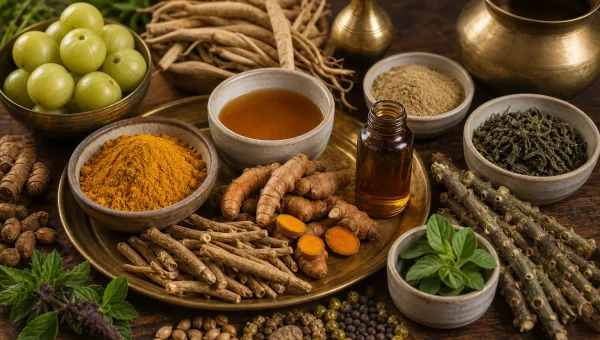
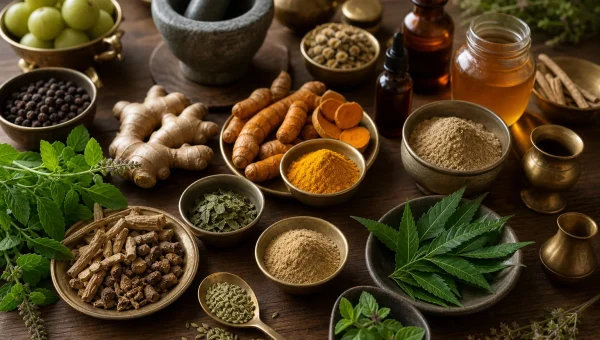
The Ayurvedic Pharmacopoeia of India identifies Haridra as the dried rhizome of Curcuma longa and lists curcumin among its constituents. Laboratory investigations indicate that curcumin can interact with DNA methyltransferases, histone acetyltransferases, histone deacetylases, microRNAs, and transcriptional pathways. Much of this work involves cultured cells, animal models, or concentrations that do not directly establish clinical epigenetic effects from dietary turmeric. Turmeric should not be presented as a proven method for unlocking beneficial genes or reversing disease-associated methylation in humans. Our Turmeric guide discusses its wider clinical context.
2. Ashwagandha (Withania somnifera)
The pharmacopoeial drug Ashwagandha consists of the dried mature roots of Withania somnifera. Randomized trials of standardized root extracts have reported changes in perceived stress, sleep, or cortisol in particular populations, although products, doses, and results differ. Separate cell experiments involving isolated withaferin A have demonstrated effects on epigenetic machinery in cancer models. These laboratory findings do not establish that ordinary Ashwagandha treatment reverses stress-related epigenetic marks or reprograms the human hypothalamic-pituitary-adrenal axis.
3. Brahmi (Bacopa monnieri)
The Ayurvedic Pharmacopoeia identifies Brahmi as the whole plant of Bacopa monnieri. Clinical and experimental literature has examined its cognitive and neurological effects, but a reproducible human epigenomic mechanism has not been established. Proposed actions involving neurotransmission, antioxidant defenses, neurotrophic signaling, or bacosides should not be converted into claims that Brahmi directly switches particular memory genes on or off. Our Brahmi guide describes its traditional use and clinical considerations.
4. Amalaki (Phyllanthus emblica)
Amalaki is the fruit of Phyllanthus emblica, also listed under the synonym Emblica officinalis. The fruit contains tannins and ascorbic acid. In experimental systems, ascorbate can support TET enzymes involved in DNA demethylation and certain enzymes involved in histone demethylation. This biochemical role does not demonstrate that consuming Amalaki causes predictable genome-wide demethylation in humans. The activity of an isolated nutrient cannot be used to assign a clinical epigenetic effect to the complete fruit or an Ayurvedic formulation.
5. Guduchi (Tinospora cordifolia)
The pharmacopoeial Guduchi drug is prepared from the mature stem of Tinospora cordifolia. Experimental literature describes immunological and inflammatory actions of Guduchi extracts and isolated constituents. Changes in cytokines or NF-kB signaling, however, do not by themselves prove histone modification or another epigenetic mechanism. Direct, well-controlled human epigenomic studies of Guduchi remain limited. Our Guduchi guide covers its traditional identity and safety considerations.
Reproduction, Beeja, and Transgenerational Epigenetics
Classical Ayurvedic embryology discusses beeja, beejabhaga, and beejabhagavayava when explaining reproduction and the origin of inherited abnormalities. These concepts demonstrate close attention to parental reproductive material and the formation of particular organs or traits. They should not be translated literally as DNA, chromosomes, and genes, because the classical categories arose within a different anatomical and philosophical framework.
Transgenerational epigenetic inheritance has been demonstrated in several non-human organisms, but it is difficult to establish conclusively in humans. Researchers must distinguish true transmission through the germline from direct exposure during pregnancy, shared family environments, socioeconomic conditions, culture, and inherited DNA variants. Classical discussions of beeja can be compared with modern heredity as a historical and conceptual exercise, but they do not constitute proof that Ayurveda identified germline DNA methylation or transgenerational epigenetic inheritance.
Practical Lifestyle Guidance
The most defensible application of this topic is not an attempt to target individual genes. It is the use of sustainable behaviors that already have broader physiological value. Epigenetic measurements may help explain parts of their biology, but they are not required to justify regular sleep, suitable exercise, nutritious food, stress management, or avoidance of harmful exposures.
| Practice | Modern Biological Context | Ayurvedic Context |
|---|---|---|
| Maintain a regular sleep-wake schedule | Sleep and circadian disruption can influence hormonal signaling, metabolism, gene expression, and tissue-specific methylation. | Dinacharya emphasizes orderly daily conduct and sleep appropriate to the individual. |
| Exercise regularly at an appropriate intensity | Repeated exercise produces metabolic, transcriptional, and methylation-related adaptations in responsive tissues. | Vyayama is advised according to strength, season, age, diet, and health status. |
| Eat a varied, minimally processed diet | Nutrients supply substrates and cofactors used in methylation, acetylation, antioxidant defense, and cellular metabolism. | Ayurvedic dietary guidance considers digestion, constitution, quantity, compatibility, season, and preparation. |
| Use meditation or another suitable stress-management method | Stress-related neuroendocrine and inflammatory pathways can influence transcriptional regulation. | Mental discipline, meditation, ethical conduct, and regulation of the senses support psychological balance. |
| Avoid tobacco and unnecessary toxic exposures | Smoking and environmental pollutants are associated with extensive molecular and epigenetic alterations. | Ayurvedic preventive care includes avoiding causes and behaviors that disturb health. |
Limits of the Current Evidence
Ayurgenomics and lifestyle epigenetics are active fields, but direct studies of classical Ayurvedic interventions remain limited. Many herb-related mechanisms come from cell cultures or animal experiments. Human studies may use small cohorts, different constitutional assessment methods, varied products, surrogate biomarkers, or short follow-up periods. Epigenetic association also does not establish that a particular mark caused the observed health outcome. Claims that a routine, herb, massage, or purification procedure resets the epigenome, reverses inherited disease risk, or activates predetermined beneficial genes exceed the available human evidence.
Safety and Disclaimer
This article is for educational purposes and does not provide a diagnosis or individualized treatment. Epigenetic language should not be used to promise prevention or reversal of cancer, diabetes, cardiovascular disease, neurological illness, infertility, or inherited disorders. Ayurvedic herbs can vary in composition and may interact with medicines, affect pregnancy, aggravate existing disease, or cause adverse effects. Panchakarma and other intensive procedures require proper clinical assessment and supervision. Consult a qualified Ayurvedic practitioner and an appropriate healthcare professional before using supplements, changing prescribed treatment, fasting, or beginning a therapeutic procedure.
Actionable tip: Choose one sustainable practice, such as keeping a consistent sleep and waking schedule or meditating for ten minutes each day. Ayurveda traditionally places waking within the pre-dawn, sunrise-relative period known as brahma muhurta, while also considering digestion, strength, age, season, and health. A safe and repeatable routine is more appropriate than attempting to manipulate individual genes or following a rigid clock time that conflicts with adequate sleep.
References
- Epigenetic differences arise during the lifetime of monozygotic twins (2005), PubMed Central
- Genome (genome.gov)
- Epigenetics and lifestyle (2011), PubMed Central
- Ayurveda and Epigenetics (2020), PubMed Central
- Genome (genome.gov)
- Can Exercise Training Alter Human Skeletal Muscle DNA Methylation? (2022), PubMed Central
- Acute sleep loss results in tissue-specific alterations in genome-wide DNA methylation state and metabolic fuel utilization in humans (2018), PubMed Central
- Yogic meditation reverses NF-κB and IRF-related transcriptome dynamics in leukocytes of family dementia caregivers in a randomized controlled trial (2013), PubMed Central
- Whole genome expression and biochemical correlates of extreme constitutional types defined in Ayurveda (2008), PubMed Central
- An Ayurgenomics Approach: Prakriti-Based Drug Discovery and Development for Personalized Care (2022), PubMed Central
- Epigenetic control and the circadian clock: linking metabolism to neuronal responses (2014), PubMed Central
- Charaka Samhita — Dinacharya
- Charaka Samhita — Dinacharya
- Ayurvedic Pharmacopoeia of India
- Ayurvedic Pharmacopoeia of India
- Dravyaguna notes
- “Curcumin, the King of Spices”: Epigenetic Regulatory Mechanisms in the Prevention of Cancer, Neurological, and Inflammatory Diseases (2015), PubMed Central
- An investigation into the stress-relieving and pharmacological actions of an ashwagandha (Withania somnifera) extract: A randomized, double-blind, placebo-controlled study (2019), PubMed
- A Novel Combination of Withaferin A and Sulforaphane Inhibits Epigenetic Machinery, Cellular Viability and Induces Apoptosis of Breast Cancer Cells (2017), PubMed
- Ayurvedic Pharmacopoeia of India
- Regulation of the Epigenome by Vitamin C (2015), PubMed Central
- Tinospora cordifolia (Willd.) Hook. f. and Thoms. (Guduchi) – validation of the Ayurvedic pharmacology through experimental and clinical studies (2010), PubMed Central
- Charaka Samhita — Khuddika Garbhavakranti Sharira
- Nature (nature.com)
- Jaims (jaims.in)

Useful post on Epigenetics and Ayurveda. Small daily changes are easier to follow than a perfect plan.
I want to understand the mechanism more specifically. When the article says Ayurvedic interventions can switch genes on and off, is this primarily through DNA methylation, histone modification, or non-coding RNA pathways? The epigenetic mechanisms are not equivalent and the Ayurvedic protocols might target different ones.
I am a geneticist and I want to note that while the epigenetics framing is compelling, the claim that dietary and lifestyle interventions reliably and specifically switch disease-relevant genes on or off is oversimplified. The effects of diet on the epigenome are real but diffuse and hard to predict at the individual gene level. The article presents this with more precision than the science warrants.
found this post helpful. will try the suggested approach. (ref 1926-71)
Useful post on Epigenetics and Ayurveda. This is the kind of detail readers can test slowly.
My grandfather had the same genetic risk factors as his brother for cardiovascular disease. His brother died at 58 from a heart attack. My grandfather lived to 91 following the exact kind of seasonal Ayurvedic routines described in this article. Their gene expression must have diverged significantly over 30 years of different lifestyle choices.
The possibility of reversing epigenetic damage from years of unhealthy lifestyle is the most hopeful thing in this article. Is there a critical period after which the epigenetic changes from poor lifestyle become irreversible? The research on epigenetic age reversal is still early but the trajectory is encouraging.
The thing that stays with me from this article is the idea that our choices are continuously writing our health story at the molecular level and that story can be edited. As someone with a family history of diabetes I find this framing more actionable than being told I have elevated genetic risk. Risk is not destiny. That is the message of both epigenetics and Ayurveda.
The twin study mentioned really shows how environment can shape gene activity even when DNA is identical.
The article conflates reversible epigenetic changes with permanent ones. Some epigenetic marks established in utero or early childhood are very resistant to change. The lifestyle-modifiable portion of the epigenome is real but it is not the entire epigenome. The optimism about reversibility should be tempered.
I teach biology at university and I am going to use the twin example from this article in my epigenetics lecture. It is the most accessible explanation I have found. The Ayurvedic connection is not something I would present in a biology class but the epigenetics explanation itself is excellent.
I wonder if daily routines like waking before sunrise actually influence methylation patterns in practice.
How long does it take for Ayurvedic lifestyle changes to produce measurable epigenetic changes? I know this is an impossible question to answer precisely but if I follow the Dinacharya and Ritucharya protocols for 6 months, would I expect to see changes in any biomarker that reflects epigenetic modification?
Useful post on Epigenetics and Ayurveda. This feels more usable than a long list of herbs.
It seems reasonable that diet and sleep could affect histone acetylation without claiming they switch genes on or off.
the intergenerational epigenetic transmission angle is missing from this article. the Ayurvedic emphasis on lifestyle practices before conception is partly about changing what you pass on epigenetically to your children. this is one of the most important and underappreciated aspects of the epigenetics-Ayurveda connection.
Sattva-Rajas-Tamas as epigenetic influence. chronic Rajas activation looks remarkably similar to glucocorticoid-mediated epigenetic modification in chronic stress studies
Biology teacher here. using the twin example in my epigenetics lecture. the Ayurvedic connection isn’t for the classroom but the epigenetics explanation itself is excellent
grandfather with same cardiovascular genetic risk factors as his brother. brother died at 58. grandfather lived to 91 following Ayurvedic seasonal routines
found this post helpful. will try the suggested approach. (ref 1926-34)
I’m a geneticist and the claim that lifestyle interventions reliably and specifically switch disease-relevant genes on and off is oversimplified. effects are real but diffuse
🌿 biology teacher here. using the twin example in my epigenetics lecture. the Ayurvedic connection isn’t for the classroom but the epigenetics explanation itself is excellent
the reversibility claim needs tempering. some epigenetic marks established in utero or early childhood r very resistant to change
risk is not destiny. that is the message of both epigenetics and Ayurveda. most actionable framing ive found for managing genetic risk
The Epigenetics and Ayurveda explanation is clearer than most short posts. This would be easier to follow with a one-week sample plan.
the reversibility claim needs tempering. some epigenetic marks established in utero or early childhood are very resistant to change
found this post helpful. will try the suggested approach. (ref 1926-21)
risk is not destiny. that is the message of both epigenetics and Ayurveda. most actionable framing I’ve found for managing genetic risk
found this post helpful. will try the suggested approach. (ref 1926-14)
After reading about prakriti, I’m curious how practitioners assess constitution without relying on lab tests.
I liked the practical side of Epigenetics and Ayurveda. The practical details matter more than people think.
The Epigenetics and Ayurveda explanation is clearer than most short posts. The main idea is clear even if someone is new to Ayurveda.
found this post helpful. will try the suggested approach. (ref 1926-47)
Same here!
I liked the practical side of Epigenetics and Ayurveda. Would be useful to see a short checklist next.
I liked the practical side of Epigenetics and Ayurveda. I appreciate that it does not oversell the result.
biology teacher here. using the twin example in my epigenetics lecture. the Ayurvedic connection isn’t for the classroom but the epigenetics explanation itself is excellent 🙌
found this post helpful. will try the suggested approach. (ref 1926-18)
Biology teacher here. using the twin example in my epigenetics lecture. the Ayurvedic connection isn’t for the classroom but the epigenetics explanation itself is excellent धन्यवाद
🙌 biology teacher here. using the twin example in my epigenetics lecture. the Ayurvedic connection isn’t for the classroom but the epigenetics explanation itself is excellent
I liked the practical side of Epigenetics and Ayurveda. This feels more usable than a long list of herbs.
The safest part of the Epigenetics and Ayurveda advice is keeping it simple. The main idea is clear even if someone is new to Ayurveda.
not related to this post but does anyone know a good practitioner in Hyderabad?
found this post helpful. will try the suggested approach. (ref 1926-22)
@Sandeep found this post helpful. will try the suggested approach. (ref 1926-91)
The article’s caution about equating Panchakarma with epigenome resetting feels important for realistic expectations.
The safest part of the Epigenetics and Ayurveda advice is keeping it simple. Good starting point for a cautious reader.
found this post helpful. will try the suggested approach. (ref 1926-24)
This helped me understand Epigenetics and Ayurveda without too much jargon. The practical details matter more than people think.
✨ biology teacher here. using the twin example in my epigenetics lecture. the Ayurvedic connection isn’t for the classroom but the epigenetics explanation itself is excellent
Biology teacher here. using the twin example in my epigenetics lecture. the Ayurvedic connection isn’t for the classroom but the epigenetics explanation itself is excellent ठीक है
found this post helpful. will try the suggested approach. (ref 1926-31)
Biology teacher here. using the twin example in my epigenetics lecture. the Ayurvedic connection isn’t for the classroom but the epigenetics explanation itself is excellent ✨
This helped me understand Epigenetics and Ayurveda without too much jargon. The main idea is clear even if someone is new to Ayurveda.
biology teacher here. using the twin example in my epigenetics lecture. the Ayurvedic connection isn’t for the classroom but the epigenetics explanation itself is excellent 🙏
The Epigenetics and Ayurveda section feels grounded enough to try carefully. The article avoids making it sound like a quick fix.
This helped me understand Epigenetics and Ayurveda without too much jargon. Good starting point for a cautious reader.
found this post helpful. will try the suggested approach. (ref 1926-36)
The identical twins framework is such a clean way to make the epigenetics argument concrete. I’ve tried explaining to skeptical family members why two people with similar genetics can age so differently and I always struggle to make it stick. Does the article address whether epigenetic changes from long-term Ayurvedic practice show up in any measurable biomarkers, or is the evidence still mostly observational at this point?
found this post helpful. will try the suggested approach. (ref 1926-37)
found this post helpful. will try the suggested approach. (ref 1926-38)
found this post helpful. will try the suggested approach. (ref 1926-41)
biology teacher here. using the twin example in my epigenetics lecture. the Ayurvedic connection isn’t for the classroom but the epigenetics explanation itself is excellent 🌿
found this post helpful. will try the suggested approach. (ref 1926-43)
One point that stuck with me is that herbal effects seen in cells don’t always translate to whole plant use.
found this post helpful. will try the suggested approach. (ref 1926-44)
I was looking for a plain explanation of Epigenetics and Ayurveda. This would be easier to follow with a one-week sample plan.
found this post helpful. will try the suggested approach. (ref 1926-46)
I was looking for a plain explanation of Epigenetics and Ayurveda. Good starting point for a cautious reader.
found this post helpful. will try the suggested approach. (ref 1926-50)
It’s interesting to see how stress related pathways might be modulated by meditation, though results vary.
The advice around Epigenetics and Ayurveda is specific enough to be useful. The practical details matter more than people think.
found this post helpful. will try the suggested approach. (ref 1926-51)
found this post helpful. will try the suggested approach. (ref 1926-52)
I appreciate the reminder that avoiding tobacco and pollutants aligns with both Ayurvedic advice and epigenetic research.
The advice around Epigenetics and Ayurveda is specific enough to be useful. This would be easier to follow with a one-week sample plan.
found this post helpful. will try the suggested approach. (ref 1926-54)
found this post helpful. will try the suggested approach. (ref 1926-55)
found this post helpful. will try the suggested approach. (ref 1926-92)
The discussion on seasonal adaptation made me think about how changing food with the seasons could influence gene expression.
found this post helpful. will try the suggested approach. (ref 1926-56)
found this post helpful. will try the suggested approach. (ref 1926-57)
🙏 biology teacher here. using the twin example in my epigenetics lecture. the Ayurvedic connection isn’t for the classroom but the epigenetics explanation itself is excellent
Reading about beeja and transgenerational ideas reminded me that ancient concepts can inspire modern questions without being literal.
found this post helpful. will try the suggested approach. (ref 1926-59)
The suggestion to pick one sustainable habit, like a regular sleep schedule, feels practical and achievable.
The Epigenetics and Ayurveda angle is useful here. I appreciate that it does not oversell the result.
I found the explanation of DNA methylation as a context dependent mark rather than a simple off switch quite clarifying.
found this post helpful. will try the suggested approach. (ref 1926-61)
found this post helpful. will try the suggested approach. (ref 1926-95)
biology teacher here. using the twin example in my epigenetics lecture. the Ayurvedic connection isn’t for the classroom but the epigenetics explanation itself is excellent 💯
It’s helpful that the article distinguishes between observed associations and proven causation in epigenetic studies.
The Epigenetics and Ayurveda angle is useful here. The examples make the advice less abstract.
The Epigenetics and Ayurveda angle is useful here. I would like to know how long to try it before judging results.
Good reminder on Epigenetics and Ayurveda. The practical details matter more than people think.
Good reminder on Epigenetics and Ayurveda. Would be useful to see a short checklist next.
found this post helpful. will try the suggested approach. (ref 1926-67)
biology teacher here. using the twin example in my epigenetics lecture. the Ayurvedic connection isn’t for the classroom but the epigenetics explanation itself is excellent ❤️
Good reminder on Epigenetics and Ayurveda. This would be easier to follow with a one-week sample plan.
found this post helpful. will try the suggested approach. (ref 1926-70)
found this post helpful. will try the suggested approach. (ref 1926-72)
I came for Epigenetics and Ayurveda and this answered the main question. Small daily changes are easier to follow than a perfect plan.
found this post helpful. will try the suggested approach. (ref 1926-74)
❤️ biology teacher here. using the twin example in my epigenetics lecture. the Ayurvedic connection isn’t for the classroom but the epigenetics explanation itself is excellent
biology teacher here. using the twin example in my epigenetics lecture. the Ayurvedic connection isn’t for the classroom but the epigenetics explanation itself is excellent नमस्ते
I came for Epigenetics and Ayurveda and this answered the main question. The safety notes could be expanded a little.
I came for Epigenetics and Ayurveda and this answered the main question. This feels more usable than a long list of herbs.
found this post helpful. will try the suggested approach. (ref 1926-79)
found this post helpful. will try the suggested approach. (ref 1926-80)
Will try this.
found this post helpful. will try the suggested approach. (ref 1926-82)
found this post helpful. will try the suggested approach. (ref 1926-83)
found this post helpful. will try the suggested approach. (ref 1926-84)
The part about Epigenetics and Ayurveda feels realistic. The main idea is clear even if someone is new to Ayurveda.
The part about Epigenetics and Ayurveda feels realistic. I would like to know how long to try it before judging results.
found this post helpful. will try the suggested approach. (ref 1926-87)
This makes sense for Epigenetics and Ayurveda. The practical details matter more than people think.
found this post helpful. will try the suggested approach. (ref 1926-89)
found this post helpful. will try the suggested approach. (ref 1926-90)
found this post helpful. will try the suggested approach. (ref 1926-93)
found this post helpful. will try the suggested approach. (ref 1926-94)