
Acne Scars Ayurvedic Healing: The Vrana Shopha Framework
Acne scars ayurvedic healing works best when it separates two post-acne concerns that are often given the same name. Post-inflammatory hyperpigmentation (PIH) is a flat discoloration left after inflammation, usually brown, grey-brown, or blue-grey depending on depth and skin tone. It is driven mainly by excess or irregular melanin after the acne lesion heals. A true scar is different: it changes the skin’s surface and dermal architecture, producing indented atrophic scars such as icepick, boxcar, and rolling scars, or raised hypertrophic and keloid scars.
Ayurveda can read this sequence through the language of mukha dushika, vrana shopha, vrana, and post-healing complexion care. The inflamed acne lesion resembles a local shopha state; once the lesion settles, the focus shifts toward vrana shodhana (keeping the site clean and non-irritated), vrana ropana (supporting sound repair), and vaikritapaham care (minimizing residual discoloration or unevenness). Flat facial pigmentation can be approached with varnya, rakta-prasadana, and pitta-calming measures, while indented or raised scars require a wound-remodeling outlook rather than simple brightening.
This distinction matters for expectations. PIH often improves gradually when new acne inflammation is controlled and the skin is protected from ultraviolet exposure. Deeper dermal pigmentation and true texture scars move more slowly. Deep icepick scars, established rolling scars, and keloids often need dermatological procedures alongside Ayurvedic support; topical oils and pastes can support the skin, but they should not be presented as guaranteed scar erasers.
Phase 1: Active Clearing of PIH
Post-inflammatory hyperpigmentation is the most responsive post-acne mark because the surface is flat and the main task is to calm residual inflammation, protect the skin from darkening, and support a more even complexion. The Ayurvedic emphasis is gentle, steady, and non-abrasive: reduce pitta-rakta irritation, avoid picking or scrubbing, and use complexion-supporting herbs only on fully closed skin.
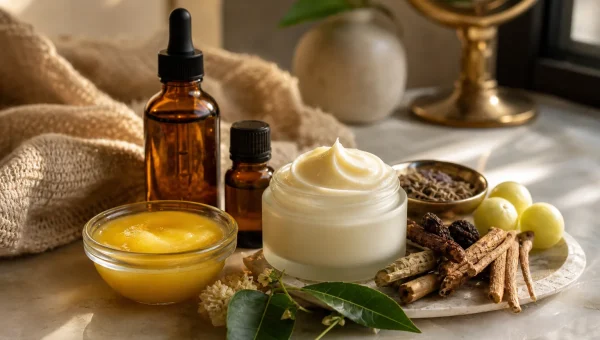
Kumkumadi tailam as the nightly complexion oil: Apply 2-4 drops to clean, dry skin at night, warming the oil between the fingertips and pressing it lightly over the face rather than rubbing aggressively. Traditional kumkumadi preparations commonly use complexion-supporting ingredients such as kumkuma, chandana, yashtimadhu, manjistha, and sesame oil. This makes it most appropriate for dullness, uneven tone, and flat marks after acne has healed. Skip application on open pimples, cystic flares, or areas where oil clearly clogs the skin. A detailed application routine can be followed here: kumkumadi night protocol.
Haridra and chandana spot paste: Mix a small pinch of turmeric powder or a few drops of fresh turmeric juice with 1/2 teaspoon sandalwood powder and enough rose water to form a thin paste. Apply only to flat PIH areas for 10-15 minutes, then rinse gently without scrubbing. Use this two or three times weekly rather than as a harsh daily mask. Turmeric can temporarily stain lighter skin, and sandalwood should be sourced carefully because adulterated powders and essential oils may irritate sensitive skin.
Kumari gel for calming the healing surface: Use the clear inner gel of fresh aloe vera as a 15-20 minute mask over healed PIH areas. Avoid the yellow latex near the rind, as it can irritate the skin. Aloe is best used as a cooling, barrier-friendly support when the skin feels hot, tight, or easily inflamed. Patch test first, because even traditional cooling plants can irritate individual skin types.
Rakta-Prasadana Support: Manjistha, Neem, and Amalaki
Topical care gives better results when the active acne cycle is also addressed. In Ayurvedic terms, every new inflamed papule keeps the pitta-rakta and kapha involvement active and creates the possibility of a new dark mark. Manjistha is traditionally valued for rakta-prasadana and complexion support; neem is used in skin conditions where heat, itching, oiliness, and microbial tendency are part of the picture; amalaki is a pitta-pacifying rasayana fruit that also supports normal tissue repair through its nutrient profile.
Internal herbs should be individualized rather than taken casually in high-dose extract form. Neem, manjistha, guggulu combinations, and concentrated herbal tablets may be inappropriate during pregnancy, breastfeeding, fertility treatment, liver or kidney disease, anticoagulant use, or when prescription medication is being taken. A qualified Ayurvedic practitioner can decide whether internal herbs, diet correction, bowel regularity, or acne-specific treatment should be the priority.
Food support should be simple and steady. Fresh amalaki, citrus, guava, bell pepper, and leafy vegetables support vitamin C intake. Lentils, pumpkin seeds, sesame, chickpeas, and nuts support zinc and protein needs. Warm, digestible meals, adequate hydration, and regular elimination help reduce the dietary and digestive strain that often aggravates recurrent acne in pitta-kapha skin patterns.
Phase 2: True Scar Treatment
True atrophic acne scars are not pigment deposits; they are structural changes in the dermis. Ayurvedic care therefore focuses on supporting mature, healed skin through gentle sneha, careful massage, and wound-repair herbs, while keeping expectations realistic. Home care may soften the look of surrounding skin and improve overall tone, but deep pits usually require professional procedures such as microneedling, subcision, TCA CROSS, fractional laser, fillers, or punch techniques.
Khadira paste for oily, thick, or raised-looking scar areas: Khadira bark decoction or a very fine khadira powder paste may be used as a short-contact application on healed, non-broken skin. Its astringent nature makes it more suitable for oily, thick, or uneven areas than for dry, delicate, or irritated skin. Leave on for 10-15 minutes and rinse before the skin becomes tight or flaky. Avoid using drying pastes on active inflamed acne, open lesions, or already dry barrier-damaged skin.
Mandukaparni oil massage for mature texture support: Mandukaparni, also known as gotu kola, is a useful wound-support herb for mature, closed scars. Use a small amount of mandukaparni-infused oil or a gentle non-comedogenic oil and massage only fully healed textured areas with light circular pressure for one or two minutes. The purpose is to soften, mobilize, and nourish the skin, not to forcefully break scar tissue. Do not massage active acne, fresh wounds, painful raised scars, or growing keloids.
Raised hypertrophic and keloid scars: These scars require caution. They may itch, enlarge beyond the original acne area, or become firm and tender. Aggressive massage, heating oils, strong exfoliants, or repeated irritation can worsen them in some people. Ayurvedic support should remain gentle and practitioner-guided, while a dermatologist evaluates whether intralesional treatment, silicone, pressure therapy, laser, or another medical option is needed.
| Post-Acne Mark | Primary Topical Focus | Internal Support | Timeline | Realistic Outcome |
|---|---|---|---|---|
| PIH: flat brown or grey marks | Kumkumadi, aloe, haridra-chandana spot paste, daily sunscreen | Practitioner-guided rakta-prasadana support, amalaki-rich diet | Usually months, depending on pigment depth and new acne control | Gradual evening of tone, best in flat epidermal marks |
| Rolling or boxcar scars | Gentle mandukaparni oil massage on mature healed scars | Protein, vitamin C foods, zinc-rich foods, acne control | Long-term; procedures may speed visible change | Softening and improved overall texture; lifting usually needs dermatology |
| Icepick scars | Gentle complexion care and sunscreen; avoid harsh picking or scrubbing | General wound-repair nutrition and active acne prevention | Long-term | Home care will not reliably erase deep narrow pits |
| Hypertrophic or keloid scars | Non-irritating care only; avoid aggressive massage and heating applications | Practitioner-guided support only | Requires professional monitoring | Flattening, itch reduction, and softening may need medical treatment |
The Daily 7-Minute Scar Protocol
Consistency matters more than intensity. Acne-prone, PIH-prone skin usually worsens when it is scrubbed, burned, picked, or overloaded with too many actives. The daily routine should therefore be short, cooling, protective, and repeatable.
Morning (3 minutes): Cleanse with a mild, non-abrasive cleanser or plain cool water if the skin is not oily on waking. Apply a thin layer of fresh aloe gel only if it suits your skin, then apply broad-spectrum sunscreen over the full face. SPF 30 or higher is a practical baseline; SPF 50+ is preferable for strong sun exposure, outdoor work, or stubborn PIH. Do not pick flakes, squeeze bumps, or rub healing marks with towels.
Evening (4 minutes): Remove sunscreen gently with a mild cleanser or a small amount of suitable cleansing oil followed by water-based cleansing. On two or three evenings weekly, apply the haridra-chandana paste only to flat marks for 10-15 minutes and rinse. On other evenings, go straight to 2-4 drops of kumkumadi tailam if it suits your skin. For mature texture scars, add one minute of very gentle mandukaparni oil massage on fully healed areas only.
Sunscreen deserves special emphasis in PIH care. Ultraviolet exposure can darken healing pigment and prolong the time it takes for marks to fade. Every complexion herb, oil, and mask works against a stronger obstacle when the skin is repeatedly exposed to sun without protection. For acne scars, daily sun protection is not cosmetic excess; it is part of the treatment foundation.
Nutrition for Healing Skin
The three dietary priorities for acne-scar support are adequate protein, vitamin C, and zinc. Protein provides amino acids for repair. Vitamin C supports normal collagen formation and antioxidant protection. Zinc participates in wound healing and tissue remodeling. Good food choices include amalaki, guava, citrus, bell peppers, pumpkin seeds, sesame, lentils, chickpeas, mung dal, nuts, and well-cooked seasonal vegetables.
Ayurveda also gives importance to agni. Heavy, greasy, very sugary, or repeatedly reheated foods may aggravate acne-prone pitta-kapha patterns in many people, while overly restrictive dieting can weaken repair. A practical middle path is warm, freshly prepared food, enough protein, steady bowel movements, and avoiding foods that clearly trigger breakouts in your own body. The complete DIY approach including gentle mask options is covered at DIY Ayurvedic face masks for clear skin.
Medical Disclaimer: This content is for educational purposes only and does not constitute medical advice. Significant acne scarring, deep icepick scars, painful raised scars, spreading keloids, severe acne, infection, pregnancy, breastfeeding, chronic illness, or prescription medication use requires guidance from a qualified healthcare provider. Consult a licensed Ayurvedic practitioner for personalized internal herbs and a dermatologist for procedural scar treatment when needed. Patch test all topical preparations before full-face use and stop any application that causes burning, rash, swelling, or worsening acne.
References
- NCBI
- Dermnetnz (dermnetnz.org)
- Acne scars: pathogenesis, classification and treatment (2010), PubMed Central
- Atrophic acne scarring: a review of treatment options (2015), PubMed Central
- A Comprehensive Review of Non-Surgical Treatments for Hypertrophic and Keloid Scars in Skin of Color (2024), PubMed Central
- Management of acne scarring, part II: a comparative review of non-laser-based, minimally invasive approaches (2012), PubMed
- Pharmacodynamic appraisal of wound-healing herbs of Sushruta Samhita (2021), PubMed Central
- Jaims (jaims.in)
- Wjpr (wjpr.s3.ap-south-1.amazonaws.com)
- Jaims (jaims.in)
- Clinical evaluation of Varnya Gana Lepa in Vyanga (melasma) (2015), PubMed Central
- Ayurvedic Pharmacopoeia of India
- Modulation of melanogenesis by aloesin: a competitive inhibitor of tyrosinase (2002), PubMed
- Aloesin inhibits hyperpigmentation induced by UV radiation (2002), PubMed
- The inhibitory effect of glabridin from licorice extracts on melanogenesis and inflammation (1998), PubMed
- ROS-scavenging and Anti-tyrosinase Properties of Crocetin on B16F10 Murine Melanoma Cells (2018), PubMed
- Sciencedirect (sciencedirect.com)
- Ijdvl (ijdvl.com)
- Wound healing potential of Acacia catechu in streptozotocin-induced diabetic mice using in vivo and in silico approach (2023), PubMed Central
- Ijbcp (ijbcp.com)
- A Systematic Review of the Effect of Centella asiatica on Wound Healing (2022), PubMed Central
- A Prospective Randomized, Controlled, Double-Blind Trial of the Efficacy Using Centella Cream for Scar Improvement (2018), PubMed Central
- Scar massage for hypertrophic burns scarring-A systematic review (2018), PubMed
- Therapeutics Role of Azadirachta indica (Neem) and Their Active Constituents in Diseases Prevention and Treatment (2016), PubMed Central
- Mdpi (mdpi.com)
- NIH Office of Dietary Supplements
- Zinc in Wound Healing Modulation (2017), PubMed Central
- Role of matrix metalloproteinase in wound healing (2022), PubMed Central
my grandmother used to make something similar for us. never knew it had a proper Ayurvedic name.