Rosacea Through a Pitta-Rakta Lens: Why the Treatment Logic Changes
Rosacea ayurvedic skin treatment becomes clearer when the main features of the condition—facial flushing, warmth, burning, persistent redness, papules, pustules, and visible superficial vessels—are read through a pitta-rakta pattern. This is not a claim that rosacea has a single one-to-one classical disease name. It is a practical Ayurvedic treatment lens: when heat, redness, reactivity, and vascular flushing dominate, the daily plan should emphasize pitta-rakta pacification, cooling discipline, gentle barrier care, and avoidance of heat, friction, pungency, and harsh topical practices.
Modern dermatology describes rosacea as a chronic inflammatory facial condition that commonly affects the central face and may include flushing, persistent erythema, telangiectasia, papules, pustules, thickened skin, and ocular symptoms. Ayurveda reads the same heat-redness-burning pattern as pitta expressing strongly through rakta and the facial skin. The practical result is important: rosacea-prone skin is not treated like ordinary acne. It is not managed by aggressive drying, scrubbing, steaming, or strong heating digestive herbs. The first priority is to reduce repeated heat-provocation and calm the skin’s reactivity.
Pitta Skin Assessment: Is This Rosacea or Another Facial Condition?
Begin with diagnosis. Rosacea can be confused with acne vulgaris, seborrheic dermatitis, periorificial dermatitis, contact dermatitis, and lupus-related facial rashes. Persistent facial redness, recurring flushing, eye irritation, a new photosensitive rash, or any painful, asymmetric, rapidly worsening, or unusual facial eruption should be assessed by a dermatologist before starting any protocol.
| Feature | Rosacea Pattern | Acne Vulgaris | Seborrheic Dermatitis |
|---|---|---|---|
| Main distribution | Central face: cheeks, nose, chin, forehead | Face, and often neck, chest, or back | Scalp, eyebrows, glabella, nasolabial folds, beard area, ears |
| Flushing and warmth | Prominent, episodic, often triggered by heat, sun, alcohol, spicy food, exercise, or stress | Not a defining feature | Not a defining feature; scaling and greasiness are more typical |
| Comedones | Absent; blackheads and whiteheads point away from rosacea | Present: open and closed comedones are typical | Absent |
| Scale | May feel dry or sting, but greasy scale is not the main sign | Not central unless irritated by products | Greasy or flaky scale is common |
| Visible superficial vessels | May be present, especially with persistent redness | Not typical | Not typical |
In Ayurvedic assessment, the pitta-rakta reading is strongest when flares are provoked by sun, heat, hot drinks, alcohol, pungent food, emotional intensity, vigorous exercise, hot showers, or harsh topical products. It is weaker when the main picture is comedonal acne, greasy-scaly dermatitis, steroid-related periorificial dermatitis, or a photosensitive malar rash suggestive of lupus.
The Trigger Elimination Protocol: First-Month Priority
The most useful first-month intervention is not adding many herbs at once. It is identifying and removing the strongest personal triggers. Rosacea triggers vary by person, so a four-to-six-week diary is more useful than guessing. Track flushing, burning, papules, alcohol, spicy food, hot drinks, sun, heat exposure, stress, exercise, skincare products, and menstrual or medication changes where relevant.
- Sun and heat: Use daily broad-spectrum SPF 30 or higher, shade, hats, and heat avoidance. Choose a sunscreen that does not sting; mineral formulas with zinc oxide or titanium dioxide are often easier for reactive skin to tolerate. Avoid steam, sauna, hot towel facials, and hot baths during active flares.
- Alcohol: Pause alcohol for four to six weeks, especially red wine and spirits. Reintroduce only as a single test exposure if the skin has been stable.
- Hot drinks: Take tea, coffee, and herbal drinks warm rather than hot. The temperature of the drink can matter as much as the drink itself.
- Spicy and pungent foods: Pause chilies, hot sauce, cayenne, pepper-heavy dishes, and very sharp pickles during the reset phase. In Ayurvedic terms, this reduces repeated pitta provocation.
- Cinnamaldehyde and histamine-rich foods: Test cinnamon, tomatoes, citrus fruits, chocolate, aged cheese, wine, and processed or aged meats only after the face has calmed. These are not universal triggers, but they are common enough to evaluate carefully.
- Exercise: Do not abandon movement. Shift exercise to cooler times, reduce overheating, take breaks, and use cool water or a cool compress on the face afterward.
- Stress and emotional heat: Add a daily cooling practice such as slow nasal breathing, gentle meditation, or the routine described in pranayama stress breathing. The aim is not suppression of emotion; it is reducing the heat-spike that often follows stress.
Internal Herb Protocol for a Pitta-Rakta Rosacea Pattern
Internal herbs should be chosen according to prakriti, digestion, bowel pattern, medications, pregnancy status, and the severity of the skin condition. The dose ranges below are educational and should not replace individualized care. For rosacea-prone skin, it is safer to introduce one herb at a time under the guidance of a qualified Ayurvedic practitioner rather than taking a large “blood purifier” stack during an active flare.
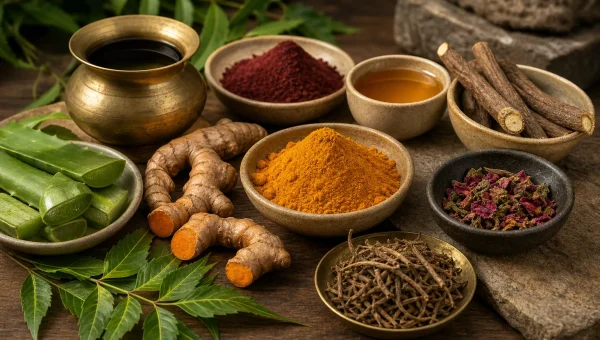
Sariva (Hemidesmus indicus): Sariva is one of the most appropriate classical herbs for a heat-prone pitta-rakta skin pattern. The Ayurvedic Pharmacopoeia of India lists Sariva root with madhura rasa, guru and snigdha guna, shita virya, madhura vipaka, and raktashodhaka, tridoshanashana, dipana, and jvarahara karma. Its listed therapeutic uses include kandu, kushtha, and raktavikara. This profile makes Sariva a strong candidate when facial heat, burning, itching, and redness are central to the presentation.
Guduchi (Tinospora cordifolia): Guduchi is useful when the rosacea pattern is accompanied by low resilience, recurring inflammatory reactivity, or weak recovery after flares. The Ayurvedic Pharmacopoeia of India lists Guduchi stem with tikta and kashaya rasa, laghu guna, ushna virya, madhura vipaka, and rasayana, tridoshashamaka, raktashodhaka, and jvaraghna karma, with kushtha among its therapeutic uses. Although its virya is listed as ushna, its rasayana and tridosha-supporting profile makes it a practitioner-selected herb rather than a simple “cooling herb.”
Manjistha (Rubia cordifolia): Manjistha is best understood as a rakta-oriented and complexion-supporting herb, not as a universally cooling herb. The Ayurvedic Pharmacopoeia of India lists Manjistha stem with madhura, tikta, and kashaya rasa, guru guna, ushna virya, katu vipaka, and kaphapittashamaka, varnya, shothaghna, kushthaghna, shonitasthapana, and rasayana karma. It is classically relevant when redness is accompanied by persistent inflammatory lesions, discoloration, or a deeper rakta pattern, but it should be selected carefully in people whose flushing is intensely hot and easily aggravated.
Dhanyaka seed water (Coriandrum sativum): Coriander seed water is a gentle kitchen-level support, not a stand-alone rosacea treatment. The Ayurvedic Pharmacopoeia of India lists Dhanyaka fruit with madhura, katu, tikta, and kashaya rasa, laghu and snigdha guna, ushna virya, madhura vipaka, tridoshanut and mutrala karma, and therapeutic uses including daha, trishna, jvara, chardi, and ajirna. For a mild household preparation, crushed coriander seed can be steeped or briefly simmered, cooled, and sipped at room temperature if it suits digestion.
Topical Application for Rosacea-Prone Skin
Rosacea-prone skin needs a gentler topical plan than acne-prone skin. The core rules are simple: keep everything cool or room temperature, avoid scrubbing, avoid steam, avoid strong fragrance and alcohol-based products, patch-test every new ingredient, and protect the skin barrier. Ayurvedic lepa can be useful only when it is fine, clean, non-irritating, and removed before it dries into a tight, cracking mask.
Daily cleansing: Use cool to lukewarm water and a mild, fragrance-free cleanser if cleansing is needed. Do not rub with towels, exfoliating powders, brushes, loofahs, or grainy ubtan on active facial rosacea. Pat dry and apply a bland moisturizer while the skin is still slightly damp.
Barrier support and sunscreen: A simple moisturizer and daily SPF 30 or higher are part of the rosacea plan, not cosmetic extras. Choose non-perfumed, non-stinging products. When sunscreen irritates, try a mineral sunscreen with zinc oxide or titanium dioxide and apply it with minimal rubbing.
Cooling lepa for selected skin: A cautious lepa may be made from very fine Shveta Chandana powder and Lodhra powder with clean cool water, applied thinly for five to ten minutes and rinsed before the paste becomes tight. Shveta Chandana is listed in the Ayurvedic Pharmacopoeia of India with madhura and tikta rasa, laghu and ruksha guna, shita virya, katu vipaka, pittahara, varnya, vishaghna, dahaprashamana, and trishnahara karma, with daha and raktavikara among its listed uses. Lodhra is listed with kashaya rasa, laghu guna, shita virya, katu vipaka, and kaphapittanut karma, with shotha and raktapitta among its listed uses. Stop immediately if there is stinging, increased redness, tightness, or burning.
What not to apply: Do not apply lemon juice, undiluted essential oils, strong alcohol toners, mentholated preparations, abrasive scrubs, hot oils, or thick occlusive masks to active rosacea. Do not apply any lepa, oil, or herbal paste near the eyes or eyelids.
What to Avoid in a Pitta-Rakta Rosacea Plan
A pitta-rakta plan is as much about restraint as it is about remedies. Over-treating the face can keep rosacea active, especially when the skin barrier is already reactive. The following practices commonly work against the goal of cooling, calming, and stabilizing the skin.
- Hot towel facials, steam therapy, sauna, and very hot showers.
- Harsh exfoliation, facial scrubs, aggressive ubtan, cleansing brushes, and repeated clay masking.
- Alcohol-based toners, strong fragrance, menthol, eucalyptus, and irritating “cooling” products that sting.
- Self-prescribed heating herb combinations, strong detox programs, or purgation during an active flare.
- Using acne routines built around drying, peeling, and scrubbing when comedones are absent.
- Stopping dermatology medicines abruptly without medical guidance, especially if topical steroids have been used on the face.
When Rosacea Needs Medical Care
Rosacea is manageable, but it is still a medical skin condition. Dermatology care is especially important when redness is persistent, papules and pustules are frequent, visible vessels are increasing, the nose or facial skin is thickening, or the eyes feel gritty, red, watery, painful, or light-sensitive. Medical options may include topical metronidazole, azelaic acid, ivermectin, brimonidine or oxymetazoline for erythema, oral medicines in selected cases, and laser or light-based care for visible vessels.
Medical disclaimer: This article is educational and does not diagnose or treat a medical condition. Rosacea, lupus-related facial rash, periorificial dermatitis, acne, and seborrheic dermatitis require proper diagnosis when symptoms overlap. Ocular rosacea requires ophthalmological evaluation. Do not apply herbal preparations to the periocular area. Consult a dermatologist and a qualified Ayurvedic practitioner before starting herbs, supplements, detoxes, or therapeutic protocols, especially if pregnant, managing a medical condition, or taking medication.
References
- NCBI
- Dermnetnz (dermnetnz.org)
- Rosacea (rosacea.org)
- Aad (aad.org)
- Rosacea and Diet: What is New in 2021? (2021), PubMed Central
- Aafp (aafp.org)
- Bad (bad.org.uk)
- Rosacea (rosacea.org)
- Dermnetnz (dermnetnz.org)
- Dermnetnz (dermnetnz.org)
- Dermnetnz (dermnetnz.org)
- Dermnetnz (dermnetnz.org)
- Aad (aad.org)
- Rosacea: Epidemiology, pathogenesis, and treatment (2017), PubMed Central
- Charaka Samhita — Pitta dosha
- Charaka Samhita — Raktapitta Chikitsa
- Ayurvedic Pharmacopoeia of India
- Ayurvedic Pharmacopoeia of India