
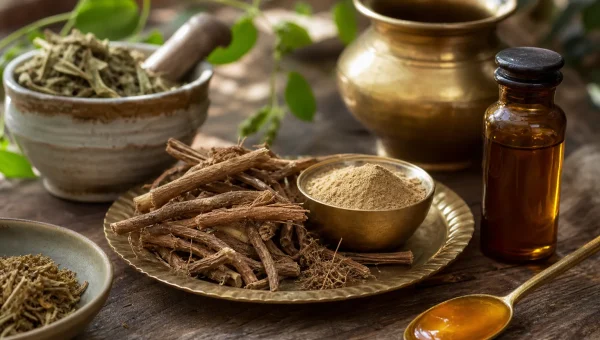
My grandmother kept a small clay pot on her kitchen shelf in Kerala. Inside it, she stored a rough, dark powder with an earthy, aromatic smell. Whenever someone in the house complained of heaviness after a festival meal, loose stools after unsuitable food, sour belching, bloating, or a dull appetite, she reached for that pot. She called it Musta. I understood its importance only later, when formal Ayurvedic study showed me that this humble rhizome has one of the clearest digestive profiles in the Ayurvedic materia medica.
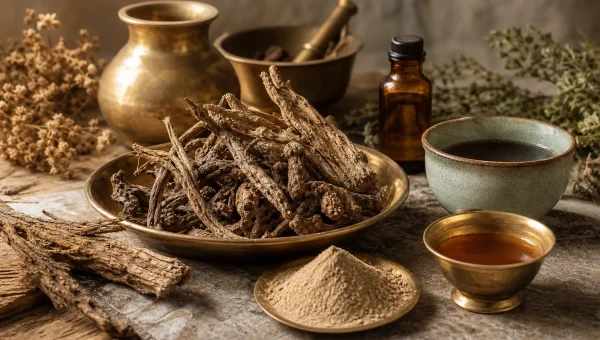
Musta (Cyperus rotundus L.), known as Nagarmotha, Motha, Nut Grass, or Purple Nut Sedge, is used in Ayurveda as the dried rhizome, not as a true root in the botanical sense. The Ayurvedic Pharmacopoeia of India describes Musta as the dried rhizome of Cyperus rotundus of the Cyperaceae family, occurring throughout India in waste grounds, gardens, and roadsides, up to about 1800 metres. Agriculturally, the plant is famous as a stubborn weed; medicinally, the same underground persistence gives Ayurveda a light, dry, aromatic digestive herb with a special place in disorders of Agni, stool, thirst, fever, and Kapha-Pitta accumulation.
Why Musta Is Central to Ayurvedic Digestive Medicine
Musta is valued because it combines three actions that are often needed together: Dīpana (supporting digestive fire), Pācana (digesting or clearing undigested residue), and Grāhī (absorbing excess intestinal fluid and helping restore stool form). The Ayurvedic Pharmacopoeia of India lists Musta with actions including Dīpana, Pācana, Grāhī, Kṛmighna, Jvaraghna, Tṛṣṇānigrahaṇa, Śothahara, and Pittakaphahara. Its listed therapeutic uses include Agnimāndya (weak digestion), Ajīrṇa (indigestion), Atisāra (diarrhea), Saṅgrahaṇī (chronic irregular bowel pattern), Jvara (fever), Tṛṣṇā (excessive thirst), Vamana (vomiting), Kāsa (cough), Śvāsa (breathlessness), Mūtrakṛcchra (painful urination), Stanyavikāra (disorder of breast milk), Āmavāta, and Kṛmiroga (worm or parasitic disorders).
Its classical pharmacological profile is Kaṭu, Tikta, and Kaṣāya Rasa (pungent, bitter, and astringent taste), Laghu and Rukṣa Guṇa (light and dry qualities), Śīta Vīrya (cooling potency), and Kaṭu Vipāka (pungent post-digestive effect). This explains why it is especially useful where heat, dampness, heaviness, poor digestion, sourness, or loose stools are present. It is classically Pitta-Kapha hara; because it is drying, it should be used carefully in people with strong Vata dryness, constipation, depletion, or frailty.
In simple terms, Musta is not merely a “stomach herb.” It is used when digestion is weak, residue is present, appetite is dull, stool is loose or unstable, thirst and fever disturb digestion, or Kapha-Pitta heaviness blocks normal appetite and elimination. For background on why Agni is treated as foundational in Ayurveda, see our article on Agni as the foundation of Ayurveda.
The 12 Digestive Applications of Musta
The following applications keep to Musta’s classical digestive role: restoring appetite, digesting residue, absorbing excess intestinal moisture, cooling Pitta heat, reducing Kapha heaviness, and supporting recovery when fever or illness weakens digestion.
1. Atisāra: Diarrhea and Loose Stools
Musta is one of the most practical Ayurvedic herbs for Atisāra when loose stools are linked with weak digestion, damp heaviness, or a need for Grāhī action. Its use is most appropriate after proper assessment of the stage of diarrhea; in an early Āma stage, Ayurveda does not rush to bind the bowel before the irritant or residue has moved out. Once fluid loss, fever, and danger signs are assessed, Musta may be used to help restore stool consistency and appetite.
2. Ajīrṇa and Agnimāndya: Indigestion and Dull Appetite
The Dīpana and Pācana actions of Musta make it useful when food feels heavy, appetite is low, burping is sour or unpleasant, and digestion remains incomplete after meals. Its bitter, pungent, and astringent profile makes it more suitable for Kapha-Pitta indigestion than for dry Vata indigestion, where warming and unctuous support may also be needed.
3. Āma-Linked Heaviness and Bloating
When bloating comes with a coated tongue, dull appetite, sluggishness, loose or sticky stools, and a sense that food is “sitting” in the abdomen, Musta is used as an Āma-pācana support. In this pattern it is not chosen merely to force gas downward; it is chosen to make digestion cleaner, lighter, and less damp.
4. Vamana and Chardi-Type Nausea
The Ayurvedic Pharmacopoeia lists Vamana among Musta’s therapeutic uses. In practical use, Musta is especially suited to nausea that appears with fever, excess heat, sourness, bitter taste, heaviness, or poor digestion. Because vomiting can also be a sign of infection, dehydration, pregnancy complications, food poisoning, or other medical conditions, persistent vomiting should not be managed with herbs alone.
5. Tṛṣṇā: Excessive Thirst During Illness
Musta is classically listed for Tṛṣṇā, pathological thirst, and is also included in the Tṛṣṇā-nigrahaṇa group of herbs in the Charaka tradition. This is not ordinary thirst after exercise; it refers to thirst associated with heat, fever, digestive disturbance, dryness of the mouth, or Pitta aggravation. In these cases, Musta’s cooling potency and lightness make it a useful ingredient in carefully selected preparations.
6. Jvara: Fever-Related Digestive Collapse
During fever, appetite often drops and undigested residue can accumulate quickly if the patient eats heavily. Musta is listed as Jvaraghna and appears in classical fever-drink traditions such as Ṣaḍaṅga Pānīya, where it is combined with cooling and digestive herbs. Its role here is to support lightness, thirst regulation, and digestive clarity during febrile states.
7. Saṅgrahaṇī: Chronic Irregular Bowel Pattern
Saṅgrahaṇī involves unstable digestion, irregular stool formation, weakness of Agni, and alternating patterns of looseness, heaviness, and incomplete digestion. Musta is used because it supports both digestion and absorption. This is a long-term clinical pattern and should be treated with diet, routine, and practitioner guidance rather than by repeatedly taking drying herbs on one’s own.
8. Kāsa and Śvāsa with Digestive Involvement
Musta is listed for Kāsa and Śvāsa. In an Ayurvedic digestive context, it is most relevant when cough, breath discomfort, or throat congestion is accompanied by Kapha heaviness, poor appetite, feverishness, or undigested residue. It is not a substitute for medical care in asthma, pneumonia, severe cough, wheezing, chest pain, or breathing difficulty.
9. Mūtrakṛcchra with Lower Abdominal Heat or Heaviness
The Ayurvedic Pharmacopoeia includes Mūtrakṛcchra among Musta’s uses. In digestive practice, this matters when painful or difficult urination appears with lower abdominal heat, heaviness, thirst, feverishness, or Pitta-Kapha disturbance. Burning urination, blood in urine, flank pain, fever, or suspected urinary infection requires medical assessment.
10. Stanyavikāra: Breast Milk Disturbance
Musta is listed in the Stanyavikāra indication and appears in the Charaka Stanyaśodhana group. This is a specialized postpartum and lactation application, not a casual home remedy. Nursing parents should use Musta only under the guidance of a qualified Ayurvedic physician and healthcare provider, especially because general supplement safety during breastfeeding is not well established.
11. Kṛmiroga: Worm and Parasitic Disorders
Musta’s Kṛmighna action and its listing for Kṛmiroga explain its use in digestive protocols where worms, parasites, abdominal discomfort, poor appetite, or irregular stools are part of the clinical picture. Suspected parasitic infection should be properly diagnosed, particularly in children, pregnancy, severe weight loss, anemia, persistent diarrhea, or recurrent abdominal pain.
12. Post-Fever and Post-Illness Digestive Restoration
After fever, infection, travel-related digestive upset, or a period of heavy medication, appetite may remain low and stools may be unstable. Musta’s Dīpana, Pācana, Grāhī, and Jvaraghna actions make it suitable in small, guided doses for rebuilding digestive steadiness without adding heaviness. This is one reason it remains a favourite in traditional households after the acute phase of illness has passed.
Key Herbs That Work With Musta
Musta is often used alone, but its best-known classical and household uses are in combinations. The companion herb depends on whether the dominant pattern is fever, thirst, Kapha heaviness, Pitta heat, Vata gas, or chronic weak digestion.
- Musta (Cyperus rotundus): The primary herb for lightening, digesting, absorbing excess moisture, and supporting stool form.
- Parpata or Parpataka (Fumaria parviflora / Fumaria indica): Often paired in fever and thirst patterns with Pitta involvement.
- Ushira (Vetiveria zizanioides / Chrysopogon zizanioides): A cooling aromatic root used with Musta in heat, thirst, and fever drinks.
- Chandana (Santalum album): A cooling companion in classical fever and thirst preparations.
- Udichya or Hrivera (Pavonia odorata or related traditional substitutions): Used in cooling aromatic combinations such as Ṣaḍaṅga Pānīya.
- Nagara or Shunthi (Zingiber officinale, dry ginger): Added when coldness, Vata gas, or sluggish movement accompanies poor digestion.
- Dhanyaka (Coriandrum sativum, coriander): A gentle digestive and cooling kitchen herb that pairs well when thirst and mild heat are present.
- Kiratatikta (Swertia chirata / Swertia chirayita): A bitter herb used in Pitta-fever and bitter digestive formulations under practitioner guidance.
The Classic Musta Decoction Recipe
A decoction is the most traditional way to extract the qualities of a rhizome. The Ayurvedic Pharmacopoeia lists Musta dose as 3–6 g in powder form and 20–30 ml as Kwatha. The practical recipe below keeps the preparation modest and suitable for adult educational use; individual dose should be adjusted by a practitioner.
Musta Kwatha: Traditional Digestive Decoction
What you need:
- 3–6 g dried Musta rhizome, coarsely powdered or lightly crushed
- 120–240 ml clean water
- Optional: a few coriander seeds when heat and thirst are present
- Optional: a very small piece of dry ginger when gas, coldness, or Vata obstruction is present
- Honey only if advised, added after the liquid is warm rather than hot
Method:
- Place the Musta and water in a small saucepan.
- Bring to a gentle boil, then simmer uncovered on low heat.
- Reduce the liquid to roughly one-half to one-quarter, depending on the strength advised.
- Strain through a fine cloth or strainer.
- Use the decoction fresh; do not keep it for long periods at room temperature.
Adult dose: 20–30 ml of finished decoction, once or twice daily, or as directed by a qualified practitioner.
Duration: For short-term digestive disturbance, use only for a few days unless supervised. Chronic loose stools, recurrent indigestion, or fever-related digestive symptoms require proper assessment.
Note: Decoctions are stronger than light teas. A weak infusion and a reduced Kwatha are not the same preparation.
Powder Dosage and Practical Use
The official single-drug dose in the Ayurvedic Pharmacopoeia of India is 3–6 g of powder or 20–30 ml of decoction. Many household traditions use smaller amounts, but therapeutic use should follow constitution, age, strength, digestive state, and disease stage.
| Use Pattern | Typical Form | Vehicle | Important Note |
|---|---|---|---|
| Agnimāndya and Ajīrṇa | Powder within the 3–6 g daily range, or Kwatha 20–30 ml | Warm water | Best for Kapha-Pitta heaviness, not dry Vata depletion |
| Atisāra after assessment | Kwatha 20–30 ml or powder as advised | Rice water, thin gruel, or warm water | Do not ignore dehydration, blood, high fever, or prolonged diarrhea |
| Fever with thirst and digestive heaviness | Musta-containing formulation such as Ṣaḍaṅga Pānīya | As directed for the fever stage | Fever requires clinical judgment, especially in children and older adults |
| Saṅgrahaṇī-type irregularity | Powder or Kwatha under supervision | Warm water or suitable diet vehicle | Long-term bowel issues need diet, routine, and diagnosis |
| Post-illness digestive recovery | Low end of guided dose | Warm water or light gruel | Avoid if constipation, dryness, or weakness worsens |
| Maximum routine therapeutic range | 3–6 g powder daily | As directed | Higher or prolonged dosing should be practitioner-led |
Phytochemistry and Contemporary Pharmacology
The Ayurvedic Pharmacopoeia identifies volatile oil as the principal constituent marker for Musta. Essential oil analyses of Cyperus rotundus describe aromatic compounds such as α-cyperone, β-pinene, α-pinene, myrtenol, and α-selinene, while broader reviews describe sesquiterpenes, flavonoids, phenolic compounds, tannins, alkaloids, and related constituents. This helps explain why Musta is aromatic, bitter-astringent, light, and drying in practical use.
Preclinical publications describe antidiarrhoeal activity of Cyperus rotundus rhizome extract in castor-oil-induced diarrhea models, and experimental work on a tuber decoction reports activity relevant to infectious diarrhea mechanisms, including antigiardial activity and effects on bacterial adherence, invasion, and toxin activity. These findings do not make Musta a replacement for oral rehydration, diagnostic testing, antibiotics when indicated, or emergency care, but they are consistent with its long-standing Ayurvedic use in Atisāra.
Other pharmacology publications describe anti-inflammatory, antimicrobial, antioxidant, and gastroprotective activities for Cyperus rotundus preparations or constituents. Ayurveda expresses these actions through terms such as Śothahara, Kṛmighna, Jvaraghna, Pācana, and Grāhī, applied according to the patient’s constitution and disease stage.
Combining Musta with a Gentle CCF Tea Protocol
For mild, everyday heaviness, Musta may be paired with a gentle cumin-coriander-fennel style digestive tea when the person is not pregnant, not dehydrated, not severely ill, and not experiencing bloody stool or high fever. Coriander is especially compatible when heat or thirst is present, while fennel and cumin make the drink more familiar and food-like. Add only a very small amount of Musta unless a practitioner has advised a full therapeutic dose. Our article on CCF tea for digestive reset gives the broader food-based protocol.
Sourcing and Safety Notes
Musta is a serious medicinal herb even though it is common and widely available. Its drying, absorbing, cooling, and bitter-astringent nature makes it useful in the right condition and unsuitable when the pattern is wrong.
- Use correctly identified Cyperus rotundus rhizome from a reputable supplier; the Ayurvedic Pharmacopoeia gives identity, purity, extractive, ash, and volatile oil standards for the official drug.
- Because Musta is Rukṣa (drying), it can aggravate Vata dryness, constipation, depletion, or excessive lightness if used too strongly or too long.
- Pregnant people should avoid self-use of Musta. General supplement safety in pregnancy is not established, and conservative sources advise avoiding purple nut sedge during pregnancy.
- Breastfeeding and postpartum use should be supervised. Although Ayurveda includes Musta in Stanyavikāra and Stanyaśodhana contexts, that is a physician-led application, not a casual home supplement.
- For diarrhea with blood, diarrhea lasting more than 2–3 days, fever around or above 38.9°C / 102°F, frequent vomiting, dizziness, very low urination, dry mouth, severe abdominal pain, or signs of dehydration, seek medical care promptly.
- Children, older adults, immunocompromised people, and anyone with chronic gastrointestinal disease should use Musta only with qualified guidance.
Disclaimer: This article provides traditional and educational information. Musta should not replace medical treatment for serious gastrointestinal, urinary, respiratory, febrile, pregnancy-related, or pediatric conditions. Consult a qualified Ayurvedic practitioner and healthcare provider before using herbal preparations for ongoing symptoms, pregnancy, breastfeeding, chronic illness, or medication use.
My grandmother never labeled her clay pot. She did not need to. She knew Musta by use: lightening the stomach after heaviness, steadying stools after digestive upset, cooling feverish thirst, and helping appetite return after illness. Modern readers do not need to romanticize that clay pot, but we can respect what it held: a verified classical digestive herb whose value lies in precision, moderation, and correct timing.
References
- Ayurvedic Pharmacopoeia of India
- Iucngisd (iucngisd.org)
- Powo (powo.science.kew.org)
- Easyayurveda (easyayurveda.com)
- Charaka Samhita — Atisara Chikitsa
- Acspublisher (acspublisher.com)
- Fssai (fssai.gov.in)
- Ayurpharm (ayurpharm.com)
- Jaims (jaims.in)
- Chemical composition of the essential oils of Cyperus rotundus L. from South Africa (2009), PubMed Central
- Antidiarrhoeal activity of Cyperus rotundus (2006), PubMed
- Studies on the activity of Cyperus rotundus Linn. tubers against infectious diarrhea (2011), PubMed Central
- Cyperus rotundus L.: Traditional uses, phytochemistry, and pharmacological activities (2015), PubMed
- Japsonline (japsonline.com)
- Webmd (webmd.com)
- Edaegypt (edaegypt.gov.eg)
- CDC
My grandmother had the same clay pot with the same dark powder. Now I understand what was in it. The wet earth and camphor smell is exactly right. Bought Musta from an Ayurvedic pharmacy this week.
For Musta (Nagarmotha), consistency seems like the hard part. The safety notes could be expanded a little.
What mechanism distinguishes Musta from other digestive bitters? The action on ama accumulation is described but is there pharmacological data on specific compounds responsible?
The 12 digestive issues list is ambitious. Does Musta work equally for all 12 or is it particularly indicated for some and only moderately useful for others? Clinical nuance would help.
For Musta (Nagarmotha), consistency seems like the hard part. The examples make the advice less abstract.
I remember my own grandmother keeping a similar jar of dried powder for upset stomachs, it’s interesting to see the Ayurvedic reasoning behind it.
Is there a contraindication for Musta in pregnancy? I’m asking for my wife who has the bloating and heaviness described here and is 14 weeks pregnant.
The differentiation between festival-meal heaviness and chronic digestive dysfunction is important and the article handles it well. Musta for acute overindulgence vs Musta as part of a longer protocol are different applications.
The description of the rhizome looking like a weed yet having strong medicinal properties makes me curious about other overlooked plants.
I work as a pharmacognosist and Cyperus rotundus has a genuinely interesting pharmacological profile including antimicrobial, antioxidant, and prokinetic activity. The traditional uses map well to what the compounds can plausibly do.
Is the powder safe to use daily for someone with a Vata predominant constitution?
I tried a small dose of the powder with warm water after a heavy meal and felt less bloated the next morning.
I can’t find quality Musta at my local Ayurvedic shop, only Nagarmotha listed separately and some sources say it’s the same plant. Is there a difference between what’s sold as Musta vs Nagarmotha?
The article mentions using coriander seeds and dry ginger in the decoction; I wonder how much each addition changes the flavor.
It’s fascinating that a plant considered invasive worldwide is valued in Ayurveda for its digestive actions.
The first herb I’d never heard of before that actually made a noticeable digestive difference. Tried it two months ago on the recommendation of this post and my practitioner. The sour stomach after heavy meals is much less.
Does the cooling virya of Musta make it unsuitable for people who often feel cold?
The clear breakdown of the twelve applications, especially the note on breast milk quality, was helpful.
Safety notes about avoiding high doses for dry constitutions make sense given the drying quality described.
Wondering if the traditional clay pot storage affects the potency of the powder over time.
The clay pot detail made me smile. My grandmother kept something similar, though she called it by a different name in Tamil and I never thought to ask what was in it. I wonder now if it was the same root. The smell you describe — wet earth and camphor — sounds exactly right.
@Sunita how does Musta compare to Haritaki for chronic constipation specifically. both seem to work on the same channel
@Eric ❤️ triphala before bed, small dose 3g. morning elimination dramatically improved after just 2 weeks 🌿
The link between ama clearance and skin eruptions was a new connection for me; I’d like to read more on that topic.
How long?
The Musta (Nagarmotha) section feels grounded enough to try carefully. The timing advice is the part I would start with.
the agni assessment section helped me understand why my digestion is inconsistent. Vishama agni exactly describes my pattern
I was looking for a plain explanation of Musta (Nagarmotha). This is the kind of detail readers can test slowly.
i tried the triphala protocol for 3 months and it caused loose stools consistently. had to stop
musta is hard to find outside of India and the substitutes in the article dont have the same clinical evidence base
I was looking for a plain explanation of Musta (Nagarmotha). Good starting point for a cautious reader.
धन्यवाद! how does Musta compare to Haritaki for chronic constipation specifically. both seem to work on the same channel
The advice around Musta (Nagarmotha) is specific enough to be useful. This would be easier to follow with a one-week sample plan.
post-antibiotic gut repair with Ayurveda, is there a specific protocol or just general Agni rebuilding
धन्यवाद! triphala before bed, small dose 3g. morning elimination dramatically improved after just 2 weeks 🌿
for the kitchari base recipe, does the dal type matter much. I only have red lentils not split mung
What dose?
Good reminder on Musta (Nagarmotha). Small daily changes are easier to follow than a perfect plan.
post-antibiotic gut repair with Ayurveda, is there a specific protocol or just general Agni rebuilding 💯
post-antibiotic gut repair with Ayurveda, is there a specific protocol or just general Agni rebuilding 🙏
Good reminder on Musta (Nagarmotha). The examples make the advice less abstract.
for the kitchari base recipe, does the dal type matter much. I only have red lentils not split mung asked this recently
the article makes IBS sound simple to treat with herbs. for severe SIBO cases this approach alone is insufficient around 600mg KSM-66
I came for Musta (Nagarmotha) and this answered the main question. I appreciate that it does not oversell the result.
post-antibiotic gut repair with Ayurveda, is there a specific protocol or just general Agni rebuilding asked this just now
The part about Musta (Nagarmotha) feels realistic. The article avoids making it sound like a quick fix.
The part about Musta (Nagarmotha) feels realistic. This would be easier to follow with a one-week sample plan.
The part about Musta (Nagarmotha) feels realistic. The examples make the advice less abstract.
Musta is hard to find outside of India and the substitutes in the article don’t have the same clinical evidence base around 600mg KSM-66