
Three months after delivering her second child, Sunitha called me in tears. Not about her baby’s feeding schedule or her own sleep deprivation, though those were real. She was crying because she had just found a clump of hair the size of her palm on the shower floor. “It started as a handful here and there,” she said. “Now every morning I find enough hair to make a wig. I look in the mirror and I barely recognize myself.”
Postpartum hair loss is usually a form of telogen effluvium, a temporary shift in the hair cycle after childbirth. During pregnancy, higher estrogen levels can keep more scalp hairs in the growing phase. After delivery, estrogen levels fall, and more hairs enter the resting phase; a few months later, the retained hairs shed together. This timing can feel alarming, but in most women the process is self-limiting and gradually settles as the hair cycle normalizes.
Ayurveda approaches the postpartum period as Sutika Kala, a season of recovery after pregnancy, delivery, blood and fluid loss, interrupted sleep, and lactation. In that framework, postpartum hair fall is not treated as a purely cosmetic scalp problem. It is addressed through Vata pacification, restoration of Agni and appetite, and nourishment of the tissues that support hair quality.
Understanding Khalitya in the Postpartum Context
Classical Ayurvedic discussions of hair loss include Khalitya and Indralupta, while premature greying is discussed as Palitya. Diffuse postpartum shedding is not the same as patchy alopecia or scarring baldness; in practice it is approached as a Khalitya-like presentation occurring in the wider context of Sutika recovery.
- Vata aggravation: Labor, blood and fluid loss, pain, disturbed sleep, anxiety, and irregular routines are classic postpartum Vata-aggravating factors. The first goal is steadiness: warmth, oiling, rest, routine, and regular meals.
- Rasa-Rakta depletion: Ayurveda places strong emphasis on rebuilding the nutritive stream after delivery. Warm, digestible, protein-containing, iron-supportive meals are more useful than relying only on external hair oils.
- Asthi connection: Ayurvedic physiology links scalp hair with Asthi Dhatu as a metabolic byproduct. This is why long-term hair quality is connected with deeper nourishment rather than only surface treatment.
- Agni disturbance: Skipped meals, cold foods, constipation, bloating, and weak appetite reduce the ability to transform food into tissue nourishment. The postpartum hair plan should therefore begin with digestion and recovery foods.
This framework explains why the Ayurvedic response to postpartum hair loss is three-pronged: rebuild tissues, calm Vata, and strengthen digestive fire. For a broader background, see our guide on Ayurvedic hair care.
The Five Core Supports in the Khalitya Protocol
The best postpartum plan is gentle, consistent, and compatible with breastfeeding and maternal recovery. Herbs should be individualized, especially in the first months after birth.
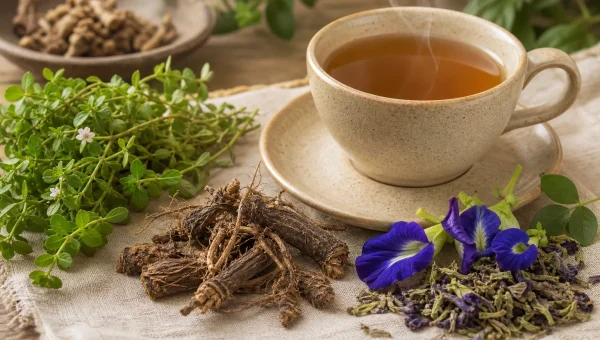
1. Bhringraj / Bhringaraja (Eclipta alba / Eclipta prostrata)
Bhringaraja is the central herb in many Ayurvedic hair oils. It is traditionally used for scalp and hair support, and preclinical hair-cycle work on Eclipta extracts supports its role in promoting anagen activity. In a postpartum routine, it is best used as a warm scalp oil massage rather than as an aggressive internal supplement.
2. Shatavari (Asparagus racemosus)
Shatavari is a classic nourishing herb for women and is widely used in Ayurveda during lactation. Its root contains steroidal saponins known as shatavarins, and clinical lactation literature describes it as a traditional galactagogue with mixed but promising findings. For a nursing mother, it should still be chosen with professional guidance, especially if there is allergy, hormonal medication use, or any complicated postpartum condition. Our detailed post on Shatavari for women’s health covers its wider profile.
3. Amalaki / Amla (Emblica officinalis / Phyllanthus emblica)
Amalaki is an Ayurvedic Rasayana and a source of ascorbic acid, gallotannins, and polyphenols. In a postpartum hair plan, it supports the nutrition side of recovery, pairs well with iron-rich foods, and is also used externally in traditional hair preparations. It is better taken in forms that suit digestion; very sour preparations may aggravate reflux in sensitive mothers. See our complete guide to Amla (Amalaki) benefits.
4. Brahmi (Bacopa monnieri)
Brahmi is a Medhya Rasayana, traditionally used to support the mind, memory, and nervous system. For postpartum hair loss, its value is indirect: calmer routines, better stress resilience, and improved rest protect recovery. Brahmi oil may be used topically if the scalp tolerates it, while internal use during breastfeeding should be discussed with a qualified practitioner.
5. Ashwagandha (Withania somnifera)
Ashwagandha is often used in Ayurveda for stress, strength, and recovery, but it is not a default herb for breastfeeding mothers. Reliable lactation safety references advise avoiding it while nursing, especially with a newborn or preterm infant, unless a qualified healthcare provider specifically recommends it. For non-nursing mothers, or later postpartum under supervision, it may be considered when stress, insomnia, and depletion are prominent.
The Khalitya Protocol: Phase-by-Phase Treatment Plan
The protocol below keeps the original Ayurvedic intent: nourish the mother first, then support the scalp. Doses and herb choices should be individualized by a qualified Ayurvedic practitioner, OB-GYN, midwife, or lactation-informed clinician.
Phase 1: Foundation (Month 1 to 2 Postpartum, Preventive)
In the early postpartum window, the priority is not forceful hair regrowth. The priority is warmth, regular meals, bowel comfort, sleep protection, lactation support, and gentle Vata-pacifying care.
| Support | Ayurvedic Focus | How to Use | Postpartum Notes |
|---|---|---|---|
| Warm, digestible meals | Agni and Rasa support | Khichdi, rice gruel, mung soup, soft cooked vegetables, ghee as tolerated | Begin with appetite and digestion; avoid heavy foods if bloated or constipated |
| Shatavari in milk or food vehicle | Stanya and tissue nourishment | Use only a practitioner-guided dose and form | Do not use as a substitute for lactation assessment if milk supply is low |
| Amalaki food or powder | Rasayana and antioxidant nourishment | Use a small amount with food or as advised | Avoid sour or concentrated preparations if reflux, loose stools, or sensitivity occurs |
| Warm scalp oiling | Vata pacification | Use bhringraj oil, sesame oil, or coconut-based hair oil 1 to 3 times weekly | Patch test first; keep massage gentle and avoid chilling after oiling |
Phase 2: Active Shedding (Month 3 to 6 Postpartum)
This is the period when many mothers notice the heaviest shedding. The goal is to reduce panic, protect the hair that remains, support new growth, and continue postpartum nourishment.
| Support | Ayurvedic Focus | How to Use | Postpartum Notes |
|---|---|---|---|
| Bhringraj or Neelibhringadi oil | Scalp nourishment | Massage gently for 5 to 10 minutes, leave 30 to 60 minutes, then wash | Use overnight only if it does not worsen cold, headache, itching, or scalp irritation |
| Amla, shikakai, or mild herbal wash | Gentle cleansing | Use as a mild wash instead of harsh shampoos when suitable | Avoid strong scrubbing; wet hair is fragile |
| Brahmi oil or a calming evening routine | Manas and Vata support | Use a small amount of oil on the scalp or practise a quiet wind-down routine | Internal Brahmi should be clinician-guided during breastfeeding |
| Constipation support | Apana Vata regulation | Warm water, cooked fiber, soaked raisins, ghee in food, or mild herbs if prescribed | Use Triphala only if appropriate for digestion, breastfeeding status, and constitution |
The Postpartum Nutrition Protocol for Hair Recovery
Ayurvedic postpartum nutrition, or Sutika Paricharya, emphasizes warm, unctuous, digestible, gradually strengthening foods. Modern breastfeeding guidance also emphasizes extra energy, protein-rich foods, fluids to thirst, and attention to iron, calcium, iodine, vitamin B12, and other micronutrients.
- Ghee: Use in warm food according to appetite and digestion. In Ayurveda, ghee is valued as a Vata-pacifying fat and as a carrier for nourishment.
- Mung dal, lentils, beans, dairy, eggs, fish, or meat as appropriate: Protein supports postpartum recovery and breastfeeding needs. Choose according to constitution, culture, appetite, and medical advice.
- Sesame seeds (Tila): Traditionally valued in Ayurveda and nutritionally useful as a mineral-rich seed. Use toasted sesame, tahini, or sesame chutney if digestion tolerates it.
- Dates, figs, raisins, leafy greens, beans, and lentils: These can support the iron-rich diet often needed after delivery, especially when paired with vitamin-C-rich foods.
- Drumstick leaves (Shigru, Moringa oleifera): A nutrient-dense leafy vegetable used in many Indian postpartum diets. Cook well and use according to digestion and regional food habits.
- Rice gruel, mung soup, and meat soup where culturally suitable: Classical postpartum regimens often progress from light gruels and soups toward richer foods as appetite and strength return.
Scalp Routine: The Weekly Khalitya Protocol
A postpartum scalp routine should be calming rather than aggressive. The scalp massage is not meant to pull out shedding hairs; it is meant to soften the scalp, reduce dryness, and create a steady ritual of care.
| Day | Scalp Treatment | Duration | Key Herbs or Oils |
|---|---|---|---|
| Monday | Gentle bhringraj oil massage | 30 to 60 minutes pre-wash | Bhringraj, sesame oil, or coconut oil base |
| Wednesday | Light scalp oiling only if comfortable | 20 to 30 minutes | Brahmi oil or plain sesame oil |
| Friday | Mild wash | As needed | Amla, shikakai, or a gentle non-stripping shampoo |
| Sunday | Restorative oil mask | 30 to 90 minutes pre-wash | Bhringraj oil or Neelibhringadi oil; avoid castor oil if sensitive |
When to Expect Results
Hair follicles work slowly. Postpartum shedding commonly begins a few months after delivery and usually improves gradually within the first year. After the shedding phase settles, new hairs may appear as short baby hairs along the hairline and temples before overall density feels normal again.
- Daily shedding may remain noticeable for several weeks during the active telogen phase.
- Less breakage can occur sooner when tight hairstyles, heat styling, harsh brushing, and strong chemical treatments are reduced.
- Visible regrowth often takes months because new hair shafts need time to grow long enough to see.
- Full cosmetic recovery can take longer than the end of shedding, especially when sleep deprivation, low iron, thyroid imbalance, or restrictive dieting is present.
Safety and Disclaimer
Postpartum hair loss is usually temporary, but persistent or severe hair loss deserves medical evaluation. Seek care if shedding continues beyond 12 months, if there are bald patches, scalp pain, scaling, signs of infection, heavy fatigue, marked weight change, heat or cold intolerance, palpitations, depression, or symptoms of anemia or thyroid disease. Postpartum thyroiditis can occur within the first year after delivery and may include fatigue, anxiety, palpitations, weight change, temperature sensitivity, and hair loss.
Important: Nursing mothers should consult an OB-GYN, midwife, lactation consultant, qualified Ayurvedic practitioner, or healthcare provider before using internal herbs. Ashwagandha should not be used while breastfeeding unless specifically approved by a qualified clinician. Choose tested herbal products from reputable manufacturers, avoid unknown metallic or mineral preparations, and patch test all oils before applying them widely to the scalp.
One Actionable Tip
Tonight, warm 1 to 2 tablespoons of bhringraj oil, Neelibhringadi oil, or plain sesame oil until it is comfortably warm. Apply it section by section, massage gently with the pads of the fingers for 5 to 10 minutes, wrap with a soft towel, and wash after 30 to 60 minutes. Repeat two or three times weekly if the scalp feels comfortable. Combine this with a warm, protein-containing dinner and an early bedtime window whenever possible.
Nothing in this article diagnoses or treats a medical condition. Use it as educational information and consult a qualified Ayurvedic practitioner or physician before starting herbs, supplements, detoxes, or therapeutic protocols, especially if pregnant, breastfeeding, managing a condition, or taking medication.
References
- My (my.clevelandclinic.org)
- Hopkinsmedicine (hopkinsmedicine.org)
- The Postpartum Telogen Effluvium Fallacy (2016), PubMed Central
- NCBI
- Investigation of exacerbating factors for postpartum hair loss: a questionnaire-based cross-sectional study (2023), PubMed Central
- Researchgate (researchgate.net)
- Nepjol (nepjol.info)
- Easyayurveda (easyayurveda.com)
- Ijhsr (ijhsr.org)
- Charaka Samhita — Asthi dhatu
- Natural Ingredient Resource Center
- Hair growth promoting activity of Eclipta alba in male albino rats (2008), PubMed
- Eclipta alba extract with potential for hair growth promoting activity (2009), PubMed
- Eclipta prostrata promotes the induction of anagen, sustains the anagen phase through regulation of FGF-7 and FGF-5 (2019), PubMed Central
- Plant profile, phytochemistry and pharmacology of Asparagus racemosus (Shatavari): A review (2013), PubMed Central
- NCBI
- A Double-Blind Randomized Clinical Trial for Evaluation of Galactogogue Activity of Asparagus racemosus Willd (2011), PubMed Central
- Miracledrinksclinic (miracledrinksclinic.com)
- Phyllanthus emblica: a comprehensive review of its phytochemical composition and pharmacological properties (2023), PubMed Central
- Functional and Nutraceutical Significance of Amla (Phyllanthus emblica L.): A Review (2022), PubMed Central
- Ayurvedic Pharmacopoeia of India
- NCBI
- Efficacy of Standardized Extract of Bacopa monnieri (Bacognize®) on Cognitive Functions of Medical Students: A Six-Week, Randomized Placebo-Controlled Trial (2016), PubMed Central
- An investigation into the stress-relieving and pharmacological actions of an ashwagandha (Withania somnifera) extract: A randomized, double-blind, placebo-controlled study (2019), PubMed Central
- Adaptogenic and Anxiolytic Effects of Ashwagandha Root Extract in Healthy Adults: A Double-blind, Randomized, Placebo-controlled Clinical Study (2019), PubMed
- NCBI
- NCCIH
- CDC
- Mayoclinic (mayoclinic.org)
- ACOG
- Postpartum thyroiditis (2004), PubMed
- Hopkinsmedicine (hopkinsmedicine.org)
- Mdpi (mdpi.com)
- NCCIH
- FDA
The palm-sized clump in the shower is such an accurate description of postpartum hair loss that I had to stop reading for a moment. I went through exactly this after my second child and the combination of physical recovery, new baby sleep deprivation, and watching your hair fall out is genuinely destabilizing.
found this post helpful. will try the suggested approach. (ref 1872-20)
The Khalitya protocol timing is what I needed to know. I’m four months postpartum and just starting to see the shedding. Is it too late to start the internal protocol now or should I have begun it earlier?
What’s the stance on bhringraj during breastfeeding? I’ve seen conflicting advice and I’m currently nursing. The topical application seems safe but I want to clarify whether internal use of bhringraj is appropriate while feeding.
The iron and Vata depletion connection makes so much sense for postpartum hair loss. Most advice focuses on biotin or collagen. But if iron is the real driver, neither of those will work. My postpartum anemia was never properly addressed and the hair loss persisted for over a year.
I tried the bhringraj oil massage protocol starting at three months postpartum and combined it with the dietary changes for Vata. By six months the shedding had stopped almost completely and by nine months I had visible regrowth at the temples. The combination approach worked where individual interventions hadn’t.
The 90% statistic for new mothers experiencing postpartum hair loss is striking and never mentioned in standard postpartum care. I was told it was normal without being told what to do about it or how long it would last without intervention.
Does this protocol apply to postpartum hair loss from a cesarean versus vaginal birth? I ask because the physiological recovery profile seems different and I’m not sure whether the Vata depletion pattern would be the same.
I came for Postpartum Hair Loss Recovery and this answered the main question. Small daily changes are easier to follow than a perfect plan.
My partner went through the same thing after our son was born — the hair loss started around month three and she was devastated. We didn’t know there was a name for the hormonal mechanism or that the timing was so predictable. The Bhringraj oil mentioned here, is that applied to the scalp daily or a few times a week? And does it need to be warmed before application for best absorption?
After reading about the Khalitya protocol I wonder if the sesame seed scalp mask really helps with shedding.
I came for Postpartum Hair Loss Recovery and this answered the main question. Would be useful to see a short checklist next.
I’m one year postpartum and still shedding more than before my pregnancy. The standard advice is just to wait. But this protocol suggests the extended shedding indicates ongoing depletion that should be actively addressed. Going to try the internal support protocol.
1 year postpartum and still shedding more than before pregnancy. the standard advice is just to wait. this protocol suggests extended shedding indicates ongoing depletion that should be actively addressed
It seems the three month window mentioned matches what many new moms notice.
three rounds of the bhringraj milk preparation and my scalp health is noticeably different. the oiliness that had been wrong since delivery has normalized and the shedding has reduced. not a dramatic before-after but consistent steady improvement
My friend tried shatavari tea and said her energy improved though she didn’t see less hair fall yet.
4 months postpartum and just starting the shedding. is it too late to start the internal protocol now?
the one month vs three month timeline expectation is the most practically useful information here. most people stop trying something after four weeks if they don’t see dramatic results. knowing the hair growth cycle means the minimum meaningful assessment point is three months.
Good reminder on Postpartum Hair Loss Recovery. Good starting point for a cautious reader.
Good reminder on Postpartum Hair Loss Recovery. The safety notes could be expanded a little.
@Asha bhringraj during breastfeeding topical seems safe but is internal use appropriate while nursing? 🙌
I shared this with my sister who is currently four months postpartum and going through exactly this. She had been blaming herself, assuming she wasn’t eating well enough or that stress was causing it. The explanation of telogen effluvium as a normal hormonal response rather than a sign that something is wrong was genuinely reassuring for her. Does the Khalitya protocol need to be adjusted if she is still breastfeeding?
palm-sized clump in the shower is such accurate description of postpartum hair loss. the physical, emotional, and hair-loss combination is genuinely destabilizing
3 rounds of bhringraj milk preparation. scalp health noticeably different. oiliness that had been wrong since delivery has normalized
Bhringraj oil massage starting at 3 months postpartum combined with dietary Vata changes. by 6 months the shedding had stopped almost completely
Bhringraj oil massage starting at 3 months postpartum combined with dietary Vata changes. by 6 months the shedding had stopped almost completely 🙌
found this post helpful. will try the suggested approach. (ref 1872-43)
I came for Postpartum Hair Loss Recovery and this answered the main question. I would still ask a practitioner before changing medicines.
iron and Vata depletion connection makes sense. my postpartum anemia was never properly addressed and the hair loss persisted for over a year
iron and Vata depletion connection makes sense. my postpartum anemia was never properly addressed and the hair loss persisted for over a year ✨
The explanation of telogen effluvium made sense but I’m curious how long the bhringraj oil should be left on.
bhringraj oil massage starting at 3 months postpartum combined with dietary Vata changes. by 6 months the shedding had stopped almost completely 🌿
✨ bhringraj oil massage starting at 3 months postpartum combined with dietary Vata changes. by 6 months the shedding had stopped almost completely
bhringraj oil massage starting at 3 months postpartum combined with dietary Vata changes. by 6 months the shedding had stopped almost completely नमस्ते
found this post helpful. will try the suggested approach. (ref 1872-44)
Bhringraj oil massage starting at 3 months postpartum combined with dietary Vata changes. by 6 months the shedding had stopped almost completely 💯
❤️ Bhringraj oil massage starting at 3 months postpartum combined with dietary Vata changes. by 6 months the shedding had stopped almost completely
Bhringraj during breastfeeding topical seems safe but is internal use appropriate while nursing?
bhringraj during breastfeeding topical seems safe but is internal use appropriate while nursing? ❤️
🙏 bhringraj during breastfeeding topical seems safe but is internal use appropriate while nursing?
found this post helpful. will try the suggested approach. (ref 1872-21)
The part about Postpartum Hair Loss Recovery feels realistic. Good starting point for a cautious reader.
found this post helpful. will try the suggested approach. (ref 1872-28)
This makes sense for Postpartum Hair Loss Recovery. The safety notes could be expanded a little.
Bhringraj oil massage starting at 3 months postpartum combined with dietary Vata changes. by 6 months the shedding had stopped almost completely 🙏
found this post helpful. will try the suggested approach. (ref 1872-31)
This makes sense for Postpartum Hair Loss Recovery. The timing advice is the part I would start with.
found this post helpful. will try the suggested approach. (ref 1872-26)
found this post helpful. will try the suggested approach. (ref 1872-27)
Reading about rasa rakta depletion reminded me of my own postpartum fatigue.
found this post helpful. will try the suggested approach. (ref 1872-29)
Will try this.
@Rakesh bhringraj during breastfeeding topical seems safe but is internal use appropriate while nursing? 🌿
A question: does the protocol recommend avoiding cold foods entirely or just limiting them?
🌿 Bhringraj during breastfeeding topical seems safe but is internal use appropriate while nursing?
found this post helpful. will try the suggested approach. (ref 1872-34)
I appreciate that the article mentions checking with a provider before using ashwagandha while nursing.
❤️ Bhringraj during breastfeeding topical seems safe but is internal use appropriate while nursing?
found this post helpful. will try the suggested approach. (ref 1872-37)
Sometimes the sheer amount of hair on the shower floor feels more alarming than the actual numbers suggest.
The tip about warming bhringraj oil and wrapping the head with a towel sounds simple enough to try tonight.
Useful post on Postpartum Hair Loss Recovery. This is the kind of detail readers can test slowly.
found this post helpful. will try the suggested approach. (ref 1872-40)
found this post helpful. will try the suggested approach. (ref 1872-41)
💯 bhringraj during breastfeeding topical seems safe but is internal use appropriate while nursing?
found this post helpful. will try the suggested approach. (ref 1872-45)
For Postpartum Hair Loss Recovery, consistency seems like the hard part. Would be useful to see a short checklist next.
🙌 Bhringraj during breastfeeding topical seems safe but is internal use appropriate while nursing?
found this post helpful. will try the suggested approach. (ref 1872-48)
found this post helpful. will try the suggested approach. (ref 1872-49)
bhringraj oil massage starting at 3 months postpartum combined with dietary Vata changes. by 6 months the shedding had stopped almost completely ❤️
Thank you.
For Postpartum Hair Loss Recovery, consistency seems like the hard part. Good starting point for a cautious reader.
Sorry off-topic but has anyone here used Ayurveda for hair loss?
found this post helpful. will try the suggested approach. (ref 1872-54)
Useful.
found this post helpful. will try the suggested approach. (ref 1872-56)
found this post helpful. will try the suggested approach. (ref 1872-57)
🙏 Bhringraj oil massage starting at 3 months postpartum combined with dietary Vata changes. by 6 months the shedding had stopped almost completely ठीक है
bhringraj during breastfeeding topical seems safe but is internal use appropriate while nursing? ✨
Reading this later and the Postpartum Hair Loss Recovery advice still feels relevant. I would like to know how long to try it before judging results.
found this post helpful. will try the suggested approach. (ref 1872-61)
✨ bhringraj during breastfeeding topical seems safe but is internal use appropriate while nursing?
found this post helpful. will try the suggested approach. (ref 1872-63)
The Postpartum Hair Loss Recovery explanation is clearer than most short posts. I appreciate that it does not oversell the result.
bhringraj during breastfeeding topical seems safe but is internal use appropriate while nursing? 🙏
found this post helpful. will try the suggested approach. (ref 1872-66)
Noted!
found this post helpful. will try the suggested approach. (ref 1872-68)
found this post helpful. will try the suggested approach. (ref 1872-69)