
The Weight That Arrives With Menopause and Refuses the Old Rules
Every woman who has moved through perimenopause recognizes the strange unfairness of this phase: the habits that once kept weight stable may no longer produce the same result. A smaller dinner, a daily walk, fewer sweets, or a stricter calorie target can help, but the body often responds more slowly because the terrain has changed. Ayurveda does not treat menopausal weight gain as a simple failure of willpower. It reads it as a change in agni, vata, kapha, meda dhatu, and the medovaha srotas—the channels involved with the formation, movement, and management of fat tissue.
The menopausal transition, called rajonivritti in contemporary Ayurvedic usage, is a natural stage in which menstrual function ceases and the body enters a new rhythm. At the same time, modern physiology recognizes that midlife weight change is influenced by aging, loss of muscle mass, changing estrogen levels, sleep disturbance, stress, and a tendency for fat to move toward the abdomen. The Ayurvedic protocol therefore has to do more than “eat less.” It must strengthen digestion, reduce Kapha-Meda stagnation, protect Vata, preserve muscle, and move food, sleep, and exercise back into a stable daily rhythm.
What Is the Medovaha Srotas and Why Menopause Disrupts It
The medovaha srotas, more precisely meda dhatuvaha srotas, is the Ayurvedic channel system connected with meda dhatu. Classical Ayurveda describes srotas as transporting and transforming pathways through which body tissues are nourished, maintained, and cleared. Charaka places the roots of the medovaha srotas in the vrikka and vapavahana, a description that points to the deep abdominal and metabolic seat of fat-tissue regulation rather than only visible subcutaneous fat.
In practical terms, a healthy medovaha srotas allows food to be digested cleanly, tissue nourishment to proceed in sequence, and excess Kapha-Meda heaviness to be mobilized rather than stored. When the channel is disturbed, the body may feel heavy after meals, hunger may become dull or erratic, the abdomen may thicken, bowel clearance may slow, and exercise may feel less rewarding. Charaka names lack of exercise, day sleep, overuse of fat-promoting foods, and excessive alcohol as causes that vitiate the medovaha srotas. These are not “menopause causes” by themselves, but they become more powerful during midlife because the body has less metabolic margin than it once had.
Ayurveda also frames menopause as a Vata-increasing time. Dryness, irregular sleep, anxiety, variable appetite, joint stiffness, and a lighter tolerance for stress often appear alongside Kapha-Meda accumulation. This is the central paradox of menopausal weight gain: the protocol must reduce Kapha and meda without aggravating Vata. Harsh fasting, excessive stimulants, dry dieting, and exhausting exercise may reduce weight temporarily but can worsen sleep, cravings, constipation, hot flashes, and fatigue. The better route is a medovaha reset: warm digestion, steady strength work, appropriate herbs, lighter evening food, and enough nourishment to keep Vata calm.
The Herb Stack for Medovaha Srotas Correction
The herb plan is best understood as prescription logic, not as a universal stack for every woman. A Kapha-Meda-dominant woman with heaviness, thick coating on the tongue, sluggish appetite, and abdominal fat needs a different emphasis than a Vata-Pitta woman with dryness, heat, poor sleep, anxiety, and weight gain from stress eating. The following herbs and formulations belong to the verified Ayurvedic framework for meda, agni, Kapha, and channel correction, but they should be selected and dosed by a qualified practitioner.
Guggulu and Kanchanara Guggulu
Guggulu is the purified oleo-gum resin of Commiphora wightii. The Ayurvedic Pharmacopoeia of India lists guggulu as medohara, with classical therapeutic use in medoroga and prameha. This makes it one of the central classical substances for Kapha-Meda disorders. In practice, guggulu should be used as shuddha guggulu or in properly prepared formulations, not as raw resin taken casually.
Kanchanara Guggulu is a classical formulation built around Kanchanara bark, Triphala, Trikatu, Varuna, aromatic spices, and purified guggulu. The Ayurvedic Formulary of India lists its traditional use in conditions such as gulma, gandamala, apachi, granthi, vrana, kustha, bhagandara, and slipada. For menopausal weight gain, this makes Kanchanara Guggulu most appropriate when the weight pattern has a Kapha-Meda, abdominal, glandular, nodular, or congestive quality rather than simple Vata depletion.
Trikatu Churna
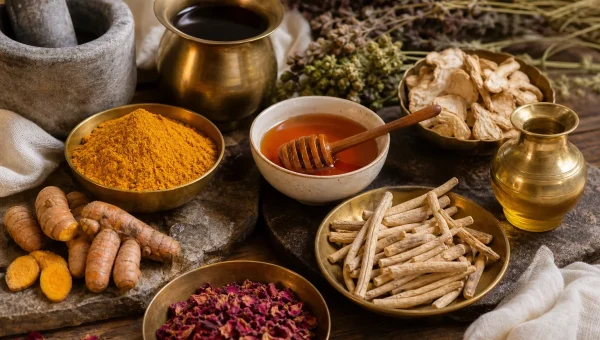
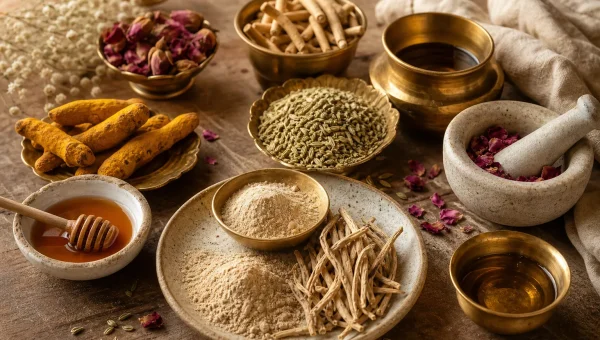
Trikatu is the three-pungent combination of shunthi (dry ginger), maricha (black pepper), and pippali (long pepper). Its role is dipana and pachana: kindling weak digestion and helping clear ama. It is useful when menopausal weight gain is accompanied by cold digestion, heaviness after meals, mucus tendency, dull appetite, and a thick tongue coating. Because Trikatu is hot, sharp, and drying, it is not the right foundation for women with strong burning, reflux, ulcers, bleeding tendency, marked heat, or aggravated Pitta symptoms.
Triphala
Triphala combines haritaki, bibhitaki, and amalaki. Charaka includes Triphala in the management of sthaulya, and its value in a menopausal medovaha reset is especially practical: it supports regular elimination, lightness, and the downward movement needed when Kapha-Meda heaviness and Vata irregularity coexist. It should not be treated as a harsh laxative; the goal is a clear morning bowel movement and a lighter abdomen, not purging.
Vidanga
Vidanga is the dried mature fruit of Embelia ribes. Charaka includes Vidanga with Nagara, Yavakshara, iron ash, honey, yava, and amalaki in a formulation praised for weight reduction. The Ayurvedic Pharmacopoeia lists Vidanga as katu and tikta in taste, ruksha, laghu, and tikshna in quality, ushna in potency, katu in post-digestive effect, and kaphavatahara, dipana, anulomana, and kriminasana in action. In this protocol it fits best when abdominal heaviness, gas, sluggish bowels, Kapha accumulation, and an ama-type presentation are present.
| Herb or Formula | Verified Ayurvedic Role | Best-Fit Menopausal Pattern | Use Note |
|---|---|---|---|
| Shuddha Guggulu | Medohara; used in Medoroga and Prameha contexts | Kapha-Meda heaviness, metabolic sluggishness, abdominal accumulation | Use purified guggulu or classical formulations under supervision |
| Kanchanara Guggulu | Classical guggulu formula with Kanchanara, Triphala, Trikatu, Varuna, and aromatics | Kapha-Meda with glandular, nodular, abdominal, or congestive quality | AFI reference dose is 3 g; commercial tablets vary |
| Trikatu Churna | Dipana, Pachana, Kapha-Vatahara, Ama-pachaka | Cold digestion, heaviness, dull appetite, Kapha coating | Avoid in strong Pitta, burning, reflux, ulcer tendency, or bleeding tendency |
| Triphala | Classically included in Sthaulya management; supports elimination and lightness | Sluggish bowels, abdominal heaviness, irregular elimination | Use gently; the aim is regularity, not purgation |
| Vidanga | Dipana, Anulomana, Kaphavatahara, Kriminasana | Kapha-Meda with abdominal gas, heaviness, Ama or Krimi-type signs | Use as a practitioner-selected herb, not as casual daily self-dosing |
Meal Timing Protocol for Menopausal Medovaha Reset
Meal timing becomes more important at menopause because the medovaha reset depends on rhythm. Charaka’s dietary guidance emphasizes warm food, proper quantity, and eating only after the previous meal has digested. These rules are simple, but they become powerful when the body is no longer forgiving late dinners, constant snacking, iced drinks, cold leftovers, and food taken without true hunger.
The first rule is to make the most substantial meal the meal that is digested best. For many women this is lunch, taken when appetite is clear and the body has enough daytime activity remaining to process it. Dinner should be earlier, warmer, and lighter than lunch: soup, thin khichadi, cooked vegetables, mung preparations, or a simple protein-and-vegetable meal are better than a heavy grain-and-sweet meal at night. A gentle 10–12 hour overnight gap between dinner and breakfast is usually enough; this is not aggressive fasting, and women with Vata depletion, diabetes medication, adrenal fatigue, pregnancy, eating-disorder history, or medical fragility need individualized guidance.
The second rule is to remove the cold-Kapha burden. During the reset, avoid iced drinks, cold smoothies, cold yogurt at night, raw-heavy dinners, and large late salads. Warm water, cumin-coriander-fennel tea, ginger in small amounts when Pitta is not aggravated, and freshly cooked meals are more compatible with agni. This does not mean every woman needs strong spices; the correct intensity depends on whether the presentation is Kapha-cold, Pitta-hot, or Vata-dry.
The third rule is to choose foods that reduce heaviness without starving the body. Charaka’s obesity chapter lists foods such as yava, mudga, kulattha, patola, and amalaki in the broader Sthaulya framework. A modern menopausal plate can follow the same logic: warm cooked vegetables, adequate protein, bitter and astringent tastes, lighter grains when suitable, and enough healthy fat to prevent Vata dryness. The mistake is to remove nourishment completely. A dry, joyless diet may aggravate Vata and increase cravings for sweet, heavy foods later in the day.
| Reset Rule | Ayurvedic Purpose | Practical Application |
|---|---|---|
| Eat after the previous meal is digested | Protects agni and prevents ama formation | Avoid constant grazing; wait for clear appetite |
| Keep dinner light and early | Reduces night Kapha-Meda storage and morning heaviness | Finish dinner 2–3 hours before sleep when possible |
| Use warm, freshly prepared meals | Supports digestion, Vata movement, and Kapha reduction | Prefer cooked meals, warm drinks, and lighter evening foods |
| Avoid harsh fasting | Prevents Vata aggravation, sleep disturbance, and rebound cravings | Use a gentle overnight gap instead of extreme restriction |
Exercise Modifications for Medovaha Srotas
Menopausal weight care must include muscle. Walking is valuable, but walking alone may not be enough once age-related muscle loss and abdominal fat redistribution are already underway. Resistance training gives the body a stronger glucose sink, improves functional strength, supports bone and joint resilience, and helps counter the metabolic slowing that often appears in midlife. The minimum foundation is two weekly strength sessions; many women do better with three sessions when recovery, sleep, joints, and schedule allow.
Ayurveda also gives an important limit: vyayama should be done according to capacity, and classical guidance describes exercise up to half one’s strength rather than exhaustion. This matters for menopausal women because overtraining can aggravate Vata, disturb sleep, increase hunger, and worsen joint dryness. The correct session leaves the body warm, lighter, and steadier, not depleted. Strength training, brisk walking, mobility work, and breath-led recovery can all be used, but the measure of success is consistency over months, not punishment in a single week.
For Kapha-Meda patterns, classical Ayurveda gives a place to udvartana, dry therapeutic powder massage, as part of obesity management. This is more appropriate than claiming that any oil massage “melts fat.” Warm oil massage may still be useful when Vata symptoms dominate, especially dryness, stiffness, nervous tension, poor sleep, or post-exercise soreness, but it is a Vata-support practice rather than the primary meda-reducing tool. A Kapha-heavy woman may need more dry rubbing, movement, and sweating; a Vata-dry woman may need gentler training, oiling, warmth, and recovery.
The Vata-Pitta Support Layer
A complete menopause protocol cannot only reduce Kapha and meda; it must also protect the tissues from Vata dryness and Pitta heat. This is where Shatavari may be helpful for the right woman. The Ayurvedic Pharmacopoeia identifies Shatavari as the tuberous root of Asparagus racemosus and lists it as sweet and bitter in taste, heavy and unctuous in quality, cooling in potency, sweet in post-digestive effect, and actions such as balya, rasayana, pittahara, and vatahara. That profile makes Shatavari supportive when menopausal weight gain is accompanied by dryness, heat, tissue depletion, poor recovery, and sleep disturbance.
Shatavari is not the main meda-reducing herb. In a Kapha-heavy woman with thick coating, dull appetite, water retention, and strong heaviness, too much sweet, heavy, unctuous support can be counterproductive unless paired correctly. In a Vata-Pitta woman who is gaining weight from stress, insomnia, irregular meals, and cravings created by depletion, Shatavari may help the protocol feel sustainable. The principle is balance: reduce the excess without drying the woman out.
A Practical 6-Week Medovaha Reset
For six weeks, keep the protocol simple enough to repeat. Begin the morning with warm water and wait for real appetite before breakfast. Make lunch the most complete meal when digestion is strongest for you. Keep dinner early, warm, and lighter. Use Triphala gently if elimination is sluggish. Use Trikatu only if the digestion is cold and Kapha-dominant. Consider guggulu-based formulations, Vidanga, or Kanchanara Guggulu only after assessment by a qualified practitioner. Train strength two or three times weekly, walk daily as capacity allows, and avoid day sleep unless medically needed.
Track the right signs. The scale is only one marker. Better signs include a clearer morning appetite, less heaviness after meals, a lighter abdomen, steadier bowels, reduced evening cravings, improved sleep, better lifting strength, and a slowly decreasing waist measurement. If hot flashes, anxiety, constipation, reflux, irritability, or insomnia worsen, the protocol is too heating, too drying, too restrictive, or too intense and should be adjusted.
Disclaimer: This article is for educational purposes only and does not replace professional medical advice. Consult a qualified Ayurvedic practitioner or healthcare provider before starting herbs, formulations, fasting-style meal timing, or a new exercise program, especially if you take medication or have an ongoing medical condition.
References
- Menopause (menopause.org)
- Nature (nature.com)
- Pib (pib.gov.in)
- Charaka Samhita — Sroto Vimana
- Charaka Samhita — Ashtauninditiya Adhyaya
- Ia800501 (ia800501.us.archive.org)
- Natural Ingredient Resource Center
- Dravyaguna notes
- Ijrap (ijrap.net)
- Charaka Samhita — Ahara vidhi
- Effectiveness of Early Time-Restricted Eating for Weight Loss, Fat Loss, and Cardiometabolic Health in Adults With Obesity: A Randomized Clinical Trial (2022), PubMed Central
- Charaka Samhita — Vyayama
- Link (link.springer.com)
- Ayurvedic Pharmacopoeia of India

started Guggulu-based protocol for metabolic syndrome 3 months ago alongside dietary changes. waist circumference down 4cm and fasting glucose improved by 12 points.
for Medovaha Srotas reset, how long before measurable metabolic changes? the article mentions 3-6 months but doesn’t define what ‘measurable’ looks like.
The part about old strategies simply stopping to work is so accurate it’s almost painful to read. I was doing everything right for years and then perimenopause arrived and nothing landed the same way. Does the Medovaha Srotas reset require working with a practitioner or are there self-directed starting points?
for metabolic flexibility, how does the training approach change based on whether someone is primarily Kapha dominant versus Kapha-Pitta? 🙌
for sarcopenic obesity, is strength training sufficient alongside the herbs or is Panchakarma (specifically Virechana) needed first?
calling menopause weight gain purely a Medovaha issue oversimplifies the hormonal biology. estrogen withdrawal alone drives significant adipose redistribution.
the article mentions Trikatu for improving Agni in metabolic conditions. is there a risk of aggravating Pitta in menopausal women who already tend toward Pitta excess?
sarcopenic obesity requires progressive resistance training as a primary intervention. herbal support is secondary. the article’s hierarchy should reflect this.
does the Kapha-reducing diet for metabolic flexibility differ significantly from a standard low-carb approach? the similarities are striking. tbh 💯 ठीक है
sarcopenic obesity is so underdiagnosed. the Mamsa-Meda imbalance framing is accurate, muscle loss with fat gain simultaneously is exactly what I see in the mirror.
can the Medovaha Srotas protocol be followed while on HRT? does estrogen supplementation change the Srotas balance? 🌿
does the Kapha-reducing diet for netabolic flexibility differ significantly from a standard low-carb approach? the similarities are striking.
the Kapha training approach for metabolic flexibility makes sense. building fat-burning capacity is not just about eating less but changing fuel utilization.
What dosage of Kanchnar Guggulu did the author recommend for someone just starting the reset?
the Kapha metabolic flexibility article lacks actual nutritional specifics. ‘reduce sweet and heavy foods’ isn’t actionable without quantities.
Doing this.
What struck me most is how this article explains the why behind the shift, not just what to do. The idea that estrogen changes alter how the body processes ama and fat tissue makes more intuitive sense to me than vague hormonal explanations from my doctor. Has anyone here actually followed this protocol through a full perimenopause transition?
the Medovaha Srotas framework for menopause weight gain finally explains why standard caloric restriction doesn’t work the way it did pre-menopause. the Kapha accumulation mechanism is different.
@Asha sarcopenic obesity requires progressive resistance training as a primary intervention. herbal support is secondary. the article’s hierarchy should reflect this.