
Persistent ringing, buzzing, whistling, or humming in the ear can be deeply disturbing, especially when sleep, concentration, and emotional steadiness begin to suffer. In Ayurveda, tinnitus-like symptoms are approached primarily through the lens of Vata disturbance in the auditory pathway, especially when the sound is high-pitched, variable, worse at night, and associated with dryness, anxiety, irregular sleep, travel, depletion, or stress.
Karna Purana, the practice of retaining warm medicated oil in the ear, is one of the most important local therapies used for selected ear conditions. A Bilva-based oil such as Bilva Taila or Bilwadi Taila is traditionally chosen when the practitioner identifies a Vata-dominant ear disorder and confirms that there is no active infection, perforated eardrum, discharge, recent trauma, or other contraindication.
What Ayurveda Calls Karnanada
In practical Ayurvedic usage, Karnanada refers to the perception of sound in the ear, while classical descriptions in Sushruta Samhita, Uttara Tantra, Chapter 20 include related ear conditions such as Karna Pranada, Karnaksveda, and Badhirya. Badhirya is closer to deafness or hearing impairment, so it should not be used as a blanket synonym for tinnitus. A careful distinction between sound perception, hearing loss, pain, discharge, and fullness is essential before treatment is planned.
Sushruta describes Karna Pranada as a condition in which aggravated Vata affects the channels that carry sound, producing the experience of different kinds of sounds. Karnaksveda is also linked with aggravated Vata in the auditory path and is associated with causes such as exertion, depletion, dry and astringent intake, excessive cleansing procedures, and exposure to cold. This makes the classical emphasis clear: many tinnitus-like presentations are treated by calming, nourishing, warming, and stabilizing Vata.
Identifying the Dosha Pattern
Ayurvedic management depends on the presenting pattern rather than the symptom name alone. A ringing sound after exhaustion, insomnia, fasting, travel, or dryness is treated differently from tinnitus associated with heat, infection, congestion, wax obstruction, or heaviness. The table below gives a practical clinical framework for doshic assessment.
| Pattern | Typical Sound Quality | Associated Features | Common Aggravating Factors |
|---|---|---|---|
| Vataja Karnanada | High-pitched ringing, hissing, whistling, changing sounds | Dryness, poor sleep, anxiety, constipation, variable symptoms | Cold wind, fasting, overwork, excessive travel, late nights, stress |
| Pittaja involvement | Sharp, intense sound with heat or irritation | Burning sensation, inflammation, irritability, acidity, redness | Spicy food, alcohol, heat exposure, anger, infection |
| Kaphaja involvement | Low humming, dull sound, muffled perception | Fullness, heaviness, congestion, wax tendency, sluggishness | Cold heavy foods, excess dairy, inactivity, unresolved congestion |
Karna Purana is most appropriate when the ear is dry, painful, sensitive, or Vata-dominant. It is not appropriate when the main problem is active discharge, acute infection, severe pain of unknown cause, suspected perforation, or sudden unexplained hearing loss.
Why Use Bilva-Based Taila in the Ear
Bilva (Aegle marmelos) is a classical Ayurvedic plant described in the Ayurvedic Pharmacopoeia of India. Its fruit pulp is listed with katu, tikta, and kashaya rasa, laghu and ruksha guna, ushna virya, katu vipaka, and Vata-Kapha-hara action. This means Bilva itself is not classically described as unctuous; the unctuous and softening effect in ear therapy comes from the medicated oil vehicle, commonly sesame oil, processed with Bilva and other substances according to the formulation.
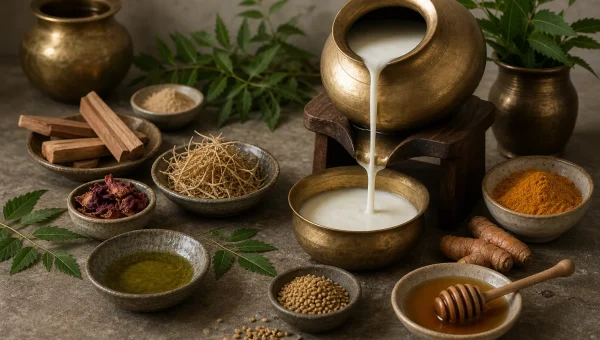
Bilwadi Taila is a Bilva-based medicated oil used in Ayurvedic ear care, especially in the context of Karna Roga and Badhirya. Classical and pharmacy-oriented descriptions of this oil include Bilva fruit pulp processed in an oil base with liquid media such as goat milk, cow urine, and water, though formulations may vary by text, region, and manufacturer. Because the ear is delicate, only a properly prepared, clean, practitioner-recommended oil should be used.
For Vataja tinnitus-like symptoms, the logic of Bilva-based ear oil is twofold: Bilva contributes a warming, Vata-Kapha-pacifying herbal action, while the oil medium supplies local oleation, softness, and protection against dryness in the ear canal and surrounding tissues.
Key Herbs and Formulations in a Vata-Focused Plan
Tinnitus management in Ayurveda rarely depends on ear drops alone. A practitioner may combine local ear therapy with internal herbs, diet, sleep correction, stress reduction, and broader Vata-pacifying measures. The herbs below are not universal prescriptions; they are examples of classical medicines that may be selected after assessment of constitution, digestion, strength, age, medicines, and comorbidities.
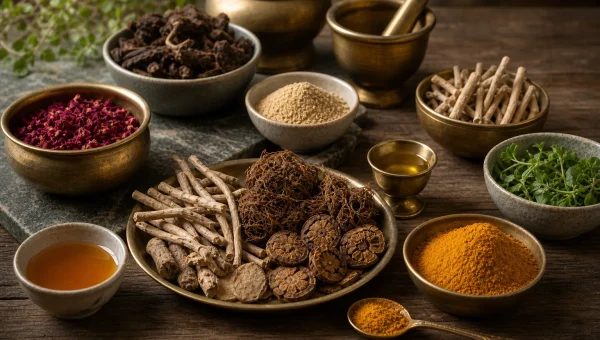
- Bilva (Aegle marmelos) — Used as the central herb in Bilva-based oils for ear therapy. In the pharmacopoeial description, Bilva is warming and Vata-Kapha-pacifying, which makes it relevant when dryness, coldness, variable sound, and depletion are part of the presentation.
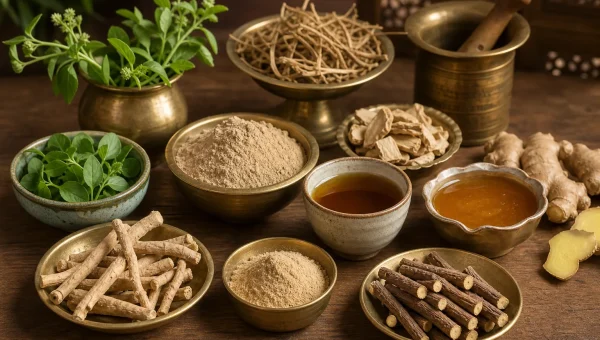
- Ashwagandha (Withania somnifera) — A classical Rasayana, Balya, and Vata-Kapha-pacifying root used when tinnitus is accompanied by weakness, poor sleep, nervous exhaustion, or chronic Vata aggravation.
- Brahmi (Bacopa monnieri) — Described as Medhya, Rasayana, and Vatahara. It may be considered when tinnitus is accompanied by mental restlessness, poor concentration, worry, or disturbed sleep.
- Shatavari (Asparagus racemosus) — A nourishing, snigdha, Rasayana herb with Vatahara action. It is more suitable when the patient shows dryness, depletion, low strength, and tissue deficiency, but its cooling and nourishing nature means it is not the right choice for every case.
- Yashtimadhu or Yashti (Glycyrrhiza glabra) — Described as sweet, heavy, unctuous, cooling, and Vata-Pitta-pacifying. It may be selected when dryness, throat irritation, burning, or Pitta–Vata features accompany the ear complaint, but it requires caution in people with high blood pressure, fluid retention, kidney disease, low potassium risk, or interacting medicines.
Karna Purana: The Ear Oil Therapy, Step by Step
Karna Purana literally means filling or nourishing the ear. Ashtanga Hridaya, Sutra Sthana, Chapter 22 describes filling the ears with medicated oil or fat and massaging the root of the ear. In home practice, the method should be gentler and should follow the dose, duration, and oil selected by a qualified Ayurvedic practitioner.
Preparation
Begin only after the ear has been assessed and contraindications have been ruled out. The oil should be clean, authentic, comfortably warm, and never hot.
- Warm the closed bottle of prescribed Bilva Taila or Bilwadi Taila by placing it in warm water for a few minutes.
- Test one drop on the inner wrist. It should feel comfortably warm, not hot.
- Choose a quiet time, preferably before bathing or in the evening when there is no need to go out into cold wind immediately afterward.
- Lie on one side with the affected ear facing upward. Keep a clean cloth nearby for drainage.
Application
The aim is to bathe and soften the ear canal without force. Do not push instruments, cotton buds, or fingers into the canal.
- Instill only the number of drops prescribed by the practitioner. For many home routines this is a small quantity rather than a full clinical filling of the ear.
- Gently press the tragus, the small cartilage flap in front of the ear opening, a few times to help the oil spread.
- Massage around the base of the ear, the jaw joint area, and the region behind the ear with gentle circular movements.
- Remain lying quietly for the advised duration. Avoid talking, screens, loud sound, and sudden head movement during this period.
- Turn slowly and allow excess oil to drain onto a clean cloth. Wipe only the outer ear.
Aftercare
After Karna Purana, the ear should be protected from cold, wind, water, and loud sound so that the local oleation is not immediately disturbed.
- Keep the ear dry for the rest of the day unless the practitioner has advised otherwise.
- Avoid cold wind, direct air-conditioning, swimming, and hair washing immediately afterward.
- Do not use cotton swabs deep inside the ear canal.
- Stop the procedure and seek medical advice if pain, dizziness, discharge, bleeding, sudden hearing change, or worsening symptoms occur.
Dosage Summary for Supportive Internal Herbs
The dose of any herb depends on constitution, digestive strength, age, body weight, pregnancy status, medical history, and current medicines. The ranges below reflect pharmacopoeial adult powder doses for the raw herbs and should not be treated as a self-prescription.
| Herb | Classical Relevance | Pharmacopoeial Powder Dose Range | Practical Caution |
|---|---|---|---|
| Ashwagandha | Rasayana, Balya, Vata-Kapha-pacifying | 3–6 g | Use under guidance, especially with sedatives, thyroid medicines, pregnancy, autoimmune conditions, or chronic illness. |
| Brahmi | Medhya, Rasayana, Vatahara | 1–3 g | Best selected according to sleep, digestion, mental state, and overall strength. |
| Shatavari | Snigdha, nourishing, Rasayana, Vatahara | 3–6 g | May be too heavy or cooling for some patients with weak digestion or Kapha congestion. |
| Yashti | Sweet, unctuous, cooling, Vata-Pitta-pacifying | 2–4 g | Avoid unsupervised use in hypertension, kidney disease, edema, low potassium risk, pregnancy, or with diuretics and blood pressure medicines. |
Dietary and Lifestyle Support
For a Vataja tinnitus pattern, the daily routine should reduce dryness, irregularity, cold exposure, and nervous overstimulation. The most helpful measures are often simple: warm meals, stable sleep, less noise, less screen strain, and regular oil-based body care.
- Favor warm, cooked, mildly spiced, unctuous meals such as khichdi, soups, stews, ghee-cooked vegetables, and soft grains.
- Reduce cold drinks, raw dry foods, skipping meals, excessive caffeine, alcohol, and very dry snacks.
- Use regular gentle Abhyanga with suitable oil when advised, especially around the head, neck, jaw, shoulders, and feet.
- Protect the ears from cold wind, direct air-conditioning, loud music, and high-volume earphones.
- Keep sleep regular. Late nights, overwork, and irregular routines are common drivers of Vata aggravation.
- Reduce jaw clenching, excessive talking, prolonged headphone use, and screen-heavy nights when these worsen symptoms.
When to See an ENT Specialist
Ayurvedic care is safest and most effective when dangerous causes have been ruled out. Tinnitus should be medically evaluated, especially if it is new, unilateral, pulsatile, severe, persistent, associated with hearing change, or accompanied by neurological or vestibular symptoms.
- Sudden tinnitus with sudden hearing loss requires urgent medical assessment.
- One-sided tinnitus should be evaluated, especially if persistent or associated with hearing change.
- Pulsatile tinnitus, where the sound follows the heartbeat, needs medical review.
- Tinnitus with progressive hearing loss should be assessed by an ENT specialist or audiologist.
- Tinnitus with vertigo, facial weakness, severe headache, neurological symptoms, or imbalance requires prompt evaluation.
- Ear pain, discharge, bleeding, suspected perforation, recent ear surgery, ear tubes, or head trauma are contraindications to self-administered oil drops.
- Tinnitus in children should be assessed medically before any home herbal or oil therapy is attempted.
Do not use Karna Purana, herbal ear drops, or oil in the ear if there is known or suspected eardrum perforation, active infection, discharge, severe pain, bleeding, recent surgery, or sudden hearing loss unless a qualified clinician has specifically advised it.
Realistic Expectations
Ayurveda approaches tinnitus-like symptoms by addressing the condition of the ear, the state of Vata, sleep, digestion, nervous system strain, and daily routine. Some people notice early relief from local oil therapy when dryness and Vata sensitivity are prominent, while chronic cases usually require a broader and more sustained plan.
The most appropriate expectation is gradual improvement in sleep, distress, sound sensitivity, and the intensity or intrusiveness of the ringing. A qualified Ayurvedic practitioner should reassess the plan regularly and adjust the oil, internal medicines, diet, and routine according to response.
Nothing in this article diagnoses or treats a medical condition. Use it as educational information and consult a qualified Ayurvedic practitioner, ENT specialist, audiologist, or healthcare provider before starting herbs, supplements, medicated oils, ear procedures, or therapeutic protocols, especially if pregnant, elderly, treating a child, managing a medical condition, or taking medication.
References
- Easyayurveda (easyayurveda.com)
- Charaka Samhita — Indriyopakramaniya Adhyaya
- Easyayurveda (easyayurveda.com)
- Ayurvedic Pharmacopoeia of India
- Phytopharmajournal (phytopharmajournal.com)
- Ask-ayurveda (ask-ayurveda.com)
- Ayurvedic Pharmacopoeia of India
- Ayurvedic Pharmacopoeia of India
- NCCIH
- Entnet (entnet.org)
- Cks (cks.nice.org.uk)
- Tinnitus: systematic approach to primary care assessment and management (2022), PubMed Central
- Mayoclinic (mayoclinic.org)
- NHS
- My (my.clevelandclinic.org)
- Nidcd (nidcd.nih.gov)
Been using taila for about 3 months now and the difference in how I feel is real. My practitioner said the same things this article covers so good to have it spelled out.
The Vata-in-the-channels of the ear explanation for post-infection tinnitus makes physiological sense. Post-infectious tinnitus is poorly understood in conventional audiology and the Vata disturbance framework at least provides a treatment rationale even if the mechanism is not identical.
What is the difference between Bilva Taila and standard sesame oil for Karna Purana? The article suggests Bilva is specific but I cannot find it in local stores. Would plain warm sesame oil have partial benefit while I source the specific preparation?
I am an audiologist and tinnitus is one of the most frustrating conditions to manage because we have very few effective interventions. Reading the case of significant reduction in tinnitus after karna purana is enough to make me want to ask patients about this as an option.
Does this apply to children or only adults?
Good article on this subject. #74
My Pitta constitution responds exactly as described here. The taila worked within two weeks for me where pharmaceutical options had failed for months.
What is the safety profile for people with perforated eardrums? I have a small permanent perforation and I do not know whether ear oil is safe for me. This seems like a critical contraindication that should be at the top of the article.
The internal Saraswatarishta for the nervous component of tinnitus is something my practitioner recommended. I was sceptical about treating an ear problem with a nerve tonic. But the central nervous sensitization involved in chronic tinnitus does make the approach logical.
Good article on this subject. #91
The case of Meera really shows how Ayurveda looks at tinnitus beyond just the ear.
My tinnitus started after extended noise exposure, not after infection. Does the Vata-in-ear-channels framework apply to acoustic trauma tinnitus or is that pathologically different from the post-infectious type in this article?
Good article on this subject. #82 💯
I have had tinnitus for 6 years after a major stress event. The stress-Vata-auditory channel connection described here is something no ENT has discussed. The approach of addressing the underlying Vata disturbance rather than just masking the sound is a fundamentally different frame.
started this 3 weeks ago, too early to say but the process itself feels right
Good article on this subject. #86
I wonder if the warm oil step would feel strange at first for someone used to ear drops.
I tried this protocol for 3 months for my right-sided tinnitus of 4 years duration. Minimal improvement in my case. I wonder whether the longer the tinnitus has been established, the less responsive it is to this kind of treatment. The article’s case study is recent-onset.
Good article on this subject. #69
Good article on this subject. #90
It seems important to get an ENT check before trying any herbal routine, as the article stresses.
The recommendation to do karna purana before sleeping makes sense for allowing the oil to sit. I have been doing this for 3 weeks and the volume of the tinnitus at night, which was the worst time, is noticeably reduced.
The seasonal variation angle is underused in most health content. Good to see it here
Is this suitable for elderly patients or does the dosage need adjustment?
The section on dosage was the most practically useful for me
The neck tension connection to tinnitus was surprising. Never linked the two
Doing this
Is this approach suitable for tinnitus post-ear infection or only idiopathic cases?
Bookmarked for future reference.
Good article on this subject. #60
My tinnitus started after COVID. Would this protocol still apply?
Thanks!
Good article on this subject. #84
Not skeptical about Ayurveda generally but some claims here need stronger evidence
tbh wasnt expecting much from this but the specifics are actually helpful
Good article on this subject. #79
This explains something I’ve experienced but couldn’t name. Good validation
My doctor dismissed this as pseudoscience. Going to try it anyway and report back
The Vata-imbalance connection to tinnitus is something my ENT dismissed completely ✨
Useful post
Been dealing with tinnitus for 4 years. No one mentioned Bilva Taila to me before this
Would love a follow-up article going deeper on the herb preparation methods
Are there clinical studies backing the specific herb combination you mentioned?
How long typically before seeing results with this approach?
@Maria Same here
Does this protocol change if someone is pregnant or breastfeeding?
Which Ayurvedic doctor in India specializes in this? Looking for second opinion after 2 allopathy failures
The karnapurana procedure can I do it at home or needs trained practitioner?
The description of Vataja Karnanada matching high pitched ringing and anxiety feels spot on for many sufferers.
Can this be combined with modern medication or is it better standalone?
The contraindications section was important and often missing from similar articles
good info, sharing with my father who has been looking for something like this 💯
The connection between gut health and this condition is the angle most allopathic doctors miss
The stress-tinnitus-Vata loop you described is exactly what I experience before presentations at work
The Ayurvedic framing made this topic much easier to understand than the Western medical version
I tried a similar approach last year but without the specific sequencing. Wonder if that’s why it didn’t work ✨
@Christopher This helped clarify my doubts.
My father has had tinnitus for about four years following a viral infection, identical situation to the patient described here. He’s been told the same thing — learn to live with it. The Bilva Taila treatment is new to me. Is this something that needs to be administered by a practitioner or is there a safe at-home version? He is in a smaller city where Ayurvedic clinics are limited.
Good article on this subject. #62
Been following Ayurveda for 5 years and this article still taught me something new
The traditional context helps understand why it’s done this way. Not just ‘eat this herb’
The dosage range given is wide. Is there a way to determine where in the range I should start?
Did this for 6 weeks exactly as described, going to update here with results
tried sesame oil in ears once, felt weird. Is Bilva Taila different in texture? 🙏
Where do you recommend sourcing the herbs mentioned here in India?
Just reading about Bilva Taila preparation makes me curious about trying the warm towel compress after.
Shared this with my Ayurveda practitioner. She agreed with most points
Will try
What’s the typical duration of the treatment before reassessing?
@Asha Good article on this subject. #75
I appreciate how specific the instructions are compared to most Ayurveda articles 🙌
Hmm, the part about protecting ears from AC vents is something I never considered before.
Is the ringing worse in Vata season (winter) a recognized pattern? Mine definitely gets worse Oct-Dec
Anyone else tried this for longer than 6 months? Wondering about long-term effects
Is the morning or evening timing more important for this protocol overall?
Good information on this topic.
Helpful article, thank you.
Tried this, results were good.
Interesting perspective here.
I liked that the protocol includes dietary tips like favoring khichdi and ghee cooked veggies.
Will try this approach soon.
Good article on this subject. #80
Thanks for the clear explanation.
Does the Dashamula decoction need to be taken exactly before meals, or can it be flexible?
It’s reassuring to see that the author advises seeing a specialist if there’s pulsatile tinnitus or dizziness.
Useful and actionable.
Following this protocol now.
The mention of Shatavari for dryness makes sense given the Vata imbalance picture.
Good article on this subject. #55
Good article on this subject. #56
I’m a bit skeptical about claiming significant reduction in just six weeks, but the case study is interesting.
Good article on this subject. #57
Good article on this subject. #58
Good article on this subject. #59
Good article on this subject. #95
Good article on this subject. #61
Good article on this subject. #63
Using a dropper and pressing the tragus sounds like a simple self care step one could learn quickly.
Good article on this subject. #64
Good article on this subject. #65
Good article on this subject. #66
The article’s note on avoiding screens during the oil rest period feels like a nice mindfulness touch.
Good article on this subject. #67
Good article on this subject. #68
I appreciate the balanced view that Ayurveda works best alongside modern evaluation, not as a replacement.
Good article on this subject. #70
Good article on this subject. #71
Good article on this subject. #72
Good article on this subject. #73
Good article on this subject. #76
Good article on this subject. #77
Good article on this subject. #78 💯
Good article on this subject. #81
Good article on this subject. #83
Good article on this subject. #85 🌿
Good article on this subject. #87
Good article on this subject. #88
Good article on this subject. #89
Good article on this subject. #92
Good article on this subject. #93
Good article on this subject. #94