Takradhara is one of Ayurveda’s most distinctive external therapies for patients whose skin symptoms, scalp discomfort, sleep, stress response, and head-related complaints overlap. The treatment is simple in appearance: medicated takra (buttermilk) is prepared, kept at a comfortable therapeutic temperature, and poured in a steady stream over the forehead and scalp. Its clinical value lies in the combined effect of the takra base, the rhythmic dhara method, the marma-focused head procedure, and condition-specific physician selection.
Charaka describes takra as deepana, grahi, and laghu, with madhura vipaka and qualities useful in kapha and vata disorders when appropriately prepared. (Charaka Samhita, Chikitsa Sthana 15.117-119)
This classical description is important because takra should not be reduced to a simple “cooling dairy liquid.” In Ayurvedic dravyaguna, takra is described with ushna virya, madhura vipaka, laghu and ruksha qualities, and kapha-vata usefulness. In Takradhara, the physical temperature, thickness, herbal processing, duration, and disease context are adjusted by the practitioner rather than applied as a fixed home remedy.
What Is Takradhara? Preparation and Procedure
Takradhara combines takra meaning buttermilk and dhara meaning a continuous stream. It is a specialized form of Shirodhara in which medicated takra is poured rhythmically over the forehead, especially the frontal region, and allowed to flow over the scalp. The procedure is used in Ayurvedic practice for selected dermatological, scalp, neurological, psychosomatic, sleep-related, and blood-pressure-associated presentations.
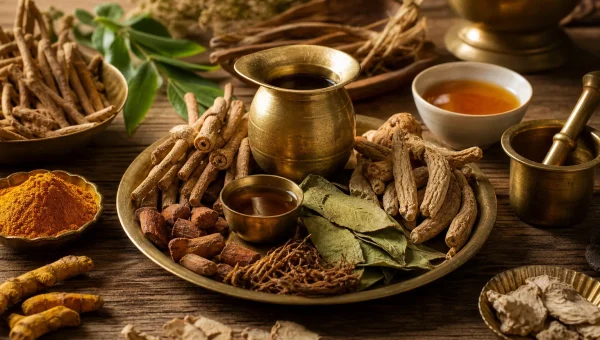
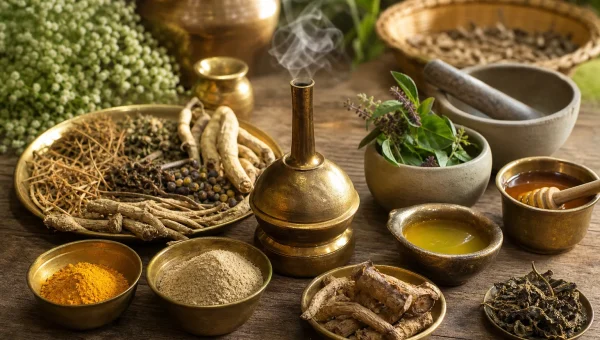
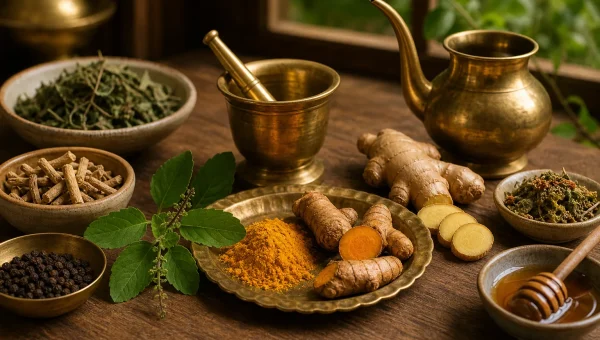
A commonly described preparation begins with a medicated milk decoction using herbs such as Musta, water, and milk; takra is then added and processed, with Amalaki frequently included in classical-style Takradhara preparations. The patient is positioned comfortably, the eyes are protected, the ears are plugged, and a cloth band is tied around the head to guide the flow and prevent irritation. The takra is poured in a continuous stream from about twelve angula above the forehead and moved rhythmically across the frontal area.
The usual sitting lasts about 45-75 minutes, and courses commonly run for 7-14 days, depending on constitution, disease strength, season, tolerance, and the physician’s plan. For skin protocols, Takradhara may be combined with other external measures such as Udwartana, and with internal medicines, diet, and lifestyle correction when indicated.
Takradhara for Psoriasis and Scalp Scaling
In Ayurveda, psoriasis-like presentations are commonly discussed under Kushtha, especially Eka-Kushtha and sometimes Kitibha, depending on the clinical features. Eka-Kushtha is described as a Kshudra Kushtha with features such as asvedana, mahavastu, and matsyashakalopama scaling, and is generally understood as a Vata-Kapha predominant condition with inflammatory participation in many patients.
Modern psoriasis is a chronic immune-mediated skin disease in which the immune system becomes overactive and skin cells multiply too quickly, producing inflamed, scaly plaques. In practice, Takradhara is most relevant when plaques, scalp scaling, itching, sleep disturbance, heat or heaviness of the head, and stress-linked flares appear together. It is not a replacement for dermatological care, but it can be selected as part of a broader Ayurvedic protocol for the skin-mind cycle.
A clinical observation study on Eka-Kushtha used Sarvanga Udwartana with Manjistha and Triphala, followed by Takradhara with Musta, Asandi, and Amalaki in 20 diagnosed patients. The protocol was given for 35 minutes daily over 14 consecutive days and reported improvement in itching, scaling, erythema, epidermal thickening, and PASI assessment. Because the protocol used both Udwartana and Takradhara, it is best understood as a combined Ayurvedic external-care approach rather than a single-variable Takradhara-only intervention.
Takradhara for Stress, Sleep, and Anxiety-Linked Symptoms
Takradhara is also valued when stress, poor sleep, restlessness, irritability, and skin flares reinforce one another. The continuous stream over the forehead gives sustained, gentle sensory input to the head region, with practical focus on marma areas such as Sthapani, Shankha, Avarta, and Apanga. The treatment setting itself is quiet, repetitive, and settling, which is why dhara procedures are traditionally used in mind-body and head-related conditions.
Related Shirodhara clinical literature describes reductions in state anxiety and changes in physiological stress markers after forehead-stream therapy. Takradhara uses the same dhara principle but replaces oil with medicated buttermilk, making it especially suitable where the practitioner wants a lighter, kapha-pitta-relevant head treatment rather than a heavily unctuous oil procedure.
For stress-related skin disease, the practical benefit is not limited to relaxation alone. Better sleep, reduced head heaviness, a calmer sensory state, and a structured treatment course can support the wider Ayurvedic plan of diet, digestion correction, bowel regularity, compatible herbs, and avoidance of known triggers.
Role in Hypertension-Associated Head Symptoms
Ayurvedic discussions of Uchcha Raktachapa generally treat hypertension as a modern clinical correlation rather than a direct one-word classical disease label. It is often interpreted through Vata predominance, tridosha involvement, rakta dhatu disturbance, stress, sleep, and lifestyle factors. Takradhara is therefore best positioned as an adjunctive head-and-mind therapy for selected patients with stress-linked blood pressure elevation, headache, insomnia, irritability, or heat sensation in the head.
Takradhara should not be presented as a direct substitute for antihypertensive medicines or medical monitoring. Blood pressure should be checked during the course, and patients already taking antihypertensive drugs should continue medical care unless their physician changes the prescription. Strong herbs such as Sarpagandha should not be casually added to a Takradhara formula, because Rauwolfia serpentina contains reserpine and related alkaloids with antihypertensive activity.
Common herbs: Musta + Amalaki; protocol may include Asandi
Often combined with Udwartana
Typical course: 14 days
Use: scaling, itching, scalp involvement, stress-linked flares
Focus: steady forehead dhara
Typical sitting: 45-75 minutes
Typical course: 7-14 days
Use: restlessness, poor sleep, stress-skin cycle
Focus: head calm, sleep, stress regulation
Course: individualized
Monitor: blood pressure during course
Avoid: Sarpagandha unless prescribed
| Clinical Context | Ayurvedic Framing | Verified Protocol Element | Practical Role |
|---|---|---|---|
| Plaque psoriasis / scalp scaling | Eka-Kushtha or related Kushtha presentation | Udwartana plus Takradhara with Musta, Asandi, and Amalaki used for 14 days in an observation study | Adjunctive external care for scaling, itching, and stress-linked flares |
| Stress, poor sleep, anxiety-linked symptoms | Mind-body and head-region imbalance treated through dhara procedures | Continuous rhythmic forehead stream, quiet setting, marma-focused head therapy | Support for relaxation, sleep routine, and the stress-skin cycle |
| Hypertension-associated head symptoms | Uchcha Raktachapa interpreted through Vata, tridosha, rakta, stress, and sleep factors | Adjunctive Takradhara with blood-pressure monitoring | Supportive therapy, not a replacement for prescribed antihypertensive treatment |
| Dandruff and scalp discomfort | Scalp and dermatological indication for medicated takra dhara | Medicated takra streamed over forehead and scalp | Clinician-selected external care when scaling, heat, or heaviness is present |
Contraindications and Practical Considerations
Takradhara should be administered by a trained Ayurvedic practitioner because the result depends on correct preparation, stream continuity, temperature, duration, patient positioning, and disease selection. It should be avoided or postponed in acute fever, recent head injury, active scalp wounds, active scalp infection, severe cold exposure intolerance, unstable blood pressure, or any condition where prolonged head treatment is unsuitable.
Because Takradhara uses a dairy-based preparation, patients with known milk allergy should not undergo the procedure unless a qualified clinician has specifically assessed the risk. Lactose intolerance and milk allergy are not the same condition, but both require individualized caution when buttermilk is used on the body or recommended alongside therapy.
Takradhara occupies a useful place among Ayurvedic external therapies because it is lighter than oil-based head therapies, adaptable to skin and scalp conditions, and clinically relevant where stress, sleep, head symptoms, and inflammatory skin patterns overlap. Its strongest use is as part of a complete Ayurvedic plan rather than as an isolated treatment.
Nothing in this article diagnoses, treats, or cures a medical condition. Use it as educational information and consult a qualified Ayurvedic practitioner or healthcare provider before starting Takradhara, herbs, supplements, detoxes, or therapeutic protocols, especially if pregnant, managing a chronic condition, allergic to dairy, or taking medication.
References
- Ijapr (ijapr.in)
- Ijapr (ijapr.in)
- Charaka Samhita — Grahani Chikitsa
- Jaims (jaims.in)
- Jaims (jaims.in)
- Niams (niams.nih.gov)
- Psychoneuroimmunologic effects of Ayurvedic oil-dripping treatment (2008), PubMed
- Shirodhara: A psycho-physiological profile in healthy volunteers (2013), PubMed Central
- Impact of Shirodhara on biological markers of stress: A case study (2021), PubMed
- Jahm (jahm.co.in)
- Antihypertensive and Antihyperlipidemic Activity of Aqueous Methanolic Extract of Rauwolfia Serpentina in Albino Rats (2020), PubMed Central
- My (my.clevelandclinic.org)
- NCCIH
I had Takradhara at a clinic in Thiruvananthapuram six years ago for plaque psoriasis covering about 30% of my body. After 14 sessions over 21 days, I was about 60% clear. Nothing in eight years of dermatology had come close.
The Takradhara section feels grounded enough to try carefully. The main idea is clear even if someone is new to Ayurveda.
I have treatment-resistant seborrheic dermatitis on my face that has not responded to antifungals or corticosteroid creams. Would Takradhara be appropriate for facial seborrheic conditions or is it primarily a scalp and head treatment?
The psychological effect of the treatment is something practitioners rarely discuss. The parasympathetic activation from the steady stream is real and measurable. My practitioner tracked cortisol before and after a full course.
Is there a simplified home version? I understand full clinical Takradhara isn’t replicable at home but something that approximates the benefit for mild scalp psoriasis maintenance would be useful.
The part about topical steroids managing but never resolving is my 12-year experience with psoriasis. The mechanism you describe for why Takradhara works differently is the first explanation that gave me hope rather than just management.
The steady stream of medicated buttermilk described really captures why this therapy feels both simple and profound.
What are the required herbs for the medicated buttermilk? The article mentions specific additions for psoriasis vs seborrheic conditions but doesn’t list the formulation clearly.
Are there food interactions with stress that I should be aware of? My Ayurvedic doctor mentioned something about dairy but wasn’t specific.
I wonder how the exact temperature range of 35 to 37 degrees Celsius is maintained in a typical clinic setting.
I was looking for a plain explanation of Takradhara. Small daily changes are easier to follow than a perfect plan.
The mention of Nimba Amalaki and Guduchi for psoriasis makes me curious about sourcing those powders locally.
I’m skeptical of the mechanism claims. The clinical improvement in psoriasis from Takradhara could be explained by stress reduction alone rather than any specific pharmacological action of the buttermilk components.
It seems the probiotic angle of fresh buttermilk adds an interesting gut brain layer to the stress relief claim.
Has anyone tried the home adaptation with a cloth soaked in herbal buttermilk and noticed any difference?
My psoriasis is confined to my scalp and the article focuses mostly on plaque psoriasis. Is there a protocol difference for scalp-only psoriasis where Takradhara is the primary affected area?
The reference to Charaka Samhita verse about buttermilk salt fire and four actions ties the ancient text to modern outcomes nicely.
I appreciate that the article notes contraindications like active scalp wounds and recent head trauma which are often overlooked.
The reduction of mean arterial pressure by 8.5 mmHg in the hypertension study sounds like a meaningful complement to lifestyle changes.
For seborrheic dermatitis the suggested herbs Nimba Haridra and Amalaki seem like a straightforward blend to try.
I had Takradhara done over a course of seven sessions at a clinic in Coimbatore and the effect on my stress levels was unlike anything I’d tried before. The psoriasis improvement was gradual but the mental clarity after each session was immediate. What I didn’t expect was how specific the herbal additions needed to be for my particular presentation. The first practitioner I visited used a generic preparation and it did almost nothing.
Good read
been following this blog for 6 months and this is one of the more grounded posts
It is encouraging to see that benefits persisted at three month follow up after the fourteen day psoriasis course.
useful info but hard to find a practitioner who does this type of treatment outside major cities
my vaidya in Pune recommended exactly this. nice to see it confirmed here
The explanation of lactic acid normalizing skin pH and reducing Staphylococcus aureus colonization gives a clear biochemical rationale.
would prefer more citations in the text itself
Will try
This makes sense for Takradhara. The examples make the advice less abstract.
the post-workout vata thing explains why I feel wired and tired after intense exercise
shankhpushpi for my vertigo was recommended by my neurologist’s colleague who practices integrative medicine. the bhrama framing here is useful
neem and turmeric face pack left my skin tight and slightly red. maybe my pitta constitution makes it too heating?
the gut-brain axis stuff is everywhere now but the ayurvedic framing of gut emotions is actually more nuanced than the microbiome narrative
IBS protocol section should address SIBO separately. the treatments overlap but they’re not the same condition
same here
brahmi worked better for my anxiety than ashwagandha honestly. the adaptogen thing is too broadly marketed
which of these approaches works best for Kapha constitution? the article mixes all three doshas
trying the lip scrub recipe with honey and sugar. first time in years my lips aren’t chapped in winter
sharing with my mom
For Takradhara, consistency seems like the hard part. The safety notes could be expanded a little.
does anyone know if these herbs are safe while on blood thinners? would really appreciate a response
does the approach differ for someone with multiple doshas elevated at once?
tried this for 30 days, mixed results. maybe my constitution assessment is wrong
tried 3 of the suggestions here. 2 worked well, 1 made no difference. good enough ratio for me
will try and report back. fingers crossed
been doing this for 6 months, amazing difference in energy levels
Very helpful, thank you
agni concept finally clicked for me reading this. it explains why I digest the same food differently depending on stress levels
I wish more doctors knew about this approach
the quality of herbs varies so much between brands. really hard to replicate these results
started this protocol 2 weeks ago. nothing notable yet but will report back in a month
Vidar churna for stress is hard to find. any reliable online sources or substitutes for those outside India 🌿
late to this but wanted to ask if anyone has combined these approaches with conventional treatment
the basic concepts here match what I learned in my yoga teacher training
the seasonal rotation idea is something I had never considered before
reading this in 2027, has anything changed about the dosage recommendations since this was published? 💯
The advice around Takradhara is specific enough to be useful. Would be useful to see a short checklist next.
tried the fennel seed protocol after meals for 3 weeks. bloating reduced significantly but my appetite increased a lot too
Just found this via Google search, is this still the current recommendation?