Stuttering is a fluency disorder in which the flow of speech may be interrupted by repetitions, prolongations, blocks, or visible effort. Ayurveda should not be presented as a replacement for speech-language pathology; it is best used as supportive care alongside assessment and therapy from a qualified speech-language professional.
Within an Ayurvedic lens, the most useful starting point is the pattern around the speech difficulty. When stuttering worsens with restless sleep, constipation, dryness, shallow breathing, cold extremities, jaw tension, and anticipatory fear of speaking, the presentation is approached as a Vata-dominant disturbance affecting speech, breath, and nervous-system steadiness. The goal is not to force speech into perfection, but to reduce the instability that makes fluent speech harder to access.
Gadgadatva: Ayurveda’s Understanding of Stuttering
Ayurvedic literature uses terms such as Gadgada for broken, spasmodic, or stammering speech. Classical discussion places such speech disturbances within Vata-related disorders and, in some explanations, within obstruction of Vata by Kapha in the channels connected with voice and speech. This makes the Ayurvedic emphasis practical: pacify aggravated Vata, clear obstruction where heaviness or mucus is present, nourish the voice and throat, and train breath so that speech is supported by a steadier exhalation.
More specifically, an Ayurvedic protocol for Gadgadatva attends to three functional areas:
- Udana Vata: The upward-moving aspect of Vata associated with speech, voice, effort, expression, and controlled exhalation.
- Prana Vata: The aspect of Vata connected with breath, attention, sensory regulation, and mental steadiness before speech begins.
- Kapha support of the throat and head: The lubricating, stabilizing, and nourishing principle that becomes important when dryness, strain, or vocal fatigue is present.
Modern clinical understanding also treats stuttering as more than a simple habit. Speech fluency depends on coordinated timing between breathing, phonation, articulation, attention, and motor planning. Current neurobiological descriptions commonly involve speech-motor networks that include cortical areas and basal-ganglia-thalamocortical circuits. Ayurveda and modern speech therapy use different languages, but both point toward timing, regulation, breath, and repeated practice.
The Integrated Ayurvedic-Speech Therapy Protocol
The most responsible approach is integrative. Speech therapy remains central for fluency shaping, stuttering modification, communication confidence, and reduction of avoidance behaviors. Ayurveda can support the terrain around that work by improving sleep regularity, reducing Vata-provoking routines, supporting the voice, calming performance anxiety, and using carefully selected herbs and therapies under supervision.
A practical protocol usually has four layers: professional speech therapy, daily breath and voice regulation, Vata-pacifying diet and routine, and targeted herbs or therapies only when they are appropriate for the individual constitution, age, medical history, and medicines already being taken.
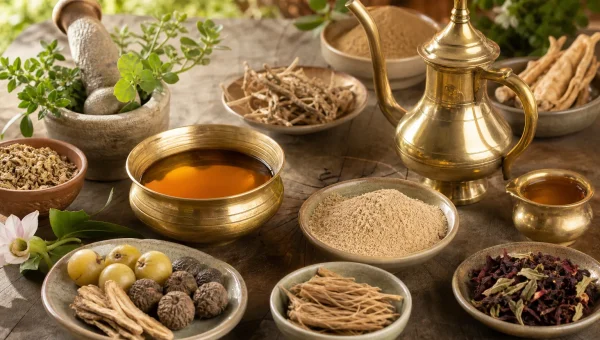
Core Herbs for Gadgadatva
The herbs below are not “anti-stuttering pills.” They are Ayurvedic supports for speech, voice, memory, stress tolerance, throat comfort, and Vata regulation. Internal use should be guided by a qualified Ayurvedic practitioner, especially in children, adolescents, pregnancy, hypertension, liver disease, kidney disease, seizure disorders, or when prescription medicines are being used.
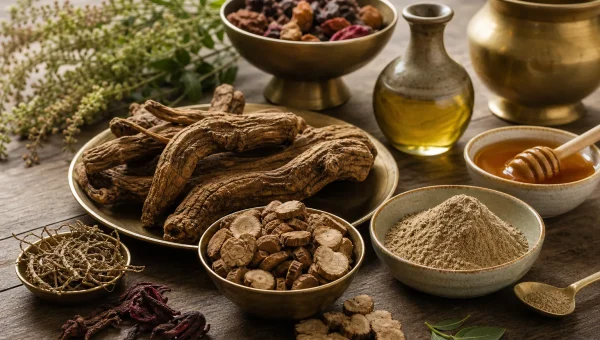
Vacha (Acorus calamus)
Vacha is one of the most speech-relevant herbs in the Ayurvedic materia medica. The Ayurvedic Pharmacopoeia of India describes Vacha as katu and tikta in taste, laghu and tikshna in qualities, ushna in potency, and katu in post-digestive effect. Its listed actions include kanthya for the throat, medhya for intellect and mental clarity, kaphahara, and vatahara. This is why Vacha is traditionally considered when speech is blocked, heavy, unclear, or associated with dullness and Kapha-Vata obstruction.
Important safety note: Vacha must not be used casually. The Ayurvedic Pharmacopoeia gives a small internal powder dose of 60–120 mg and notes purification before internal use. Calamus preparations may contain asarones, and beta-asarone has raised toxicology concerns in animal and laboratory safety evaluations. Use only correctly identified, purified Vacha from a reliable source and only under professional supervision. Avoid long-term or high-dose self-use.
Brahmi (Bacopa monnieri)
Brahmi is a classical medhya and rasayana herb used for mental clarity, learning, memory, and steadiness of the mind. The Ayurvedic Pharmacopoeia describes Brahmi as madhura, tikta, and kashaya in taste, laghu and sara in qualities, sheeta in potency, and madhura in post-digestive effect. Its listed actions include medhya, rasayana, svarya, vatahara, and kaphahara.
For a person whose stuttering worsens under exam pressure, stage fear, or mental overactivity, Brahmi is often chosen as a gentle nervous-system support. Classical powder dosing in the Pharmacopoeia is 1–3 g, while modern standardized extracts are used in different doses depending on preparation. It is best taken consistently rather than as an emergency remedy immediately before speaking.
Ashwagandha (Withania somnifera)
Ashwagandha is most relevant when stuttering is amplified by chronic stress, poor sleep, fatigue, fearfulness, or depletion. The Ayurvedic Pharmacopoeia describes the root as tikta and kashaya in taste, laghu in quality, ushna in potency, and madhura in post-digestive effect. Its listed actions include rasayana, balya, vajikarana, and Vata-Kapha pacification.
In this protocol, Ashwagandha is not used to act directly on speech sounds. It is used to build resilience, support sleep, and reduce the Vata-driven stress loop in which fear of stuttering increases tension, tension disrupts breath, and disrupted breath worsens speech blocks. Classical powder dosing is 3–6 g, but the appropriate form and dose depend on digestion, heat signs, body weight, age, and medical history.
Yashtimadhu (Glycyrrhiza glabra)
Yashtimadhu is a sweet, demulcent herb used when the throat, voice, or vocal tract feels dry, strained, irritated, or fatigued. The Ayurvedic Pharmacopoeia describes it as madhura in taste, guru and snigdha in qualities, sheeta in potency, and madhura in post-digestive effect. Its listed uses include kasa, kshaya, svarabheda, vatarakta, and vrana, making it especially relevant when speech difficulty is accompanied by hoarseness, dryness, or throat strain.
Caution: Licorice can raise blood pressure, lower potassium, and interact with medicines. Avoid unsupervised use in hypertension, kidney disease, heart disease, low potassium, pregnancy, or when taking diuretics, corticosteroids, heart medicines, or blood-pressure medicines.
Nasya: The Direct Route to Cranial Vata
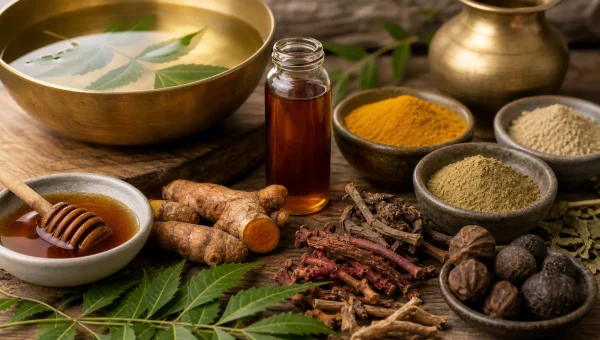
Nasya is the Ayurvedic practice of administering medicated oil, ghee, powder, or juice through the nasal route for conditions of the head, nose, throat, and sense organs. The classical principle is that the nose is the gateway to the head; therefore, nasya is often considered when Vata disturbance affects speech, voice, sleep, facial tension, or mental steadiness.
For a Vata-dominant speech presentation, a practitioner may consider gentle oil-based nasya after assessing age, strength, season, digestion, sinus condition, and contraindications. Anu Taila is a classical nasya oil used for head-and-sense-organ care. Vacha-containing preparations may be selected only when they are appropriate and properly prepared. Nasya should not be done during acute fever, active sinus infection, immediately after meals, intoxication, pregnancy without professional guidance, or in children without expert supervision.
Pranayama for Speech Fluency
Breath is central to both Ayurveda and speech therapy. Many people who stutter experience breath holding, shallow inhalation, speaking on residual air, or tension before phonation. Pranayama gives the person a daily way to train slower exhalation, softer onset of sound, and less panic before speech begins.
| Practice | Sanskrit Name | Suggested Duration | Use in a Gadgadatva Protocol |
|---|---|---|---|
| Alternate nostril breathing | Nadi Shodhana / Anulom Vilom | 5–10 minutes daily | Settles Prana Vata, slows mental overactivity, and prepares the breath before speaking practice. |
| Humming bee breath | Bhramari | 5 minutes daily | Trains prolonged exhalation and gentle phonation while calming the stress response. |
| Soft ocean breath | Ujjayi | 3–5 minutes daily | Builds awareness of throat, breath flow, and controlled exhalation without forcing the voice. |
| Lion practice | Simhasana | 3–5 relaxed repetitions | Releases tension around the tongue, jaw, face, and throat before speech exercises. |
Bhramari deserves special emphasis because it is speech-adjacent: it uses breath, vibration, and controlled sound without requiring words. Practiced gently, it helps the speaker experience sound production without the pressure of conversation. A simple routine is to inhale slowly through the nose, exhale with a steady humming sound, and repeat for 8–10 rounds. The sound should be comfortable, not loud or strained.
The Shirodhara Option
Shirodhara, the steady pouring of warm liquid over the forehead, is best reserved for cases where Vata aggravation is dominated by poor sleep, persistent worry, sensory overload, and nervous-system hyperarousal. It should be performed by a trained practitioner in an appropriate clinical setting. For stuttering, it is not a direct speech therapy; it is a calming and Vata-pacifying support that may make the person more settled for speech practice, sleep, and daily routine.
A Practical 8-Week Support Plan
An Ayurvedic plan for stuttering should be simple enough to follow and safe enough to sustain. The plan below is a supportive framework, not a prescription. Herbs and nasya should be individualized by a qualified practitioner.
- Weeks 1–2: Continue speech therapy, begin 5 minutes of Bhramari nightly, fix sleep and wake times, reduce late-night screen exposure, and use warm, regular meals to pacify Vata.
- Weeks 3–4: Add Nadi Shodhana before speaking practice, include gentle jaw and tongue relaxation, and track which situations increase blocks, fear, or avoidance.
- Weeks 5–6: Under supervision, consider Brahmi for mental steadiness or Yashtimadhu for throat dryness if indicated.
- Weeks 7–8: If Vata signs remain strong, a practitioner may consider nasya, Ashwagandha, or a deeper calming therapy such as Shirodhara, depending on constitution and safety profile.
Start Tonight
Practice Bhramari pranayama for 5 minutes before bed. Sit upright, relax the jaw, inhale slowly through the nose, and exhale with a smooth humming sound until the breath is comfortably complete. Repeat 8–10 rounds. Track sleep quality, speaking anxiety, jaw tension, and ease of voice for 14 days before adding more interventions.
Stuttering is a complex fluency disorder. This Ayurvedic protocol is designed as adjunctive support and is not a replacement for professional speech-language pathology, medical evaluation, or mental-health care when anxiety is severe. Consult a qualified Ayurvedic practitioner and healthcare provider before beginning herbs, nasya, or Shirodhara.
References
- Nidcd (nidcd.nih.gov)
- Asha (asha.org)
- Involvement of the Cortico-Basal Ganglia-Thalamocortical Loop in Developmental Stuttering (2019), PubMed Central
- A review of brain circuitries involved in stuttering (2014), PubMed Central
- Academic (academic.oup.com)
- Charaka Samhita — Panchakarmiya Siddhi
- Jaims (jaims.in)
- Jaims (jaims.in)
- Ayurvedic Pharmacopoeia of India
- Ec (ec.europa.eu)
- Onlinelibrary (onlinelibrary.wiley.com)
- Ayurvedic Pharmacopoeia of India
- NIH Office of Dietary Supplements
- NCCIH
- Jaims (jaims.in)
- Researchgate (researchgate.net)
- Immediate Effects of Bhramari Pranayama on Resting Cardiovascular Parameters in Healthy Adolescents (2016), PubMed Central
- Effects of Bhramari Pranayama on health – A systematic review (2018), PubMed Central
- Shirodhara: A psycho-physiological profile in healthy volunteers (2013), PubMed Central
- Impact of Shirodhara on biological markers of stress: A case study (2021), PubMed Central
The safest part of the Stuttering (Gadgadatva) advice is keeping it simple. Good starting point for a cautious reader.
The self-medicating with silence detail is hauntingly accurate for what severe stuttering does socially. The avoidance behaviors accumulate and become as limiting as the stutter itself. Any treatment that addresses the anxiety component alongside the speech component is addressing the whole problem.
My son has a stutter and we’ve been through conventional speech therapy with modest results. The Vata constellation you describe, cold extremities, dry skin, restless sleep, constipation, is his exact picture. I’m taking this to his Ayurvedic doctor next week.
Speech pathology doesn’t have great outcomes for stuttering in adults and teenagers. About 70% of young children who stutter resolve naturally. For those who don’t, the options are limited. An Ayurvedic approach that addresses the nervous system component is interesting because that’s the mechanism speech therapy least addresses.
The Vacha herb for speech and cognitive function is one of the oldest Ayurvedic prescriptions. The fact that it’s specifically indicated for speech disorders in classical texts and is now being studied for acetylcholine modulation suggests the traditional indication had a physiological basis.
Is there any contraindication for combining Ayurvedic treatment with ongoing speech therapy? I’d think they address different levels of the same problem and would complement each other but I want to know if there’s any reason not to do both simultaneously.
The anxiety that develops around stuttering becomes its own problem distinct from the stutter. I know people who have reduced their stutter significantly but whose lives are still limited by the social anxiety built up over years. Treating one without the other leaves the person only partly recovered.
This helped me understand Stuttering (Gadgadatva) without too much jargon. The article avoids making it sound like a quick fix.
Reading about Arjun’s struggle reminded me of a friend who faced similar exam pressure
This helped me understand Stuttering (Gadgadatva) without too much jargon. I appreciate that it does not oversell the result.
The description of cold extremities and dry skin really highlights how Vata shows up physically
The exam preparation context is particularly cruel for stuttering. The higher the stakes the worse the Vata aggravation and the worse the stutter. That’s the spiral that makes the condition so limiting for young people in high-pressure academic environments.
One thing that stood out was the emphasis on Vacha Nasya for speech clarity
I wonder how long the herbal doses should be taken before seeing any change
It seems important to combine these Ayurvedic steps with regular speech therapy rather than replace it
A simple practice like Bhramari pranayama before bedtime could help calm the mind
Many readers might be curious about the safety of long term Vacha use given the beta asarone note
The case study gave a clear picture of how anxiety and speech interact in a vicious cycle
I appreciate the practical tip to track voice quality and sleep depth for two weeks
Shirodhara sounds like a soothing option for severe anxiety related stuttering
The article would benefit from more rigorous sourcing. The studies referenced are mostly observational, not randomized controlled.
The timeline expectations seem unrealistic for a chronic condition. Most patients I’ve spoken to report much longer recovery arcs.
Balancing Prana and Udana Vata through specific breathing exercises appears central to the approach
does Nasya help specifically with speech-related Vata or is it more for neurological function generally?
I’m skeptical of the causal claims here. Symptom improvement after starting a protocol can easily be a placebo response or regression to the mean.
I have a question about the duration. Is the 30-day protocol meant to be repeated or is one cycle sufficient for chronic cases?
Is this protocol safe to follow alongside standard allopathic treatment, or does it need to be spaced out?
finding the herbs in my city is nearly impossible, the ones available are often low quality
is Brahmi relevant here given the connection to speech and cognitive function? the article focuses on Vata herbs but doesn’t mention it 🌿
honestly i’ve been doing this for 2 months and the results are underwhelming. might just be my body type ✨
tried it, didnt work for me. maybe need proper vaidya supervision
wen to take, before or after food? confused by diff sources
some of the herb names in english vs sanskrit are confusing, i ended up buying the wrong thing
does anyone know if this works the same way for Kapha types? feels like the article is more Vata focused
the dose ranges seem very broad, like 1 to 3 grams is quite a big difference. would be more helpful with narrower guidance
tried this for my stutter for 6 months without real change. speech therapy was much more impactful. not dismissing but be realistic about expectations
tried this last month, honestly surprised how well it worked for me 🌿
I tried a similar protocol for 6 weeks and saw no improvement. It may depend heavily on individual constitution. 🙏
where do u buy quality herbs in India? the market stuff seems adulterated
what’s the recommended dose for someone with a Pitta constitution? the article mentions general ranges but i want to confirm 💯
For Stuttering (Gadgadatva), consistency seems like the hard part. This is the kind of detail readers can test slowly.
I notice the article doesn’t address interactions with thyroid medication. Is there a concern there?
For Stuttering (Gadgadatva), consistency seems like the hard part. The examples make the advice less abstract.
The mechanism explanation is interesting. I would like to understand whether the effect diminishes with long-term use.
I started this protocol last month. Would it be acceptable to continue Triphala alongside it or would that be too much?
The scientific citations are helpful. Are there any RCTs specifically for the combination therapy mentioned?
Without knowing a patient’s Prakriti and Agni status, applying a generic protocol seems premature. This kind of generalized advice can actually cause harm.
same issue here, doc said try ayurveda. will try this n update
finally something that explains the dosage properly instead of just saying ‘take as needed’
how long u take this before seeing results? asking for my dad
Could you clarify whether the herbal preparation needs to be freshly made each day or if a week’s batch is acceptable?
my son has been on the Vata protocol for 4 months with speech therapy and his fluency is measurably better. combination approach seems key
Reading this later and the Stuttering (Gadgadatva) advice still feels relevant. The timing advice is the part I would start with.