
I recommend yoga nidra to people who train hard, work late, travel often, and still feel crushed halfway through the week. They may be eating well and sleeping a reasonable number of hours, but the body never fully downshifts. The muscles get attention; the nervous system does not.
Yoga nidra is a practical way to change that. It is not a magic substitute for sleep, and it does not erase the need for food, hydration, deloads, or medical care. But as a 20-minute recovery ritual, it gives the body a clear signal: stop bracing, stop scanning, stop fighting.
What Yoga Nidra Actually Is
Yoga nidra is a structured relaxation practice usually done lying down in Savasana. The practitioner stays still, keeps the eyes closed, and follows a guided sequence of internal cues: settling, intention, body awareness, breath awareness, imagery, quiet rest, and a gradual return. The body becomes deeply relaxed while the mind remains lightly aware of the instructions.
In Ayurvedic language, this kind of practice is especially useful when the pattern resembles aggravated Vata dosha: restlessness, irregularity, light sleep, racing thoughts, anxiety, travel fatigue, and the wired-but-tired feeling that comes from too much motion and stimulation. Yoga nidra is not described as a drug or cure; it is a calming, grounding routine that supports the return to steadiness.
Think of it this way: seated meditation often asks you to concentrate. Yoga nidra asks you to follow, soften, and release. That is why people who struggle to sit upright and meditate often find yoga nidra more accessible.
Setup: Get This Right or Don’t Bother
The setup matters because the body needs to feel safe, warm, and supported before it will stop guarding. Keep it simple and repeatable so the same environment becomes a recovery cue.
- Surface: Use a yoga mat with a folded blanket on top. You want support without sinking so deeply that you fall asleep immediately.
- Temperature: Cover yourself with a light blanket from chest to toes. During stillness, the body often feels cooler.
- Eye cover: Use a sleep mask or folded cloth over the eyes. Less light means less stimulation.
- Knee support: Place a small pillow or rolled towel under the knees if the lower back feels tight.
- Sound: Use a quiet room, earplugs, or very low, steady background sound. Avoid lyrics or anything emotionally dramatic.
- Timer: Set a gentle alarm for 22 minutes so you can fully let go without checking the clock.
Lie flat on your back in Savasana. Keep the arms slightly away from the sides, palms facing up. Let the feet rest wider than the hips, with the toes falling outward. Close your eyes and commit to staying still unless there is pain, numbness, or real discomfort.
The Full 20-Minute Yoga Nidra Script
You can record yourself reading this slowly, or have someone read it aloud. Leave 3-5 seconds between most instructions. The voice should be calm, plain, and steady.
Minutes 1-3: Settling and Sankalpa
Bring your attention to the weight of your body on the floor. Feel the back of the head, the shoulder blades, the arms, the pelvis, the legs, and the heels supported by the ground. There is nowhere to go and nothing to achieve. With every exhale, allow the body to become heavier.
Take three slow breaths in through the nose and out through the mouth. Let each exhale be longer than the inhale. Then allow the breath to return to normal.
Now form your Sankalpa, a short and positive intention. Keep it simple: “I rest deeply,” “My body recovers steadily,” or “I return to balance.” Repeat it silently three times with quiet confidence. Do not analyze it. Place it in the mind and move on.
Minutes 3-10: Systematic Body Scan
Move awareness through each body part as it is named. Do not move the body. Simply notice each point, then let your attention shift to the next one.
Right side: Right thumb. Index finger. Middle finger. Ring finger. Little finger. Palm of the hand. Back of the hand. Wrist. Forearm. Elbow. Upper arm. Shoulder. Right armpit. Right side of the ribcage. Right hip. Right thigh. Kneecap. Shin. Calf. Ankle. Top of the right foot. Sole of the right foot. Right big toe. Second toe. Third toe. Fourth toe. Fifth toe.
Left side: Left thumb. Index finger. Middle finger. Ring finger. Little finger. Palm of the hand. Back of the hand. Wrist. Forearm. Elbow. Upper arm. Shoulder. Left armpit. Left side of the ribcage. Left hip. Left thigh. Kneecap. Shin. Calf. Ankle. Top of the left foot. Sole of the left foot. Left big toe. Second toe. Third toe. Fourth toe. Fifth toe.
Back body: Right shoulder blade. Left shoulder blade. Upper back. Middle back. Lower back. Right buttock. Left buttock. Back of the right leg. Back of the left leg. Both heels.
Front body: Chest. Sternum. Belly. Navel. Right side of the abdomen. Left side of the abdomen. The whole front body.
Head and face: Throat. Jaw. Lower lip. Upper lip. Right cheek. Left cheek. Right nostril. Left nostril. Tip of the nose. Right eye. Left eye. Right eyebrow. Left eyebrow. Space between the eyebrows. Forehead. Top of the head. The whole head.
Pause for 10 seconds. Feel the whole body at once. The whole body lying on the floor, completely still, completely supported.
Minutes 10-13: Breath Awareness
Bring attention to the natural breath. Do not force it. Notice the breath moving in and out of the nostrils, chest, ribs, and abdomen.
Now count each exhale backward from 27 to 1. Inhale naturally. Exhale: 27. Inhale. Exhale: 26. Continue in that way. If you lose count, simply return to 27 without frustration.
In Ayurveda and yoga, breath awareness is closely related to Prana Vayu, the inward-moving vital function associated with respiration and sensory intake. The long exhale also supports the downward, releasing quality associated with Apana Vayu. In practical terms, the count gives the mind one quiet task and reduces mental scattering.
Minutes 13-17: Visualization
Let each image arise lightly in the mind. See it, feel it for a moment, then let it dissolve before the next one appears.
A still lake at dawn. Tall grass moving in slow wind. A single candle flame in a dark room. Warm sunlight on closed eyelids. A heavy stone sinking through deep water. Snow falling in silence. Your own body lying perfectly still and at peace.
Pause 5-8 seconds between each image.
Now let all images fade. Rest in the darkness behind the eyelids. Nothing to picture. Nothing to solve. Just quiet awareness.
Minutes 17-20: Return
Bring your Sankalpa back. Repeat it silently three times, using the same words as before.
Begin to notice the floor beneath you. Notice the temperature of the air. Notice sounds in the room. Take a slow, deeper breath. Wiggle the fingers and toes. Roll the wrists and ankles gently.
Draw the knees toward the chest and roll to the right side. Stay there for three natural breaths. Then press yourself up to a seated position. Keep the eyes soft or half-closed for another 30 seconds before standing.
You are done.
When to Practice for Maximum Recovery
The best time is the time you will actually repeat. For athletes, lifters, runners, and people with demanding work schedules, yoga nidra works best when it is attached to an existing rhythm instead of saved for emergencies.
| Timing | Best For | Notes |
|---|---|---|
| After training | Downshifting after physical effort | Shower, hydrate, then practice on the floor |
| Early afternoon | Mental reset without a long nap | Useful on rest days or heavy workdays |
| Before bed | Restless sleep and Vata-type mental activity | Practice on the floor first, then go to bed |
For most people, two to four sessions per week is enough to build the habit. Daily practice is also fine when the sessions are gentle and the person does not use it to ignore true exhaustion, illness, pain, or sleep deprivation.
Yoga Nidra vs. Sleep: The Recovery Comparison
Yoga nidra and sleep are related, but they are not the same. Sleep moves through organized stages, including light sleep, deep sleep, and REM sleep. Yoga nidra is a guided waking practice that can include sleep-like relaxation and local slow-wave changes in parts of the brain while awareness of the instructions remains present.
That is exactly why it is useful. It gives the body a deliberate recovery pause without asking you to sleep on command. It can support calm, sleep quality, and mental reset, but it should not be treated as a replacement for a full night of sleep.
Adults still need adequate nightly sleep. If you are regularly sleeping too little, waking unrefreshed, snoring heavily, gasping at night, or dealing with persistent insomnia, yoga nidra can be a supportive practice, but it should not be your only intervention.
Herbs That May Support the Practice
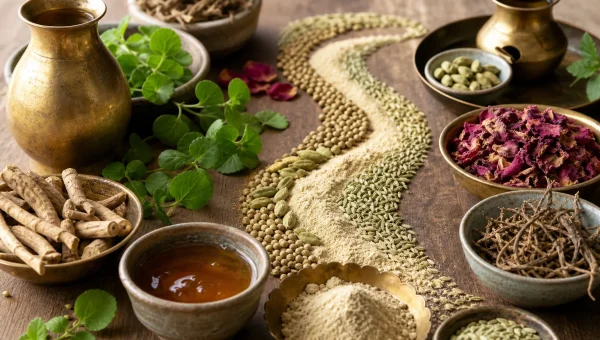
Herbs are optional. Yoga nidra does not require capsules, powders, teas, or tonics. If the nervous system is very unsettled, an Ayurvedic practitioner may choose herbs based on constitution, digestion, sleep pattern, medications, pregnancy status, and overall health.
- Ashwagandha (Withania somnifera): Traditionally used as a strengthening and restorative herb. It may suit depleted, Vata-type fatigue when properly selected.
- Brahmi (Bacopa monnieri): A classical Medhya herb used to support the mind, learning, and steadiness of attention.
- Jatamansi (Nardostachys jatamansi): A traditional calming herb used in Ayurveda for sleep and disturbed mental states.
- Tagara (Valeriana wallichii): A traditional sleep-supporting herb used for Anidra, especially when the mind is restless and the body will not settle.
- Shankhapushpi (Convolvulus pluricaulis): A Medhya herb traditionally used for the mind and nervous system; it is commonly taken in powder or formulation form under guidance.
Safety note: Do not combine sedative herbs with alcohol, sleeping pills, anti-anxiety medicines, antidepressants, or other nervous-system medicines unless a qualified practitioner or healthcare provider approves it. Avoid self-prescribing herbs during pregnancy, breastfeeding, liver disease, complex medical conditions, or when taking regular medication.
Common Mistakes to Avoid
Small mistakes can turn yoga nidra into an ordinary nap or an overcomplicated performance. Keep the practice simple, quiet, and consistent.
- Falling asleep every time. If this happens, practice earlier in the day or use a slightly more upright, supported position. Sleep is not failure, but the yoga nidra method is built around relaxed awareness.
- Skipping the Sankalpa. The intention gives the session direction. Keep it short and repeat the same wording at the beginning and end.
- Practicing only when desperate. Yoga nidra is strongest as a routine. Use it before the nervous system is completely overdrawn.
- Using the bed too soon. If you practice in bed, many people fall asleep before the body scan is complete. Use the floor unless the goal is specifically to transition into sleep.
- Expecting it to replace recovery basics. Yoga nidra supports recovery; it does not replace sleep, protein, hydration, intelligent training, sunlight, or medical care when needed.
Start this week. Pick one post-training session or one afternoon reset, set a timer, and follow the script above. Twenty minutes. No equipment, no app subscription, no performance. Let the body receive a clear signal that the work is over and recovery has begun.
References
- The Origin and Clinical Relevance of Yoga Nidra (2022), PubMed Central
- Nmji (nmji.in)
- The Impact of Yoga Nidra and Seated Meditation on the Mental Health of College Professors (2018), PubMed Central
- Ayurvedic doshas as predictors of sleep quality (2015), PubMed Central
- En (en.wikipedia.org)
- Yogainternational (yogainternational.com)
- Yoga nidra practice shows improvement in sleep in patients with chronic insomnia: A randomized controlled trial (2021), PubMed
- Frontiersin (frontiersin.org)
- Improved sleep, cognitive processing and enhanced learning and memory task accuracy with Yoga nidra practice in novices (2023), PubMed
- Journals (journals.plos.org)
- Nature (nature.com)
- Verywellhealth (verywellhealth.com)
- CDC
- Ayurvedic Pharmacopoeia of India
- HPLC analysis and standardization of Brahmi vati – An Ayurvedic poly-herbal formulation (2013), PubMed Central
- An important Indian traditional drug of ayurveda jatamansi and its substitute bhootkeshi: chemical profiling and antioxidant activity (2013), PubMed Central
- A comparative clinical study on the effect of Tagara (Valeriana wallichii DC.) and Jatamansi (Nardostachys jatamansi DC.) in the management of Anidra (primary insomnia) (2015), PubMed Central
- Ijapr (ijapr.in)
- NCCIH
- NCCIH
- Central nervous system depressant activity of Jatamansi (Nardostachys jatamansi DC.) rhizome (2020), PubMed


The nervous system never fully downshifting description is exactly what I needed someone to name. I train consistently, sleep enough, eat well. But something is still wrong by Wednesday. Reading this gave me a language for it and a solution.
I’m a nurse and I’ve started incorporating some of these principles into my own self-care routine
The dosage guidance here is more specific and helpful than what I got from my last consultation.
The Armed Forces Medical Research brainwave data is the piece that made my skeptical mind engage. Cortisol reduction and theta wave induction in 20 minutes isn’t spiritual. It’s measurable physiology. That’s the framing that makes this accessible to non-practitioners.
You make an excellent point about individual variation. What works beautifully for one person may need adjustment for another, that’s the beauty of personalized Ayurvedic care.
How does this compare to Savasana for recovery purposes? My yoga teacher says Savasana is adequate but I feel like what’s described here goes deeper. Is Yoga Nidra systematically different from a prolonged Savasana?
lol my grandmother used to say the same thing. finally understand the science behind it
this is the kind of content that makes Ayurveda accessible to beginners without dumbing it down.
The 2-3 sleep hour equivalent from one 20-minute Yoga Nidra session is a claim that some readers will want sourced. I’ve seen this figure cited elsewhere too but without a consistent primary study reference.
My partner was skeptical but tried it after reading this. Now they’re a convert.
This is better than the consultation I paid for. Seriously thorough and well-researched
step by step is great, makes it way more doable than other articles ive read
I’ve been looking for exactly this information for weeks. Thank you for being so thorough.
Thank you for this! You’ve articulated it beautifully, it’s exactly this kind of awareness that sets Ayurveda apart from a one-size-fits-all approach.
Followed this advice for a month. Not only did it not help, my symptoms actually got slightly worse before I went back to my doctor
I struggled with this for years before discovering Ayurveda. Six months later, I barely recognize my old self.
I tried this script last night after a particularly punishing leg day and made it maybe eight minutes before I fell fully asleep. Is that normal for beginners? I wasn’t sure if I was doing it right or just exhausted. Either way I woke up feeling more rested than usual.
We appreciate your candid feedback. You’re right that we should distinguish more clearly between traditional knowledge and clinical evidence. We’re working on adding more research citations.
I teach Yoga Nidra at a studio in Hyderabad and my students who use this script specifically report different results than those who use other scripts. The body scan sequence from periphery to core to periphery creates a different somatic response than the usual top-down sequence.
I was looking for a plain explanation of Yoga Nidra for Beginners. The safety notes could be expanded a little.
I was looking for a plain explanation of Yoga Nidra for Beginners. The main idea is clear even if someone is new to Ayurveda.
The technique works when I’m on the mat with silence. Trying to use it on a train or during commute doesn’t produce the same depth. Environmental factors seem to matter more for Yoga Nidra than for some other meditation formats.
The body scan section felt surprisingly detailed especially noticing each toe individually
I’m a combat veteran and this is the practice my VA therapist recommended alongside EMDR for nervous system regulation. The body scan component of Yoga Nidra and trauma therapy overlap significantly in what they’re trying to achieve.
The Sankalpa planting at the beginning and end of the practice is the element most Western presentations skip. The receptive theta state is when suggestion most effectively reaches the subconscious. That’s not mysticism, it’s the same principle as therapeutic hypnosis.
You mentioned using a sleep mask does a simple folded cloth work just as well
How does frequency matter? Daily versus three times a week versus weekly. I have limited time and I want to know the minimum effective dose for the recovery benefit specifically.
After trying the breath counting from twenty seven down I realized how easy it is to lose track
I tried melatonin, magnesium, chamomile tea, and sleep restriction therapy before finding Yoga Nidra. Within four days of consistent practice my sleep onset changed. Thirteen years of poor sleep quality with a 20-minute practice addressing the root issue.
Setting the timer for twenty two minutes removes the urge to keep checking the clock
Sometimes I skip the visualization and just stay in the dark behind my eyelids and it still feels resetting
One thing that helped me was placing a rolled towel under my knees before lying flat
If you practice right after a workout make sure to wipe off excess sweat so the blanket stays dry
The Yoga Nidra for Beginners section feels grounded enough to try carefully. I would like to know how long to try it before judging results.
agreed, that part was confusing for me too. I ended up doing 2 to 3 times per week
that’s a fair concern. I’d suggest starting lower and building up
does the sankalpa need to stay the same across sessions or can it change?
the rotation of consciousness section, how slow should the inner movement be? the script doesn’t specify timing धन्यवाद
can this be done in the morning or does it need to be before sleep to be effective?
how many days of consistent practice before the deeper states become accessible?
the rotation of consciousness section, how slow should the inner movement be? the script doesnt specify timing
off topic but can these herbs be taken with thyroid medication? my doctor doesnt know 🙏
sorry to go off topic but any tips for Ayurvedic approach to knee pain?
sorry off-topic but has anyone here used Ayurveda for hair loss? nothing seems to work
unrelated question but does anyone know a good vaidya in Pune?
I was looking for a plain explanation of Yoga Nidra for Beginners. This would be easier to follow with a one-week sample plan.