
Yashtimadhu: Classical Identity, Uses, and Modern Safety
Yashtimadhu, also called Yashti or Madhuyashti, is the dried root and stolon of Glycyrrhiza glabra L. The Ayurvedic Pharmacopoeia of India identifies it as a sweet, cooling, unctuous and nourishing drug traditionally used in conditions such as cough, hoarseness, wasting, wounds and Vatarakta. Modern interest has focused on its triterpenoid saponins, especially glycyrrhizin, but the same constituents that contribute to its pharmacological activity can also cause clinically important adverse effects. Whole-root licorice, standardized extracts and deglycyrrhizinated licorice are therefore not interchangeable.
Identity and Pharmacopoeial Standard
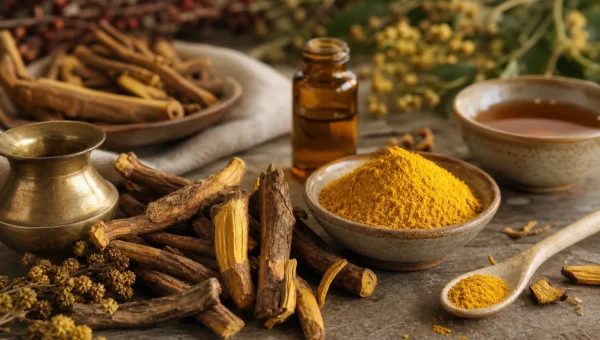
The official Ayurvedic monograph describes Yashti as the dried, unpeeled stolon and root of Glycyrrhiza glabra L., family Leguminosae. Its recognized synonyms include Yashtimadhuka, Yashtika, Madhuka, Madhuyashti and Yashtyahva. Correct botanical identification matters because commercial products may differ in plant species, extraction method, glycyrrhizin content and intended route of use.
| Pharmacopoeial Feature | Verified Description |
|---|---|
| Official part | Dried, unpeeled root and stolon |
| Botanical source | Glycyrrhiza glabra L. |
| Important constituents listed in the API | Glycyrrhizin, glycyrrhizic acid, glycyrrhetinic acid, asparagine, sugars, resin and starch |
| Pharmacopoeial powder dose | 2–4 g, subject to professional individualization |
Classical Ayurvedic Pharmacology
The Ayurvedic Pharmacopoeia gives Yashtimadhu a predominantly nourishing and cooling profile. Its properties support its classical use where soothing, unctuous and strength-promoting actions are desired, while its heaviness and sweetness require thoughtful selection in patients with marked Kapha, sluggish digestion or fluid retention.
- Rasa: Madhura (sweet)
- Guna: Guru (heavy) and Snigdha (unctuous)
- Virya: Shita (cooling)
- Vipaka: Madhura (sweet post-digestive effect)
- Dosha action: Vatapittajit, meaning it pacifies Vata and Pitta
- Classical karmas: Balya, Chakshushya, Vrishya, Varnya and Raktaprasadana
- Pharmacopoeial therapeutic uses: Kasa, Kshaya, Svarabheda, Vatarakta and Vrana
Classical Groupings and Rasayana Context
In Charaka Samhita, Madhuka—a recognized synonym of Yashti in the Ayurvedic Pharmacopoeia—is included in several ten-drug groups, including Jeevaniya, Sandhaniya, Varnya, Kanthya and Kandughna. These classifications place the drug in life-supporting, tissue-restorative, complexion-promoting, throat-benefiting and itching-relieving contexts. Charaka also describes Yashtimadhu powder taken with milk among the Medhya Rasayana measures. This is a classical mode of administration and should not be converted into a modern disease prescription without assessing digestion, constitution, comorbidities and concurrent medicines.
Phytochemical Profile
Licorice root contains several constituent classes rather than a single active principle. Glycyrrhizin and its metabolite glycyrrhetinic acid are especially important because they influence cortisol metabolism and account for much of the characteristic safety profile. Flavonoids and chalcones such as liquiritin, isoliquiritigenin and glabridin are also well described, although findings from laboratory studies do not establish identical clinical effects for every licorice preparation.
| Constituent Class | Representative Compounds | Clinical Relevance |
|---|---|---|
| Triterpenoid saponins | Glycyrrhizin and glycyrrhizic acid | Major markers of whole-root licorice and principal contributors to mineralocorticoid-type adverse effects |
| Triterpenoid metabolite | Glycyrrhetinic acid | Inhibits 11-beta-hydroxysteroid dehydrogenase type 2 |
| Flavonoids and chalcones | Liquiritin, isoliquiritigenin and glabridin | Phytochemical markers investigated in experimental pharmacology |
| Other constituents | Asparagine, sugars, resin and starch | Components recorded in the Ayurvedic pharmacopoeial monograph |
Digestive and Oral Applications
European and Canadian herbal monographs recognize traditional digestive uses of licorice preparations for symptoms such as burning, dyspepsia and minor inflammatory irritation of the gastrointestinal tract. Evidence is preparation-specific: whole-root tea, standardized extracts and DGL differ substantially in glycyrrhizin exposure, dose and safety considerations.
Functional Dyspepsia
A randomized, double-blind, placebo-controlled trial evaluated the standardized licorice extract GutGard at 75 mg twice daily for 30 days in adults with functional dyspepsia. Total symptom scores improved more with the extract than with placebo at days 15 and 30, and quality-of-life scores also improved. The result supports the studied extract and regimen; it does not establish equivalent dosing for ordinary root powder, tea or unrelated commercial products.
Deglycyrrhizinated Licorice
DGL is processed to remove most of the original glycyrrhizic acid. Health Canada’s oral DGL monograph permits claims for relief of minor gastrointestinal inflammation and abdominal pain or burning in the stomach. For adults, it lists 380–1,520 mg per dose three times daily, chewed or mixed with saliva between meals or about 20 minutes before meals. The finished product must contain no more than 3% of the original glycyrrhizic acid quantity. These specifications apply to qualifying DGL products, not to whole Yashtimadhu powder.
Aphthous Ulcers
A small clinical trial using licorice bioadhesive hydrogel patches in recurrent aphthous ulcers reported reductions in pain and lesion dimensions compared with placebo or no treatment. A separate Canadian buccal DGL monograph recognizes temporary relief of minor oral mucosal inflammation, including canker sores. Persistent, unusually large or frequently recurring ulcers require dental or medical assessment rather than repeated self-treatment.
Respiratory and Throat Use
Yashtimadhu’s traditional respiratory role is consistently reflected across sources. The Ayurvedic Pharmacopoeia lists Kasa and Svarabheda among its uses, while Charaka includes Madhuka in the Kanthya group. The European herbal monograph recognizes licorice root as a traditional expectorant for cough associated with a cold. Breathlessness, high fever, purulent sputum or a cough that persists or worsens warrants prompt medical evaluation.
Cortisol Metabolism and Pseudoaldosteronism
In kidney tissue, 11-beta-hydroxysteroid dehydrogenase type 2 normally converts active cortisol to cortisone and thereby protects the mineralocorticoid receptor. Glycyrrhetinic acid inhibits this enzyme. Cortisol can then stimulate mineralocorticoid receptors, promoting sodium and water retention, potassium loss, raised blood pressure and, in severe cases, cardiac rhythm disturbances. This pathway explains licorice-induced pseudoaldosteronism; it is not a basis for self-treating fatigue, suspected adrenal insufficiency or low cortisol.
“Adrenal fatigue” is not an accepted endocrine diagnosis, and a 2016 systematic review found no substantiation for it as a distinct medical condition. Persistent fatigue, weakness, dizziness, weight change or suspected adrenal disease should be investigated by a qualified healthcare provider rather than managed with licorice on the assumption that prolonging cortisol action is beneficial.
Dose and Preparation Matter
Published doses belong to specific traditions, products and indications. They should not be combined, multiplied or transferred from one preparation to another. Glycyrrhizin content varies, and the patient’s blood pressure, potassium status, kidney function, medicines and duration of use can change the risk substantially.
| Preparation | Verified Reference Dose | Important Qualification |
|---|---|---|
| Ayurvedic root powder | 2–4 g | API pharmacopoeial dose; individualize under professional guidance |
| Licorice-root tea for digestive symptoms | 1.5–2 g in 150 ml water, 2–4 times daily after meals | EMA traditional-use regimen; do not use longer than 4 weeks without medical advice |
| Licorice-root tea for cough with a cold | 1.5 g in 150 ml water twice daily | EMA traditional-use regimen for adults |
| Qualifying oral DGL product | 380–1,520 mg per dose, 3 times daily | Chew or mix with saliva; product must meet the DGL glycyrrhizic-acid specification |
European and international safety evaluations have discussed regular intake around 100 mg glycyrrhizinic acid per day as unlikely to cause adverse effects in most adults, but this is not a guaranteed safe dose or an established acceptable daily intake. Susceptible individuals may develop adverse effects below that amount, especially with repeated exposure.
Safety, Contraindications and Interactions
Whole licorice can produce water retention, hypokalemia, hypertension and arrhythmias, particularly with high intake, prolonged use or increased susceptibility. It should not be treated as an unrestricted food-like tonic. A qualified Ayurvedic practitioner or healthcare provider should review any planned course, especially when symptoms are chronic or medicines are being taken.
- Avoid during pregnancy. During breastfeeding, use only after professional assessment.
- Avoid in hypertension, hypokalemia, kidney disease, liver disease or cardiovascular disease unless specifically supervised by a clinician.
- Do not combine casually with potassium-depleting diuretics, cardiac glycosides, corticosteroids, stimulant laxatives or other medicines that can worsen electrolyte imbalance.
- Licorice may oppose antihypertensive treatment and may increase the consequences of low potassium.
- Avoid taking several licorice-containing teas, candies, supplements or formulas at the same time.
- Seek medical care if swelling, marked weakness, muscle cramps, palpitations or a substantial rise in blood pressure occurs.
Responsible Ayurvedic Use
Yashtimadhu is best selected according to the patient’s Prakriti, current dosha disturbance, Agni, tissue state, age, season and medical history. Its Madhura, Guru, Snigdha and Shita qualities can be appropriate in selected Vata- or Pitta-predominant presentations, but the same profile may be unsuitable where heaviness, poor digestion, congestion or fluid retention dominate. Long-term use should not proceed solely because the herb is described as Balya, Medhya or Rasayana in a classical context.
- Confirm the botanical identity, plant part and preparation on the label.
- Distinguish whole-root licorice from DGL and standardized extracts.
- Use the lowest appropriate dose for the shortest suitable duration.
- Do not use licorice as a substitute for evaluation of persistent gastrointestinal, respiratory, endocrine, hepatic or oral symptoms.
- For constitutional context, see the Prakriti assessment guide, while recognizing that formal prescribing requires an individualized consultation.
A Balanced Clinical View
Yashtimadhu is a well-defined Ayurvedic drug with verified classical actions, traditional digestive and respiratory uses, and a small but relevant body of preparation-specific clinical evidence. Its benefits should be interpreted alongside its predictable effects on cortisol metabolism, blood pressure, potassium and fluid balance. Correct identification, appropriate formulation, limited duration and professional supervision preserve the value of this classical herb while reducing avoidable harm.
References
- Ayurvedic Pharmacopoeia of India
- Ayurvedic Pharmacopoeia of India
- Charaka Samhita — Shadvirechanashatashritiya Adhyaya
- Charaka Samhita — Rasayana Adhyaya (Chikitsa Sthana 1.3)
- Liquorice (Glycyrrhiza glabra): A phytochemical and pharmacological review (2018), PubMed
- Ema (ema.europa.eu)
- An Extract of Glycyrrhiza glabra (GutGard) Alleviates Symptoms of Functional Dyspepsia: A Randomized, Double-Blind, Placebo-Controlled Study (2012), PubMed
- Webprod (webprod.hc-sc.gc.ca)
- The efficacy of the bioadhesive patches containing licorice extract in the management of recurrent aphthous stomatitis (2009), PubMed
- Webprod (webprod.hc-sc.gc.ca)
- NCBI
- Clinical Risk Factors of Licorice-Induced Pseudoaldosteronism Based on Glycyrrhizin-Metabolite Concentrations: A Narrative Review (2021), PubMed Central
- Adrenal fatigue does not exist: a systematic review (2016), PubMed
- Ec (ec.europa.eu)
- Apps (apps.who.int)
- Webprod (webprod.hc-sc.gc.ca)
Could you address the challenge of publishing Ayurvedic research in high-impact Western journals? The gatekeeping issues are significant for the field
I had a very similar experience! The first few weeks are the adjustment period, it really does get better.
The methodological limitations section is what makes this article trustworthy. Any content that doesn’t acknowledge study limitations should be viewed skeptically.
I appreciate you sharing the skeptical perspective too. It keeps the conversation grounded
This makes sense for Yashtimadhu (Licorice). I would still ask a practitioner before changing medicines.
This makes sense for Yashtimadhu (Licorice). The practical details matter more than people think.
it’s wonderful to see both believers and skeptics engaging respectfully in the comments. That’s how we all learn.
I’m a pharmacist and I share this kind of content with colleagues who are curious about herb-drug interactions. The safety discussion here is appropriately thorough.
The comparison of bioavailability across different formulations is exactly the kind of practical information clinicians need when recommending these herbs to patients.
Same here! The practitioner recommendation made all the difference for me. Don’t try to do this without guidance.
This makes sense for Yashtimadhu (Licorice). The safety notes could be expanded a little.
the cytokine data cited here is consistent with what we know from preclinical models. Eager to see the larger clinical trials that are apparently in progress.
your experience with the diet changes mirrors mine almost exactly. Week two is when it clicks
The mechanism explanations are fascinating. Understanding HOW these compounds work at a cellular level makes the traditional observations make much more sense.
I’ve been using it for a year and can confirm, the results you’re describing are consistent with my longer-term experience.
I appreciate the discussion of what we don’t yet know as much as what we do. Scientific humility is undervalued in health communication.
the phytochemistry section is accessible without being dumbed down. Hard to strike that balance for non-specialist readers and you’ve managed it well.
The part about Yashtimadhu (Licorice) feels realistic. I would like to know how long to try it before judging results.
The combination approach you described is exactly what my practitioner recommended too. Validation always feels good.
I shared this with three colleagues from my university’s integrative medicine program. The evidence synthesis here is genuinely graduate-level quality.
I had the exact same confusion about this. Glad the article cleared it up for both of us
This makes sense for Yashtimadhu (Licorice). I appreciate that it does not oversell the result.
This makes sense for Yashtimadhu (Licorice). The main idea is clear even if someone is new to Ayurveda.
The safety profiles described here are consistent with what’s in the peer-reviewed literature. I appreciate that adverse effects are discussed alongside benefits.
The biomarker studies cited here suggest mechanisms that go beyond placebo. That’s an important threshold for clinical credibility.
That’s a really important distinction you’ve made. I think a lot of people skip the preparation phase and then wonder why results are inconsistent.
The historical references add credibility. Knowing this has been used for centuries matters to me.
The historical context of when these compounds were first investigated scientifically, versus how long they’d been used traditionally, is always striking to me.
Your persistence through the adjustment period is inspiring. I’m currently in it and your comment helps
The 40 studies framing is useful. I’ve seen licorice dismissed repeatedly as ‘just raises blood pressure’ and this article corrects that with a proper evidence review. The distinction between whole root and carbenoxolone derivatives is the key clinical nuance most people miss.
I have low cortisol (confirmed by morning cortisol test). My functional medicine doctor recommended licorice specifically for HPA support. Been on DGL for 6 months with normalized morning cortisol at my last test.
Can blood pressure be taken alongside metformin? I have type 2 diabetes and my endocrinologist hasn’t heard of this approach.
The anti-viral properties section particularly the GL inhibition of viral replication is something that got more attention during COVID and the subsequent research on Yashtimadhu has been interesting. More than just a throat lozenge ingredient.
As an immunologist, the mechanisms described for the immune-modulating herbs align well with what we understand about these pathways. Good translation of complex science.
The traditional knowledge systems described here had thousands of years of empirical observation. Modern science is essentially validating what healers learned through patient outcomes.
My experience was mixed at best. The dietary changes helped a little but the herbal recommendations did nothing noticeable.
Is Yashtimadhu appropriate for adrenal support during perimenopause? The HPA axis changes during hormonal transition are significant and I’m looking for evidence-based support that doesn’t involve further estrogen supplementation.
The gastric mucosa protection from glycyrrhizin this is one of the better-validated traditional uses. GI protection from Yashtimadhu was used before NSAID therapy existed and is now being studied as a co-prescription with NSAIDs to reduce GI side effects.
Can Yashtimadhu be combined with Ashwagandha for combined adrenal and cortisol support? They seem to target different aspects of the HPA axis and might be complementary.
Interesting perspective, but I’ve read contradicting information from other Ayurvedic sources. How does a beginner know who to trust?
I’d rate this a 6/10. Good foundational info but lacks the specificity needed to actually implement. More like an introduction than a protocol
Thank you for sharing your experience, it’s important that readers see the full range of outcomes, not just success stories. Not every approach works for everyone.
The duration guidance is missing. For adrenal support, how long should Yashtimadhu be taken before expecting a change? And should it be cycled or is continuous use appropriate?
Appreciate you keeping us honest. We’ve noted your feedback about dosage specificity and will address it in a revised version of this article.
The phytoestrogen content is this clinically significant for women with hormone-sensitive conditions? I have a history of hormone-receptor-positive breast cancer and my oncologist reviews everything I take.
The Yashtimadhu (Licorice) angle is useful here. The safety notes could be expanded a little.
The licorice candy versus medicinal licorice distinction is something most people don’t understand. The amount of actual glycyrrhizin in commercial candy varies enormously and the therapeutic properties of a licorice lozenge vs a proper root extract are not comparable.
I wonder how the glycyrrhizin levels in everyday licorice candy compare to the doses mentioned for functional dyspepsia.
The distinction between whole root preparations and deglycyrrhizinated forms seems crucial for anyone thinking about long term use.
Claims about adrenal fatigue relief need more evidence given the review that found no substantiation for that condition.
A licorice root tea after a cold left my throat feeling less scratchy for a couple of days.
Correct botanical identification matters because product labels sometimes list related species that lack the same safety profile.
The section on diet modifications alongside the herb protocol is what makes this more complete than other guides.
I wish you had included more on the Vata-specific approach. The article focuses heavily on Pitta.
my vaidya recommends something slightly different but the core approach is the same
The research citations are good but mostly from small studies. Would like to see larger trial data.
The specific dosage mentioned in the article, is that for adults only or does it change for elderly users?
The quality of the herb source makes a big difference I’ve found. The article should mention what to look for when buying.
Just found this post through a search. Is the recommendation still current or has anything changed?
This confirmed what I was already doing intuitively. Nice to have the Ayurvedic framework to understand why.
The historical context from Charaka Samhita grounding the recommendation was reassuring.
Will try
Does the treatment timeline change if you’ve had this issue long-term vs recently?
The morning routine elements you suggest are already part of my dinacharya. Adding the missing piece you mentioned now.
The Yashtimadhu (Licorice) explanation is clearer than most short posts. I would still ask a practitioner before changing medicines.
I’ve been dealing with this issue for 2 years and tried multiple things. Starting the approach you outlined here.
Does this interfere with standard medications? I take something daily and want to be careful.
I started following the protocol you described 3 weeks back. Early results are encouraging.
Does this protocol vary by dosha type? I’m Pitta dominant and some of what you describe seems heating.
tried this and the results surprised me after only 10 days
Useful
The comparison to modern medicine approach was helpful. My doctor and vaidya recommend different things.
Doing this
Same here
I’m a Kapha type and the protocol seems designed more for Vata. Any modifications?
Late to this post but finding it very helpful. The practical step-by-step format makes it easy to follow.
The section on contraindications was the most useful part. I have a pre-existing condition and needed that clarity.
The 3-week timeline seems optimistic based on my experience. More like 6 weeks for me.
Any guidance for people who travel frequently? Hard to maintain a consistent protocol.
The approach described here is different from what my vaidya recommends. Is there a regional variation in this protocol?