
Berberine and metformin are compared because both can lower glycaemic markers and influence cellular energy metabolism. Berberine is an isoquinoline alkaloid present in several plants, whereas Daruharidra is the Ayurvedic drug obtained from Berberis aristata DC. Evidence for purified berberine cannot automatically be transferred to Daruharidra. Metformin is a prescription medicine with a larger clinical evidence base; berberine remains a supervised adjunct, not an established first-line substitute.
Botanical Identity and Berberine Sources
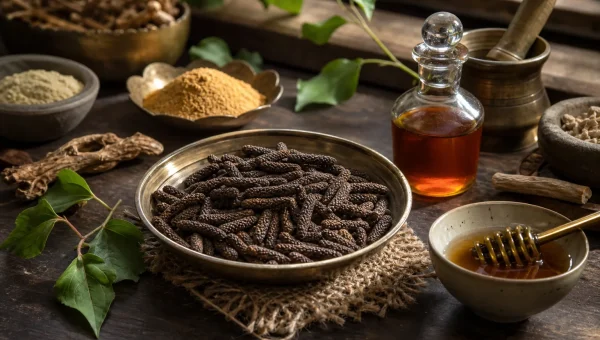
The Ayurvedic Pharmacopoeia of India identifies Daruharidra as the dried stem of Berberis aristata DC., family Berberidaceae. It describes a spinous deciduous shrub found in Himalayan ranges at about 1,000–3,000 metres and in the Nilgiri hills. The official drug is the stem, not purified berberine. Berberine also occurs in plants such as Coptis chinensis, Hydrastis canadensis and Mahonia aquifolium.
The API lists alkaloids as constituents but does not assign every Daruharidra sample a fixed berberine percentage. Concentration varies with source and analysis. Claims that all material contains 3–6% berberine, or that clinical extracts are universally 97–98% pure, require batch-specific evidence.
Authentic Ayurvedic Profile
The API records Daruharidra as tikta rasa (bitter), ruksha guna (dry) and ushna virya (heating); no vipaka is stated in this monograph. Listed actions are stanya-shodhana, stanya-doshahara and dosha-pachana. Listed uses include kandu, medoroga, mukharoga, vrana, amatisara, urustambha, kapharoga, karnaroga, netraroga and meha. These categories do not prove that isolated berberine treats type 2 diabetes.
Mechanisms: AMPK and Mitochondrial Effects
Preclinical work shows that berberine can inhibit mitochondrial respiratory complex I, alter cellular energy status and activate AMP-activated protein kinase (AMPK). Metformin can also influence mitochondrial and AMPK-associated pathways, but both have additional actions. Shared laboratory pathways do not establish equal clinical efficacy, dosing or safety.
Experimental studies report increased glucose uptake, altered glucose-transporter activity, AMPK-related inhibition of acetyl-CoA carboxylase, and effects on hepatic glucose regulation. Gut and bile-acid pathways may also contribute, but no single microbiome change is an established mechanism. DPP-4 inhibition and altered GLP-1 secretion are mainly preclinical findings; berberine is not a GLP-1 receptor agonist.
Clinical Evidence: Berberine vs. Metformin
The often-cited direct comparison was a small 2008 pilot, not a 116-person equivalence trial. Thirty-six adults with newly diagnosed type 2 diabetes were randomized to berberine or metformin, each at 500 mg three times daily, for three months. Glycaemic measures improved in both groups, and the authors described similar short-term effects. With only 18 participants per arm, the study could not establish equivalence or justify replacing metformin.
The separate 116-person study identified by PMID 18397984 compared berberine with placebo. Participants with type 2 diabetes and dyslipidaemia received 1 g/day of berberine or placebo for three months. HbA1c, fasting and post-load glucose, triglycerides, total cholesterol and LDL cholesterol improved in the berberine group; five berberine recipients developed constipation.
A 2012 review of 14 randomized trials involving 1,068 participants found favourable glucose and lipid signals but rated study quality generally low. A 2022 meta-analysis estimated an average HbA1c reduction of about 0.63 percentage points across heterogeneous trials. These findings support short-term activity, not equivalence to metformin or proven cardiovascular, renal or mortality benefit.
PCOS and Lipid Evidence
A three-month study in 89 women with PCOS and insulin resistance compared berberine, metformin and placebo alongside other management. Berberine improved some body-composition, lipid and hormonal measures, but the study was too small and brief to establish fertility benefit. A later systematic review found no solid evidence that berberine improves live birth or other major clinical outcomes in PCOS.
A small hypercholesterolaemia study reported LDL lowering, while experimental work showed increased hepatic LDL-receptor expression through stabilization of LDL-receptor mRNA. This differs from the principal mechanism of statins, but improving a lipid marker is not proof that berberine prevents heart attacks or strokes.
Berberine vs. Metformin Comparison
The evidence permits a comparison of short-term markers, not a conclusion that the treatments are interchangeable.
| Parameter | Berberine | Metformin | Interpretation |
|---|---|---|---|
| Direct evidence | 36-person, 3-month pilot | Comparator in that pilot | Not an equivalence trial |
| HbA1c | Short-term reductions reported | Extensive clinical evidence | No verified universal 2% reduction |
| Lipids | Favourable LDL and triglyceride signals | Not chiefly a lipid drug | No proven outcome benefit for berberine |
| GI effects | Constipation, diarrhoea, nausea or bloating | GI symptoms are common | No proof berberine is universally better tolerated |
| Quality | Varies by source and formulation | Standardized prescription product | Supplement labels may not match trial material |
| Role | Supervised adjunct or investigational option | Guideline-based therapy | Do not substitute without medical supervision |
AMPK Signalling Infographic
This simplified diagram shows experimental overlap without implying therapeutic equivalence.
Safety and Drug Interactions
Reported adverse effects include abdominal pain, constipation, diarrhoea, nausea, vomiting and bloating. Most trials are short and do not establish long-term safety. Repeated berberine dosing in a human study reduced CYP2D6, CYP2C9 and CYP3A4 activities, and a transplant study found increased ciclosporin concentrations. Additive glucose lowering may occur with insulin or other diabetes medicines.
Berberine should not be used during pregnancy or breastfeeding and should not be given to infants because of concern about bilirubin accumulation and neonatal toxicity. Anyone taking prescription medicines, especially transplant or glucose-lowering drugs, should consult a qualified healthcare provider. Prescribed metformin or other diabetes treatment must not be stopped or reduced without the prescriber.
Dosage and Standardization
Many purified-berberine trials used 1–1.5 g/day in divided doses, often 500 mg two or three times daily. This describes research protocols, not a universal personal dose. The API dose for Daruharidra is 5–10 mL in kvatha form; it is not a berberine-hydrochloride dose and cannot be converted directly into one. Oral berberine has low and variable bioavailability, while enhanced formulations require their own clinical evidence.
Conclusion
Berberine has biological activity and may improve glucose and lipid markers in some short-term studies. It has not been shown to match metformin in routine care, to be consistently superior for lipids or tolerability, or to provide comparable long-term outcomes. Daruharidra has an authentic Ayurvedic identity and pharmacopoeial profile, but whole-drug tradition and isolated-alkaloid research must not be conflated. Berberine should be considered only as a supervised adjunct with attention to product quality, interactions, pregnancy status and glucose monitoring.
References
- Ayurvedic Pharmacopoeia of India
- Berberine: Botanical Occurrence, Traditional Uses, Extraction Methods, and Relevance in Cardiovascular, Metabolic, Hepatic, and Renal Disorders (2018), PubMed Central
- Berberine and its more biologically available derivative, dihydroberberine, inhibit mitochondrial respiratory complex I: a mechanism for the action of berberine to activate AMP-activated protein kinase and improve insulin action (2008), PubMed
- Metformin and berberine, two versatile drugs in treatment of common metabolic diseases (2018), PubMed Central
- Efficacy of berberine in patients with type 2 diabetes mellitus (2008), PubMed
- Treatment of type 2 diabetes and dyslipidemia with the natural plant alkaloid berberine (2008), PubMed
- Berberine in the treatment of type 2 diabetes mellitus: a systemic review and meta-analysis (2012), PubMed
- Glucose-lowering effect of berberine on type 2 diabetes: A systematic review and meta-analysis (2022), PubMed
- A clinical study on the short-term effect of berberine in comparison to metformin on the metabolic characteristics of women with polycystic ovary syndrome (2012), PubMed
- The Effect of Berberine on Reproduction and Metabolism in Women with Polycystic Ovary Syndrome: A Systematic Review and Meta-Analysis of Randomized Control Trials (2019), PubMed
- Berberine is a novel cholesterol-lowering drug working through a unique mechanism distinct from statins (2004), PubMed
- Repeated administration of berberine inhibits cytochromes P450 in humans (2012), PubMed
- NCCIH
- Displacement of bilirubin from albumin by berberine (1993), PubMed
- Berberine: A Review of its Pharmacokinetics Properties and Therapeutic Potentials in Diverse Vascular Diseases (2021), PubMed Central
- 9. Pharmacologic Approaches to Glycemic Treatment: Standards of Care in Diabetes-2026 (2026), PubMed Central
The AMPK activation overlap with metformin is the finding that made berberine interesting to conventional endocrinologists. The Daruharidra connection grounds it in a classical Ayurvedic context that has been using the plant for metabolic support for centuries before the AMPK pathway was characterized.
I keep coming back to this article. There’s always something new I pick up on each read
What does the actual HbA1c comparison data look like in the competitive trials? I know the headline result says ‘surprisingly competitive’ but I want the numbers. How much does each reduce HbA1c by in comparable populations?
whole family reads this site now lol. keep up the great work
I switched from metformin to berberine from Daruharidra for 6 months under my physician’s supervision. My HbA1c moved from 6.8 to 6.4 which was better than my metformin result at the previous equivalent period. My GI tolerance of berberine was also better.
The dosage guidance here is more specific and helpful than what I got from my last consultation.
The microbiome modulation as a secondary mechanism is important. Metformin’s anti-diabetic mechanism is now thought to be partially mediated by gut microbiome changes. If berberine operates similarly, the mechanistic overlap may be deeper than just AMPK.
my skin cleared up within the first month of following similar advice. Wish I’d started sooner
The professional background you bring to this discussion is really valuable. Thank you for reading and contributing.
finally some nuance. most stuff just says do X without explaining anything
What’s the safety profile for Daruharidra in people with existing liver disease? Some berberine preparations require hepatic metabolism and liver impairment could change the dose-response significantly.
Bought the berberine supplement from a reputable supplier, followed the protocol for 2 months. Nothing. I want to believe but my experience doesn’t match what’s described here.
The traditional Ayurvedic use of Daruharidra for liver and metabolic conditions predating the diabetes framing is interesting. The classical practitioners were observing metabolic effects without having a glucose measurement tool. They were working from symptomatic presentation.
Is there data on combining Daruharidra with other Ayurvedic metabolic herbs like bitter melon or gudmar? Some practitioners use combinations and I’m curious whether the AMPK activation is additive or whether there’s any redundancy.
The article makes clear that Daruharidra refers to the whole stem, not just isolated berberine.
My ayurvedic vaidya prescribed Berberis aristata preparation for my prediabetes along with dietary changes and my fasting glucose came down into normal range within three months. I wasn’t expecting that speed of response.
The cost comparison between pharmaceutical metformin and berberine from Daruharidra is worth addressing. In India both are accessible but for patients in other countries the cost differential could be significant.
I wonder how the Himalayan habitat affects the alkaloid concentration in Berberis aristata.
Berberine’s ability to activate AMPK is interesting, but the paper notes it doesn’t guarantee the same clinical effect as metformin.
Tried this approach for 4 months with no measurable change in my inflammation markers. My rheumatologist said exactly what I expected: ‘nice but not proven.’
It seems the 2008 pilot with thirty six participants is often cited, yet the authors themselves warn it isn’t an equivalence trial.
One thing that stands out is the warning about product variability; the API doesn’t fix a berberine percentage for Daruharidra.
I found the section on gut and bile acid pathways useful for thinking about why berberine might help lipids.
Metformin’s longer safety record makes it hard to see berberine as a first line substitute based on current data.
The Ayurvedic properties listed, tikta rasa, ruksha guna, ushna virya, remind me that tradition uses the whole plant differently.
Anyone considering a supplement should check for batch specific testing since claims about 3 to 6 percent berberine need proof per batch.
Useful
the quality variation between Berberis aristata suppliers is significant. which standardization markers should I look for?
for someone already on metformin, is combination with Daruharidra safe or is there redundancy and risk of hypoglycemia?
what dose of standardized berberine was used in the trials you reference? the HbA1c comparison needs the actual dose context
how long before measurable HbA1c change appears on the berberine protocol? the article doesn’t specify the minimum trial period
off topic but can these herbs be taken with thyroid medication? my doctor doesnt know
sorry off-topic but has anyone here used Ayurveda for hair loss? nothing seems to work
sorry to go off topic but any tips for Ayurvedic approach to knee pain?
unrelated question but does anyone know a good vaidya in Pune?
what dose of standardized berberine was used in the trials u reference? the HbA1c comparison needs the actual dose context
how long before measurable HbA1c change appears on the berberine protocol? the article doesnt specify the minimum trial period 🌿