Vertigo can shrink a person’s world very quickly. A brief spinning episode may begin as something easy to dismiss, but repeated dizziness, nausea, imbalance, fear of driving, and anxiety about the next attack can disturb work, sleep, travel, and confidence. In Ayurveda, this spinning or giddiness is commonly discussed under Bhrama, while a modern medical evaluation is still essential to identify causes such as BPPV, vestibular migraine, Ménière’s disease, vestibular neuritis, medication effects, anemia, blood pressure changes, or neurological disease.
What Is Bhrama? Understanding Vertigo Through the Ayurvedic Lens
Bhrama refers to giddiness, dizziness, or a spinning sensation. In the Ayurvedic classical framework, it is connected strongly with disturbed Vata, and later diagnostic traditions also describe the involvement of Pitta and Rajas. This is clinically meaningful because Vata governs movement, instability, sensory coordination, dryness, lightness, and irregularity, while Pitta brings heat, sharpness, burning, irritability, and intensity. When these qualities disturb the head, senses, sleep, digestion, or nervous system, the patient may experience dizziness with different associated features.
Ayurveda does not replace the need for medical diagnosis. It offers a pattern-based way to understand why one person’s dizziness is cold, erratic, anxious, and insomnia-linked, while another person’s dizziness is hot, headache-linked, and light-sensitive, and a third person’s dizziness is heavy, congested, and dull.
The Three Doshic Presentations Commonly Seen in Bhrama
Classical Ayurvedic diagnosis begins with the qualities of the presentation, not with the disease name alone. The following patterns are a practical way to organize Bhrama while remaining consistent with the classical qualities of Vata, Pitta, and Kapha.
1. Vata-Predominant Bhrama
Vata-predominant Bhrama is usually irregular, sudden, shifting, and unpredictable. It may be associated with disturbed sleep, anxiety, tinnitus, dryness, constipation, tremulousness, fatigue, and aggravation after travel, fasting, stress, cold wind, late nights, or irregular meals. This pattern calls for warmth, steadiness, oiling, nourishment, routine, and careful calming of the nervous system.
2. Pitta-Predominant Bhrama
Pitta-predominant Bhrama has more heat and intensity. The dizziness may come with headache, burning sensation, pressure in the head, irritability, nausea, sourness, sweating, intolerance of heat, sensitivity to light or sound, and aggravation after spicy food, alcohol, anger, sun exposure, or summer heat. When vertigo occurs with migraine-like features such as photophobia, phonophobia, nausea, and recurrent attacks, a physician should also consider vestibular migraine.
3. Kapha-Associated Bhrama
Kapha-associated Bhrama tends to feel heavy, dull, slow, congested, or cloudy rather than sharply spinning. It may appear with sinus congestion, mucus, sluggish digestion, sleepiness, heaviness of the head, and aggravation in the morning, after heavy meals, or in damp weather. In this presentation, treatment usually emphasizes lightness, warmth, channel-clearing, digestion, and reduction of excess heaviness without over-drying the patient.
Core Ayurvedic Herbs and Formulations Used Around Bhrama
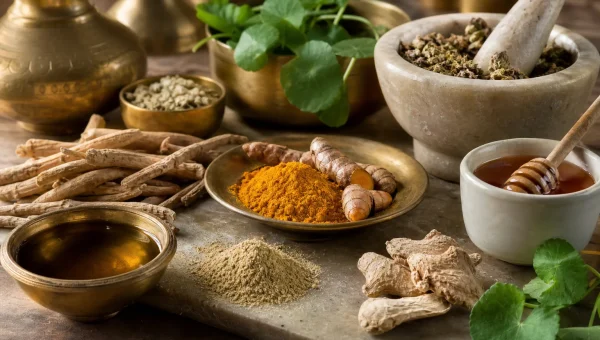
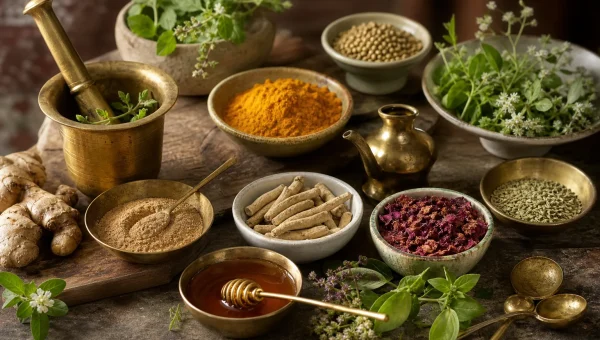
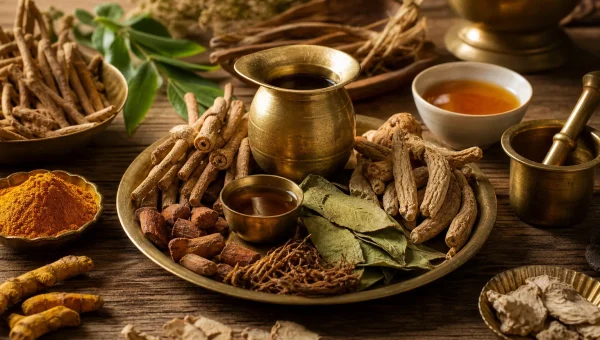
The herbs below are traditionally selected according to the person’s doshic picture, strength, digestion, age, medicines, and associated symptoms. They should not be treated as a universal prescription for all vertigo.
Shankhpushpi
Shankhpushpi is one of the classical Medhya Rasayana herbs connected with intellect, memory, mental clarity, and calmness. In practice, it is most suitable when Bhrama is associated with Vata disturbance, mental restlessness, poor sleep, worry, sensory overstrain, or fatigue. The botanical identity of Shankhpushpi varies across traditions and products, so quality, correct identification, and a reputable manufacturer matter.
Brahmi
Brahmi, identified in the Ayurvedic Pharmacopoeia of India as Bacopa monnieri whole plant, is used as a Medhya and Rasayana herb. It is most relevant when dizziness is accompanied by mental fog, poor concentration, nervous exhaustion, anxiety, or sleep disturbance. Brahmi is often used as ghrita, churna, tablet, or extract, but the form and dose should be chosen carefully because sensitive patients may experience digestive discomfort.
Ashwagandha
Ashwagandha is a strengthening Rasayana herb prepared from the mature root of Withania somnifera. It is most appropriate when chronic stress, fatigue, poor sleep, nervous depletion, and Vata aggravation form the background of Bhrama. It is not ideal for every patient, especially those with pregnancy, autoimmune complexity, liver concerns, thyroid instability, sedative use, or multiple prescription medicines unless supervised.
Jatamansi
Jatamansi is the rhizome of Nardostachys jatamansi, a classical aromatic drug used in Ayurveda for conditions involving the mind, sleep, and nervous system. It is considered when Bhrama is accompanied by insomnia, palpitations, agitation, tremulousness, or excessive mental activity. Because it can be sedating and product quality varies, it should be used under professional guidance.
Sarivadi Vati
Sarivadi Vati is a classical herbo-mineral formulation associated with Karnaroga, the Ayurvedic category of ear disorders. It is most relevant when dizziness is accompanied by tinnitus, hearing symptoms, ear fullness, or Vata-Kapha involvement of the ear region. Because Sarivadi Vati may contain mineral preparations such as bhasma depending on the manufacturer and reference followed, it should be taken only under the supervision of a qualified Ayurvedic physician.
Vacha
Vacha (Acorus calamus) appears in classical formulations and is traditionally used for Kapha-Vata obstruction, heaviness, dullness, and channel-clearing. It should not be used casually as a home remedy. Some Acorus calamus materials contain beta-asarone, a compound with significant safety concerns, and calamus is prohibited for food use in the United States. Any use of Vacha should be practitioner-guided, properly sourced, and compliant with local safety standards.
Matching Treatment to the Doshic Pattern
A practical Bhrama protocol is built by matching the intervention to the dominant qualities of the case. The same herb or therapy that helps one person may aggravate another when the doshic picture is different.
| Doshic Pattern | Common Ayurvedic Direction | External Support | Dietary Focus |
|---|---|---|---|
| Vata-Predominant | Shankhpushpi, Brahmi, Ashwagandha, Jatamansi, ghee-based support when digestion allows | Gentle abhyanga, Shirodhara with suitable warm oil, practitioner-guided Nasya | Warm, soft, cooked, mildly oily meals; regular meal timing; avoid fasting, cold foods, excess caffeine, and late nights |
| Pitta-Predominant | Brahmi, cooling Medhya support, Pitta-pacifying herbs selected by the physician | Cooling head therapies when appropriate; avoid overheating therapies | Cooling, non-spicy, non-fermented foods; avoid alcohol, excess sourness, fried foods, and prolonged sun exposure |
| Kapha-Associated | Digestive and channel-clearing support selected according to strength and digestion | Steam only when suitable, warming local therapies, carefully selected Nasya | Light, warm, freshly cooked meals; reduce heavy dairy, cold drinks, excess sweets, and daytime sleeping |
Shirodhara for Bhrama
Shirodhara is the continuous pouring of a warm liquid, usually medicated oil, over the forehead in a controlled therapeutic setting. In Vata-predominant dizziness, a practitioner may choose warming and nourishing oils such as sesame-based preparations or Ksheerabala Taila. In Pitta-predominant cases, the liquid and temperature are selected more cautiously so that heat, headache, and sensitivity are not increased.
Shirodhara is not a stand-alone cure for every form of vertigo. It is most useful when Bhrama is linked with nervous system agitation, insomnia, stress, sensory overstrain, anxiety, Vata instability, or Vata-Pitta disturbance. It should be avoided or postponed in acute fever, active infection, severe congestion, uncontrolled blood pressure, acute neurological symptoms, intoxication, or immediately after heavy meals unless a physician decides otherwise.
Nasya: Treating the Head Through the Nasal Route
Ayurveda gives special importance to Nasya, the administration of medicated substances through the nose, because the nose is treated as an important gateway to the head region. For Bhrama, Nasya may be considered when symptoms involve the head, senses, sinus region, ears, or Vata-Kapha obstruction.
Anu Taila is a classical medicated oil commonly used for Nasya. In a mild daily form, Nasya is generally gentler than strong cleansing procedures, but even mild nasal oiling is not suitable for everyone. It should be avoided during acute cold, fever, active sinus infection, recent nasal bleeding, immediately after food, intoxication, and in people with sesame allergy or special medical restrictions unless supervised.
Diet and Routine: The Foundation That Makes the Herbs Work
In Bhrama, food and routine often decide whether the treatment holds. Vata-type patients usually need warm breakfasts, regular meal times, early sleep, reduced travel strain, oil massage, and protection from cold wind. Pitta-type patients usually need cooling meals, less chili and sour food, reduced heat exposure, and calmer work pacing. Kapha-associated patients usually need lighter dinners, warm water, movement, less sugar, less dairy, and avoidance of daytime sleeping.
A dizziness diary is valuable. Record the time of each episode, head position, food, sleep, stress, menstrual cycle if relevant, heat exposure, travel, medicines, tinnitus, hearing changes, headache, nausea, visual symptoms, and blood pressure if advised. This helps both the physician and Ayurvedic practitioner distinguish positional vertigo, migraine-linked dizziness, ear-related disorders, and doshic triggers.
Frequently Asked Questions About Bhrama
The following answers are general and should be personalized by a qualified practitioner.
Is Bhrama the same as BPPV?
No. BPPV is a specific vestibular disorder in which otoconia particles move into the semicircular canals of the inner ear and trigger positional vertigo. Bhrama is a broader Ayurvedic symptom category for giddiness or spinning sensation. A person with BPPV may be described as having Bhrama from an Ayurvedic perspective, but the modern mechanical cause still needs appropriate diagnosis and treatment.
Can Ayurvedic care be used with vestibular rehabilitation?
Yes, when supervised properly. Vestibular rehabilitation, canalith repositioning for BPPV, migraine management, ENT care, and Ayurvedic dosha-based support can be complementary. The important point is not to delay urgent medical care or ignore a clear modern diagnosis.
Can I start Shankhpushpi or Brahmi on my own?
Simple herbal products are widely available, but self-medication is not ideal when dizziness is recurrent, severe, unexplained, or associated with other symptoms. People taking sedatives, antihypertensives, antidepressants, seizure medicines, thyroid medicines, blood thinners, or multiple prescriptions should consult a qualified healthcare provider before starting herbs.
How long does Ayurvedic management take?
Acute, mild, clearly triggered Vata disturbance may improve quickly when sleep, meals, stress, and digestion are corrected. Chronic Bhrama, migraine-linked dizziness, tinnitus-associated dizziness, or long-standing Vata depletion usually requires a longer plan with diet, routine, herbs, and external therapies adjusted over time.
Where to Start If You Are Experiencing Vertigo
The safest starting point is to rule out urgent causes, identify the modern diagnosis where possible, and then build an Ayurvedic plan around the person’s doshic pattern.
- Seek urgent medical care if vertigo is new or severe and occurs with facial weakness, arm or leg weakness, numbness, trouble speaking, double vision, fainting, severe headache, chest pain, difficulty walking, confusion, sudden hearing loss, or persistent vomiting.
- Get evaluated by an appropriate clinician, especially if dizziness is recurrent, positional, associated with tinnitus or hearing change, linked with headache, or interfering with work and driving.
- Track the pattern for one to two weeks if symptoms are not urgent: sleep, food, stress, weather, head position, travel, menstrual cycle, caffeine, alcohol, and associated symptoms.
- Correct the foundations: regular meals, warm cooked food, hydration, earlier sleep, reduced screen strain, and avoidance of fasting or sudden exertion.
- Consult a qualified Ayurvedic physician before using compound formulations, bhasma-containing tablets, Vacha, strong Nasya, Panchakarma, or Shirodhara.
“Rogam adau pariksheta tato anantaram aushadham” — first examine the disease, then choose the medicine.
Charaka Samhita, Sutra Sthana 20/20
Vertigo deserves both caution and hope. Ayurveda gives a language for understanding why dizziness behaves differently in different people, and it offers tools for stabilizing Vata, cooling Pitta, clearing Kapha, supporting the senses, and rebuilding confidence. The best results come when emergency warning signs are respected, modern diagnosis is not ignored, and Ayurvedic care is individualized rather than taken as a one-size-fits-all remedy.
Medical Disclaimer: This article is for educational purposes and reflects traditional Ayurvedic principles. It is not a substitute for professional medical advice, diagnosis, or treatment. Always consult a qualified healthcare provider or qualified Ayurvedic physician before starting herbs, oils, Nasya, Shirodhara, Panchakarma, or compound formulations, especially if you are pregnant, nursing, elderly, managing a chronic condition, or taking prescription medicines. Sudden or severe vertigo with neurological symptoms requires emergency medical care.
References
- Charaka Samhita — Maharoga Adhyaya
- Easyayurveda (easyayurveda.com)
- Hopkinsmedicine (hopkinsmedicine.org)
- Ichd-3 (ichd-3.org)
- Nootropic herbs (Medhya Rasayana) in Ayurveda: An update (2012), PubMed Central
- Jcimjournal (jcimjournal.com)
- Miracledrinksclinic (miracledrinksclinic.com)
- Does Bacopa monnieri improve memory performance in older persons? Results of a randomized, placebo-controlled, double-blind trial (2010), PubMed
- Ayurvedic Pharmacopoeia of India
- A prospective, randomized double-blind, placebo-controlled study of safety and efficacy of a high-concentration full-spectrum extract of ashwagandha root in reducing stress and anxiety in adults (2012), PubMed Central
- NIH Office of Dietary Supplements
- An important Indian traditional drug of ayurveda jatamansi and its substitute bhootkeshi: chemical profiling and antioxidant activity (2013), PubMed Central
- Researchgate (researchgate.net)
- Pharmahealthsciences (pharmahealthsciences.net)
- Hfpappexternal (hfpappexternal.fda.gov)
- Mdpi (mdpi.com)
- Psychoneuroimmunologic effects of Ayurvedic oil-dripping treatment (2008), PubMed
- Shirodhara: A psycho-physiological profile in healthy volunteers (2013), PubMed Central
- Researchgate (researchgate.net)
- Ijam (ijam.co.in)
- Identification and estimation of bioactive constituents Negundoside, Berberine chloride, and Marmelosin by HPLC and HPTLC for development of quality control protocols for Ayurvedic medicated oil formulation (2021), PubMed Central
- Mayoclinic (mayoclinic.org)
- My (my.clevelandclinic.org)
- Mayoclinic (mayoclinic.org)
- NHS
I had vertigo for 2 years after a car accident. Negative BPPV test, negative neurological workup. My ENT said vestibular neuritis and offered rehab exercises. My Ayurvedic physician identified it as Vata vitiation in the Srotamsi and the Shankhpushpi protocol here is essentially what she prescribed. 3 months later I drove again for the first time.
The negative Dix-Hallpike finding is important context. Most articles on vertigo assume BPPV. The population of vertigo patients with normal vestibular testing but persistent symptoms is large and poorly served by conventional medicine. The Ayurvedic framework for this subgroup is the useful contribution here.
I get vertigo episodes specifically during transitions between seasons and when I travel long distance. My neurologist found nothing. The Vata aggravation from environmental change and movement as a trigger for Bhrama is the first explanation that fits my pattern.
The Vertigo in Ayurveda explanation is clearer than most short posts. Would be useful to see a short checklist next.
I developed vertigo during perimenopause and my gynecologist told me it was unrelated. Reading the Vata increase in perimenopause and its role in Bhrama makes me think they may be the same root process. The timing was too coincident to be unrelated.
As a physiotherapist I work with vertigo patients and most cases outside BPPV are managed with vestibular rehabilitation and medication. The Nasya and oil protocol described here would theoretically not interfere with my standard approach. Has anyone combined these two protocols in clinical practice?
The Vertigo in Ayurveda explanation is clearer than most short posts. The article avoids making it sound like a quick fix.
How much Shankhpushpi syrup should I take if I’m also on a mild blood pressure pill?
I tried the Shankhpushpi ghee as described here for 6 weeks for mild positional vertigo. Modest improvement. Not the dramatic result in the case study but consistent enough that I have continued to month 4.
The article does not adequately address when vertigo requires emergency evaluation. I worry that someone reading this will use it to rationalize avoiding urgent care for what could be a central neurological cause. A clear red flags section belongs near the top.
Trying Shirodhara with sesame oil once left me with a noticeable calm after the session.
I have had vertigo my whole adult life and tried everything conventional medicine offered. Sarivadi vati was the first thing that genuinely reduced episode frequency for me. I cannot explain why. My neurologist cannot explain why. But the pattern held over 12 months.
Wondering if the herb formulations truly make a difference compared to simply resting.
After reading about Vata-predominant vertigo, I recognized my own pattern of dry eyes and anxiety.
Does the article say Bhrama can include BPPV, or are they completely separate?
Keeping a simple diary of when the spinning happens helped me notice it gets worse after late nights.
The schoolteacher’s experience really shows how vertigo can creep up during ordinary work.
Is Anu Taila safe to use every morning for someone with seasonal allergies?
Switching to warmer, oily meals seemed to reduce my head heaviness during humid days.
Curious about how long the effects of Shankhpushpi last once you stop taking it.
Feeling hopeful after reading that the spinning stopped completely after three months for the teacher.
For Pitta-predominant vertigo, would coconut oil Shirodhara be too cooling in winter?
My nutritionist sent me this link 🌿
Combining Brahmi with Shankhpushpi sounds like a good way to tackle both anxiety and fog.
🌿 tried 3 of the suggestions here. 2 worked well, 1 made no difference. good enough ratio for me
It’s responsible that the author reminds readers to check with a doctor before starting any herbs.
which of these approaches works best for Kapha constitution? the article mixes all three doshas 💯
the translation of Sanskrit terms throughout helps a lot for those of us learning this system
late to this but wanted to ask if anyone has combined these approaches with conventional treatment
same question as above, any substitute for herbs not available outside India?
I came for Vertigo in Ayurveda and this answered the main question. The main idea is clear even if someone is new to Ayurveda.
will try and report back. fingers crossed 🙏
my vaidya in Pune recommended exactly this. nice to see it confirmed here
Is the churna form of Ashwagandha better than tablets for bedtime use?
Doing this
Vidar churna for stress is hard to find. any reliable online sources or substitutes for those outside India
brahmi worked better for my anxiety than ashwagandha honestly. the adaptogen thing is too broadly marketed
the basic concepts here match what I learned in my yoga teacher training
useful info but hard to find a practitioner who does this type of treatment outside major cities
I tried something similar on my own without guidance and had side effects. really recommend consulting a vaidya first ❤️
good information but the references section would make this much more credible
following this from UK, hard to find some of these herbs here
this is the most detailed breakdown of the topic I’ve found. saving for reference
🌿 Good read
नमस्ते, this is exactly what I was looking for 🙏
does the approach differ for someone with multiple doshas elevated at once?
been doing this for 6 months, amazing difference in energy levels
I would like more detail on Vertigo in Ayurveda. The safety notes could be expanded a little.
tried this for 30 days, mixed results. maybe my constitution assessment is wrong
Useful post on Vertigo in Ayurveda. The practical details matter more than people think.
useful
🙏 reading this in 2027, has anything changed about the dosage recommendations since this was published?
started this protocol 2 weeks ago. nothing notable yet but will report back in a month
shankhpushpi for my vertigo was recommended by my neurologist’s colleague who practices integrative medicine. the bhrama framing here is useful
Will try
Reading this later and the Vertigo in Ayurveda advice still feels relevant. The article avoids making it sound like a quick fix.
the vagal tone concept applied to ayurveda is something I hadn’t seen before. makes the pranayama recommendations more grounded
the seasonal rotation idea is something I had never considered before ❤️
धन्यवाद for the detailed protocol
just found this via Google search, is the protocol here still the current recommendation?
the post-workout vata thing explains why I feel wired and tired after intense exercise
my vaidya says the same thing about agni being central to everything
would love a follow-up article on the same topic but for elderly patients
Thanks!
the quality of herbs varies so much between brands. really hard to replicate these results
This helped me understand Vertigo in Ayurveda without too much jargon. This is the kind of detail readers can test slowly.
same here
does anyone know if these herbs are safe while on blood thinners? would really appreciate a response