
Ayurvedic medicated oils are often described as if every herbal constituent passes through the skin and enters the bloodstream during Abhyanga. Modern skin pharmacology supports a more precise account. A substance placed on the skin may remain on the surface, enter the stratum corneum, accumulate in the epidermis or hair follicles, reach deeper local tissue, or cross into systemic circulation. These outcomes are not interchangeable, and the presence of an herb in oil does not by itself establish a measurable blood concentration.
Skin is a highly effective barrier, yet it is not completely impermeable. Some small molecules can cross it by passive diffusion, while many larger, highly polar, poorly soluble, unstable, or weakly concentrated constituents cannot reach therapeutically relevant levels without a specially designed formulation. The sound conclusion is therefore compound-specific: transdermal delivery from an Ayurvedic oil is possible for some constituents, plausible but unquantified for others, and unlikely for many complex phytochemicals.
The Pharmacokinetics of Skin Penetration
The epidermis contains the stratum corneum, the outer barrier made of flattened corneocytes embedded in a lipid matrix. Beneath it lie the viable epidermis and the vascular dermis. A topically applied molecule must first leave its vehicle, partition into the stratum corneum, diffuse across successive layers, and then either remain within the skin or reach dermal circulation.
- Intercellular route: Molecules move through the lipid domains between corneocytes. This winding lipid pathway is important for many small, moderately lipophilic permeants.
- Transcellular route: Molecules pass through corneocytes and surrounding lipid layers, repeatedly encountering hydrophilic and lipophilic environments.
- Appendageal route: Hair follicles, sebaceous units, and sweat ducts provide shunt pathways and can act as reservoirs. Their openings occupy only a small fraction of total skin area, so follicular deposition does not automatically mean systemic delivery.
The frequently cited “500 Dalton rule” is a useful screening principle rather than a guarantee: passive penetration becomes difficult for molecules above about 500 Da, but molecular weight alone cannot predict performance. Partition coefficient, ionization, melting point, concentration, solubility in the vehicle, release from the oil, application site, skin hydration, barrier damage, contact time, and the potency required at the target all matter. A whole herbal extract contains many compounds with different properties, so it cannot be assigned a single transdermal bioavailability.
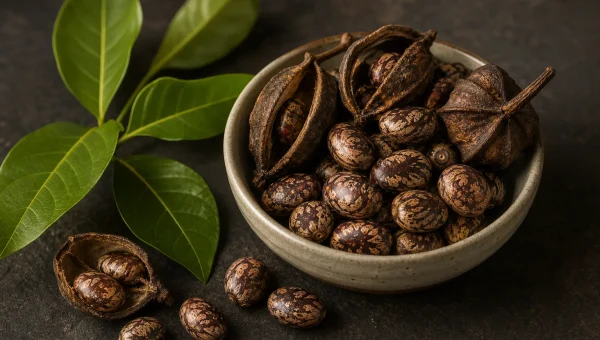
Sesame Oil as an Ayurvedic Base and Pharmaceutical Vehicle
The Ayurvedic Pharmacopoeia of India identifies Tila as the seed of Sesamum indicum. Its monograph records madhura, katu, tikta, and kashaya rasa; vyavayi, guru, snigdha, and sukshma guna; ushna virya; madhura vipaka; and actions that include snehana and vataghna. These Ayurvedic attributes explain its traditional importance as an unctuous base, but they should not be converted into an automatic claim of systemic drug delivery.
Sesame oil is composed mainly of triglycerides rich in oleic and linoleic acids; in commonly cited analyses these two fatty acids together account for more than 80% of the fatty-acid fraction, although cultivar and processing cause variation. Oleic acid can alter stratum-corneum lipid organization in experimental formulations, and natural oils may influence the release and partitioning of a co-applied compound. The magnitude and even the direction of that effect depend on the complete formulation. Sesame oil itself has not been shown to increase every herbal constituent by a fixed multiple, and it is not inherently safer than all synthetic penetration enhancers.
Sesame oil also contains lignans such as sesamin and sesamolin, with sesamol occurring especially after some forms of processing. These constituents contribute to the chemical stability and biological profile of the oil. Their presence does not establish that whole-body massage produces systemic antioxidant or anti-inflammatory doses.
Specific Constituents: What Their Chemistry Does and Does Not Show
Molecular size and lipophilicity can identify candidates for further testing, but they cannot replace product-specific permeation studies and human pharmacokinetics. The following examples illustrate why a traditional ingredient name is not enough to predict absorption.
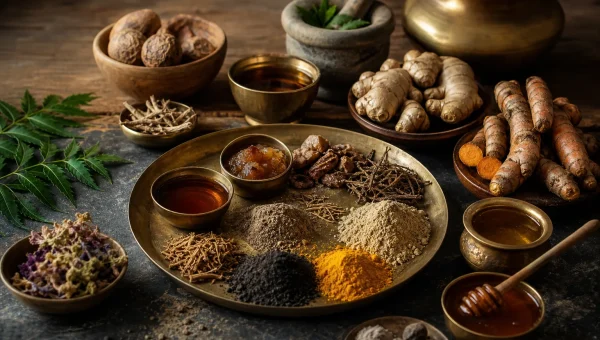
Ashwagandha (Withania somnifera) in Medicated Oil
Several major withanolides have molecular masses near 470 Da and steroid-like structures, placing them near the conventional size boundary for passive skin penetration. Other Ashwagandha constituents, including glycosides, are larger and more polar. Whether a particular taila extracts a withanolide, keeps it dissolved, releases it into the skin, and delivers a meaningful dose depends on its recipe and manufacture. No systemic dose of withanolides can be calculated from the surface area covered during Abhyanga, and medicated-oil use should not be equated with oral Ashwagandha exposure.
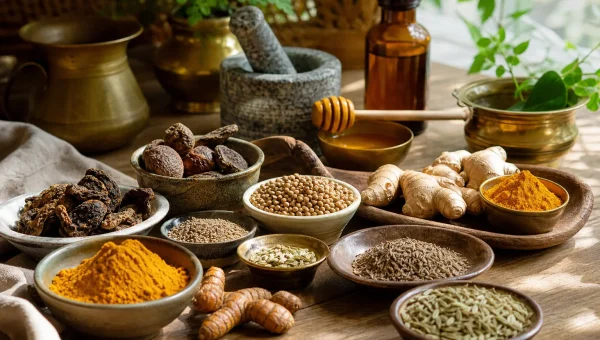
Curcumin in Turmeric-Medicated Oils
Curcumin has a molecular mass of about 368 Da and is lipophilic, so it can be incorporated into topical delivery systems. Its low water solubility, chemical instability, binding within the vehicle, and limited passage through intact skin remain formulation challenges. Engineered gels, vesicles, nanoparticles, and nanoemulsions can improve cutaneous deposition, but results from those systems cannot be transferred to a simple Haridra taila. Turmeric oil application may provide surface or local skin exposure; it does not justify numerical systemic bioavailability claims or treatment claims for psoriasis, eczema, or arthritis.
Bala (Sida cordifolia) in Compound Taila
Bala is included in a number of Ayurvedic formulations, but the chemical profile of a finished oil depends on plant identity, plant part, extraction medium, proportions, and processing. The presence of Bala does not establish a standardized transdermal dose of ephedrine-type alkaloids, and classical compound oils should not be described as selectively concentrating those alkaloids in muscle. Any pharmacokinetic or tissue-distribution claim must be demonstrated for the exact finished product.
Camphor and Menthol in Topical Pain Preparations
Camphor and menthol are small, volatile terpenoids used in many topical counterirritant products. Their sensory effects arise mainly from actions on cutaneous nerve pathways, including temperature-sensitive transient receptor potential channels. Regulatory monographs recognize camphor- and menthol-containing external analgesic products within specified formulations and concentrations. This supports a local topical action, not the claim that either compound is absorbed “rapidly and completely.” Camphor can be toxic if swallowed, and excessive application, damaged skin, occlusion, or external heat can increase risk.
Why Warm Oil Changes the Experience but Not by a Fixed Factor
Warm oil is commonly used because it spreads easily and is comfortable when properly prepared. Temperature can alter viscosity, drug release, skin blood flow, and diffusion. Experiments with approved transdermal systems, including fentanyl patches, show that elevated temperature can increase flux; this is also why heating pads and other external heat sources can create safety problems with some topical or transdermal medicines.
Those findings do not establish a universal multiplier for Ayurvedic oils. A change from 25°C to 40°C does not increase every herbal molecule by the same amount, and there is no general human pharmacokinetic value for warm Abhyanga. Oil should be comfortably warm rather than hot. Pinda Sveda, Dhara, and other procedures combine heat, duration, pressure, and specialized materials; they should not be presented as proven methods for forcing herbal compounds into deep tissues or blood.
Topical, Dermal, and Transdermal Effects Are Different
Claims about medicated oils become clearer when the intended site of action is stated. Oral and skin routes should not be compared with invented percentages, because bioavailability is compound- and formulation-specific.
| Level of delivery | Meaning | Reasonable interpretation for medicated oils |
|---|---|---|
| Surface effect | Oil remains mainly on the stratum corneum | Lubrication, reduction of friction, occlusion, and improved softness are plausible without systemic absorption. |
| Cutaneous deposition | Constituents enter the stratum corneum, epidermis, or follicles | Local skin or sensory effects may occur if the compound is released at an adequate concentration. |
| Local deeper delivery | A compound reaches the dermis or nearby tissue | This requires direct measurement; skin retention alone does not prove delivery to muscle or joint. |
| Systemic transdermal delivery | A compound reaches circulating blood at a quantifiable level | Plasma concentration, exposure over time, dose proportionality, and safety must be established for the finished formulation. |
Classical Sneha Preparation Is Not Automatically a Nanoemulsion
Classical Sneha Kalpana processes combine a lipid base with prescribed herbal paste and liquid media, followed by controlled heating until the required taila-paka characteristics are reached. This can transfer oil-soluble constituents into the lipid phase and can also change the finished product through heating and concentration. The Ayurvedic Pharmacopoeia specifies ingredients, proportions, processing, and quality parameters for individual formulations.
A nanoemulsion, however, is a defined colloidal system whose droplet size and stability must be measured. Published turmeric-in-sesame nanoemulsions have used surfactants and high-energy microfluidization to obtain nanoscale droplets. Ordinary classical cooking for several days does not, by itself, prove formation of 100–300 nm carriers, follicular targeting, or enhanced systemic delivery. Each finished oil requires analytical characterization before it can be described as a nanocarrier.
Clinical Implications for Abhyanga
Charaka Samhita, Sutrasthana 5.85–89, places regular oil massage within daily regimen and describes benefits in Ayurvedic terms such as smoothness, strength, tolerance of exertion, and pacification of Vata associated with tactile function and skin. These classical statements support Abhyanga as an Ayurvedic practice; they do not constitute a modern pharmacokinetic demonstration of blood-borne herbal compounds.
- Duration: Longer contact may increase exposure for some permeants, but there is no universal 15–20-minute onset of steady-state flux for Ayurvedic oils. Contact time should follow the specific product, procedure, skin condition, and practitioner’s guidance.
- Massage technique: Strokes distribute the oil, increase contact, and may transiently warm the skin. Direction of hair growth and circular friction have not been established as universal methods for maximizing systemic delivery.
- Waiting before bathing: A short resting period is a practical part of many routines, allowing the oil to remain in contact with the skin. It should be understood as procedural guidance, not a quantified guarantee of maximum absorption.
- Safety: Use only products intended for topical application. Avoid the eyes, mucosa, broken or infected skin, excessive heat, and unadvised occlusion. Stop if burning, rash, swelling, dizziness, or breathing symptoms occur.
For the full traditional routine, our guide on Abhyanga self-massage ritual covers practical technique. For a distinct route of administration, see Nasya therapy. For the therapeutic sequence in which external oleation may be used as preparatory care, our Panchakarma complete guide provides broader context.
References
- Enhancement strategies for transdermal drug delivery systems: current trends and applications (2022), PubMed Central
- Size-dependent penetration of nanoemulsions into epidermis and hair follicles: implications for transdermal delivery and immunization (2017), PubMed Central
- The 500 Dalton rule for the skin penetration of chemical compounds and drugs (2000), PubMed
- Transdermal Drug Delivery: Innovative Pharmaceutical Developments Based on Disruption of the Barrier Properties of the stratum corneum (2015), PubMed Central
- Ayurvedic Pharmacopoeia of India
- Physicochemical, potential nutritional, antioxidant and health properties of sesame seed oil: a review (2023), PubMed Central
- Value addition in sesame: A perspective on bioactive components for enhancing utility and profitability (2014), PubMed Central
- Penetration enhancing effects of selected natural oils utilized in topical dosage forms (2015), PubMed
- Pubchem (pubchem.ncbi.nlm.nih.gov)
- Pubchem (pubchem.ncbi.nlm.nih.gov)
- Cancer (cancer.gov)
- The role and mechanism of action of menthol in topical analgesic products (2018), PubMed
- Camphor activates and strongly desensitizes the transient receptor potential vanilloid subtype 1 channel in a vanilloid-independent mechanism (2005), PubMed
- FDA
- Evaluation of Heat Effects on Fentanyl Transdermal Delivery Systems Using In Vitro Permeation and In Vitro Release Methods (2020), PubMed
- Charaka Samhita — Matrashiteeya Adhyaya
- Natural Ingredient Resource Center
- Non-Invasive Delivery of Nano-Emulsified Sesame Oil-Extract of Turmeric Attenuates Lung Inflammation (2020), PubMed Central
I liked the practical side of Transdermal Drug Delivery Through Ayurvedic Oils. The article avoids making it sound like a quick fix.
I liked the practical side of Transdermal Drug Delivery Through Ayurvedic Oils. I appreciate that it does not oversell the result.
The Bala taila absorption work is interesting but I’d want to know more about the herbal preparation method. Oil processed through traditional Ayurvedic heating cycles versus a cold-infused oil could have very different active compound profiles, and if the pharmacology studies are using one type while practitioners are using another, the conclusions might not transfer cleanly. Is that distinction addressed anywhere in the research you’ve reviewed?
I’ve been a skeptic about oil massage claims for years, so reading the part about follicular shunt pathways was genuinely new information for me. The idea that hair follicles act as fast-track channels bypassing the stratum corneum changes the picture considerably. I still want to see the Mahanarayan oil studies replicated with better controls, but I’ll admit the mechanistic case here is stronger than I expected.
I liked the practical side of Transdermal Drug Delivery Through Ayurvedic Oils. The safety notes could be expanded a little.
The curcumin transdermal data you reference is the part I keep coming back to. Oral bioavailability of curcumin is notoriously poor, which is why the pharmacology community has spent years on nanoparticle delivery systems. If a simple oil preparation can sidestep the first-pass metabolism problem through the skin route, that’s actually a significant finding. Has anyone done a head-to-head comparing serum curcumin after oral turmeric versus topical oil application?
I liked the practical side of Transdermal Drug Delivery Through Ayurvedic Oils. This feels more usable than a long list of herbs.
The article clarifies that not every herb in the oil reaches the bloodstream.
What I found most useful here is the lipophilicity argument. Fat-soluble compounds in oil-based preparations crossing the skin barrier is not actually surprising once you frame it that way — it’s the same principle behind nicotine patches and hormone creams. The more interesting question to me is whether the carrier oil itself modulates absorption or just acts as a passive vehicle. The article hints at it but I’d like to see that explored more.
It mentions that sesame oil alone does not guarantee systemic delivery of all constituents.
The section on penetration enhancers in sesame oil is where I’d want more data. Oleic acid content and its effect on stratum corneum permeability is reasonably documented, but the specific concentrations achieved in blood after a typical Abhyanga session seem to vary wildly across the studies you’re citing. Do you know whether any of the pharmacokinetic work controlled for massage pressure and duration, or were those variables left loose?
A question I have is whether the warm oil step changes absorption enough to matter.
I liked the practical side of Transdermal Drug Delivery Through Ayurvedic Oils. Good starting point for a cautious reader.
Some readers might wonder if ashwagandha withanolides can actually cross the skin barrier.
The piece notes that curcumin’s low solubility remains a hurdle even in medicated oils.
One practical takeaway is to view Abhyanga as a surface or local treatment unless proven otherwise.
I found the discussion on follicle routes interesting because they only cover a small skin area.
The article warns against equating traditional massage with oral dosing of herbs.
It would be helpful to see human pharmacokinetic data for specific medicated oils.
Many complex phytochemicals are unlikely to reach therapeutic levels without special formulation.
The mention of the 500 Dalton rule as a screening tool rather than a guarantee caught my attention.
Safety advice about avoiding broken skin and excessive heat feels relevant for home practice.
I appreciate the distinction made between cutaneous deposition and true systemic delivery.
The article’s conclusion that delivery is compound specific matches what I’ve read about topical drugs.
the dosage for children per kg bodyweight would be useful to add.
Will try 🙏
the studies cited are mostly in vitro or animal models. Any RCTs in humans for this specific claim? 🙌
can this be done alongside an allopathic treatment or should there be a gap?
three herbs three outcomes surprisingly simple when laid out like this
the comparison to NSAIDs in the COX-2 article needs important caveats about dosw and context.
the Hindi terms alongside English make this usable in both languages.
Pitta burning its way through this article and finding useful info 🔥 just kidding but yes helpful.
Thanks 🙏
Doing this
my grandma was right about all of this. just didnt have the explanation.
the IST timings in the practical section are a nice touch. Feels like its written for us.
Been following this blog for six months and the quality is consistently high.
the practical implementation section is what separates this from other Ayurveda sites.
the depth here is unusual for a blog. reads more like a textbook chapter.
what brand of triphala do u recommend? So many options and quality varies greatly. 🙏
Have been searching for this explanation for years. Saved. Sharing.
What brand of triphala do you recommend? So many options and quality varies greatly.
Nani used to say the same things in different words. There’s real wisdom here.
too theoretical without enough concrete steps. The ‘what’ is clear but the ‘how exactly’ is missing.
i appreciate the acknowledgment that this isnt a substitute for professional consultation. 🙏
Thanks for the clear writing. This isn’t easy material to explain simply. धन्यवाद
most of the research here is preliminary. The conclusion drawn feels stronger than the evidence supports.
Thanks for the clear writing. This isn’t easy material to explain simply.
Can someone here who has tried this protocol confirm the timeline? Two weeks vs six weeks?
the pharmacokinetics section on anupana is the most rigorous Ayurvedic content Ive found.
i wish there were more clinical studies cited here. Traditional use is valuable but not sufficient evidence alone. धन्यवाद
Tried this for 6 weeks without the results described. Maybe the protocol needs personalizing.
my experience perfectly matches what is described in the long-term use section.
as someone who does both allopathy and Ayurveda I appreciate that this article doesn’t demonize either. ठीक है
The morning versus evening split for herbs is something I always get confused about. Clear here.
people should know this. Sharing everywhere.
Going to share this at my wellness group meeting next week. Very useful.
for Kapha-dominant types is the warm water recommendation essential or can it be room temp?
is the bioavailability improvement from piperine consistent across all curcumin preparations?
is there a children’s version of this protocol? My daughter has a similar issue.
can this be taken in summer or only winter months?
just found this through Google. Is this still the current recommendation?
The pharmacology discussion mixes traditional theory with modern research without being clear which is which.
started following this a month ago. small but real difference. thank u
Shared with my family group and three people are already trying it.
i dont comment usually but this was actually helpful
first comment here. been lurking for months. this is the one that made me want to say thank u ✨
Do the ratios change if you are doing this as preventive care versus active treatment?
Citing studies without mentioning sample size or quality of evidence is misleading.
Finally!
Some of the preparation methods are too time-intensive for working adults. Needs a quick-version alternative. धन्यवाद
some of the preparation methods are too time-intensive for working adults. Needs a quick-version alternative.
my doctor actively discouraged this after I mentioned it. Getting conflicting guidance is difficult to navigate.
the studies cited are mostly in vitro or animal models. Any RCTs in humans for this specific claim?
I would like more detail on Transdermal Drug Delivery Through Ayurvedic Oils. The examples make the advice less abstract.
the classical text reference to Charaka Samhita gave this article more credibility in my eyes.
finally an article that doesnt treat Ayurveda as magic and also doesnt dismiss it entirely
For Transdermal Drug Delivery Through Ayurvedic Oils, consistency seems like the hard part. I would like to know how long to try it before judging results.
Reading this later and the Transdermal Drug Delivery Through Ayurvedic Oils advice still feels relevant. The timing advice is the part I would start with.
citing studies without mentioning sample size or quality of evidence is misleading. 💯
i’m in the US and getting authentic herbs here is hard. Any trusted online sources?
reading this in 2027, i dont comment usually but this was actually helpful
the Q&A format at the end would make this even more useful. Would love a FAQ section.
finally something that explains the why, not just the what.
How long does a typical protocol like this take to show results?
The classical text quotes are helpful context but I’d like to understand the modern interpretation better.
the COX-2 inhibition mechanism explained here made me understand why my inflammation actually reduced.
Late to this but for Pitta-Kapha dual constitution which aspects of the protocol take priority?
the transdermal absorption numbers seem high. Do the absorption rates hold for all oil preparations?
Does ghee quality affect results significantly? I use store-bought A2 ghee.
Late to this but the sourcing of quality herbs in my city is impossible. Makes these protocols academic for many readers.
reading this in 2027, the reference to Ashtanga Hridayam which Sutrasthana chapter? Would like to read the original.
late to this discussion but the question in the first comment is still unanswered anyone have more info?
found this searching for answers, do the ratios change if you are doing this as preventive care versus active treatment?
Just found this via Google, the depth here is unusual for a blog. reads more like a textbook chapter.
Just found this through Google. Is this still the current recommendation? धन्यवाद
The advice around Transdermal Drug Delivery Through Ayurvedic Oils is specific enough to be useful. This feels more usable than a long list of herbs.
the comments section here is almost as useful as the article itself
the combination of classical reasoning and practical steps is exactly what I was looking for.
u said it better than my 45-min consult with the vaidya tbh
Good reminder on Transdermal Drug Delivery Through Ayurvedic Oils. I would still ask a practitioner before changing medicines.
Going to share this at my wellness group meeting next week. Very useful. 🌿
shared this with my 68-year-old father. He said its exactly what his vaidya prescribed 30 years ago.
reading this in 2027, the combination of theory and practical steps is what I appreciate most about this blog.
the Guduchi prebiotic study citations are useful. Forwarding this to my gastroenterologist.
I came for Transdermal Drug Delivery Through Ayurvedic Oils and this answered the main question. I would still ask a practitioner before changing medicines.
I came for Transdermal Drug Delivery Through Ayurvedic Oils and this answered the main question. This would be easier to follow with a one-week sample plan.
the balance between Sanskrit terminology and plain English is really well done. नमस्ते
i was prescribed this by a practitioner 2 years back but never understood why. now i do.
thanks for the clear writing. This isnt easy material to explain simply.
i appreciate that the dosages are given in actual mg not just ‘a pinch’ or ‘as needed’.
tried this for 6 weeks without the results described. Maybe the protocl needs personalizing.
reading this in 2027 r the herb sourcing recommendations still valid?
Makes sense
old post but still helpful. the reference to Ashtanga Hridayam which Sutrasthana chapter? Would like to read the original.
the question about brand quality is important. not all suppliers are equal.
for Pitta-Kapha dual constitution which aspects of the protocol take priority? नमस्ते
reading this in 2027, tried. Liked. Continuing.
never thought I’d become an Ayurveda convert but here I am reading every article.
The comparison to NSAIDs in the COX-2 article needs important caveats about dose and context. 🙌
i asked my dr about this. she said she doesnt have enough info on it but didnt say no
Useful post on Transdermal Drug Delivery Through Ayurvedic Oils. The article avoids making it sound like a quick fix.
So much misinformation out there. Good to find something grounded.
will come back to this when I hit the cooling phase very detailed.
For Transdermal Drug Delivery Through Ayurvedic Oils, consistency seems like the hard part. The practical details matter more than people think.
Old post but still helpful. thanks for the clear writing. This isn’t easy material to explain simply.
Helpful
just found this via Google, skeptical but curious. trying the minimal version first.
Reading this in 2027, do the ratios change if you are doing this as preventive care versus active treatment?
Just found this via Google, is the bioavailability improvement from piperine consistent across all curcumin preparations?
i wish there were more clinical studies cited here. Traditional use is valuable but not sufficient evidence alone. 🙌
The before-and-after in my experience matches what the article predicts. That’s meaningful. 🙏
first comment here. been lurking for months. this is the one that made me want to say thank u
coming from a conventional medicine background this article impressed me with its rigor.
practical + scientific = rare combo in Ayurveda content. Good work.
The sourcing of quality herbs in my city is impossible. Makes these protocols academic for many readers.
reading this in 2027, is the bioavailability improvement from piperine consistent across all curcumin preparations?
For Kapha-dominant types is the warm water recommendation essential or can it be room temp? 🙏
This helped me understand Transdermal Drug Delivery Through Ayurvedic Oils without too much jargon. The safety notes could be expanded a little.
Tried. Liked. Continuing.
Sharing this
the reference to Ashtanga Hridayam which Sutrasthana chapter? Would like to read the original.
which form of curcumin has the best evidence? There are so many on the market now.
old post but still helpful. practical + scientific = rare combo in Ayurveda content. Good work.
reading this in 2027, most of the research here is preliminary. The conclusion drawn feels stronger than the evidence supports. धन्यवाद
The advice around Transdermal Drug Delivery Through Ayurvedic Oils is specific enough to be useful. This is the kind of detail readers can test slowly.
Just found this via Google, which form of curcumin has the best evidence? There are so many on the market now.
the comments section here is almost as useful as the atricle itself
my grandma was right about all of this. just didn’t have the explanation.
Bookmarked
Reading this in 2027 are the herb sourcing recommendations still valid?
How does weather and season affect the protocol? I’m in a hot humid climate.
Trying this
the seasonal protocol is smart. Most people try to use the same routine all year.
this is now my reference article for explaining this topic to friends. ❤️
the transdermal absorption numbers seem high. Do the absorption rates hold for all oil preparations? ठीक है
skeptical about Ayurveda in general but this is presented honestly enough that I’ll try it.
i asked my dr abuot this. she said she doesnt have enough info on it but didnt say no
my constitution is Vata-Pitta so some of this applies and some doesnt. A chart for dual types would help.
skeptical but curious. trying the minimal version first.
late to this but would like to see the contraindications section expanded. Too brief for something being suggested for health issues.
Never thought I’d become an Ayurveda convert but here I am reading every article. नमस्ते
Reading this in 2027, my western trained MD friend looked at this and said the pharmacology section was reasonable.
late to this but three months later: the results held. Happy to report.
my yoga teacher recommended this site and now I see why. नमस्ते
skeptical but curious. trying the minimal version first. 🙌
Does anyone know a practitioner in Hyderabad who works with this kind of protocol?
the balance between Sanskrit terminology and plain English is really well done.
Useful post on Transdermal Drug Delivery Through Ayurvedic Oils. The examples make the advice less abstract.
Reading this in 2027, never thought I’d become an Ayurveda convert but here I am reading every article.
i wish there were more clinical studies cited here. Traditional use is valuable but not sufficient evidence alone.
Will try for a month and report back here.
reading this in 2027, the before-and-after in my experience matches what the article predicts. That’s meaningful.
would love a video version of the preparation method ❤️
As someone who does both allopathy and Ayurveda I appreciate that this article doesn’t demonize either.
my western trained MD friend looked at this and said the pharmacology section was reasonable.
i appreciate the acknowledgment that this isnt a substitute for professional consultation.
My Ayurvedic practitioner of 12 years said this is one of the better online resources she’s seen on the topic.
which form of curcumin has the best evidence? There are so many on the market now. 🙏
Found this searching for answers, does this protocol need modification for someone who is fasting during Navratri?
thank you for citing actual studies instead of just classical text references.
Found this searching for answers, how long does a typical protocol like this take to show results?
the Hindi terms alongside English make this usable in both languages. 🌿
old post but still helpful. the studies cited are mostly in vitro or animal models. Any RCTs in humans for this specific claim?