The Problem No One Is Naming Correctly
Sarcopenic obesity Ayurveda treatment addresses one of the most frustrating metabolic patterns men over 40 can face: fat mass rises while muscle mass, strength, and functional capacity decline. The scale may move only slightly, yet the body composition shift is significant. You become softer, slower, weaker, and more metabolically vulnerable at the same time. Conventional medicine calls this sarcopenic obesity: the coexistence of excess adiposity with reduced skeletal muscle mass, strength, or physical performance. In Ayurveda, it is best approached as a meda-mamsa disorder pattern: meda vriddhi, or pathological increase of fat tissue, occurring alongside mamsa kshaya and bala kshaya, or depletion of muscle tissue and strength.
The two sides reinforce each other. Skeletal muscle is a major site of glucose disposal and metabolic resilience; when muscle declines, insulin resistance becomes easier to develop. Excess adiposity, especially abdominal and intramuscular fat, is associated with inflammatory and metabolic signaling that further weakens muscle quality, mitochondrial function, and strength. Breaking this loop requires a two-direction protocol: reduce meda without starving mamsa, and rebuild mamsa without aggravating kapha and fat accumulation.
Diagnosing Mamsa-Meda Imbalance
Before treating, confirm what you are dealing with. Sarcopenic obesity is not the same as simple obesity with preserved muscle. A person may look “large” but still have poor grip strength, slow walking speed, low training tolerance, and reduced lean mass. Treatment must therefore measure strength and function, not only body weight.
Clinical markers to assess:
- Waist circumference: in South and East Asian men, a waist circumference of 90 cm or more is a useful marker of central adiposity and metabolic risk.
- Strength and function: handgrip strength below 28 kg in men, usual walking speed below 1.0 m/s, or a slow repeated chair-stand test suggests low muscle function.
- Body composition: DEXA or bioelectrical impedance can help identify excess fat mass together with low appendicular skeletal muscle mass index, commonly using less than 7.0 kg/m2 in men as a low-muscle reference point in Asian older-adult criteria.
- Metabolic profile: triglycerides of 150 mg/dL or higher, elevated fasting glucose or HbA1c, low HDL cholesterol, hypertension, fatty liver, and high waist circumference all point toward meda-dominant metabolic involvement.
Ayurvedic assessment adds the qualitative picture. Meda vriddhi commonly presents with heaviness, lethargy, excess sweating, sleepiness, coating on the tongue, sluggish digestion, and reduced enthusiasm for movement. Mamsa kshaya and bala kshaya show as reduced muscle tone, poor exercise tolerance, weakness after exertion, slow recovery, and loss of firmness in the limbs. Charaka describes excessive corpulence as a condition in which meda obstructs channels and the nourishment of other tissues becomes disturbed; he also praises balanced muscle, compactness, strength, and proper digestion as signs of resilience.
| Parameter | Simple Obesity | Sarcopenic Obesity | Ayurvedic Correlate |
|---|---|---|---|
| Fat mass | High | High, often abdominal or metabolic | Meda vriddhi, kapha-meda excess |
| Muscle mass | Often normal or high | Low or poor-quality | Mamsa kshaya |
| Strength | Often preserved | Reduced grip, gait, lifting capacity | Bala kshaya |
| Metabolic risk | Variable | Often higher | Agni and dhatvagni disturbance; medovaha srotas involvement |
| Functional capacity | May be adequate | Fatigue, slower gait, poor recovery | Utsaha and bala decline |
The Herb Stack That Supports Both Directions
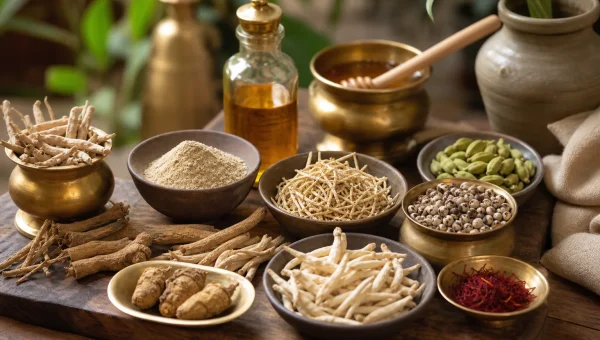
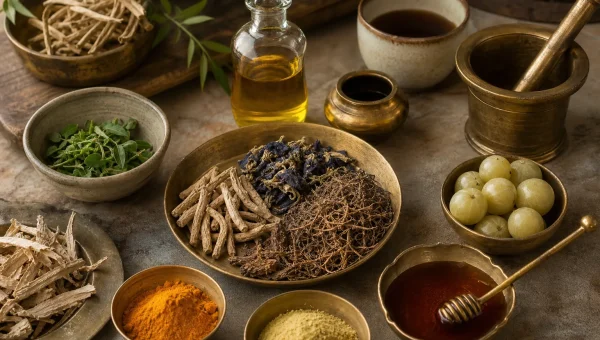
The herbal aim is not crude weight loss. The goal is to kindle digestion and tissue metabolism, reduce kapha-meda heaviness, protect strength, support recovery, and prevent an aggressive calorie deficit from worsening mamsa kshaya. Herbs should be chosen according to constitution, digestion, medications, liver and kidney status, and the exact presentation.
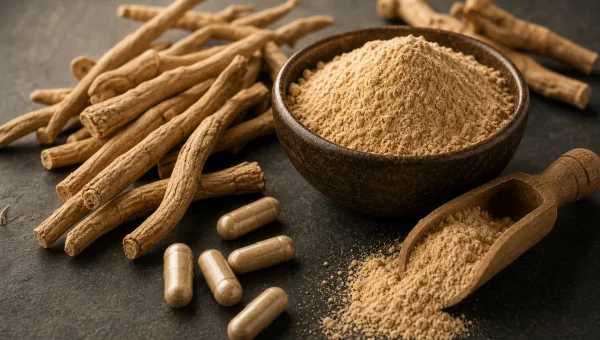
Ashwagandha (Withania somnifera): Ashwagandha is most relevant when weakness, poor recovery, stress load, poor sleep, and declining training capacity are central features. A commonly used human trial dose with resistance training is 300 mg root extract twice daily, taken with meals. In Ayurvedic logic, ashwagandha is a balya and brimhaniya herb, so it belongs on the mamsa-building side of the protocol rather than the meda-reducing side. It should be used carefully in people with liver disease, active thyroid disorders, hormone-sensitive prostate conditions, or unexplained jaundice, itching, dark urine, or abdominal pain.
Shilajit (purified mineral resin): Shilajit is appropriate only when it is purified, lab-tested, and supplied by a reputable manufacturer. Human trials commonly use 250 mg twice daily. In this protocol, shilajit is best placed as a rasayana-style support for vitality, recovery, and male metabolic resilience. Raw or unpurified shilajit should not be used because natural resin may contain unsafe contaminants unless properly purified and tested.
Guggulu (Commiphora wightii / Commiphora mukul): Shuddha guggulu or a Medohara-style guggulu formula is used when the picture is dominated by kapha-meda heaviness, sluggish metabolism, dyslipidemia tendency, and channel obstruction. It should not be treated as a guaranteed thyroid stimulant or a stand-alone fat-loss drug. Guggulu formulas are best prescribed by a qualified Ayurvedic practitioner, especially for anyone using blood thinners, thyroid medication, beta-blockers, calcium-channel blockers, estrogenic medicines, tamoxifen, or multiple long-term medications.
Punarnava (Boerhavia diffusa): Punarnava is most useful when the meda picture includes puffiness, water retention, heaviness, swelling tendency, and sluggish elimination. In Ayurvedic practice it is valued for shotha and mutrala indications, so it can help separate fluid-heavy kapha accumulation from true fat mass when tracking progress. It is not a substitute for protein, resistance training, or a full metabolic plan; the form and dose should be individualized.
Resistance Training Protocol: Sequence and Timing
Exercise sequencing matters because the central problem is not fat alone; it is fat with insufficient muscle and strength. For sarcopenic obesity, resistance training should be treated as the foundation, with cardiovascular work added in a way that supports fat loss without exhausting recovery. Lift while fresh, then use low-impact conditioning afterward or on separate days.
Priority: compound resistance movements first. Squats or sit-to-stands, hip hinges, rows, presses, carries, step-ups, and pulling patterns should come before long cardio sessions. The practical reason is simple: skill, balance, joint control, and strength output are better when fatigue is low. This protects mamsa, improves functional capacity, and makes the session safer for men with abdominal obesity, knee pain, diabetes, or cardiovascular risk.
Session structure for men with sarcopenic obesity:
- Warm-up: 8-10 minutes of dynamic mobility, joint preparation, and easy walking or cycling.
- Resistance training: 2-3 sessions per week, using whole-body compound movements, beginning with comfortable loads and progressing gradually.
- Working sets: start with 2-3 sets of 8-12 controlled repetitions for major patterns; progress toward heavier work only after technique and recovery are stable.
- Cardio: 15-25 minutes of low-impact cycling, rowing, incline walking, or swimming after lifting or on alternate days.
- Recovery: at least one rest or light-movement day between hard resistance sessions in the beginning.
- Breath and mobility: finish with slow nasal breathing, gentle mobility, and a calm cool-down to prevent vata aggravation after exertion.
Protein Timing: The Ayurvedic Calculation
Mamsa dhatu nourishment requires three things together: adequate amino-acid intake, digestible meals, and repeated mechanical stimulus from resistance training. Ayurveda describes tissue nourishment as a sequential dhatu process beginning with rasa and proceeding through rakta, mamsa, meda, asthi, majja, and shukra. The practical lesson is that muscle rebuilding is not a one-meal event. It requires steady nourishment without overfeeding kapha.
For men with sarcopenic obesity and normal kidney function, a practical daily protein range is about 1.6-2.0 grams per kilogram of target body weight when resistance training is included. For a man targeting 80 kg, that gives a range of 128-160 grams daily. Older adults or those with illness may need individualized targets, while anyone with kidney disease should set protein intake only with medical guidance.
Spread protein across 3-4 meals instead of loading it all at dinner. A useful target is 25-40 grams of high-quality protein per main meal, with one protein-rich meal within a few hours after resistance training. Vegetarian options include paneer, curd or Greek-style yogurt, milk, tofu, tempeh, soy chunks, lentils, chickpeas, mung dal, peas, nuts, seeds, whey, or pea protein. Choose the most digestible options and cook legumes with warming spices such as ginger, cumin, ajwain, black pepper, or hing when appropriate.
The Ayurvedic food strategy is laghu but nourishing: light enough to reduce kapha-meda burden, nourishing enough to protect mamsa. Barley, millet, mung, kulattha, cooked vegetables, spiced buttermilk where suitable, and warm meals are more appropriate than grazing on sweets, refined starches, fried foods, cold heavy dinners, or daytime sleep. This keeps the protocol aligned with both sides of the problem: meda reduction and mamsa preservation.
Medical disclaimer: This content is for educational purposes only. Sarcopenic obesity is a complex metabolic condition requiring individual assessment. Consult a qualified Ayurvedic practitioner and a physician or healthcare provider before beginning any supplement, calorie-reduction plan, or exercise protocol, especially if you have diabetes, cardiovascular disease, kidney disease, liver disease, thyroid disease, prostate disease, joint problems, or if you take regular medication.
References
- Definition and Diagnostic Criteria for Sarcopenic Obesity: ESPEN and EASO Consensus Statement (2022), PubMed Central
- Sarcopenic obesity in older adults: a clinical overview (2024), PubMed Central
- Sarcopenic Obesity, Insulin Resistance, and Their Implications in Cardiovascular and Metabolic Consequences (2020), PubMed Central
- Impact of Adipose Tissue and Lipids on Skeletal Muscle in Sarcopenia (2025), PubMed Central
- Asian Working Group for Sarcopenia: 2019 Consensus Update on Sarcopenia Diagnosis and Treatment (2020), PubMed
- The IDF Definition Is Better Suited for Screening Metabolic Syndrome and Estimating Risks of Diabetes in Asian American Adults: Evidence from NHANES 2011-2016 (2020), PubMed Central
- Charaka Samhita — Ashtauninditiya Adhyaya
- Concepts of Dhatu Siddhanta (theory of tissues formation and differentiation) and Rasayana; probable predecessor of stem cell therapy (2014), PubMed Central
- Link (link.springer.com)
- NIH Office of Dietary Supplements
- Clinical evaluation of purified Shilajit on testosterone levels in healthy volunteers (2016), PubMed
- SAGE Journals
- Shilajit: a natural phytocomplex with potential procognitive activity (2012), PubMed Central
- Ayurvedic Pharmacopoeia of India
- Mskcc (mskcc.org)
- Rxlist (rxlist.com)
- Research (research.uaeu.ac.ae)
- Academic (academic.oup.com)
- Effectiveness of exercise interventions on muscle mass among older adults with sarcopenic obesity: A scoping review (2024), PubMed Central
- Acsm (acsm.org)
- International Society of Sports Nutrition Position Stand: protein and exercise (2017), PubMed
- International society of sports nutrition position stand: nutrient timing (2017), PubMed Central
- Protein intake and exercise for optimal muscle function with aging: recommendations from the ESPEN Expert Group (2014), PubMed Central