
Age-related muscle loss is often dismissed as ordinary weakness until it begins to affect grip strength, balance, walking speed, chair-rise ability, and confidence in daily movement. Modern geriatrics recognises this pattern as sarcopenia: a progressive disorder of low muscle strength with reduced muscle quantity or quality, and with greater severity when physical performance is also impaired. In Ayurveda, the same pattern is best understood as gradual Mamsa Dhatu Kshaya—depletion of the muscle tissue—occurring in the setting of Vriddhavastha, the later stage of life in which Vata naturally becomes more dominant.
The Ayurvedic response is not merely to “add herbs.” It is a coordinated Brimhana approach: nourish the depleted tissues, protect digestion, reduce excessive dryness and lightness, rebuild strength gradually, and individualise the plan to the person’s constitution, appetite, medical conditions, and mobility level.
What Sarcopenia Looks Like in Ayurvedic Terms
Sarcopenia is described in modern medicine as a muscle disorder in which low muscle strength is central, with low muscle quantity or quality confirming the diagnosis and poor physical performance marking a more severe stage. In daily life, it may appear as weak grip, slower walking, difficulty rising from a chair, fear of stairs, repeated falls, unexplained fatigue after ordinary tasks, or loss of independence.
Ayurveda describes muscle tissue as Mamsa Dhatu. When this tissue becomes depleted, the body loses firmness, strength, and functional support. Classical Ayurvedic reasoning places old age under the influence of increasing Vata, whose qualities include Ruksha (dry), Laghu (light), Khara (rough), Sukshma (subtle), and Chala (mobile). These qualities oppose the nourishing, stable, and substantial qualities required for healthy muscle tissue.
The principle of Samanya-Vishesha explains why this matters clinically: similar qualities increase one another, while opposite qualities reduce one another. A rise in Vata tends to reduce Mamsa, while nourishing and stabilising measures help protect Mamsa from further depletion. For an older adult, this makes Brimhana—building, nourishing, strengthening therapy—the central Ayurvedic strategy.
The Ayurvedic Strategy: Brimhana, Balya, Rasayana, and Vyayama
A practical Ayurvedic sarcopenia-prevention plan combines four pillars. Brimhana provides nourishment and tissue-building support. Balya measures promote strength and resilience. Rasayana supports recovery, vitality, and long-term maintenance. Vyayama, adapted to age and capacity, gives the muscles the repeated stimulus they need to remain functional.
Classical depletion patterns are aggravated by excessive exertion, fasting, dry or scanty meals, insomnia, worry, grief, exposure to harsh conditions, and old age. Many older adults experience several of these together: poor appetite, irregular meals, disturbed sleep, social isolation, fear of movement after a fall, and reduced outdoor activity. The protocol therefore must be warm, strengthening, digestible, realistic, and progressive rather than harsh or exhausting.
Five Supportive Herbs for Mamsa Dhatu Nourishment
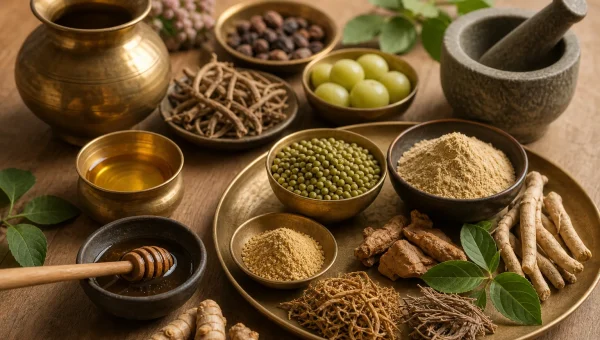
The following herbs are commonly used in Ayurvedic practice for strength, nourishment, recovery, and Vata-related depletion. They should be selected according to constitution, digestion, medications, blood pressure, blood sugar, kidney and liver status, and the presence of chronic disease. In older adults, conservative dosing and qualified supervision are especially important.
Ashwagandha (Withania somnifera)
Ashwagandha is one of Ayurveda’s best-known Balya and Rasayana herbs. It is traditionally used for weakness, depleted vitality, Vata imbalance, and reduced resilience. In a muscle-preservation plan, it is most appropriate when the person has fatigue, poor recovery, disturbed sleep, nervous exhaustion, and low strength without strong heat or inflammatory aggravation.
Traditional use commonly employs Ashwagandha root powder with warm milk or ghee-containing food when digestion allows. The Ayurvedic Pharmacopoeia of India lists a daily powder range of 3–6 g for the root. Standardised extracts have also been used in modern clinical settings, especially alongside resistance training, but extract strength varies widely and should follow product quality and practitioner guidance.
Shatavari (Asparagus racemosus)
Shatavari is a sweet, cooling, unctuous, nourishing herb with classical actions including Balya, Brimhana, Vrishya, Vatashamaka, and Pittahara. Its Madhura Rasa, Guru and Snigdha Guna, Shita Virya, and Madhura Vipaka make it suitable where depletion is accompanied by dryness, low tissue moisture, burning, irritability, or poor recovery.
For older adults with dry tissues, low body weight, and reduced appetite, Shatavari is often used with warm milk, ghee, or other nourishing carriers when tolerated. It is not a universal herb for every man with muscle loss; it is best chosen when the overall presentation calls for cooling, moistening, and nourishing support.
Bala (Sida cordifolia)
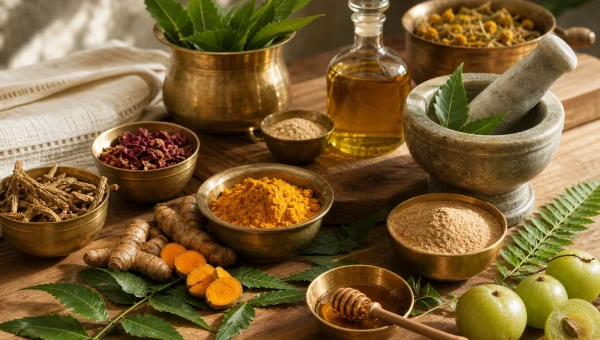
Bala literally means “strength,” and classical Ayurvedic usage places it among important strength-supporting herbs. It is used in Vata disorders, weakness, wasting, stiffness, and tissue depletion. In older adults, Bala is often especially relevant through external therapies such as Abhyanga with Bala-based medicated oils, where the aim is to reduce dryness, support comfort in joints and muscles, and prepare the body for safe movement.
Internal use of Bala requires caution. Sida cordifolia may contain ephedrine and related alkaloids, and this makes unsupervised use inappropriate for people with hypertension, heart rhythm disorders, anxiety disorders, hyperthyroidism, stimulant medication use, or significant cardiovascular risk. For many elders, external Bala oil under practitioner guidance is safer and more appropriate than internal self-supplementation.
Vidarikanda (Pueraria tuberosa)
Vidarikanda, also known as Indian kudzu, is a sweet, nourishing tuber used in Ayurvedic and traditional practice for depletion, weakness, reproductive vitality, and strength. Its use with milk, ghee, grains, and other strengthening foods reflects its role as a Brimhana substance rather than a stimulant.
Vidarikanda is most appropriate when muscle loss is accompanied by low body weight, dryness, reduced stamina, and need for gentle nourishment. It is commonly combined with other strengthening herbs and carriers in practitioner-designed formulas. People with diabetes, obesity, fluid retention, or weak digestion should use it only after individual assessment.
Shilajit (Purified Mineral Pitch)
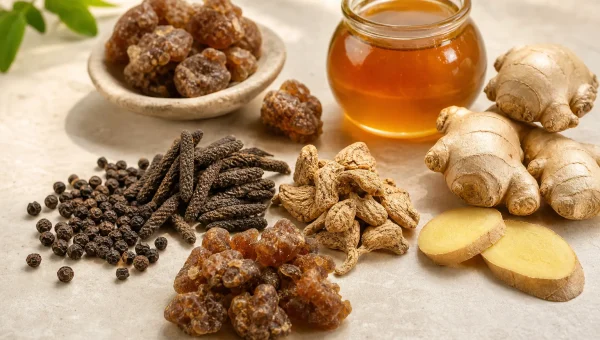
Shilajit is used in Ayurveda after purification and is associated with Rasayana-type support, stamina, and resilience. Chemically, purified Shilajit contains fulvic acid, humic substances, and related organic-mineral compounds. In a sarcopenia-support plan, it is considered when fatigue, low stamina, and poor recovery are prominent and when the person can obtain a properly purified, tested product.
Quality is essential. Raw or poorly processed Shilajit may contain unsafe levels of heavy metals or contaminants. Older adults should use only purified Shilajit from reputable manufacturers with contaminant testing, and should avoid it without medical advice if they have kidney disease, gout, iron overload, active infection, unstable diabetes, or complex medication use.
The Strength Yoga Protocol
Yoga can be a practical strength and balance adjunct for older adults who feel intimidated by gym training or who have stiffness, osteoarthritis, fear of falling, or low confidence. It should not replace clinically indicated resistance training, but it can provide a safe bridge into progressive loading when adapted carefully. The goal is not acrobatics; it is repeated, pain-free muscular effort with steady breathing and gradual progression.
Supported Utkatasana or chair sit-to-stand: Begin with a stable chair and, if needed, a wall or countertop for support. Perform two to three sets of five to ten slow chair rises, or hold a supported chair-pose position for 15–30 seconds. This trains the quadriceps, glutes, hips, and postural control needed for daily standing and stair use.
Virabhadrasana II with support: Practice near a wall or chair. Hold for 20–40 seconds on each side, one to three rounds. This builds leg endurance, lateral hip control, and confidence in a wider stance, all of which are relevant for balance and fall prevention.
Wall plank, counter plank, or modified Chaturanga hold: Start at the wall, then progress to a countertop or knees only if comfortable. Hold for 10–20 seconds for two to three rounds. This develops upper-body pushing strength, shoulder stability, and trunk endurance without forcing an older beginner into floor-based strain too early.
Progression principle: Increase only one variable at a time: hold duration, number of repetitions, number of rounds, or depth of the pose. Stop if there is chest pain, dizziness, sharp joint pain, unusual breathlessness, or loss of balance. A physiotherapist, yoga therapist, or qualified teacher should modify the plan for people with falls, osteoporosis, severe arthritis, neurological disease, or recent surgery.
Dietary Protocol for Mamsa Dhatu Nourishment
Muscle cannot be rebuilt from herbs alone. Ayurveda places equal importance on Agni, meal regularity, warm nourishment, adequate unctuousness, and foods that can actually be digested and assimilated. Modern nutrition also places protein adequacy and progressive strength work at the centre of sarcopenia prevention. For many healthy older adults, protein needs are higher than in younger adulthood, but kidney disease, liver disease, digestive disorders, and frailty require individual medical guidance.
| Food Category | Specific Foods | Ayurvedic Purpose | Timing and Notes |
|---|---|---|---|
| Protein-centred Brimhana foods | Warm milk, paneer or curd if tolerated, mung dal, urad dal, lentils, eggs, fish, or meat soup according to diet pattern | Supports Mamsa Dhatu nourishment and tissue repair | Distribute across main meals rather than relying on one large protein serving |
| Snigdha foods | Ghee, sesame oil, sesame seeds, coconut, soaked nuts, and other healthy fats suited to digestion | Counters Vata dryness and supports lubrication, satiety, and nourishment | Use modestly with warm meals; adjust for cholesterol, gallbladder disease, obesity, or weak digestion |
| Agni-supporting spices | Ginger, cumin, black pepper, turmeric, ajwain, garlic, and hing as appropriate | Supports digestion of heavier Brimhana foods | Use in cooking; avoid excessive heating spices in strong Pitta conditions, gastritis, or bleeding tendency |
| Ojas-supporting nourishment | Soaked almonds, dates, raisins, warm milk with cardamom or saffron, rice with ghee, and well-cooked strengthening meals | Supports recovery, stability, and post-exertion replenishment | Morning or evening when digestion is steady; avoid excess sugar in diabetes |
| Reduce Vata-aggravating depletion patterns | Skipped meals, very dry snacks, excessive raw salads, cold drinks, crash dieting, ultra-processed foods, and alcohol excess | Reduces dryness, irregularity, and undernourishment | Replace with warm, cooked, regular meals and adequate hydration |
For related reading, the Ayurvedic muscle-building foods guide explains food choices for supporting Mamsa Dhatu, and the Rasayana therapy and longevity review gives a broader view of rejuvenation principles.
How to Use This Protocol Safely
Sarcopenia requires proper assessment. Thyroid disease, vitamin D deficiency, B12 deficiency, chronic inflammation, cancer, medication side effects, depression, low appetite, kidney disease, neurological disease, and low physical activity can all contribute to muscle loss or weakness. A useful plan should therefore combine medical evaluation, adequate protein, progressive strength work, fall-risk reduction, sleep support, and appropriate Ayurvedic nourishment.
Safety disclaimer: This article is educational and does not replace medical care. Older adults with falls, unexplained weight loss, severe weakness, chronic disease, kidney or liver disease, heart disease, diabetes, hypertension, osteoporosis, or complex medication use should consult a qualified healthcare provider and a qualified Ayurvedic practitioner before using herbs, supplements, medicated oils, or new exercise routines. Bala and Shilajit require particular caution because of stimulant-alkaloid concerns with Sida cordifolia and contamination concerns with low-quality Shilajit.
References
- Sarcopenia: revised European consensus on definition and diagnosis (2019), PubMed Central
- Bestpractice (bestpractice.bmj.com)
- Health outcomes of sarcopenia: a consensus report by the outcome working group of the Global Leadership Initiative in Sarcopenia (GLIS) (2025), PubMed Central
- Recent sarcopenia definitions-prevalence, agreement and mortality associations among men: Findings from population-based cohorts (2023), PubMed Central
- Charaka Samhita — Dhatu
- Charaka Samhita — Ayu
- Charaka Samhita — Vata dosha
- Charaka Samhita — Deerghanjiviteeya Adhyaya
- Charaka Samhita — Samanya Vishesha Theory
- Charaka Samhita — Brimhana
- Charaka Samhita — Kiyanta Shiraseeya Adhyaya
- CCRAS
- Examining the effect of Withania somnifera supplementation on muscle strength and recovery: a randomized controlled trial (2015), PubMed Central
- Effects of Ashwagandha (Withania somnifera) on Physical Performance: Systematic Review and Bayesian Meta-Analysis (2021), PubMed Central
- NCCIH
- Ayurvedic Pharmacopoeia of India
- Plant profile, phytochemistry and pharmacology of Asparagus racemosus (Shatavari): A review (2013), PubMed Central
- Link (link.springer.com)
- Jaims (jaims.in)
- NCCIH
- Ephedra/ephedrine: cardiovascular and CNS effects (2002), PubMed Central
- Frontiersin (frontiersin.org)
- Shilajit: a natural phytocomplex with potential procognitive activity (2012), PubMed Central
- The effects of Shilajit supplementation on fatigue-induced decreases in muscular strength and serum hydroxyproline levels (2019), PubMed Central
- Hazardous or Advantageous: Uncovering the Roles of Heavy Metals and Humic Substances in Shilajit (Phyto-mineral) with Emphasis on Heavy Metals Toxicity and Their Detoxification Mechanisms (2024), PubMed
- Operation Supplement Safety
- The effects of yoga compared to active and inactive controls on physical function and health related quality of life in older adults- systematic review and meta-analysis of randomised controlled trials (2019), PubMed Central
- Position statement: Evidence-Based Exercise Guidelines for Sarcopenia in Older Adults: Insights from the Korean Working Group on Sarcopenia (2025), PubMed Central
- E-epih (e-epih.org)
- Espen (espen.org)
- Nutritionsource (nutritionsource.hsph.harvard.edu)
for frail elderly patients who cant do resistance training, is the herbal protocol alone sufficient or is mobility exercise non-negotiable for the protocol to work?
sarcopenia in elderly patients should involve geriatric assessment. the article doesn’t address the falls risk associated with muscle weakness or when physiotherapy referral is essential.
0k96f4
the Bala Ashwagandha oil massage for preserving muscle tissue integrity in elderly patients my 74-year-old father has been on this protocol and his muscle mass has stabilized on DEXA. 🙌
does the protocol address sarcopenic obesity specifically (muscle loss with fat gain), which is increasingly common in Indian elderly populations?
for sarcopenia combined with osteoporosis, does the Mamsa Dhatu protocol address both simultaneously or does it need to be sequenced with bone density support?
the protein timing aspect the article recommends Ashwagandha + protein at specific times. is there clinical evidence for the Ayurvedic timing relative to protein synthesis windows?
for frail elderly patients who can’t do resistance training, is the herbal protocol alone sufficient or is mobility exercise non-negotiable for the protocol to work?
the DEXA-verifiable muscle mass claims for Ayurvedic herbs lack the robust trial data needed for this kind of clinical assertion.
the article’s explanation of why conventional high-protein advice may be insufficient for aging muscle without Agni optimization is something my physiotherapist found interesting.
the Mamsa Dhatu preservation protocol at 62 is something I wish I’d found earlier. Ashwagandha 600mg + Shatavari + resistance training has measurably improved my muscle function test scores.
Makes sense.
Same here.
The father’s story really highlights how easily muscle loss can be mistaken for normal aging.
the DEXA-verifiable muscle mass claims for Ayurvedic herbs lack the robust trial sata needed for this kind of clinical assertion.
for frail elderly patients who cant do resistance training, is the herbsl protocol alone sufficient or is mobility exercise non-negotiable for the protocol to work? tbh
Will try! 💯
@Nikhil the Bala Ashwagandha oil massage for preservimg muscle tissue integrity in elderly patients my 74-year-old father has been on this protocol and his muscle mass has stabilized on DEXA.
@Lisa for sarcopenia combined with osteoporosis, does the Mamsa Dhatu protocol address both simultaneously or does it need to be sequenced with bone density support?
I wonder if the bala oil massage needs to be done before or after the yoga session for best effect.
@Nandini for sarcopenia combined with osteoporosis, does the Mamsa Dhatu protocol address both simultaneously or does it need to be sequenced with bone density support?
for sarcopenia combined with ostroporosis, does the Mamsa Dhatu protocol address both simultaneously or does it need to be sequenced with bone density support?
Ashwagandha dosage of 600 mg KSM-66 with milk before bed seems easy to incorporate.
the protein timing aspect the article recommends Ashwagandha + protein at specific times. is there clinical evidence for the Ayurvedic timing relative to protein synthesis windows? ठीक है
My father’s story tracks almost exactly with what this article describes — strong and active into his late fifties, then a noticeable decline in grip and leg strength through his sixties. We attributed it to age and nothing more. The concept of Mamsa Dhatu depletion as something that can be actively managed rather than just accepted gives me a lot of hope for my own trajectory. Are there any specific signs to watch for early on?
@Sneha does the protocol address sarcopenic obesity specifically (muscle loss with fat gain), which is increasingly common in Indian elderly populations? tbh
That’s a really important distinction actually — sarcopenic obesity is so common and yet the standard “eat more protein and lift weights” advice doesn’t quite fit when there’s also significant fat accumulation and metabolic sluggishness. I’m curious whether the Kapha-pacifying aspect of the protocol creates any tension with the Mamsa-building goals, since some of the same herbs seem to serve both functions.
The protein timing aspect of the Mamsa Dhatu protocol surprised me — I hadn’t expected Ayurveda to address anabolic window concepts, but the emphasis on post-exercise nourishment maps onto what sports nutritionists recommend. My 68-year-old father has been skeptical of Ayurveda generally, but framing it in terms of muscle preservation rather than just wellness might be an easier entry point for him.
for sarcopenia combined with osteoporosis, does the Mamsa Dharu protocol address both simultaneously or does it need to be sequenced with bone density support?
Has anyone tried combining the Shatavari powder with morning oatmeal instead of milk?
sarcopenia in elderly patients should involve geriatric assessment. the article doesnt address the falls risk associated with muscle weakness or when physiotherapy referral is essential. 🌿
The point about falls being the real danger of sarcopenia landed hard for me — my uncle had exactly this kind of decline and his second fall was the one that changed everything for the family. I hadn’t thought of it as a preventable condition until this article. What’s the earliest age at which it makes sense to start a Mamsa Dhatu preservation protocol proactively?
The twenty seven month fall free period mentioned is encouraging for long term adherence.
It would be helpful to see a sample daily menu that follows the Mamsa Dhatu builder categories.
I appreciate the caution about Shilajit quality and heavy metal testing before purchase.
The yoga poses described, especially Chair Pose, sound doable even with limited joint mobility.
My uncle has osteoarthritis and finds standard resistance training painful, so this protocol feels relevant.
One question: does the protocol suggest any adjustments for someone already on blood pressure medication?
The mention of Vata increasing with age connects well to the dietary recommendation of unctuous foods.
Seeing the DEXA scan improvement of eight percent makes the approach feel worth discussing with a practitioner.
I like that the article cites specific studies for each herb rather than relying only on tradition.
Will try!