
You track your macros. You eat the same high-protein meals every week. You time your post-workout shake carefully. And still, the gains plateau, recovery slows, and the joints begin to complain. In Ayurvedic language, the missing link is not always more intake; it is better conversion.
Ayurveda describes Mamsa dhatu as the muscle tissue layer. Mamsa is nourished only after food has been digested, transformed into ahara rasa, and passed through the body’s tissue-building sequence. That means muscle building depends not only on protein, but also on agni, food quality, sleep, training load, and whether the body can turn nourishment into stable tissue rather than heaviness and ama.
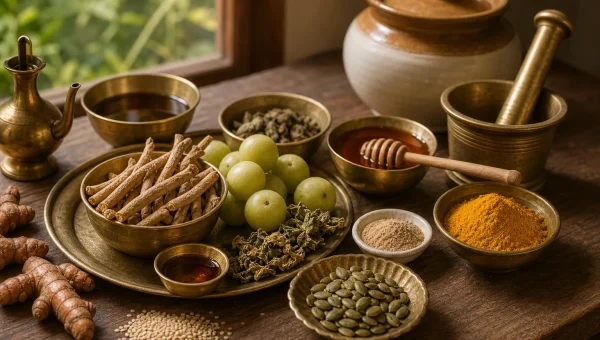
The foods and herbs below are not magic shortcuts. They are traditional, nourishing choices used in Ayurveda for strength, restoration, tissue support, and recovery when digestion is strong enough to handle them. Use them alongside progressive resistance training, adequate total protein, enough calories, and good sleep.
1. Ghee (Clarified Butter)
Ghee is valued in Ayurveda as an unctuous, nourishing fat. In practical muscle-building terms, it adds concentrated calories to warm meals, improves the palatability of simple foods like rice and dal, and supports the Ayurvedic principle of snehana, or internal unctuousness, when used in moderation.
How to use it: Use 1 to 3 teaspoons per day according to appetite, digestion, training volume, and total calorie needs. Stir it into rice, dal, khichdi, millet porridge, or warm rotis. Avoid burning it or using it to rescue a diet that is otherwise low in quality protein and whole foods.
Why it matters for muscle: Hard training increases the need for both fuel and recovery. Ghee does not replace protein, but it can help under-eating lifters bring meals up to a more nourishing, tissue-building level without relying only on powders and packaged calories.
2. Urad Dal / Masha (Black Gram)
Urad dal is one of the heavier and more strengthening pulses in the Indian kitchen. Dry black gram provides roughly one-quarter of its weight as protein, and classical Ayurvedic formulations use masha with milk, ghee, and other strengthening ingredients in vajikarana and strength-promoting contexts.
How to use it: Prepare slow-cooked whole black urad, urad dal khichdi, idli or dosa batter, or a lighter dal made with ginger, cumin, hing, and a little ghee. For many people, 1 cup cooked at lunch, 2 to 4 times per week, is a better starting point than eating it daily.
Timing tip: Eat urad dal earlier in the day, preferably at lunch, when digestion is usually strongest. If it causes bloating, heaviness, or sluggishness, reduce the portion, cook it longer, use digestive spices, or rotate with lighter pulses such as mung dal.
3. Ashwagandha (Withania somnifera)
Ashwagandha is one of Ayurveda’s best-known rasayana herbs and is listed in the Ayurvedic Pharmacopoeia of India as Balya, Rasayana, and Vajikarana. For lifters, its traditional role fits best when the issue is stress load, poor recovery, sleep disruption, or depletion rather than lack of protein alone.
Dosage: The Ayurvedic Pharmacopoeia lists 3 to 6 grams of root powder as an adult oral dose range. A common modern extract schedule used in resistance-training trials is 300 mg of standardized root extract twice daily. Powder is often taken with warm milk, while extracts should be used according to product quality and practitioner guidance.
The Ayurvedic angle: Ashwagandha is warming, strengthening, and Vata-Kapha pacifying. It is not a stimulant pre-workout. It is better understood as a restorative herb for people who are training hard, sleeping too little, and running on stress.
4. Shatavari (Asparagus racemosus)
Shatavari is often marketed for women, but Ayurveda does not limit its nourishing use to women alone. The Ayurvedic Pharmacopoeia lists Shatavari as Balya, Rasayana, Vrishya, Shukrala, and Medhya, with sweet, unctuous, cooling, and heavy qualities.
Dosage: The Ayurvedic Pharmacopoeia lists 3 to 6 grams of root powder as an adult oral dose range. For daily kitchen-style use, many people begin with about 1/2 teaspoon in warm milk or warm water, preferably with professional guidance if combining it with other herbs.
Why it belongs here: Shatavari is cooling and nourishing. It fits people who feel depleted, dry, overheated, or run down from training and stress. It is especially useful in a program that needs recovery support without adding more heat to the system.
5. Sesame Seeds (Til)
Sesame is dense, oily, mineral-rich, and traditionally valued for Vata-pacifying nourishment. The Ayurvedic Pharmacopoeia lists Tila as Balya, Rasayana, Vataghna, Snehana, Agnivardhaka, and Vajikara, with heavy, unctuous, subtle, and warming qualities.
How to use it: Use 1 to 2 teaspoons daily to start, or up to about 5 to 10 grams if digestion is comfortable. Add toasted sesame to rice, dal, vegetables, chutneys, tahini-style sauces, or traditional til preparations. Black sesame is often preferred in traditional use, while white sesame is easier for many people to include regularly.
Seasonal note: Sesame is warming and unctuous, making it especially suitable in cold, dry, Vata-dominant seasons. In peak heat, or if you already have acidity, rashes, or excess body heat, use smaller amounts or rotate with cooler fats.
6. Warm Milk Prepared the Ayurvedic Way
Milk is described in classical Ayurveda as sweet, unctuous, cooling, body-promoting, strength-promoting, and supportive of ojas. For muscle-building diets, warm milk can be a simple calorie, protein, and mineral carrier when it is well tolerated and digested comfortably.
The protocol: Bring 1 cup of whole cow’s milk to a gentle boil. Add a pinch of turmeric, a pinch of dried ginger, and a little cardamom or nutmeg. Simmer briefly, then let it cool to drinking temperature. Add ghee if you need extra calories. Do not boil honey into milk; if sweetness is needed, use dates, a small amount of raw sugar, or jaggery according to tolerance.
When to drink it: Use it in the evening or before bed if it improves sleep and does not cause heaviness, congestion, reflux, or bloating. If milk does not suit you, do not force it; choose well-cooked food and other nourishing options instead.
7. Dates (Kharjura)
Dates are one of the clearest fits for a strength-building Ayurvedic food. The Ayurvedic Pharmacopoeia lists dried Kharjura as Balya, Brimhana, Vrishya, Tarpana, and Vatahara; fresh Kharjura is also listed as Mamsavardhaka, meaning supportive of muscle tissue in Ayurvedic dietetics.
How to use them: Eat 2 to 4 dates depending on size, appetite, and training demands. They can be taken before training for quick carbohydrate energy, blended into warm milk after training, or paired with soaked almonds for a compact snack.
Avoid or limit dates if: You are managing diabetes, insulin resistance, fatty liver, or a calorie-restricted fat-loss phase. Dates are natural, but they are still sugar-dense and should match your metabolic needs.
8. Almonds (Badam)
Almonds are not a classical shortcut to muscle, but they are a useful nourishing food: calorie-dense, rich in fat, and a source of plant protein, fiber, magnesium, and other micronutrients. In an Ayurvedic-style routine, they are best used as a steady support food rather than a high-volume protein replacement.
Dosage: Use 6 to 10 almonds daily. Soak them overnight, peel them in the morning if desired, and chew well. The soaking step softens the almond and makes the traditional preparation gentler for many people.
How to use them: Eat them with dates as a pre-workout snack, grind them into warm milk with cardamom, or add almond paste to porridge. If you are prone to heaviness, acne flares, or slow digestion, keep the portion small.
9. Vidari Kanda (Pueraria tuberosa)
Vidari Kanda is a sweet, heavy, unctuous tuber used in Ayurveda for nourishment and restoration. The Ayurvedic Pharmacopoeia lists it as Balya, Rasayana, Vatahara, Jivaniya, and Brimhaniya, making it one of the more directly relevant traditional herbs for tissue-building support.
Dosage: The Ayurvedic Pharmacopoeia lists 3 to 6 grams of powder as an adult oral dose range. A practical starting amount is about 1/2 teaspoon in warm milk or warm water, used under guidance if you are also taking Ashwagandha, Shatavari, or other restorative herbs.
Where it fits: Vidari is cooling, sweet, and building. It suits depleted, dry, overtrained, or undernourished patterns better than sluggish, congested, or very Kapha-heavy patterns. Buy it only from reputable Ayurvedic suppliers that provide correct botanical identification.
10. Mung Bean Sprouts
Mung bean sprouts are lighter than urad dal and can help add variety to a muscle-building diet. Sprouting pulses can reduce phytate and improve protein digestibility, but raw sprouts also carry food-safety risk, so Ayurveda’s preference for lightly cooked, warm food is practical here.
How to sprout: Soak whole green mung beans for 8 to 10 hours. Drain, rinse, and keep them in a clean damp cloth or sprouting jar. Rinse twice daily until short sprouts appear, usually within 24 to 48 hours depending on temperature.
How to eat them: Steam or lightly cook them rather than eating them raw. Toss with cumin, black pepper, rock salt, lemon, and a little ghee. Use about 1 cup, 2 to 4 times per week, according to appetite and digestion.
Putting It All Together: A Sample Day
This sample day shows how the foods can be integrated without turning the routine into an herb-heavy protocol. Portions should be adjusted for body size, training phase, appetite, and digestion.
| Time | Meal | Muscle-Building Foods Included |
|---|---|---|
| 7:00 AM | Warm milk with 6 to 8 soaked almonds | Milk, almonds |
| 8:00 AM | Training session | |
| 9:30 AM | Dates with almonds or warm milk after training | Dates, milk, almonds |
| 12:30 PM | Rice or roti with ghee, urad dal, and cooked vegetables | Ghee, urad dal |
| 4:00 PM | Fruit with toasted sesame or sesame chutney | Sesame seeds |
| 7:30 PM | Rice, khichdi, or vegetables cooked with digestive spices | Ghee, warm cooked food |
| 9:30 PM | Warm milk with Ashwagandha or Vidari if appropriate | Milk, Ashwagandha or Vidari |
The Principle That Changes Everything
The core Ayurvedic idea is simple: digestion determines how well intake becomes tissue. A high-calorie, high-protein diet can still feel wrong if it creates bloating, coated tongue, heaviness, reflux, poor appetite, or sluggish elimination. Those are signs to simplify the diet, cook food more thoroughly, reduce heavy combinations, and rebuild agni.
Protect your digestion by eating mostly warm cooked meals, chewing thoroughly, avoiding large amounts of cold water with meals, leaving comfortable gaps between meals, and using spices such as ginger, cumin, black pepper, ajwain, and hing where appropriate. If you want to use stronger digestive formulas such as Trikatu, consult a qualified Ayurvedic practitioner rather than self-dosing aggressively.
What to Watch Over 8 to 12 Weeks
Ayurvedic muscle building is not meant to feel like forced bulking. The right signs are steadier appetite, less bloating, better sleep, improved training recovery, stable energy, and gradual increases in strength and muscle fullness when resistance training is consistent.
- First 1 to 2 weeks: Digestion should feel calmer, meals should feel more satisfying, and sleep may improve if evening routines are simplified.
- Weeks 3 to 6: Recovery may feel steadier as calorie intake, warm meals, and sleep become more consistent.
- Weeks 8 to 12: Visible muscle change depends on training quality, total calories, protein, hormones, and consistency, but this is a realistic window to judge whether the routine is supporting strength rather than just adding heaviness.
Disclaimer: This article is for general wellness information and is not a substitute for professional nutritional, medical, or Ayurvedic advice. Consult a qualified healthcare provider or Ayurvedic practitioner if you have diabetes, kidney disease, liver disease, thyroid disease, digestive disorders, food allergies, autoimmune conditions, are pregnant or breastfeeding, take medications, or plan to use herbs such as Ashwagandha, Shatavari, or Vidari Kanda regularly.
Macros still matter, but Ayurveda asks a deeper question: can your body digest, absorb, transform, and stabilize what you eat? Choose three foods from this list, use them consistently, keep training progressively, and let better digestion become the foundation for better muscle.
References
- Concepts of Dhatu Siddhanta (theory of tissues formation and differentiation) and Rasayana; probable predecessor of stem cell therapy (2014), PubMed Central
- Ayurvedic Pharmacopoeia of India
- Rkamc (rkamc.org.in)
- Nin (nin.res.in)
- Examining the effect of Withania somnifera supplementation on muscle strength and recovery: a randomized controlled trial (2015), PubMed Central
- NCCIH
- Natural Ingredient Resource Center
- Fdc (fdc.nal.usda.gov)
- Almonds (Prunus Dulcis Mill. D. A. Webb): A Source of Nutrients and Health-Promoting Compounds (2020), PubMed Central
- Ayurvedic Pharmacopoeia of India
- Link (link.springer.com)
- Archive (archive.cdc.gov)
I came for 10 Ayurvedic Muscle-Building Foods You’re Probably Not and this answered the main question. Would be useful to see a short checklist next.
I keep coming back to this article. There’s always something new I pick up on each read.
I work in healthcare and appreciate the balanced approach here. Not anti-medicine, just complementary
The Mamsa Dhatu building principle here explains why some people build muscle better on moderate rather than high protein. If agni cannot process large protein loads efficiently, the excess creates ama rather than tissue. I have experienced exactly this pattern.
This helped me understand 10 Ayurvedic Muscle-Building Foods You’re Probably Not without too much jargon. This feels more usable than a long list of herbs.
I am a competitive weightlifter and was skeptical about cooking time versus post-workout timing. But the warm sesame milk with saffron and dates as a recovery food is something I have been using for 3 months. My coach has noticed my recovery speed has improved. Not attributing everything to one food but it is part of a changed protocol.
Thank you for the kind words! It’s readers like you who motivate us to keep producing well-researched content.
having studied both Ayurveda and Western nutrition, I think this article overstates some benefits while ignoring well-established nutritional science.
step by step is great, makes it way more doable than other articles ive read
I came for 10 Ayurvedic Muscle-Building Foods You’re Probably Not and this answered the main question. The article avoids making it sound like a quick fix.
Thank you for sharing your experience, it’s important that readers see the full range of outcomes, not just success stories. Not every approach works for everyone.
I want to know the actual protein content per serving of each food recommended here. Mung dal is approximately 24g protein per 100g dry, which is competitive with conventional sources. But the Ayurvedic foods are presented by therapeutic category rather than macronutrient content.
I came for 10 Ayurvedic Muscle-Building Foods You’re Probably Not and this answered the main question. The timing advice is the part I would start with.
I came for 10 Ayurvedic Muscle-Building Foods You’re Probably Not and this answered the main question. This would be easier to follow with a one-week sample plan.
I came for 10 Ayurvedic Muscle-Building Foods You’re Probably Not and this answered the main question. The safety notes could be expanded a little.
I came for 10 Ayurvedic Muscle-Building Foods You’re Probably Not and this answered the main question. The main idea is clear even if someone is new to Ayurveda.
I never realized ghee could help shuttle amino acids into muscle tissue; adding a teaspoon to my rice changed how I feel after lifts.
I came for 10 Ayurvedic Muscle-Building Foods You’re Probably Not and this answered the main question. This feels more usable than a long list of herbs.
Has anyone tried urad dal dosa batter as a post-workout meal? It feels heavier than moong dal and keeps me full longer.
Ashwagandha at bedtime with warm milk seems to lower my morning stiffness, though I wonder if the effect is just better sleep.
Shatavari is new to me; mixing half a teaspoon into my nightly milk gave a subtle energy lift without jitters.
Sesame seeds sprinkled on salads give a nice crunch and I noticed my knees feel less creaky during squats.
Boiling milk with turmeric, ginger, and nutmeg before bed feels like a ritual; the added ghee makes it richer and easier to digest.
Stuffed dates with almond and ghee work well as a pre-run snack, delivering quick sugar and lasting fuel.
I soaked almonds overnight, peeled them, and blended into milk; the texture is smoother and I don’t get the usual heaviness.