
Rasayana and Modern Anti-Aging: Comparing Ayurvedic Rejuvenation With Geroscience
Rasayana is Ayurveda’s classical discipline of promotive and rejuvenative care. Modern geroscience, by contrast, studies the biological processes that contribute to aging and tests interventions against measurable cellular and clinical outcomes. A 2020 review in the Journal of Clinical Medicine, “Telomeres, DNA Damage and Ageing: Potential Leads from Ayurvedic Rasayana (Anti-Ageing) Drugs,” brought these fields into dialogue by examining telomere biology, DNA damage, oxidative stress and selected Rasayana substances. The paper is a translational review and does not report a clinical trial of human lifespan extension.
The two frameworks can be compared usefully when their terms are kept distinct. Geroscience describes molecular mechanisms such as genomic instability or cellular senescence. Ayurveda describes health through concepts such as agni, dhatu, srotas, constitution, strength, conduct and suitability of treatment. Laboratory findings may generate hypotheses about a herb, but they do not make an Ayurvedic category identical to a modern biomarker.
Modern Geroscience and the Hallmarks of Aging
The influential 2013 “Hallmarks of Aging” paper organized aging biology into nine interacting processes. A 2023 update expanded the framework to twelve hallmarks, reflecting developments in autophagy, inflammation and microbiome science:
- Genomic instability
- Telomere attrition
- Epigenetic alterations
- Loss of proteostasis
- Disabled macroautophagy
- Deregulated nutrient sensing
- Mitochondrial dysfunction
- Cellular senescence
- Stem-cell exhaustion
- Altered intercellular communication
- Chronic inflammation
- Dysbiosis
These hallmarks are a research framework, not a checklist that establishes whether a supplement extends life. Metformin, rapamycin and related mTOR inhibitors, NAD+ precursors, senolytics and other agents are being investigated in translational geroscience. Their effects on a pathway, laboratory marker or disease-related endpoint must be distinguished from demonstrated extension of healthy human lifespan.
Rasayana in the Charaka Samhita
Charaka Samhita, Chikitsa Sthana 1.1.7–8, describes Rasayana by its intended outcomes and as a means of obtaining excellent qualities of rasa and the subsequent dhatus. The passage associates Rasayana with longevity, memory, intellect, freedom from illness, youthful age, lustre, complexion, excellence of voice, strength of the body and senses, effective speech, respectability and brilliance. The correct expression is svaraudarya, excellence or fullness of voice; svarabheda denotes a disorder of the voice and is not listed as a Rasayana benefit.
- Dirgham ayuh: longevity
- Smriti and medha: memory and intellect
- Arogya: freedom from illness
- Tarunam vayah: youthful age
- Prabha, varna and svaraudarya: lustre, complexion and excellence of voice
- Dehendriya bala: strength of the body and senses
Classical Rasayana is broader than taking a single capsule. Charaka describes kutipraveshika, a highly regulated indoor method, and vatatapika, an outdoor method. The chapter also presents Achara Rasayana: conduct involving truthfulness, freedom from anger, nonviolence, calm speech, cleanliness, charity, compassion, self-restraint and balanced sleep and wakefulness. These elements place diet, behaviour, environment and supervision within the therapy itself.
Where the Two Frameworks Meet—and Where They Differ
Rasayana and geroscience overlap most clearly at the level of research questions: protection from cellular stress, preservation of function, cognition, metabolic regulation and resilience during aging. Their explanatory systems and standards of assessment remain different, so a correspondence should be treated as a possible bridge rather than a one-to-one translation.
| Topic | Modern geroscience | Verified Rasayana-related observation | Interpretation |
|---|---|---|---|
| Telomere biology | Examines telomere attrition, telomerase regulation and cellular senescence. | A small human study of Amalaki Rasayana reported increased telomerase activity after administration but no discernible change in telomere length. | A preliminary biomarker finding; the study did not measure human lifespan. |
| Stress and sleep | Studies neuroendocrine stress responses, sleep quality and their relation to health. | Ashwagandha is classified in the Ayurvedic Pharmacopoeia as Rasayana and Balya; short-term human trials have evaluated extracts for stress and sleep. | Relevant to symptoms and function, but separate from lifespan extension. |
| Cognition | Measures memory, attention, processing and neurodegenerative outcomes. | Brahmi is classified as Medhya and Rasayana; clinical reviews report a possible benefit for memory free recall after sustained use. | It is not established as a treatment that prevents or reverses dementia. |
| Whole-person regimen | Evaluates diet, activity, sleep and risk-factor modification alongside medicines. | Classical Rasayana includes regulated regimen, conduct, suitability and practitioner supervision. | This is a systems-level therapeutic model, not a single molecular target. |
| Identity and quality | Requires defined material, dose, manufacturing controls and adverse-event monitoring. | The Ayurvedic Pharmacopoeia specifies botanical identity, plant part, purity tests and dose ranges for listed single drugs. | Traditional names alone do not guarantee that two products are equivalent. |
Five Rasayana Examples With Corrected Classical and Scientific Context
The herbs and formulations below illustrate different parts of the Rasayana tradition. Their classical classifications, pharmacopoeial plant parts and modern findings should be stated separately so that traditional use is not confused with a demonstrated anti-aging drug effect.
Ashwagandha (Withania somnifera)
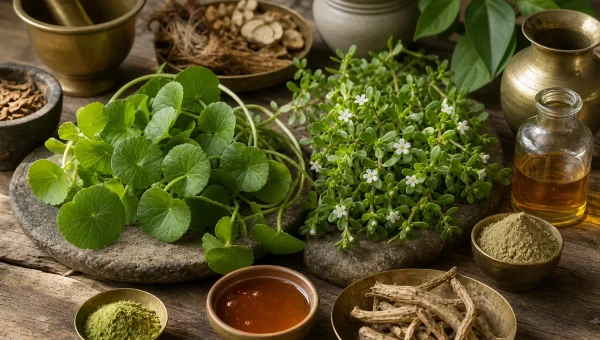
The Ayurvedic Pharmacopoeia identifies Ashwagandha as the dried mature root of Withania somnifera. It assigns tikta and kashaya rasa, laghu guna, ushna virya and madhura vipaka, with actions including Rasayana, Balya, Vajikarana and alleviation of Vata and Kapha. An in-vitro report found increased telomerase activity in HeLa cells exposed to Ashwagandha extract, but HeLa is a human cancer-cell line and the experiment does not establish safe telomerase activation in healthy people. A separate C. elegans study reported approximately 20% lifespan extension with a root extract in that worm model. Human studies are more relevant to stress and sleep outcomes than to longevity.
Amalaki (Phyllanthus emblica) and Amalaki Rasayana
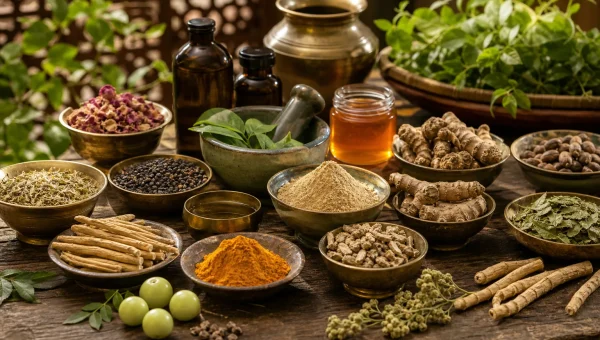
The Pharmacopoeia describes Amalaki as possessing five tastes—madhura, amla, katu, tikta and kashaya, excluding salty taste—with laghu and ruksha guna, shita virya and madhura vipaka. It classifies the fruit as Rasayana and tridoshajit. Amalaki is central to several classical preparations, including Chyavanaprasha. In a small study of healthy adults aged 45–60 years, Amalaki Rasayana was administered for 45 days after a preparatory procedure; telomerase activity increased, while telomere length did not show a discernible change during the study period. The measured outcome supports further investigation of the formulation but does not establish telomere lengthening or lifespan extension.
Brahmi (Bacopa monnieri)
The Ayurvedic Pharmacopoeia identifies Brahmi as the dried whole plant of Bacopa monnieri. Its profile is madhura, tikta and kashaya rasa; laghu and sara guna; shita virya; and madhura vipaka. Its listed actions include Medhya, Rasayana, Ayushya and Matiprada. Systematic reviews of human trials have found the most consistent cognitive signal in memory free recall, generally after repeated use over several weeks. Preclinical findings concerning amyloid, neurogenesis or neuronal protection should not be presented as demonstrated clinical effects in Alzheimer’s disease.
Chyavanaprasha
Charaka’s Chyavanaprasha is an avaleha formulation centered on Amalaki and prepared with a large group of decoction drugs, ghee, sesame oil, sugar, honey and aromatic finishing ingredients. The classical formula is not accurately reduced to a universally fixed marketing claim such as “43 herbs,” because textual editions and commercial standards must be identified specifically. Charaka advises taking an amount that does not interfere with normal food intake and digestion. This makes digestive capacity and the complete formulation more relevant than a blanket instruction to take a fixed teaspoon on an empty stomach.
Shilajatu (Shilajit)
Charaka Samhita includes Shilajatu among Rasayana preparations. Modern descriptions often emphasize fulvic substances and mitochondrial theories, but claims that Shilajit directly acts as a clinically proven electron carrier or restores mitochondrial membrane potential in aging humans exceed available human findings. Raw or poorly characterized material can contain unwanted substances, including heavy metals or mycotoxins. Only purified, authenticated and contaminant-tested material should be considered, under professional guidance.
Classical Dose Ranges Are Not Universal Anti-Aging Prescriptions
Pharmacopoeial doses refer to specified crude drugs and plant parts, usually for adults, and serve as general professional guidance. They are not interchangeable with concentrated extracts, proprietary products or multi-ingredient formulations. Individual assessment remains necessary because preparation, digestive capacity, age, constitution, disease, medicines and accompanying substances can alter suitability.
| Substance | Verified material | Published classical or pharmacopoeial guidance | Important limitation |
|---|---|---|---|
| Ashwagandha | Dried mature root powder | 3–6 g | Does not define an equivalent dose for every standardized extract. |
| Amalaki, dried | Pericarp of dried mature fruit | 3–6 g powder | Not equivalent to fresh fruit, juice or concentrated extract. |
| Amalaki, fresh | Fresh fruit pulp | 10–20 g, or 5–10 mL fresh juice | Suitability varies with digestion and the therapeutic context. |
| Brahmi | Dried whole plant of Bacopa monnieri | 1–3 g powder | The name “Brahmi” should be accompanied by the botanical species. |
| Chyavanaprasha | Complete classical avaleha | An amount that does not hinder food intake or digestion | Commercial recipes and serving sizes vary. |
| Shilajatu | Purified and tested material | Practitioner-directed | Raw material and unverified online products are inappropriate for self-treatment. |
What Rasayana Contributes to Healthy-Aging Practice
Rasayana contributes a structured view of rejuvenation in which medicine, diet, digestion, behaviour, environment and mental discipline are coordinated. Its distinct value lies in this therapeutic architecture rather than in forcing every classical term into a modern biochemical equivalent.
- Individualization: the substance and regimen are selected according to the person, digestive capacity, suitability and clinical context.
- Preparation and supervision: intensive methods such as kutipraveshika are regulated procedures, not home supplement routines.
- Behavioural discipline: Achara Rasayana makes sleep, restraint, truthful conduct, calm speech and compassion part of rejuvenative care.
- Formulation logic: classical compounds combine ingredients, processing methods and vehicles; they cannot be evaluated by naming one fashionable constituent alone.
What Modern Biology Contributes
Modern geroscience contributes precise definitions, laboratory assays, clinical endpoints, controlled comparisons and pharmacovigilance. It can determine whether an intervention changes a biomarker, improves a meaningful function, causes adverse effects or performs better than placebo or standard care. It also supplies analytical methods for confirming species, detecting adulteration and measuring microbial or heavy-metal contamination. These tools strengthen the safe study of traditional medicines without turning a biomarker change into a claim of human rejuvenation.
Safety and Clinical Boundaries
Rasayana substances are pharmacologically active and should not be treated as universally benign foods. Product identity, plant part, preparation, dose, duration, medical history and concurrent medicines all matter. Anti-aging language must never delay diagnosis or established treatment of fatigue, weight change, cognitive symptoms, sleep disturbance, endocrine disease or other health concerns.
Important: Consult a qualified Ayurvedic practitioner and an appropriate healthcare provider before beginning a Rasayana regimen, especially during pregnancy or breastfeeding, in children or older adults, or when liver, thyroid, autoimmune, metabolic or neurological conditions are present. Ashwagandha can cause gastrointestinal effects or drowsiness, has been associated with rare liver injury, may affect thyroid function and may interact with sedatives, immunosuppressants, blood-pressure medicines and diabetes medicines. Ayurvedic products may be contaminated or may intentionally contain metals; choose products with clear identity, batch testing and regulatory-quality manufacturing. Use Shilajit only when purified and independently tested. Rasayana should not be represented as proven to extend human lifespan.
A Responsible Starting Point
A sound first step is not a multi-herb “anti-aging stack.” Begin with a professional assessment, define the goal in practical terms—such as sleep, appetite, strength, recovery or memory—and choose one correctly identified preparation whose ingredients, plant parts, batch number and testing are disclosed. Review medicines and medical conditions before use, follow a time-limited plan, and monitor both benefits and adverse effects. For Chyavanaprasha or another compound Rasayana, use the practitioner’s product-specific guidance rather than assuming that every commercial version has the same composition or dose.
Research References
The following sources establish the classical passages, pharmacopoeial profiles, modern aging framework, preliminary clinical findings and safety boundaries used in this comparison:
- Telomeres, DNA Damage and Ageing: Potential Leads from Ayurvedic Rasayana (Anti-Ageing) Drugs
- The Hallmarks of Aging (2013)
- Hallmarks of Aging: An Expanding Universe (2023)
- Charaka Samhita, Rasayana Adhyaya
- The Ayurvedic Pharmacopoeia of India, Part I, Volume I
- The Ayurvedic Pharmacopoeia of India, Part I, Volume II
- Influence of Amalaki Rasayana on Telomerase Activity and Telomere Length
- NIH Office of Dietary Supplements: Ashwagandha
- The Cognitive-Enhancing Effects of Bacopa monnieri: A Systematic Review
- Shilajit: Composition and Purification-Related Safety
References
- Telomeres, DNA Damage and Ageing: Potential Leads from Ayurvedic Rasayana (Anti-Ageing) Drugs (2020), PubMed
- The hallmarks of aging (2013), PubMed
- Hallmarks of aging: An expanding universe (2023), PubMed
- Rewinding the Clock: Emerging Pharmacological Strategies for Human Anti-Aging Therapy (2025), PubMed Central
- Charaka Samhita — Rasayana Adhyaya
- Influence of Amalaki Rasayana on telomerase activity and telomere length in human blood mononuclear cells (2017), PubMed Central
- Ayurvedic Pharmacopoeia of India
- Scirp (scirp.org)
- Withania somnifera root extract extends lifespan of Caenorhabditis elegans (2013), PubMed
- Withania somnifera root extract extends lifespan of Caenorhabditis elegans (2013), PubMed Central
- Ayurvedic Pharmacopoeia of India
- The cognitive-enhancing effects of Bacopa monnieri: a systematic review of randomized, controlled human clinical trials (2012), PubMed
- Use of Bacopa monnieri in the Treatment of Dementia Due to Alzheimer Disease: Systematic Review of Randomized Controlled Trials (2022), PubMed Central
- Shilajit: a natural phytocomplex with potential procognitive activity (2012), PubMed Central
- NIH Office of Dietary Supplements
- NCCIH
The telomere-Rasayana herb connection is the kind of mechanistic bridge that helps me take Ayurveda seriously in a scientific context. I am a biologist by training and the withanolide-telomerase interaction is a legitimate research question that the 2020 paper addresses with reasonable methodology. This is not marginal science.
The anti-aging industry is full of expensive interventions with minimal evidence. The Rasayana comparison here, showing that some Ayurvedic compounds are working on similar pathways to the most studied anti-aging drugs, raises an interesting question about cost-effectiveness. Ashwagandha costs a fraction of what many longevity supplement companies charge for less well-studied compounds.
I was looking for a plain explanation of Rasayana vs Anti-Aging. The article avoids making it sound like a quick fix.
Is there a difference in efficacy between the churna form and capsules for rasayana? I’ve heard the powder absorbs differently.
I have been on a Rasayana protocol of ashwagandha, amalaki, and Chyawanprash for 3 years now since my 50th birthday. My inflammatory markers CRP and homocysteine have both decreased over that period compared to my pre-protocol baseline. I cannot attribute this causally but the direction is consistent with what the article describes.
The comparison between Rasayana as a Ayurvedic system and the modern longevity field which focuses on mTOR, AMPK, and NAD pathways is valuable. The Rasayana emphasis on tissue quality rather than just biomarkers aligns more closely with what geroscience is now calling biological age versus chronological age.
The comparison of telomerase activity changes in Amalaki Rasayana with the lack of telomere length shift is interesting.
I was looking for a plain explanation of Rasayana vs Anti-Aging. The safety notes could be expanded a little.
I wonder how the hallmarks of aging update from nine to twelve affects the way Ayurvedic concepts are mapped.
I want to be direct: most of the longevity supplement industry, including many Ayurvedic preparations marketed as anti-aging, is ahead of the evidence. This article is more careful than most but readers should understand that the mechanistic research, while interesting, has not been translated into clinical anti-aging endpoints in humans for most of these compounds.
It’s helpful that the article clarifies that laboratory findings on herbs don’t equal a proven anti aging drug.
What is the minimum sensible Rasayana practice for someone who cannot afford the full protocol? If I can only add one herb for tissue preservation at 48, what does the evidence suggest it should be, and what are the practical dosing recommendations?
The PubMed paper on telomeres is what made me take this seriously rather than skimming past. I’d seen Rasayana mentioned in wellness content before but always in vague terms. Having a peer-reviewed mechanism — actual molecular overlap rather than analogy — changes the conversation. My question is whether the research distinguishes between individual Rasayana herbs like Ashwagandha and Amalaki, or is it looking at the category as a whole?
The section on Chyavanaprasha notes that fixing a universal teaspoon dose overlooks digestive capacity.
Ashwagandha’s effect on HeLa cells raises questions about relevance to healthy human tissue.
Does the article suggest that Achara Rasayana could complement modern lifestyle interventions?
The distinction between classical Rasayana regimens and isolated supplement use feels important for safety.
I found the explanation of svaraudarya versus svarabheda a neat linguistic detail.
The warning about Shilajit contamination reminds me to check for third party testing.
It’s useful that the piece separates biomarker changes from actual lifespan extension claims.
The mention of Brahmi’s consistent signal in free recall memory matches what I’ve seen in other reviews.
I appreciate the note that Rasayana includes conduct, diet, and environment, not just herbs.
The article’s caution about using Rasayana language to delay medical advice feels responsible.
The telomere research is early-stage and mostly in vitro. Extrapolating from ashwagandha activating telomerase in cell cultures to human anti-aging effects is a substantial leap that the article makes without adequately flagging how large that gap is.
How does the Rasayana approach change for someone who has had cancer and is concerned about anything that might stimulate cell growth? The telomerase-stimulating effect described is presumably a double-edged sword in the context of cancer history.
What is the classical Ayurvedic definition of biological aging and does it correspond to what geroscience calls cellular senescence? The article maps the two without clearly establishing whether the original texts had a cellular concept of aging or whether the mapping is retrospective.
cancer history here. telomerase-stimulating effect is presumably double-edged in that context. has anyone addressed this specifically?
the telomere research is early-stage and mostly in vitro. cell culture to human anti-aging is a substantial leap the article doesn’t adequately flag 🌿
The safest part of the Rasayana vs Anti-Aging advice is keeping it simple. The main idea is clear even if someone is new to Ayurveda.