
A commonly repeated account says that researchers at Banaras Hindu University recruited 53 people, assigned their prakriti through three independent physicians, and proved that vata, pitta, and kapha have clearly different gut microbiomes. The published study behind the number 53 was instead conducted with participants from the Vadu Health and Demographic Surveillance System near Pune. Prakriti was assessed in 53 people, but gut, oral, and skin samples from only 18—six in each predominant group—were included in the microbiome analysis. Its findings were preliminary differences in the abundance of a few bacterial genera, not proof of three fixed “dosha microbiomes.”
The Gut Microbiome: A Careful Primer
The gut microbiota is the community of microorganisms living in the gastrointestinal tract, while “microbiome” commonly includes their genes and ecological functions. A revised estimate placed the bacterial population of a reference adult near 38 trillion, but this is not a universal count. Gut microbes ferment substrates that human enzymes do not fully digest, produce short-chain fatty acids, interact with the intestinal barrier and immunity, and participate in gut–brain signalling.
Microbiome composition varies with age, diet, medicines—especially antibiotics—geography, environment, bowel transit, health status, and laboratory method. It can also vary over time within one person. These influences make constitution research difficult: an association between a prakriti group and a bacterium does not show that the dosha caused the organism, that the organism explains the constitution, or that changing the organism will change prakriti.
What the Prakriti Studies Actually Reported
The 2015 CSIR-Institute of Genomics and Integrative Biology publication frequently mentioned in this discussion was a genome-wide analysis of prakriti, not a gut-microbiome trial. It reported genetic associations in strongly predominant constitutional groups. A larger gut study appeared in 2018 and examined adults from a relatively homogeneous rural population in Pune district using 16S rRNA gene sequencing. Investigators identified 135 people with extreme prakriti and analyzed 113 male and female samples after quality filtering.
| Study | Verified finding | What it did not establish |
|---|---|---|
| 2018 Vadu gut study | Bacteroidetes and Firmicutes were the main phyla across all groups and together represented more than 98 percent of measured abundance. Overall community composition was broadly similar at prakriti level, although selected core taxa differed by constitution and sex. | It did not demonstrate universally low diversity in vata, inflammatory Proteobacteria dominance in pitta, or superior calorie extraction and weight gain in kapha. |
| 2019 gut, oral, and skin study | Among 18 analyzed participants, differential abundance of five gut genera—Bacteroides, Desulfovibrio, Parabacteroides, Slackia, and Succinivibrio—was reported across the groups. | Six people per group cannot define a universal microbial profile or justify constitution-specific treatment. |
| 2021 gut and oral study | Metagenomes from 272 healthy participants showed a shared core microbiome. The authors reported preferential presence of Paraprevotella and Christensenellaceae in vata participants. | The study did not validate a stool test, probiotic, diet, or herbal prescription for diagnosing or treating a dosha. |
These studies are exploratory evidence that selected microbial features may differ among carefully selected constitutional groups. They do not show that every person of one prakriti carries the same organisms. The signatures differ between cohorts, so independent replication, standardized assessment, dietary control, and clinical outcomes remain necessary.
Agni and Koshtha Are Ayurvedic Clinical Concepts
Charaka Samhita, Vimana Sthana 6/12, describes four states of bodily agni according to strength: tikshna, manda, sama, and vishama. The same passage associates vishama agni with vata predominance, tikshna agni with pitta predominance, manda agni with kapha predominance, and sama agni with a balanced state of the doshas. This is a classical functional classification of digestion; it is not a measurement of intestinal pH, bacterial diversity, transit time, or a Firmicutes-to-Bacteroidetes ratio.
Ayurveda also assesses koshtha, broadly referring to bowel responsiveness. Classical use distinguishes harder or less responsive, softer or more responsive, and intermediate patterns. Agni and koshtha are considered with appetite, stool, symptoms, strength, age, season, diet, disease, and current doshic disturbance. Equating vata with dysbiosis, pitta with intestinal acidity, or kapha with over-fermentation is neither a faithful classical interpretation nor a result of the microbiome studies.
Ayurvedic Herbs: What Can and Cannot Be Claimed
The Ayurvedic Pharmacopoeia of India provides official monographs for the identity, purity, and quality of medicinal substances. A pharmacopoeial monograph does not by itself prove that an herb changes the human microbiome, treats inflammatory bowel disease, or suits everyone of a given prakriti. Traditional indication, laboratory antimicrobial activity, animal research, and controlled human evidence should not be treated as interchangeable.
Triphala
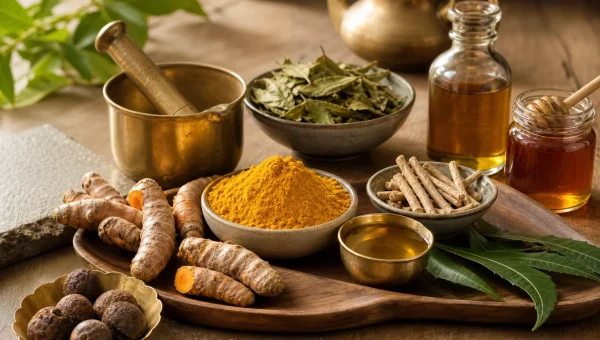
Triphala is a three-fruit formulation prepared from haritaki, bibhitaka, and amalaki. Reviews discuss laboratory, animal, and limited human research on gastrointestinal and metabolic effects, while in-vitro fermentation studies suggest that Triphala can interact with fecal microbial communities. These findings do not establish that it reliably increases microbiome diversity in humans, works equally in all constitutions, or requires a fixed 60-day course. Loose stools have been reported in clinical research, so it is not a universal nightly remedy for anyone with diarrhoea, dehydration, abdominal pain, or an undiagnosed bowel disorder.
Shatavari, Vidanga, Kutaja, Amalaki, and Neem
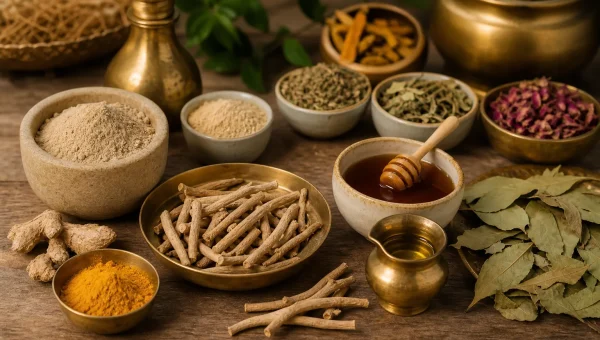
These plants have recognized identities and traditional uses. Human trials have not shown that shatavari selectively raises diversity, vidanga removes only harmful organisms, kutaja converts a pitta microbiome toward Bacteroidetes, amalaki selectively suppresses Clostridioides difficile in patients, or neem creates a “leaner” community. Persistent diarrhoea, blood in stool, suspected parasites, or inflammatory bowel disease requires diagnosis rather than empirical antimicrobial herbs.
Guduchi
Guduchi (Tinospora cordifolia) is used in Ayurveda and has been studied for immunological and inflammatory effects, but no verified human evidence shows that it corrects a “Proteobacteria-elevated pitta gut.” LiverTox summarizes more than 50 reported cases of clinically apparent acute liver injury associated with Tinospora cordifolia use since 2017, especially during widespread unsupervised use in the COVID-19 period. Species substitution may complicate some cases, yet the safety signal makes casual self-prescribing inappropriate, particularly for people with liver or autoimmune disease.
Trikatu and Ginger
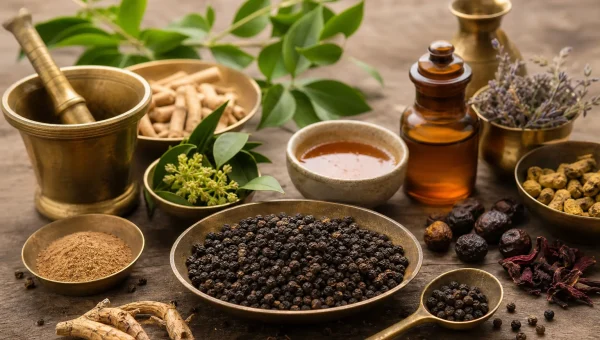
Trikatu combines shunthi or dry ginger, maricha or black pepper, and pippali or long pepper. It is traditionally used in settings involving weak digestion and kapha, but it has not been shown to remodel a kapha microbiome. A small human study found that ginger accelerated gastric emptying and stimulated antral contractions in healthy volunteers; this result cannot be transferred automatically to trikatu, constipation, or prakriti-specific care. Oral ginger may cause abdominal discomfort, heartburn, diarrhoea, and mouth or throat irritation, and pungent preparations may be unsuitable when burning or reflux is active.
Diet and Routine: The Better-Supported Starting Point
Diet is a major modifiable influence on gut microbial activity. Intestinal bacteria ferment fibre and resistant carbohydrate to produce acetate, propionate, butyrate, and other metabolites. A varied diet containing tolerated vegetables, fruits, pulses, whole grains, nuts, and seeds supplies diverse substrates. Sudden fibre increases or concentrated prebiotics can worsen gas, cramps, bloating, or diarrhoea, so changes should be gradual.
- Irregular appetite, dryness, or constipation: regular meal timing, adequate fluid, appropriately cooked food, and gradual fibre adjustment may be more tolerable than a sudden large intake of raw bran or prebiotic powder.
- Burning, sour regurgitation, or loose stool: identify personal food triggers and obtain medical assessment when symptoms persist, disturb sleep, impair swallowing, or accompany fever, bleeding, anaemia, or weight loss.
- Heaviness or sluggish appetite: review portions, repeated snacking, physical activity, sleep, medicines, and possible metabolic or endocrine contributors instead of attributing every symptom to kapha.
These suggestions use Ayurvedic pattern recognition without claiming a one-to-one microbial mechanism. Warm cooked food has not been proven to correct a vata microbiome, “cooling” food has not been shown to lower a pitta-specific intestinal acidity, and spices have not been shown to reduce a kapha-specific Firmicutes excess.
Ayurvedic dosing is individualized according to the substance and formulation, the patient’s age and strength, agni and koshtha, disease, season, route, concurrent medicines, and the practitioner’s assessment. Official quality standards are not a substitute for a personal prescription.
Commercial microbiome reports also need cautious interpretation. They may describe organisms detected in one stool sample, but there is no universally accepted ideal gut microbiome and no validated conversion from a commercial report to prakriti, agni, or an herbal regimen. Recent diet, bowel transit, infection, medicines, sample handling, and analytical platform can all affect the result. Testing is most useful when it answers a defined clinical question under professional guidance.
Safety and Disclaimer
This article is educational and does not diagnose or treat gastrointestinal disease. Seek prompt medical care for blood or black stool, persistent vomiting, severe or localized abdominal pain, fever with diarrhoea, dehydration, unexplained weight loss, anaemia, jaundice, difficulty swallowing, or a sustained change in bowel habits. People who are pregnant or breastfeeding, children, older adults, and anyone with liver, kidney, autoimmune, inflammatory-bowel, bleeding, or postsurgical gastrointestinal conditions should consult a qualified healthcare provider and a properly trained Ayurvedic practitioner before taking medicinal-dose herbs. The Ministry of Ayush also advises the public to avoid self-diagnosis and self-medication with ASU&H medicines.
One Actionable Tip
For two weeks, keep a simple record of meal timing, foods, medicines, stool form, pain, bloating, burning, and urgency. Make one low-risk change at a time—such as regularizing meals, improving hydration, or adding one tolerated fibre-rich food—and observe the response. Do not begin a constitution-specific antimicrobial cleanse or assume that gas proves a vata microbiome, acidity proves a pitta microbiome, or heaviness proves a kapha microbiome. A symptom record provides a clinician or Ayurvedic practitioner with more useful information than an unsupported microbial label.
References
- Ias (ias.ac.in)
- Understanding the association between the human gut, oral and skin microbiome and the Ayurvedic concept of prakriti (2019), PubMed
- Nature (nature.com)
- Frontiersin (frontiersin.org)
- Exploring the signature gut and oral microbiome in individuals of specific Ayurveda prakriti (2021), PubMed
- Ias (ias.ac.in)
- Revised Estimates for the Number of Human and Bacteria Cells in the Body (2016), PubMed Central
- Human microbiome: an academic update on human body site specific surveillance and its possible role (2020), PubMed Central
- Role of the gut microbiota in nutrition and health (2018), PubMed Central
- Charaka Samhita — Roganika Vimana
- Charaka Samhita — Snehadhyaya
- Ayurvedic Pharmacopoeia of India
- Therapeutic Uses of Triphala in Ayurvedic Medicine (2017), PubMed Central
- Triphala: current applications and new perspectives on the treatment of functional gastrointestinal disorders (2018), PubMed Central
- Effects of Triphala on Lipid and Glucose Profiles and Anthropometric Parameters: A Systematic Review (2021), PubMed Central
- NCBI
- Effects of ginger on gastric emptying and motility in healthy humans (2008), PubMed
- NCCIH
- What is the Healthy Gut Microbiota Composition? A Changing Ecosystem across Age, Environment, Diet, and Diseases (2019), PubMed Central
- Nih (nih.ayush.gov.in)
Been using vata for about 3 months now and the difference in how I feel is real. My practitioner said the same things this article covers so good to have it spelled out.
I had my gut microbiome tested and the Firmicutes-to-Bacteroidetes ratio was unusual. My Ayurvedic assessment was Pitta dominant. The article suggests these should correlate. Would be interesting to know if there’s a test that maps to this.
The advice around Microbiome Diversity and Prakriti is specific enough to be useful. The main idea is clear even if someone is new to Ayurveda.
The idea that dietary patterns driven by dosha assessment shaped the microbiome over generations is interesting. If Pitta types eat differently than Vata types across decades, you’d expect their microbiomes to diverge. The question is whether the microbiome difference reflects constitution or lifelong dietary difference.
My microbiome is in terrible shape after 2 years on proton pump inhibitors for reflux. Reading the Pitta-gut connection here makes me think the reflux and the microbiome damage are connected in the Ayurvedic framework, not separate problems.
The convergent validity here Ayurvedic constitutional assessment and modern genetic/microbiome analysis independently identifying similar groupings is the most interesting part. If the correlation holds in larger studies, that’s a significant finding for integrative medicine.
Does having a Vata-type microbiome mean the Ayurvedic diet for Vata types is already optimized for your specific microbial community? The therapeutic logic is circular if the microbiome and the constitution co-evolve.
The Akkermansia difference between Pitta and Kapha types is fascinating. Akkermansia is associated with metabolic health and Kapha types historically develop more metabolic dysfunction. This would be mechanistically coherent if it replicates.
Are there microbiome testing companies that incorporate Prakriti assessment alongside their standard analysis? It would be interesting to get both dimensions of the report simultaneously.
The confounding in this study seems significant. Prakriti correlates with dietary patterns, geographic origin, caste-associated food traditions, and genetic background. Isolating a ‘microbiome-constitution’ relationship from those confounders with 53 people is almost certainly not possible.
I found the part about only eighteen samples being used for the microbiome analysis surprising, it makes the results feel preliminary.
The Microbiome Diversity and Prakriti angle is useful here. Would be useful to see a short checklist next.
The article clarified that the twenty fifteen CSIR study was genetic, not a gut trial, which I had misunderstood before.
Wondering how diet changes over two weeks might actually show up in a stool test given the variability mentioned.
I read the 2015 paper this references. The methodology was careful for its scope. The limitation the authors themselves flagged was exactly what commenters here are raising. Nice to see the article engaging with those limitations rather than just presenting the finding uncritically.
It’s helpful that the piece distinguishes agni from simple pH measurements, that clears up a common mix up.
I appreciate the reminder that commercial microbiome reports need caution because sample handling can shift the outcome.
The suggestion to track meal timing and stool form seems like a low effort way to start noticing patterns.
Seeing that Bacteroidetes and Firmicutes dominate across all dosha groups makes me question claims of unique profiles.
The note about Triphala not guaranteeing increased diversity in everyone matches what I’ve read elsewhere.
I’m curious whether controlling for geography would change the associations between prakriti and microbial taxa.
The article’s warning about self prescribing Guduchi due to liver safety signals feels important to highlight.
Good reminder on Microbiome Diversity and Prakriti. Would be useful to see a short checklist next.
Good reminder on Microbiome Diversity and Prakriti. This is the kind of detail readers can test slowly.
Good reminder on Microbiome Diversity and Prakriti. The timing advice is the part I would start with.
Good reminder on Microbiome Diversity and Prakriti. I would still ask a practitioner before changing medicines.
It would be interesting to see a future study that standardizes diet and antibiotics before linking microbes to constitution.
Good reminder on Microbiome Diversity and Prakriti. The article avoids making it sound like a quick fix.
Good reminder on Microbiome Diversity and Prakriti. I appreciate that it does not oversell the result.
Good reminder on Microbiome Diversity and Prakriti. This would be easier to follow with a one-week sample plan.
I came for Microbiome Diversity and Prakriti and this answered the main question. The practical details matter more than people think.
Good reminder on Microbiome Diversity and Prakriti. The safety notes could be expanded a little.
Good reminder on Microbiome Diversity and Prakriti. The main idea is clear even if someone is new to Ayurveda.
Good reminder on Microbiome Diversity and Prakriti. This feels more usable than a long list of herbs.
Good reminder on Microbiome Diversity and Prakriti. The examples make the advice less abstract.
Good reminder on Microbiome Diversity and Prakriti. I would like to know how long to try it before judging results.
Good reminder on Microbiome Diversity and Prakriti. Good starting point for a cautious reader.
I came for Microbiome Diversity and Prakriti and this answered the main question. A few more examples would still help.
I came for Microbiome Diversity and Prakriti and this answered the main question. Small daily changes are easier to follow than a perfect plan.
I came for Microbiome Diversity and Prakriti and this answered the main question. Would be useful to see a short checklist next.
I came for Microbiome Diversity and Prakriti and this answered the main question. This is the kind of detail readers can test slowly.
I came for Microbiome Diversity and Prakriti and this answered the main question. I would still ask a practitioner before changing medicines.
I came for Microbiome Diversity and Prakriti and this answered the main question. The article avoids making it sound like a quick fix.
I came for Microbiome Diversity and Prakriti and this answered the main question. I appreciate that it does not oversell the result.
I came for Microbiome Diversity and Prakriti and this answered the main question. The safety notes could be expanded a little.
The part about Microbiome Diversity and Prakriti feels realistic. The practical details matter more than people think.
I came for Microbiome Diversity and Prakriti and this answered the main question. The timing advice is the part I would start with.
I came for Microbiome Diversity and Prakriti and this answered the main question. Good starting point for a cautious reader.
I came for Microbiome Diversity and Prakriti and this answered the main question. This would be easier to follow with a one-week sample plan.
I came for Microbiome Diversity and Prakriti and this answered the main question. The main idea is clear even if someone is new to Ayurveda.
I came for Microbiome Diversity and Prakriti and this answered the main question. This feels more usable than a long list of herbs.
I came for Microbiome Diversity and Prakriti and this answered the main question. The examples make the advice less abstract.
I came for Microbiome Diversity and Prakriti and this answered the main question. I would like to know how long to try it before judging results.
The part about Microbiome Diversity and Prakriti feels realistic. A few more examples would still help.
The part about Microbiome Diversity and Prakriti feels realistic. Small daily changes are easier to follow than a perfect plan.