
In 1975, psychologist Robert Ader and immunologist Nicholas Cohen at the University of Rochester reported that an immune response in rats could be behaviorally conditioned. They paired saccharin-flavored water with cyclophosphamide, a drug that suppresses immune activity. When the conditioned taste was later presented during an immune challenge, it altered antibody production even without another dose of the drug. The experiment became a foundational event in psychoneuroimmunology, the study of communication among behavior, the nervous system, the endocrine system, and immunity.
Ayurveda approaches the same broad territory through a different conceptual language. The Charaka Samhita states that body and mind influence one another, and it treats mental balance as part of health rather than as a separate concern. Its concepts of manas, sattva, rajas, tamas, ojas, and bala can therefore support a meaningful dialogue with psychoneuroimmunology. They should not, however, be presented as ancient names for cytokines, cortisol, natural-killer cells, or other modern measurements. They are most useful when compared carefully rather than equated.
The Ayurvedic Framework: Manas, the Gunas, Ojas, and Bala
In classical Ayurveda, manas is the mind involved in attention, perception, intention, and the coordination of the senses. The three gunas describe qualities expressed in mental life: sattva is associated with clarity and discernment, rajas with movement and activation, and tamas with inertia and obscuration. Charaka identifies rajas and tamas as the two mental doshas because their disturbance can impair judgment and conduct. Sattva is not listed as a mental dosha; it is the clearer quality through which the mind can exercise steadiness and discrimination.
These qualities are not permanent labels. Their relative expression can vary with habits, sensory input, sleep, food, relationships, surroundings, and mental training. Rajas is necessary for initiative and action, while tamas contributes to rest and stability. Difficulty arises when agitation, craving, dullness, confusion, or withdrawal becomes excessive and disrupts appropriate action.
Ojas is described as the essence of the bodily tissues and as essential to life, vitality, and strength. Bala denotes strength or capacity for resistance. These ideas are broader than the modern immune system and should not be reduced to a single laboratory marker. Classical discussions connect disturbance of ojas with factors such as excessive exertion, hunger, grief, anger, and overthinking, thereby placing emotional and behavioral strain within a wider account of diminished vitality.
| Ayurvedic concept | Classical meaning | Careful point of dialogue with modern science |
|---|---|---|
| Sattva | Clarity, steadiness, discernment, and mental balance | Self-regulation, adaptive coping, and health-supporting behavior; not a measurable immune substance |
| Rajas | Activity, stimulation, passion, and restlessness when excessive | Arousal and stress-related behavior; not identical to sympathetic activity or cortisol |
| Tamas | Stability and rest, but dullness, confusion, or inertia when excessive | Withdrawal, inactivity, and impaired self-care; not a synonym for depression or immune suppression |
| Ojas and bala | Vital essence and strength, including the capacity to withstand strain | May be discussed alongside resilience and host defense, but has no one-to-one biomedical equivalent |
What Psychoneuroimmunology Demonstrates
Psychoneuroimmunology describes bidirectional communication. The brain influences immune activity through the hypothalamic-pituitary-adrenal axis, autonomic nerves, glucocorticoids, and catecholamines. Immune cells and inflammatory mediators also signal back to the brain through circulating cytokines, neural pathways, and effects at brain interfaces. This network helps explain why infection can alter sleep, appetite, mood, and energy, and why sustained psychological stress can change selected immune and inflammatory processes.
Stress does not produce one universal immune response. Brief stress can redistribute immune cells in ways that may be temporarily adaptive, whereas prolonged or repeated stress can disturb inflammatory regulation, antiviral responses, wound repair, and vaccine responsiveness. Outcomes depend on stress duration, health, age, sleep, social circumstances, and the immune measure examined. It is therefore more accurate to speak of immune dysregulation than to claim that every stressful state simply “lowers immunity.”
A frequently cited randomized study published in 2003 evaluated an eight-week mindfulness program in healthy employees. Compared with a wait-list group, participants showed a larger shift toward left-sided anterior brain activation and higher antibody titers after influenza vaccination. The study supports the possibility that structured mental training can influence selected biological outcomes, but it does not establish that meditation universally strengthens immunity or that its effects are equivalent to the Ayurvedic quality of sattva.
A later systematic review of randomized mindfulness trials found changes in some inflammatory, cellular, and antibody-related markers, while also noting substantial variation among methods and outcomes. Likewise, a meta-analysis linked loneliness and social isolation with higher levels of some systemic inflammatory markers, but the findings were associative and varied by study design. These results support stress regulation and supportive relationships without implying that a particular emotion produces a specific cytokine pattern.
Sattvavajaya: Mind-Directed Care in Charaka
Sattvavajaya is Charaka’s mind-directed therapeutic approach. It is defined as restraining the mind from objects or activities that are unwholesome. The classical framework includes jnana (knowledge of the self), vijnana (reasoned or specific knowledge), dhairya (fortitude), smriti (memory or recollection), and samadhi (concentrated mental steadiness). It may be compared conceptually with counseling, cognitive self-regulation, and contemplative training, but it is not identical to any single modern psychotherapy.
The practical aim is to restore attention and choice. Knowledge helps a person recognize harmful patterns; reasoned understanding clarifies consequences; fortitude supports action despite discomfort; memory keeps previous learning available; and concentrated steadiness reduces impulsive movement toward unwholesome objects. Charaka also places mental care alongside suitable diet, medicines, daily conduct, and attention to the causes of illness rather than presenting it as a replacement for physical treatment.
Sadvritta, or wholesome conduct, and achara rasayana, rejuvenation through conduct, extend this approach into daily life. Truthful and measured speech, self-restraint, cleanliness, compassion, respect, moderation of the senses, and suitable social association are treated as health-supporting disciplines. Their value does not require claiming that each practice raises natural-killer-cell activity or lowers a particular cytokine. They organize behavior in ways that can protect sleep, relationships, adherence to care, and recovery from strain.
Meditation, quiet breath observation, and appropriately taught yoga practices can be used as modern supportive tools within this broader aim. They should be adapted to the individual. Forceful breath retention, prolonged fasting, sleep restriction, or intensive contemplative practice is not necessary for cultivating steadiness and may be unsuitable for some people.
Medhya Rasayana and API-Defined Herbs
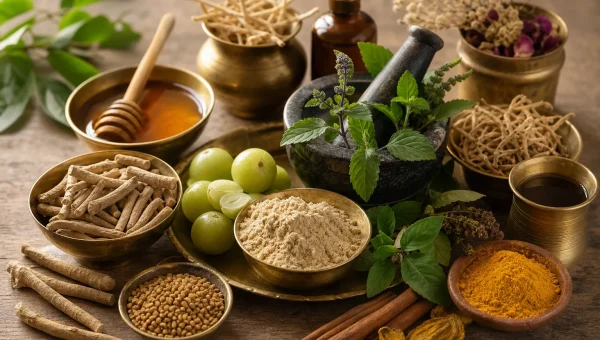
Charaka’s well-known group of four medhya rasayana substances consists of Mandukaparni, Yashtimadhu, Guduchi, and Shankhapushpi. The term medhya concerns faculties such as learning, retention, and recollection, while rasayana denotes a wider rejuvenative discipline. Brahmi and Ashwagandha are also important Ayurvedic drugs, but they should not be inserted into Charaka’s four-item list. The Ayurvedic Pharmacopoeia of India provides botanical identities, plant parts, pharmacognostic standards, and traditional attributes for official drug materials.
| Drug and official material | Rasa | Guna | Virya | Vipaka | Principal API actions |
|---|---|---|---|---|---|
| Brahmi (Bacopa monnieri), whole plant | Madhura, tikta, kashaya | Laghu, sara | Shita | Madhura | Medhya, rasayana; vata- and kapha-hara |
| Ashwagandha (Withania somnifera), root | Tikta, kashaya | Laghu | Ushna | Madhura | Rasayana, balya, vajikarana; vata- and kapha-hara |
| Shankhapushpi (Convolvulus pluricaulis), whole plant | Katu, tikta, kashaya | Sara | Shita | Katu | Medhya, rasayana, balya; pitta- and kapha-hara |
| Guduchi (Tinospora cordifolia), mature stem | Tikta, kashaya | Laghu | Ushna | Madhura | Rasayana, balya, dipana, and tridosha-shamaka |
Clinical literature should be interpreted by preparation rather than by herb name alone. Meta-analyses of Bacopa trials suggest possible benefits for selected cognitive outcomes, particularly speed of attention or recall, but they do not establish an immune-enhancing effect. A small randomized trial of a particular Ashwagandha root extract reported reductions in perceived stress and morning cortisol over eight weeks; this result does not apply automatically to every powder, extract, dose, or patient.
Guduchi’s classical designation as a rasayana does not make unsupervised use risk-free. Published case series and pharmacovigilance reports have linked Tinospora cordifolia products with clinically apparent liver injury, sometimes with autoimmune-like features. Shankhapushpi also requires correct botanical identification because other species are used under the same vernacular name in some regions. These examples show why authenticated material, appropriate formulation, dose, duration, and patient selection matter.
A Daily Sattva-Supporting Routine
A practical routine can translate the classical emphasis on steadiness into ordinary life without promising a direct rise in immunity. The purpose is to reduce avoidable agitation and dullness, strengthen attention, and support the behaviors on which health depends.
- Morning: Keep a regular waking time and begin with five to ten minutes of quiet sitting or comfortable breath observation. Avoid forceful breathing and return attention gently when the mind wanders.
- Meals: Eat at reasonably regular times, choose fresh and suitable food, and notice appetite, digestion, and satiety. Ayurveda individualizes food according to constitution, current imbalance, digestive capacity, season, and illness.
- Daytime conduct: Limit unnecessary sensory overload, pause before reactive speech, and apply one element of sadvritta such as truthfulness, patience, cleanliness, or compassion.
- Relationships: Maintain contact with trustworthy people and seek skilled help when stress, grief, anxiety, or low mood interferes with sleep, work, or self-care.
- Evening: Reduce stimulating activity before bed and protect a consistent opportunity for sleep. Review the day without harsh self-judgment and identify one habit to correct the next day.
- Herbs: Use Brahmi, Ashwagandha, Shankhapushpi, Guduchi, or medicated ghee only after an appropriately qualified practitioner has considered the exact product, medicines, pregnancy status, liver and thyroid history, and any autoimmune condition.
For related monographs, see the site’s Brahmi Ghrita guide and Guduchi profile. These substances are best understood within a complete assessment rather than as interchangeable “immune boosters.”
This article is educational and does not diagnose, prevent, or treat an immune, psychiatric, endocrine, or infectious disease. Consult a qualified Ayurvedic practitioner and a licensed healthcare provider before using herbs, especially during pregnancy or breastfeeding, before surgery, or with liver disease, thyroid disease, autoimmune illness, or prescription medicines. Ashwagandha can interact with several medicines, and Guduchi products have been associated with liver injury. Seek prompt medical care for jaundice, dark urine, persistent vomiting, severe itching, or marked fatigue after starting a supplement.
Actionable practice: For seven days, spend ten minutes each morning observing the natural breath, then record sleep quality, mood, and energy on a simple scale. Treat the notes as personal observation, not as an immune test or proof of a biological effect. The useful outcome is awareness of which routines promote steadiness and which produce agitation or dullness.
References
- Behaviorally conditioned immunosuppression (1975), PubMed
- Urmc (urmc.rochester.edu)
- Neuroimmune Interactions: From the Brain to the Immune System and Vice Versa (2018), PubMed Central
- Niimh (niimh.nic.in)
- Charaka Samhita — Deerghanjiviteeya Adhyaya
- Charaka Samhita — Sattvavajaya
- Charaka Samhita — Manas prakriti
- Charaka Samhita — Ojas
- Stress and health: psychological, behavioral, and biological determinants (2005), PubMed Central
- Alterations in brain and immune function produced by mindfulness meditation (2003), PubMed
- Mindfulness meditation and the immune system: a systematic review of randomized controlled trials (2016), PubMed
- The association between loneliness, social isolation and inflammation: A systematic review and meta-analysis (2020), PubMed
- Nootropic herbs (Medhya Rasayana) in Ayurveda: An update (2012), PubMed Central
- Ayurvedic Pharmacopoeia of India
- Ayurvedic Pharmacopoeia of India
- Ayurvedic Pharmacopoeia of India
- Meta-analysis of randomized controlled trials on cognitive effects of Bacopa monnieri extract (2014), PubMed
- An investigation into the stress-relieving and pharmacological actions of an ashwagandha (Withania somnifera) extract: A randomized, double-blind, placebo-controlled study (2019), PubMed
- Herbal Immune Booster-Induced Liver Injury in the COVID-19 Pandemic – A Case Series (2021), PubMed
- NCCIH
- Charaka Samhita — Sattva
- NCCIH
- Differential pattern of functional brain plasticity after compassion and empathy training (2014), PubMed
The 1975 rat experiment with saccharin water and cyclophosphamide really shows how expectation can tweak immune output, interesting bridge to Ayurveda’s sattva concept.
I wonder if the mindfulness vaccination study from 2003 measured any changes in ojas related vitality, not just antibody titers.
Sattva being described as clarity and discernment makes me think it aligns more with cognitive flexibility than with a specific cytokine level.
The article’s caution against equating gunas with modern markers feels wise; otherwise we risk oversimplifying both systems.
Practical tip: trying the ten minute breath observation each morning helped me notice when my mind drifted into rajas like restlessness.
This is exactly what I needed to understand why my own health kept declining during a prolonged period of work stress even though I was eating well and exercising. The Ader research framing helps — my mental state was essentially conditioning a suppressed immune response. Starting Ashwagandha and a morning meditation practice two months ago and my baseline has genuinely shifted.
The conditioned immune suppression finding is staggering when you sit with it. If a sweet taste can train the immune system downward, it follows that habitual mental patterns — rumination, chronic fear, constant Rajas — are doing something similar on a longer timescale. This piece makes the case for that more clearly than anything else I’ve read on Sattva.
The Psychoneuroimmunology and Sattva explanation is clearer than most short posts. I would like to know how long to try it before judging results.
The Psychoneuroimmunology and Sattva explanation is clearer than most short posts. Good starting point for a cautious reader.
My Pitta constitution responds exactly as described here. The psychoneuroimmunology worked within two weeks for me where pharmaceutical options had failed for months.
The psychoneuroimmunology angle here raises a practical question: how do you actually assess Sattva in a clinical Ayurvedic context? The neuroscience side has measurable proxies like NK cell activity or salivary cortisol, but the Sattva side seems much harder to operationalize for research purposes. Is there a validated tool for this?
What stands out most for me is the bidirectionality — not just that mental quality affects immunity, but that immune signaling shapes mental states. The Sattva framework seems to account for this loop in a way that Western psychiatry still handles in separate silos. Has anyone seen clinical work that tracks both inflammatory markers and Sattvic quality simultaneously?
My oncologist at a major cancer center was actually supportive of the dietary modifications described here for patients on chemotherapy. The anti-inflammatory and easily digestible food recommendations are consistent with what she advises. She was less familiar with the specific herbal interventions but open to discussion.
It would be useful to see a follow up study that tracks bala changes alongside stress reduction practices over a few weeks.
The research cited here is from the 2015-2020 period. Is there more recent work that confirms or updates these findings?
I liked the practical side of Psychoneuroimmunology and Sattva. This is the kind of detail readers can test slowly.
Helpful
Would like to see the contraindications section expanded. Too brief for something being suggested for health issues.
been following this blog for six months and the quality is consistently high.
The Ader conditioning experiment is the perfect opening for this argument — if the immune system can be suppressed by a conditioned stimulus alone, then the chronic mental state someone lives in must be doing something physiologically. Does the article connect this to Sattvic diet as a mechanism, or is the focus more on practices like meditation?
i’m in the US and getting authentic herbs here is hard. Any trusted online sources?
just found this through Google. Is this still the current recommendation?
three months later: the results held. Happy to report.
the timing protocol assumes a morning training schedule. Doesn’t address evening trainers.
Too theoretical without enough concrete steps. The ‘what’ is clear but the ‘how exactly’ is missing.
thanks for the clear writing. This isnt easy material to explain simply.
do the ratios change if you are doing this as preventive care versus active treatment?
Coming from a conventional medicine background this article impressed me with its rigor. 💯
can this be taken in summer or only winter months?
Thanks 🙏
The Psychoneuroimmunology and Sattva explanation is clearer than most short posts. The safety notes could be expanded a little.
can someone here who has tried this protocol confirm the timeline? Two weeks vs six weeks?
as someone who does both allopathy and Ayurveda I appreciate that this article doesnt demonize either.
My Ayurvedic practitioner of 12 years said this is one of the better online resources she’s seen on the topic.
Could you address the quality certification issue in a future article? Third-party tested herbs are hard to find.
what’s the cycling recommendation? Should you take a break after 3 months?
the IST timings in the practical section r a nice touch. Feels like its written for us.
brilliant breakdown. Forwarding this. 💯
The Q&A format at the end would make this even more useful. Would love a FAQ section.
The sourcing of quality herbs in my city is impossible. Makes these protocols academic for many readers.
is there a children’s version of this protocol? My daughter has a similar issue. ✨
Some of the preparation methods are too time-intensive for working adults. Needs a quick-version alternative.
this article connected the dots between things my vaidya told me over several years.
my Ayurvedic practitioner of 12 years said this is one of the better online resources she’s seen on the topic. 🙏
The before-and-after in my experience matches what the article predicts. That’s meaningful.
Skeptical about Ayurveda in general but this is presented honestly enough that I’ll try it. 🙌
No mention of the potential testosterone-related effects for men with hormone-sensitive conditions.
skeptical but curious. trying the minimal version first.
The advice around Psychoneuroimmunology and Sattva is specific enough to be useful. Small daily changes are easier to follow than a perfect plan.
I wish there were more clinical studies cited here. Traditional use is valuable but not sufficient evidence alone.
finally an article that doesn’t treat Ayurveda as magic and also doesn’t dismiss it entirely
will try for a month and report back here.
The practical implementation section is what separates this from other Ayurveda sites.
Can these adaptogens be stacked with whey protein or does it affect absorption?
ashwagandha 600mg KSM-66 is that morning or post-workout? Timing isn’t clear in the article.
Late to this discussion but the question in the first comment is still unanswered anyone have more info?
I came for Psychoneuroimmunology and Sattva and this answered the main question. I appreciate that it does not oversell the result.
I came for Psychoneuroimmunology and Sattva and this answered the main question. This feels more usable than a long list of herbs.
The part about Psychoneuroimmunology and Sattva feels realistic. Would be useful to see a short checklist next.
will come back to this when I hit the cooling phase very detailed.
How long does a typical protocol like this take to show results?
The classical text quotes are helpful context but I’d like to understand the modern interpretation better. 🙌
This makes sense for Psychoneuroimmunology and Sattva. The practical details matter more than people think.
this is now my reference article for explaining this topic to friends. धन्यवाद
never thought I’d become an Ayurveda convert but here I am reading every article.
does anyone know a practitioner in Hyderabad who works with this kind of protocol?
the comments section here is almost as useful as the article itself
i asked my dr about this. she said she doesnt have enough info on it but didnt say no
will try 🙏
The dose specificity here is what makes this actionable. Vague ‘take regularly’ instructions are useless.
What brand of triphala do you recommend? So many options and quality varies greatly.
starting today. Fingers crossed.
forwarded to my whole family WhatsApp group. Three replies already asking for more details. 🌿
tried this for 6 weeks without the results described. Maybe the protocol needs personalizing.
skeptical but curious. trying the minimal version first. 🙏
forwarded to my whole family WhatsApp group. Three replies already asking for more details.
People should know this. Sharing everywhere.
The Hindi terms alongside English make this usable in both languages.
My western trained MD friend looked at this and said the pharmacology section was reasonable.
Starting today. Fingers crossed. 💯
first comment here. been lurking for months. this is the one that made me want to say thank u
six weeks into the Bala-Ashwagandha stack and strength is up. Hard to attribute fully but the timing lines up. 🙏
i was prescribed this by a practitioner 2 years back but never understood why. now i do.
does ghee quality affect results significantly? I use store-bought A2 ghee.
the combination of theory and practical steps is what I appreciate most about this blog.
does this protocol need modification for someone who is fasting during Navratri?
old post but still helpful. some of the preparation methods are too time-intensive for working adults. Needs a quick-version alternative.
this is now my reference article for explaining this topic to friends.
just found this via Google, the comments section here is almost as useful as the article itself
three herbs three outcomes surprisingly simple when laid out like this 🙏
found this searching for answers, the question about brand quality is important. not all suppliers are equal.
The seasonal protocol is smart. Most people try to use the same routine all year.
the classical text quotes are helpful context but I’d like to understand the modern interpretation better.
is the guidance here applicable for elderly patients or is it designed for younger adults?
reading this in 2027 r the herb sourcing reccomendations still valid?
i took notes from this and created a personal protocol. Three weeks in, positive changes.
tried. Liked. Continuing.
can this be done alongside an allopathic treatment or should there be a gap?
my yoga teacher recommended this site and now I see why.
found this searching for answers, does anyone know a practitioner in Hyderabad who works with this kind of protocol?
Going to share this at my wellness group meeting next week. Very useful.
the writing assumes India-based readers. Temperature/herb availability differs greatly outside India.
The part about Psychoneuroimmunology and Sattva feels realistic. Good starting point for a cautious reader.
Just found this via Google, brilliant breakdown. Forwarding this.
the Hindi terms alongside English make this usable in both languages. 🙏
The morning versus evening split for herbs is something I always get confused about. Clear here.
finally something that explains the why, not just the what.
asgwagandha 600mg KSM-66 is that morning or post-workout? Timing isn’t clear in the article.
three herbs three outcomes surprisingly simple when laid out like this
No mention of the potential testosterone-related effects for men with hormone-sensitive conditions. ❤️
reading this in 2027 are the herb sourcing recommendations still valid?
Just found this via Google, this article connected the dots between things my vaidya told me over several years.
shared with my family group and three people are already trying it.
Coming from a conventional medicine background this article impressed me with its rigor.
u said it better than my 45-min consult with the vaidya tbh
just found this via Google, is the guidance here applicable for elderly patients or is it designed for younger adults?
Late to this but is the guidance here applicable for elderly patients or is it designed for younger adults?
old post but still helpful. too theoretical without enough concrete steps. The ‘what’ is clear but the ‘how exactly’ is missing.
the integration of modern evidence with traditional practice is the right approach. ❤️
old post but still helpful. starting today. Fingers crossed.
i dont comment usually but this was actually helpful
found this searching for answers, for an old post this is still very relevant. good information doesnt expire. ❤️
quality content. Keep writing like this.
six weeks into the Bala-Ashwagandha stack and strength is up. Hard to attribute fully but the timing lines up.
reading this in 2027, can this be taken in summer or only winter months?
this is the clearest explanation of this topic Ive found. Bookmarked for reference. 🙌
i appreciate that the dosages are given in actual mg not just ‘a pinch’ or ‘as needed’.
Finally!
thanks for the clear writing. This isnt easy material to explain simply. ✨
The classical text reference to Charaka Samhita gave this article more credibility in my eyes.
The Psychoneuroimmunology and Sattva angle is useful here. This would be easier to follow with a one-week sample plan.
Found this searching for answers, the question about brand quality is important. not all suppliers are equal. नमस्ते
been meaning to try this for two years. This article finally pushed me to start.
just found this via Google, my western trained MD friend looked at this and said the pharmacology section was reasonable.
does this work for people over 60? The age range in the examples skews younger.
is the guidance here applicable for elderly patients or is it designed for unger adults?
is there a children’s version of this protocol? My daughter has a similar issue.
Will try
nani used to say the same things in different words. There’s real wisdom here.
Trying this
The part about Psychoneuroimmunology and Sattva feels realistic. The article avoids making it sound like a quick fix.
The part about Psychoneuroimmunology and Sattva feels realistic. The safety notes could be expanded a little.
For Pitta-Kapha dual constitution which aspects of the protocol take priority?
Have been searching for this explanation for years. Saved. Sharing. नमस्ते
Reading this in 2027 are the herb sourcing recommendations still valid? धन्यवाद
found this searching for answers, tried the protocol. Week 2 no change yet but following through to the full period.
The combination of classical reasoning and practical steps is exactly what I was looking for.
my constitution is Vata-Pitta so some of this applies and some doesnt. A chart for dual types would help.
could u address the quality certification issue in a future atricle? Third-party tested herbs r hard to find.
Just found this via Google, this is the clearest explanation of this topic I’ve found. Bookmarked for reference.
old post but still helpful. my western trained MD friend looked at this and said the pharmacology section was reasonable. 🙏
Reading this in 2027, have been searching for this explanation for years. Saved. Sharing.
first comment here. been lurking for months. this is the one that made me want to say thank u ✨
i appreciate that the dosages are given in actual mg not just ‘a pinch’ or ‘as needed’. नमस्ते
my grandma was right about all of this. just didnt have the explanation.
just found this via Google, skeptical but curious. trying the minimal version first.
quality content. Keep writing like this. ✨
the reference to Ashtanga Hridayam which Sutrasthana chapter? Would like to read the original. 💯
the dosage for children per kg bodyweight would be useful to add.
just found this via Google, how long does a typical protocol like this take to show results?
My experience perfectly matches what is described in the long-term use section.
Been meaning to try this for two years. This article finally pushed me to start. 🙌
Will try for a month and report back here. ❤️
old post but still helpful. found this article after searching for 3 days. Exactly what I needed.
u said it better than my 45-min consult with the vaidya tbh 🙌
just found this via Google, this site is different from other ayurveda blogs. feels researched not just copied.
found this searching for answers, for Pitta-Kapha dual constitution which aspects of the protocol take priority?
Have been searching for this explanation for years. Saved. Sharing.
I was looking for a plain explanation of Psychoneuroimmunology and Sattva. The main idea is clear even if someone is new to Ayurveda.
The advice around Psychoneuroimmunology and Sattva is specific enough to be useful. The article avoids making it sound like a quick fix.
Found this searching for answers, going to share this at my wellness group meeting next week. Very useful.