Panchatikta Ghrita is a classical medicated ghee, but claims about dramatic responses in psoriatic arthritis, fixed reductions in C-reactive protein, or failure of multiple biologic medicines require patient records and published documentation. No verifiable source was available for the opening case history, so it should not be presented as clinical evidence. The defensible account is more modest: Panchatikta Ghrita has an official Ayurvedic monograph and a classical indication for kushtha, a broad category of skin disorders, while modern evidence for psoriasis and inflammatory arthritis remains limited.
The Ayurvedic Pharmacopoeia of India, Part II, Volume I standardizes Panchatikta Ghrita under AFI Part I, 6:26 and cites Bhaishajya Ratnavali, Kushthadhikara 114-116 as the classical source. The name means “ghee prepared with five bitter drugs,” but the official composition is not limited to five herbs: five plants are used to make the decoction, Triphala is used as the paste, and cow’s ghee is the lipid base. The exact formulation is not attributed by the official monograph to the Charaka Samhita or Ashtanga Hridaya.
The Official Composition
The pharmacopoeial formula uses equal starting quantities of the five decoction drugs. It is therefore misleading to assign each herb a unique proven mechanism, such as “immune regulation,” “liver detoxification,” or “joint protection,” because the finished medicine has not been clinically deconstructed in that way.
- Nimba (Azadirachta indica): stem bark. Nimba is one of the five bitter decoction ingredients. Laboratory research exists on neem constituents, but that does not prove that Panchatikta Ghrita treats psoriasis through NF-kB inhibition, antibacterial action, or an “anti-keratolytic” effect.
- Patola (Trichosanthes dioica): leaf. The official formula does not describe Patola as a specific liver medicine or connect it with Bhrajaka Pitta through a modern liver-skin mechanism.
- Vyaghri or Kantakari (Solanum surattense): whole plant. Its presence does not establish a disease-modifying or cartilage-protective effect in psoriatic or rheumatoid arthritis.
- Guduchi (Tinospora cordifolia): stem. Guduchi is often described in contemporary writing as “immunomodulatory,” but human evidence is incomplete, and Guduchi-containing products have also been associated with clinically apparent liver injury.
- Vasaka (Adhatoda vasica): root. Vasicine-related pharmacology has been studied mainly in extracts and experimental systems; it cannot be used to claim that the complete ghrita specifically treats hot, weeping, Pitta-type lesions.
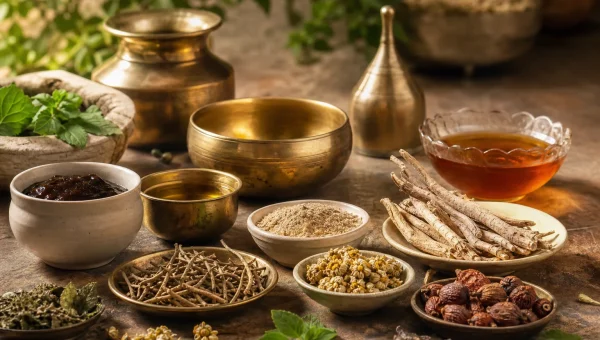
The decoction is combined with a paste of Haritaki (Terminalia chebula), Bibhitaka (Terminalia bellirica), and Amalaki (Phyllanthus emblica)—the three fruits known collectively as Triphala—and processed with clarified butter from cow’s milk. Thus, the finished formula contains eight botanical ingredients, not five or seven.
What the Classical and Official Sources Actually Indicate
The API lists dushtavrana (a difficult or non-healing ulcer), kushtha (skin diseases), disorders described in relation to aggravated Vata, Pitta, or Kapha, krimi, arsha, and kasa among its therapeutic uses. These are official Ayurvedic indications, not proof of efficacy for every modern diagnosis that appears superficially similar. Psoriasis may be discussed under different kushtha patterns by practitioners, but “psoriasis equals Kitibha” or “psoriatic arthritis equals Kushtha with Sandhigata Vata” is not a universally exact diagnostic conversion.
Classical descriptions of tikta rasa associate bitter taste with light, drying, and Kapha-Pitta-reducing actions and with use in itching and skin disorders; they also warn that excessive bitter intake can aggravate Vata and deplete tissues. Panchatikta Ghrita combines bitter herbs with ghee, so its use is assessed according to the patient’s digestion, strength, disease stage, bowel pattern, and overall dosha-dhatu presentation rather than by disease name alone.
Clinical Evidence: What Is Known and What Is Not
The clinical literature is too small and methodologically weak to support claims that Panchatikta Ghrita has “two randomized trials” proving benefit for psoriasis, or that it reliably treats eczema, acne, rheumatoid arthritis, or psoriatic arthritis. The following distinction is more accurate:
| Use or condition | Verified source | Evidence assessment |
|---|---|---|
| Kushtha and other listed classical uses | Ayurvedic Pharmacopoeia of India monograph | Official traditional indication; not equivalent to modern proof of clinical efficacy |
| Psoriasis | A 2012 uncontrolled study of 21 patients used 60 mL rectal matra basti daily for three weeks; a 2013 study placed 30 patients into three groups of 10 and used oral ghrita, leech therapy, or both | Preliminary, small, non-blinded studies with important design limitations; neither establishes effectiveness against standard dermatologic treatment |
| Psoriasis trial often cited from 2019 | CCRAS multicentre paper | It is a study protocol proposing 120 participants, not a published outcome report |
| Osteopenia | Randomized open-label controlled study of 80 adults; 65 completed 12 months | Adjunctive Panchatikta Ghrita with calcium and vitamin D improved some bone biomarkers and BMD measures, but the authors called for larger confirmation; this is not evidence for arthritis |
| Psoriatic arthritis, rheumatoid arthritis, acne, eczema, or chronic infection | No robust condition-specific controlled evidence identified for the ghrita alone | Effectiveness and appropriate dosing are not established |
How the Medicated Ghee Is Prepared
The pharmacopoeial process is a pharmaceutical extraction and concentration method, not proof that the medicine “carries active compounds into lipid-soluble tissue layers.” The five herbs are coarsely powdered, boiled in water, and reduced to one quarter to make a decoction. Triphala is finely powdered and made into a paste. Murchhita ghee is heated gently, the paste and decoction are added in stages, and the mixture is cooked with stirring until moisture is removed and the classical madhyama paka signs appear. The hot ghrita is then filtered and protected from light and moisture.
This method exposes the ingredients to both an aqueous phase and a lipid phase, which may extract a wider range of constituents than water alone. However, no human pharmacokinetic study located for Panchatikta Ghrita demonstrates superior absorption of nimbin, nimbidin, tinosporin, vasicine, or Solanum alkaloids, and no study proves preferential delivery to Rasa, Rakta, bone, joints, skin, or the “gut-liver axis.” Those statements should remain traditional interpretations or research hypotheses, not established mechanisms.
Dose and Administration
The official API dose is 12 g daily in divided doses, with warm milk or warm water as anupana. This is the clearest standardized dose available for the pharmacopoeial product. It does not support a universal 10-20 g daily range, a mandatory 90-day course, or an automatic escalation from 5 g to 20 g.
Snehapana used before Panchakarma is a separate, physician-supervised procedure in which the dose and duration are individualized and signs of proper, inadequate, or excessive oleation are monitored. A maintenance prescription and a purification-level fat-drinking protocol should not be conflated. Taking ghrita on an empty stomach is also not a universal rule for every patient; timing depends on the therapeutic purpose and the prescriber’s assessment.
Compatibility with Conventional Treatment
There are no adequate interaction studies showing that Panchatikta Ghrita can safely accompany “most” conventional medicines. It should not be used as a bridge for tapering methotrexate, corticosteroids, biologics, anticoagulants, or other immunosuppressive treatment unless the prescribing specialists are coordinating the plan. A fall in CRP or improvement in plaques does not by itself justify reducing medication.
Guduchi-containing products have been linked in published reports to acute hepatitis, sometimes with autoimmune features, although the risk of this exact standardized ghrita has not been quantified. People who are pregnant or breastfeeding, or who have liver disease, pancreatitis, gallbladder disease, fat-malabsorption disorders, unexplained abnormal liver tests, or medically prescribed fat restrictions, should obtain individualized medical advice before use. Stop the product and seek medical care for jaundice, dark urine, severe nausea, persistent abdominal pain, rash, facial swelling, or breathing difficulty.
For broader educational context, see our guides to Neem and skin care and Ayurvedic approaches to joint discomfort. These should not replace dermatology or rheumatology care.
Quality and Safety
Choose a licensed manufacturer whose label matches the intended classical reference and whose batch testing covers identity, microbial limits, aflatoxins, pesticide residues, and permitted heavy-metal limits. The API monograph specifies physicochemical and quality parameters, but a classical name on a jar does not guarantee that every commercial product uses the same plant parts or proportions.
Panchatikta Ghrita is not a home kitchen remedy. The suggested practice of steeping fresh neem leaves in ghee for 20 minutes is neither the official Panchatikta Ghrita process nor a validated tolerance test, and fresh-leaf preparations can vary greatly in identity, moisture, strength, and contamination. This article is general information, not medical advice. Consult a qualified Ayurvedic physician and the relevant dermatologist, rheumatologist, or healthcare provider before use.
One Actionable Step
Before taking Panchatikta Ghrita, photograph the full product label and batch number, list every prescription medicine and supplement you use, and ask both clinicians to confirm three points: the exact formula, the reason for prescribing it, and the planned dose and monitoring. Do not stop or taper conventional treatment and do not prepare a substitute at home.
Verified References
- The Ayurvedic Pharmacopoeia of India, Part II (Formulations), Volume I: Panchatikta Ghrita monograph
- Effect of Matra Basti of Panchatikta Ghrita in Psoriasis (2012)
- Role of Leech Therapy and Panchatikta Ghrita in Psoriasis (2013)
- Clinical Evaluation of Panchatikta Ghrita and Nalpamaradi Taila in Psoriasis: Study Protocol (2019)
- Panchatikta Ghrita as Add-on Therapy in Osteopenia: Randomized Open-Label Controlled Study (2019)
- Tinospora: LiverTox
References
- Natural Ingredient Resource Center
- Charaka Samhita — Atreyabhadrakapyiya Adhyaya
- Ijrap (ijrap.net)
- Wisdomlib — classical text
- Jaypeedigital (jaypeedigital.com)
- Assessing the Effectiveness of
Panchatikta Ghrita
, a Classical Ayurvedic Formulation as Add-on Therapy to Vitamin D
3
and Calcium Supplements in Patients with Osteopenia: A Randomized, Open-Labeled, Comparative, Controlled Clinical Study (2019) - NCBI
- Tinospora Cordifolia (Giloy)-Induced Liver Injury During the COVID-19 Pandemic-Multicenter Nationwide Study From India (2022), PubMed
The Panchatikta Ghrita section feels grounded enough to try carefully. The safety notes could be expanded a little.
The Panchatikta Ghrita section feels grounded enough to try carefully. The main idea is clear even if someone is new to Ayurveda.
I appreciate the article breaking down the difference between classical indications and modern claims about Panchatikta Ghrita.
I tried Panchatikta Ghrita for my eczema for 8 weeks and did not see the results described. My Ayurvedic practitioner said my agni was too compromised to metabolize ghee well and switched me to the tablet form first. Perhaps preparation and delivery method matter.
Can you explain the specific mechanism by which ghee carries the five bitter herbs’ active compounds into the joints? The lipophilic transport argument is one I’ve heard before but it would help to understand it clearly.
The Panchatikta Ghrita section feels grounded enough to try carefully. I would like to know how long to try it before judging results.
It was helpful to see the official composition listed with the five decoction herbs plus Triphala and ghee.
For skin conditions specifically, is oral Panchatikta Ghrita more effective or the topical application? The article focuses on the oral route but traditional use for skin disorders sometimes involves both.
I wonder if anyone has tried using this ghrita for skin itching and noticed any change in their digestion.
Using this for blood purification alongside dietary changes for the past 3 months. Skin conditions that had persisted for two years cleared almost entirely. Still on it and will continue.
The caution about liver safety with Guduchi-containing products makes me think twice before self prescribing.
Reading about the limited clinical evidence reminded me to keep my dermatologist in the loop when experimenting with Ayurvedic preparations.
The combination of Patola, Nimba, Guduchi, Vasa, and Kantakari is interesting pharmacologically. Each has individual anti-inflammatory or immunomodulatory data. The question is whether ghee is genuinely the optimal carrier or whether it’s traditional convenience.
The description of the preparation process gave me a clearer picture of why it’s not just melted butter with herbs.
I found the note about dosing with warm milk useful; it’s good to have a standard reference from the pharmacopoeia.
It’s interesting that the article points out the risk of confusing a maintenance dose with a purification level snehapana.
The timing instructions matter a lot and this article is vague on them. My practitioner was very specific about morning on empty stomach with warm water. Different from what other sources say.
I would love to see more research on whether the bitter taste actually influences Vata balance in practice.
The suggestion to photograph the label and batch number before starting seems like a smart safety step.
While the article stays neutral, it still leaves me curious about how practitioners choose patients for this ghrita.
Prescribed this for my wife’s chronic psoriasis 6 months ago by her Ayurvedic doctor in Bangalore. Combined with the Virechana prep. The skin response was the first significant improvement in 7 years of trying various treatments.
I was looking for a plain explanation of Panchatikta Ghrita. I would still ask a practitioner before changing medicines.
teh recipe proportions seem higher than what i see in other sources, is teh difference intentional
would this protocol work if i travel frequently and cant maintain a fixed routine
off topic but has anyone here tried this approach for hair loss? curious if similar principles apply
This works in theory but practically very hard to source authentic herbs in most parts of India.
finally someone explains the theory behind it and not just the recipe, this made sense to me
how long before seeing results typically? the article mentions 4 to 6 weeks but is that for everyone
How do I know if I’m seeing genuine results vs just placebo? any markers to watch.
How does this compare to the classic Ashtanga Hridayam recommendation on the same topic.
The dosage here seems higher than what my Ayurvedic doctor recommended, a bit concerned.
can pregnant women follow this or are there modifications? the article doesn’t address that specifically
tried this for 6 weeks and saw no difference, maybe im applying it wrong but nothing changed for me
what brand of the extract do you personally use or recommend? the market is full of fake products
followed the dosage table exactly for 10 days and my sleep improved, will continue
late to this but wanted to ask, do these recommendations still hold or has newer research changed anything
Will try
my vaidya recommended something similar last month, good to see the science backing it up here
Is there a Hindi or regional language resource you’d recommend alongside this for my parents.
is this suitable for pitta dominant people or mainly vata? i get confused about the cross-dosha applications
reading this after finding it on google, has the recommended dose changed since 2026?
The part about Panchatikta Ghrita feels realistic. Would be useful to see a short checklist next.
where can you source the herbs in india outside of major cities? im in a tier-2 town
Bookmarked this to share with my mother who has been struggling with the same issue for years.
just started exploring ayurveda after years of allopathy, this is helpful as an intro but still a lot to absorb
Anyone know if this is okay for kids or only adults? my 14 year old has similar symptoms.
What would the western equivalent supplement be for someone who can’t get the herb locally.
does anyone know if this works with the churna form or only the tablet? cant find ksm-66 locally
Doing this 🙌
Quick question: does the dosage change if someone is also on metformin? asked my doc but he wasn’t sure.
two months in and my symptoms r actually slightly worse, stopping and going back to basics
my constitution is vata-pitta, the article seems to focus on one or the other, any advice