
In 2022, an Environment International paper reported the first measurement of plastic particles in human blood. That finding did not prove disease causation, but it changed the conversation: microplastics and nanoplastics were no longer only an environmental issue; they were measurable human exposures. In the following years, investigators reported plastic particles in human lung tissue, placenta, breast milk, testicular tissue, and atherosclerotic plaque. Medicine is still at the stage of exposure reduction, measurement standardization, and mechanism-mapping rather than a routine clinical protocol for lowering established tissue burden.
Ayurveda does not contain a classical category for microplastics. The concept did not exist when the samhitas were composed, and microplastics should not be renamed as Ama. Yet Ama theory offers a disciplined way to think about impaired transformation, obstruction, heaviness, channel burden, and the importance of removing causative exposures. Used carefully, it can frame a serious hypothesis: traditional strategies for Agni, Ama-pachana, Srotas protection, and Nidana Parivarjana may help guide supportive care in a world where persistent environmental particles have entered human biology.
Ama Theory: What Classical Texts Actually Say
Ama is not a vague synonym for “toxins.” In the classical Ayurvedic model, Ama arises when digestion and metabolism are incomplete. Charaka Samhita Chikitsa Sthana 15 explains digestion through Agni, the transformation of food into nutritive essence, and the separation of useful and waste products. When this transformation is impaired, incompletely processed material can become a seed of disease. The idea is metabolic and functional: the body has received, processed, and circulated something, but the transformation is unfinished and the channels are burdened.
Ashtanga Hridaya describes the Sama state through practical signs: obstruction of channels, loss of strength, heaviness, impaired movement of Vata, lethargy, indigestion, stagnation of wastes, loss of taste, and fatigue. These features are important because they keep Ama grounded in observable physiology rather than abstract fear. Ama is recognized through the behavior of the system: digestion weakens, movement slows, channels become blocked, and tissues do not receive or transform nourishment cleanly.
Charaka also distinguishes digestive and tissue-level fires, including Jatharagni, Bhutagni, and Dhatvagni. This matters for any modern analogy. Ayurveda is not only concerned with stomach digestion; it also describes successive layers of transformation through which nourishment becomes tissue. When those transformations are compromised, disease is not explained only by what entered the body, but by how the body processed, circulated, tolerated, and eliminated it.
The Microplastic Problem: A Modern Ama Analog?
Microplastics are not Ama. They are exogenous synthetic polymer particles, often accompanied by additives and environmental contaminants. Ama is an endogenous Ayurvedic concept connected with impaired digestion and metabolism. The useful comparison is not identity but behavior: both raise questions about persistence, tissue burden, obstruction, inflammatory response, and the limits of ordinary clearance.
Presence in tissues and channels: Human studies have reported microplastics or nanoplastics in multiple tissues and biological samples. A 2024 prospective observational study in The New England Journal of Medicine reported polyethylene in carotid artery plaque in 150 of 257 patients who completed follow-up, and polyvinyl chloride in 31 patients. Patients in whom microplastics and nanoplastics were detected in plaque had a higher risk of the composite endpoint of myocardial infarction, stroke, or death from any cause during follow-up. This was an association, not proof that plastic particles caused the events.
Inflammatory and oxidative burden: Microplastic health science remains young, but the biological patterns being examined include oxidative stress, inflammatory signaling, immune disturbance, endocrine disruption, and altered metabolic function. In Ayurvedic language, these are not proof of Ama, but they resemble the kind of systemic disturbance expected when Agni, Srotas, and tissue transformation are under stress.
Clearance uncertainty: Toxicokinetic reviews discuss absorption, distribution, metabolism, excretion, and toxicity of microplastics, but human clearance is not yet a settled clinical field. Particle size, polymer type, surface chemistry, additives, tissue location, gut transit, bile, fecal elimination, phagocytosis, and lymphatic movement may all matter. Ayurveda’s value here is not a claim that herbs dissolve plastic, but a structured way to protect digestion, reduce new exposure, support normal elimination, and calm the inflammatory terrain.
Designing an Ayurvedic Response Without Overclaiming
The responsible Ayurvedic response is not “detox plastic from the body with a capsule.” A better framework is fourfold: reduce ongoing exposure through Nidana Parivarjana, strengthen Agni according to constitution and symptoms, use Ama-pachana only where Sama signs are present, and support the channels of elimination without exhausting the patient. This keeps the discussion aligned with Ayurveda rather than turning it into a modern supplement claim.
| Ayurvedic principle | Classical role | Relevance to the microplastic question |
|---|---|---|
| Nidana Parivarjana | Removal of causative factors | Reducing new intake is the most direct and practical intervention. |
| Agni Deepana | Kindling digestive and metabolic fire | Supports better digestion, assimilation, and resilience in the face of environmental burden. |
| Ama Pachana | Digesting or reducing the Sama state | Relevant when heaviness, coated tongue, sluggish digestion, mala stagnation, and channel obstruction are present. |
| Srotas protection | Maintaining unobstructed channels | Frames care around circulation, elimination, lymph-like movement, and tissue nourishment. |
| Rasayana | Supporting strength, recovery, and tissue quality | Useful after digestion is stable, especially when the goal is long-term resilience rather than harsh cleansing. |
Nidana Parivarjana: Reducing Ongoing Exposure
In Ayurveda, removing the cause is not optional; it is central treatment logic. For microplastics, this principle is more important than any herb. The practical aim is to reduce avoidable exposure while maintaining a realistic, non-fearful life.
- Avoid microwaving or heating food in plastic containers, especially oily, salty, or acidic foods.
- Use glass, stainless steel, ceramic, or other non-plastic containers for hot food and beverages.
- Use well-maintained drinking-water filtration where appropriate; membrane-based filtration, including reverse osmosis systems, may reduce particle exposure when suited to the local water supply.
- Reduce reliance on heavily packaged and ultra-processed foods when fresh alternatives are practical.
- Control indoor dust with ventilation, wet dusting, and regular cleaning, because indoor fibers and synthetic textiles can contribute to airborne particle exposure.
- Favor freshly prepared, fiber-containing whole foods that support regular bowel movement and stable Agni, without claiming that fiber specifically removes stored microplastics.
Agni Strengthening as the Foundation
The classical management of Ama begins with Agni. When signs of Sama digestion are present, Ayurveda may use Langhana, light warm foods, peya-like preparations, Deepana, and Pachana according to the patient’s strength, dosha state, season, and disease context. This is not the same as aggressive fasting or generic detoxing. A Vata-depleted person, a pregnant woman, a child, an older patient, and a strong Kapha-predominant adult do not receive the same approach.
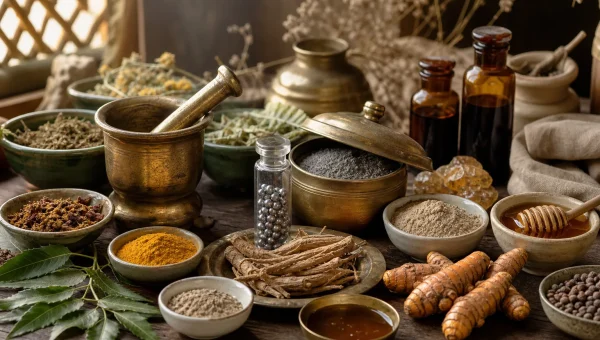
Trikatu, made from Shunthi, Maricha, and Pippali, is one classical Deepana-Pachana combination used where Kapha, coldness, heaviness, and sluggish Agni dominate. Its sharp and heating nature also means it is not universally suitable. In Pitta aggravation, acidity, burning sensation, active ulcers, pregnancy, or heat-dominant inflammatory states, it requires caution or avoidance unless prescribed by a qualified practitioner.
Yakrit, Pitta, and Biliary Support
Ayurveda often thinks about liver-region function through Yakrit, Pitta, Rakta, digestion, bile, and the transformation of food into tissue nourishment. In modern toxicokinetic thinking, hepatobiliary and fecal routes are part of the discussion for some small particles and plastic-associated chemicals, although human particle clearance remains uncertain. This creates a rational but limited bridge between Ayurvedic Yakrit-Pitta care and modern microplastic questions.
Katuki or Kutki, commonly identified with Picrorhiza kurroa, is a classical Ayurvedic drug used in liver-Pitta contexts and is also associated with choleretic and hepatoprotective pharmacology in experimental literature. It should not be presented as a proven microplastic-clearing herb. It is a potent herb with clinical cautions and should be used only with proper assessment, especially in weak digestion, pregnancy, chronic illness, or medication use.
Rasa-Rakta and Srotas Support
Classical Ayurveda places great importance on Rasa and Rakta because they are early carriers of nourishment, vitality, color, immunity, and tissue communication. When the body shows patterns of heat, congestion, sluggish circulation, skin involvement, or inflammatory burden, Rasa-Rakta-supportive herbs may be considered within a full Ayurvedic assessment.
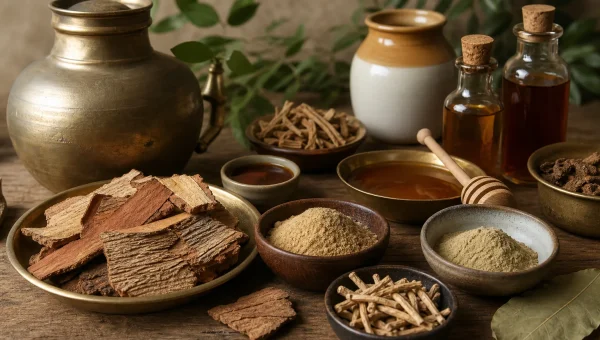
Manjistha is traditionally associated with Rakta-prasadana and Rakta-shodhana contexts and is used where blood, skin, heat, and stagnation patterns are relevant. Guduchi is described in the Ayurvedic Pharmacopoeia of India as Deepana, Rasayana, Tridosha-shamaka, Raktashodhaka, Balya, and Jvaraghna. These classical indications make Guduchi more appropriate as a resilience and tissue-support herb than as a direct “plastic remover.”
Reducing the Inflammatory Burden of Persistent Particles
Because established microplastic and nanoplastic burden cannot yet be clinically removed on demand, an Ayurvedic approach would also focus on the terrain: digestion, bowel regularity, sleep, inflammatory balance, liver-Pitta function, and tissue strength. Herbs are selected for the patient’s pattern, not merely for the modern exposure label.
| Herb | Verified Ayurvedic place | Responsible relevance to this hypothesis |
|---|---|---|
| Haridra (Curcuma longa) | Classical household and medicinal herb used in Kapha-Pitta, skin, wound, and inflammatory contexts | May support inflammatory balance when selected appropriately; not a standalone microplastic treatment. |
| Guduchi (Tinospora cordifolia) | Deepana, Rasayana, Balya, Raktashodhaka, Jvaraghna, and Tridosha-shamaka in the Ayurvedic Pharmacopoeia of India | Useful as a resilience-oriented herb where weakness, inflammatory tendency, or post-illness depletion is part of the presentation. |
| Manjistha (Rubia cordifolia) | Traditionally used in Rakta and skin-related contexts | Relevant where the clinical picture suggests Rakta-Pitta congestion, heat, or stagnation patterns. |
| Punarnava (Boerhavia diffusa) | Classically used in swelling, fluid, urinary, and Kapha-related contexts | May support fluid balance and elimination where oedema or heaviness is part of the pattern. |
| Katuki/Kutki (Picrorhiza kurroa) | Used in liver-Pitta and digestive contexts | Relevant to Yakrit-Pitta support, but too potent for casual self-prescribing. |
What This Framework Can and Cannot Claim
Ama theory can help organize the microplastic discussion around impaired transformation, persistence, channel burden, inflammatory terrain, and removal of causes. It can also prevent two common mistakes: treating microplastics as if they were simply “toxins” that any detox can flush out, or dismissing traditional frameworks before examining their practical logic.
The boundary is equally important. Ayurveda did not predict microplastics, microplastics are not Ama, and no herb should be advertised as dissolving or eliminating stored plastic particles from human tissues. The most defensible position is a hypothesis-generating one: reduce exposure, preserve Agni, maintain bowel and liver-supported elimination, use herbs only according to classical indication, and encourage formal studies that measure microplastic burden before and after well-designed Ayurvedic interventions.
This broader question—how traditional Ayurvedic categories can be evaluated with modern biomarkers—is related to the discussion in metabolomics meets Ayurveda: how blood testing validates traditional treatment. The goal is not to force modern toxicology into ancient language, but to let each system clarify the other where the comparison is disciplined and clinically honest.
This article is educational and hypothesis-generating. It does not diagnose, treat, or claim to remove microplastics from the body. Consult a qualified Ayurvedic practitioner or healthcare provider before using herbs, supplements, detoxification procedures, fasting, or therapeutic protocols, especially during pregnancy, while managing a medical condition, or while taking medication.
References
- Oceanservice (oceanservice.noaa.gov)
- Discovery and quantification of plastic particle pollution in human blood (2022), PubMed
- Jogh (jogh.org)
- Plasticenta: First evidence of microplastics in human placenta (2021), PubMed
- Raman Microspectroscopy Detection and Characterisation of Microplastics in Human Breastmilk (2022)
- Microplastic presence in dog and human testis and its potential association with sperm count and weights of testis and epididymis (2024), PubMed Central
- Nejm (nejm.org)
- Pace-cme (pace-cme.org)
- Med (med.stanford.edu)
- Impact of Microplastic Exposure on Human Health: A Systematic Review of Mechanisms, Biomarkers, and Clinical Outcomes (2025), PubMed Central
- Absorption, distribution, metabolism, excretion and toxicity of microplastics in the human body and health implications (2022), PubMed
- Microplastics in human body: accumulation, natural clearance, and biomedical detoxification strategies (2025), PubMed
- Charaka Samhita — Grahani Chikitsa
- Easyayurveda (easyayurveda.com)
- Charaka Samhita — Nidana Sthana
- Charaka Samhita — Nidana Sthana
- Easyayurveda (easyayurveda.com)
- Ayurvedic Pharmacopoeia of India
- Ayurvedic Pharmacopoeia of India
- Europepmc (europepmc.org)
- Indian herb Tinospora cordifolia and Tinospora species: Phytochemical and therapeutic application (2024), PubMed Central
- Characterization of Rubia cordifolia L. root extract and its evaluation of cardioprotective effect in Wistar rat model (2018), PubMed Central
- Phytochemical, therapeutic, and ethnopharmacological overview for a traditionally important herb: Boerhavia diffusa Linn (2014), PubMed Central
- Assessing the Release of Microplastics and Nanoplastics from Plastic Containers and Reusable Food Pouches: Implications for Human Health (2023), PubMed
- Microplastic Removal from Drinking Water Using Point-of-Use Devices (2023), PubMed Central
- Eerstekamer (eerstekamer.nl)
- FDA
I never thought about linking Ama to microplastics, but the idea of sticky residue blocking channels makes sense when I read about arterial plaque.
the dietary recommendations to reduce microplastic intake (reducing heated plastic containers, choosing glass storage) align perfectly with Sattvic food preparation principles.
the article builds a plausible narrative but the actual detoxification evidence for microplastics via herbal protocols is essentially zero at present.
The article mentions Kutki increasing bile flow; has anyone tried it for liver support and noticed changes in digestion?
I wonder if eating more fiber really helps move microplastics out of the gut faster, as the 2025 study suggested.
Using glass containers instead of plastic seems like a simple step, but I’m curious about the cost difference for bulk storage.
no mention of the regulatory and contamination issue of Ayurvedic herbs themselves sometimes containing microplastics from irrigation water. the source matters.
That’s a really important counterpoint. Organic certification helps but if the irrigation water is contaminated the herb itself may carry the very burden it’s supposed to address. Makes you wonder whether sourcing location and water testing should be part of how we evaluate Ayurvedic suppliers.
Valid concern, and it cuts both ways. If herbs can absorb microplastics from their environment then the efficacy of the Shodhana protocol partly depends on using clean-sourced inputs. Bit of a paradox if the detox tools are themselves contaminated. धन्यवाद for raising this.
The description of Ama as cold and heavy matches how I feel after eating processed snacks, could that be a sign of buildup?
I’m skeptical that herbs like Guduchi can actually affect macrophage activity in humans, but the animal data is intriguing.
Has anyone looked into whether reverse osmosis filters remove all sizes of nanoplastics, or just the larger ones?
which Ayurvedic Shodhana procedures are most relevant for lipid-stored toxins? Virechana seems more logical than Basti for this pathway. ✨
The part about avoiding heating food in plastic reminded me to stop microwaving leftovers in those containers.
I appreciate the caution that these Ayurvedic strategies are mechanistic hypotheses, not proven cures.
Manjistha’s role in moving plasma/lymph makes me think about dry brushing; could that complement herbal support?
The correlation between arterial plaque microplastics and 4.5 fold higher cardiac risk is alarming, worth tracking in future checkups.
I’m trying Trikatu with honey before meals to see if my digestion feels warmer, as the article says it counters mitochondrial stress.
Reducing synthetic fabrics at home feels like a big lifestyle shift; any tips on finding natural fiber alternatives?
the Triphala + Shilajit protocol as a modern Ama-clearing approach for microplastic detox is interesting. started the protocol 3 weeks ago, early days.
The article’s note about Amapachana herbs needing specific preparation rather than normal detox caught my attention.
I’d love to see a clinical trial measuring microplastic levels before and after an Ayurvedic regimen, even if it’s just a pilot.
is there any research on whether fasting (Langhana) increases or decreases microplastic mobilization? could be important if toxins are stored in fat.
the Ama-toxin mapping is a conceptual framework, not a clinical protocol. treating microplastic accumulation with Ayurvedic detox without specific evidence is a stretch.
the article recommends Guduchi for immune modulation around nicroplastic exposure. is there any specific mechanism proposed?
does the Ama tjeory account for lipid-soluble vs water-soluble toxins differently? microplastics partition into fatty tissue which might require different ‘Shodhana’ than the usual Ama. tbh
Will try!
does the Ama theory account for lipid-soluble vs water-soluble toxins differently? microplastics partition into fatty tissue which might require different ‘Shodhana’ than the usual Ama.
The arterial plaque finding from 2025 is the detail in this article that stopped me cold. 🙏 I came into this skeptical of the Ama framing but when you line up the properties — lipophilic, channel-blocking, inflammatory — the parallel is hard to dismiss. Does the author have references on Triphala’s role in phase-two detox pathways?
@Karthik which Ayurvedic Shodhana procedures are most relevant for lipid-stored toxins? Virechana seems nore logical than Basti for this pathway.
@Jessica does the Ama theory account for lipid-soluble vs water-soluble toxins differently? microplastics partition into fatty tissue which might require different ‘Shodhana’ than the usual Ama.
The placenta and breast milk findings mentioned here are the ones that concern me most as a new parent. The article’s argument that Ama accumulation can be intergenerational maps uncomfortably well onto what the microplastic research is showing. Has anyone looked into whether there’s a pre-conception Shodhana protocol discussed anywhere on this site?
Helpful.
the Ama-toxun mapping is a conceptual framework, not a clinical protocol. treating microplastic accumulation with Ayurvedic detox without specific evidence is a stretch.
no mention of the regulatory and contamination issue of Ayurvedic herbs themselves sometines containing microplastics from irrigation water. the source matters. tbh
does the Ama theory account for lipid-soluble vs water-soluble toxins differently? micropkastics partition into fatty tissue which might require different ‘Shodhana’ than the usual Ama.
the Ama-microplastuc parallel is genuinely novel. I hadn’t thought of PFAS accumulation as fitting the Ama definition but the properties match sticky, channel-blocking, metabolically disruptive.
@Rachel no mention of the regulatory and contamination issue of Ayurvedic herbs themselves sometimes containing microplastics from irrigation water. the source matters.
@Vikram no mention of the regulatory and contamination issue of Ayurvedic herbs themselves sometimes containing microplastics from irrigation water. the source matters.
the article recommends Giduchi for immune modulation around microplastic exposure. is there any specific mechanism proposed?