
Gut-microbiome research has advanced rapidly, but it has not completed a clean transition from association to causation. Human studies still identify many disease-associated patterns, while germ-free animals, defined microbial communities, organoids, metabolomics, and intervention trials help test mechanisms. A 2025 international consensus statement nevertheless emphasized that cause-and-effect remains difficult to establish and that microbiome-directed therapies require rigorous clinical evaluation.
Ayurvedic herbs are reasonable subjects for this research. Plant fibers, polysaccharides, tannins, and other constituents may be transformed by intestinal microbes or may alter microbial metabolism. That is biologically plausible; it is not proof that every herb described as dipana, pachana, or rasayana works through the microbiome.
Classical Ayurveda and modern microbiome science ask different questions. The former describes qualities, actions, indications, and formulations; the latter measures organisms, genes, metabolites, barrier function, and clinical outcomes. The two can generate useful hypotheses, but they should not be treated as interchangeable evidence.
Background: What Microbiome Modulation Means
The gut microbiota is the community of microorganisms inhabiting the gastrointestinal tract; the microbiome includes their collective genes, functions, and ecological setting. A widely cited estimate for a typical adult male is about 38 trillion bacterial cells and 30 trillion human cells, but both are approximations. An early metagenomic catalogue identified about 3.3 million non-redundant microbial genes in 124 European participants; that was a cohort catalogue, not a fixed count for every person.
Gut microbes ferment carbohydrates that human enzymes do not fully digest, producing acetate, propionate, and butyrate. They also participate in vitamin metabolism and communicate with intestinal epithelial and immune cells. These functions vary with diet, transit, medicines, host physiology, and interactions among microbes. More of one named bacterium is therefore not automatically better in every person or disease.
A prebiotic is a substrate selectively used by host microorganisms that confers a health benefit. A laboratory change in bacterial abundance alone does not prove prebiotic efficacy. Probiotics are live microorganisms given in adequate amounts for a health benefit, while postbiotics are preparations of inanimate microorganisms or their components with demonstrated benefit. Most Ayurvedic herbs have not yet met a clinical standard for a microbiome-directed therapy.
Triphala: Promising Evidence, Not a Proven Universal Prebiotic
The Ayurvedic Formulary of India lists Triphala Churna as equal parts of Haritaki (Terminalia chebula), Bibhitaka (Terminalia bellirica), and Amalaki (Emblica officinalis in the formulary). Their tannins, polyphenols, and carbohydrates could interact with intestinal microorganisms. However, no clinical Triphala study has shown that ellagitannin-to-urolithin conversion explains response or that this conversion differs by Vata or Kapha constitution.
The most relevant published human experiment is a 2020 randomized, double-blind, placebo-controlled pilot. Thirty-one healthy adults were assigned to Triphala, Manjistha, or placebo for four weeks, taking 2,000 mg daily. Fecal 16S rRNA profiling suggested that Triphala altered community composition, but responses were highly individualized and no bacterial taxon changed uniformly. The study was too small to establish treatment efficacy, a disease indication, or a standard microbiome dose.
A 2023 laboratory study incubated Triphala extracts with fecal microbiota from adults with obesity. It found no statistically significant difference in overall microbial profiles between Triphala and control cultures, although metabolomic analysis detected many altered metabolites. This supports mechanistic research, not a claim that Triphala treats metabolic disease or restores the post-antibiotic microbiome in humans.
What the Published Studies Actually Support
| Evidence | Exposure studied | Main finding | Not established |
|---|---|---|---|
| 2020 human pilot | 2,000 mg daily for 4 weeks | Individualized community shifts; no uniformly altered taxon | A therapeutic dose or disease benefit |
| 2023 fecal-culture model | Triphala extract in an anaerobic gut model | Metabolomic changes without a significant overall profile difference | Clinical efficacy or durable human change |
| Current conclusion | No validated regimen | Microbiome activity is plausible but preliminary | Routine use for everyone labelled with “dysbiosis” |
Guduchi: Classical Rasayana, Unproven Human Microbiome Therapy
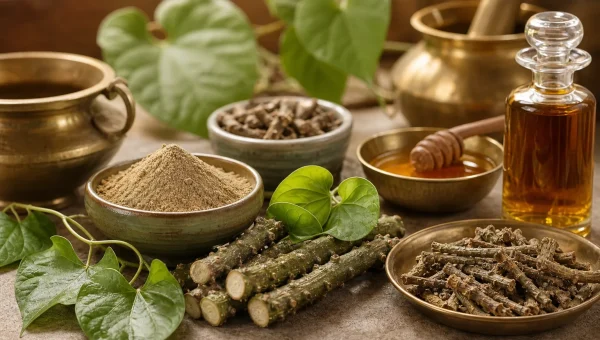
Guduchi is the dried mature stem of Tinospora cordifolia in the Ayurvedic Pharmacopoeia of India. Its monograph records tikta and kashaya rasa, laghu guna, ushna virya, and madhura vipaka, with actions including dipana, rasayana, sangrahi, and tridoshashamaka. “Immunomodulator” is a modern pharmacological label, not the Sanskrit classification stated in that monograph.
There is no human evidence that Guduchi repairs rasa or rakta-vaha srotas through Akkermansia muciniphila or through demonstrated increases in tight-junction proteins.
The pharmacopoeial monograph gives general adult quantities of 3–6 g for powder and 20–30 g of drug for decoction, but these are not microbiome doses or individualized prescriptions. Published case series and the NIH LiverTox review also document clinically apparent liver injury associated with Tinospora cordifolia, sometimes with autoimmune-like features and greater danger in pre-existing liver disease. Botanical authentication is essential, but substitution concerns do not erase this safety signal.
Pippali: In Vitro Activity and Interaction Risk
Pippali is the dried immature fruit of Piper longum. The Ayurvedic Pharmacopoeia records katu rasa; laghu and snigdha guna; anushna virya; and madhura vipaka. Listed actions include dipana, ruchya, rasayana, and rechana. This is more precise than describing Pippali simply as a heating antimicrobial.
A 2019 study examined turmeric, ginger, long pepper, and black pepper in anaerobic cultures of human fecal microbiota followed by 16S rRNA sequencing. Long pepper altered cultured communities and carbohydrate-utilization pathways, supporting preclinical investigation. It did not demonstrate selective stimulation of Bifidobacterium longum, inhibition of Clostridium perfringens, or benefit in patients.
Pippali contains piperine, often called a bioavailability enhancer. Mechanistic studies show that piperine can inhibit P-glycoprotein and CYP3A4, systems involved in handling many medicines. That creates interaction potential as well as possible altered absorption. Concentrated Pippali or piperine products should be reviewed by a clinician when prescription medicines are used, especially drugs with a narrow therapeutic range.
Haritaki: Classical Anulomana and Mainly Preclinical Data
Haritaki is the dried mature fruit pericarp of Terminalia chebula. Its pharmacopoeial profile includes five tastes—madhura, amla, katu, tikta, and kashaya—with laghu and ruksha guna, ushna virya, and madhura vipaka. The monograph lists dipana, rasayana, anulomana, and sarvadosha-prashamana.
Terminalia chebula extracts have influenced gut microbes and short-chain fatty acids in animal models. A 2024 study of raw and processed material in dextran-sodium-sulfate-induced colitis reported changes in intestinal flora and SCFAs alongside improvement in rats. Other animal studies have examined extracts or isolated chebulagic acid. Such results cannot establish a human dose, long-term safety, or treatment efficacy for inflammatory bowel disease.
A registered study has investigated standardized Terminalia chebula extract and the human gut microbiome, but registration is not peer-reviewed evidence of efficacy. Haritaki is best described as a classical drug with emerging microbiome research, not a proven microbiome-restoration agent.
The Agni–Microbiome Interface: Analogy, Not Equivalence
Ayurvedic literature and explanatory traditions commonly organize Agni into thirteen categories: one jatharagni, five bhutagni, and seven dhatvagni. Jatharagni is foundational to processing food, while the remaining categories describe transformation at elemental and tissue levels within the Ayurvedic model. Agni, Ama, dosha, dhatu, and srotas should first be explained on their own terms.
Dysbiosis is a modern ecological description of altered microbial composition or function. It can involve microbial metabolites, barrier function, immune signaling, diet, infection, or medicines. There is no validated equation in which Ama equals lipopolysaccharide, intestinal permeability equals srotorodha, or a coated tongue proves dysbiosis. Similar symptoms do not show that the two systems describe the same biological entity.
The strongest synthesis is methodological: classical observations can suggest modern tests. Researchers can ask whether a standardized dipana formulation changes microbial genes, metabolites, transit, barrier markers, symptoms, or drug exposure, and whether those changes mediate outcomes. Until replicated, microbiome language should illuminate a hypothesis rather than retrospectively prove a classical action.
Research Priorities for 2026 and Beyond
More defensible priorities follow from the gaps in published evidence.
- Larger, preregistered human trials: replicate the Triphala pilot with standardized products, dietary monitoring, adverse-event reporting, and meaningful clinical outcomes.
- Function as well as taxonomy: combine metagenomics with metabolomics, stool chemistry, transit, barrier markers, and symptoms instead of treating one bacterial genus as proof of benefit.
- Product authentication: document species, plant part, processing, contaminants, and chemical profile.
- Individual variation: test diet, medicines, antibiotic exposure, age, geography, and Prakriti as possible response modifiers without assuming the result.
- Safety and interactions: monitor liver tests, gastrointestinal adverse effects, and herb–drug interactions, particularly with Guduchi and piperine-containing products.
For related reading on staged laboratory and clinical validation, see our review of reverse pharmacology and Ayurvedic validation.
Clinical Implications and Responsible Herb Selection
The evidence supports caution rather than a universal microbiome protocol. A commercial stool report does not by itself establish an Ayurvedic diagnosis, and a classical diagnosis does not identify a specific microbial signature. Herb selection should consider the clinical picture, product quality, medicines, bowel pattern, age, pregnancy, liver health, and whether symptoms require conventional investigation.
- Do not prescribe Triphala to everyone with “dysbiosis”: one small healthy-volunteer pilot and laboratory studies cannot define a universal indication or dose.
- Do not assume probiotics or herbs restore the post-antibiotic microbiome: recovery varies; persistent diarrhea, blood in stool, fever, dehydration, or weight loss needs medical assessment.
- Keep sequencing claims in their proper category: using dipana-pachana before selected nourishing measures may be Ayurvedic clinical reasoning, but its microbiome mechanism is unproven.
- Prioritize fundamentals: use a varied, tolerated diet and evidence-based medical care rather than an unvalidated “microbiome detox.” IBD, infection, metabolic disease, or medication-related symptoms require qualified healthcare oversight.
For practical context, see our guides to the gut-brain axis in Ayurveda and Ayurvedic anti-inflammatory dietary principles.
Research and safety note: Effects seen in cell culture, fecal fermentation, or animals are not established human treatment effects. Do not self-treat serious or persistent gastrointestinal symptoms with Triphala, Guduchi, Pippali, Haritaki, probiotics, or restrictive diets. Consult a qualified Ayurvedic practitioner and an appropriate healthcare provider before medicinal use, especially during pregnancy or breastfeeding, in children, with liver disease, or alongside prescriptions. Stop a product and seek prompt medical advice for jaundice, dark urine, severe abdominal pain, persistent vomiting, blood in stool, allergic symptoms, or marked worsening.
References
- Nature (nature.com)
- Revised Estimates for the Number of Human and Bacteria Cells in the Body (2016), PubMed Central
- Nature (nature.com)
- Dietary Fiber Intake and Gut Microbiota in Human Health (2022), PubMed Central
- Expert consensus document: The International Scientific Association for Probiotics and Prebiotics (ISAPP) consensus statement on the definition and scope of prebiotics (2017), PubMed
- Nature (nature.com)
- The International Scientific Association of Probiotics and Prebiotics (ISAPP) consensus statement on the definition and scope of postbiotics (2021), PubMed
- Ayurvedic Pharmacopoeia of India
- Modulatory Effects of Triphala and Manjistha Dietary Supplementation on Human Gut Microbiota: A Double-Blind, Randomized, Placebo-Controlled Pilot Study (2020), PubMed
- Efficacy of Triphala extracts on the changes of obese fecal microbiome and metabolome in the human gut model (2023), PubMed Central
- Ayurvedic Pharmacopoeia of India
- NCBI
- Tinospora Cordifolia (Giloy)-Induced Liver Injury During the COVID-19 Pandemic-Multicenter Nationwide Study From India (2022), PubMed Central
- Ayurvedic Pharmacopoeia of India
- Prebiotic Potential of Culinary Spices Used to Support Digestion and Bioabsorption (2019), PubMed
- Piperine, a major constituent of black pepper, inhibits human P-glycoprotein and CYP3A4 (2002), PubMed
- Investigating the mechanism of enhanced medicinal effects of Terminalia chebula fruit after processing based on intestinal flora and metabolomics (2024), PubMed
- Clinicaltrials (clinicaltrials.gov)
- Physiological aspects of Agni (2010), PubMed Central
- Clinicaltrials (clinicaltrials.gov)
- Clinicaltrials (clinicaltrials.gov)
- Clinicaltrials (clinicaltrials.gov)
- NCCIH
The causation vs correlation shift in microbiome research is significant and you’ve summarized it well. The Guduchi immunomodulation data through gut microbiome pathways is something I’d been following in the literature. Nice to see a synthesis.
Which specific Ayurvedic herbs have the strongest 2025-2026 microbiome evidence? The article is broad but I’d like to know the top 3 by strength of evidence for clinical use.
The framing of Agni as a concept that maps onto microbiome function is intellectually credible but the translation has limits. Agni is much broader in classical texts than gut flora counts, and oversimplifying risks creating a reductive understanding of both systems.
The Triphala section is well done. Three years of daily use and my gut function is unrecognizably better than before. I had tried every probiotic brand available and nothing came close.
I appreciated the breakdown of how Triphala’s tannins might interact with gut microbes but wish the piece had more data on long term safety.
I’d want to see the actual citations rather than just mentions of studies from 2022-2026. The herb-microbiome space has some low-quality research alongside the good. Without distinguishing, readers can’t evaluate.
Does the article mention any human trials that looked at Guduchi’s effect on Akkermansia levels specifically?
The bit about Shilajit and short chain fatty acid production is something my nutritionist mentioned last month. Seeing the mechanism explained here helps me understand why she recommended it for my post-antibiotic gut restoration.
I found the distinction between Ayurvedic dipana and modern microbiome measurements helpful for framing future studies.
Does the microbiome-modulating effect of these herbs differ based on cooking method? I’m thinking specifically about whether boiling Triphala in water versus cold water extraction changes the prebiotic component availability.
The part about Pippali’s piperine interfering with drug metabolism made me think twice about using it with my current meds.
The Gut Microbiome Modulation by Ayurvedic Herbs angle is useful here. This feels more usable than a long list of herbs.
It’s interesting that the 2020 Triphala pilot showed individualized shifts but no uniform taxon change, showing how personal gut ecology is.
I wonder if the authors plan to update the piece once the Kasturba Medical College trial results are published.
The Gut Microbiome Modulation by Ayurvedic Herbs angle is useful here. The examples make the advice less abstract.
quick question: does the dosage change if someone is also on other medication?
Is this suitable for Pitta dominant people or mainly Vata?
The Pitta protocol here caused a lot of heat and skin irritation for me.
@Stephanie I’ve been on Triphala for 6 months and my gut microbiome testing showed only modest shifts.
Followed the dosage table for 10 days and my sleep improved, will continue 🙏. ठीक है
Would this protocol work if I travel frequently and can’t maintain a fixed routine.
The shift from association to causation in the microbiome literature is genuinely significant and I’m glad this article covers it. The 2026 data on Triphala’s prebiotic effects specifically — does the research distinguish between the three constituent fruits acting separately versus the synergistic combination? I’ve seen conflicting claims on whether all three are needed or whether haritaki alone drives most of the microbial benefit.
@Maya Some of these claims are very strong for what is essentially anecdote-level evidence.
@Maya my functional medicine doctor mentioned something similar, helpful to have the ayurvedic framing too 🌿
Tried the morning routine from this article and noticed a difference by day 5. 🙌
bookmarked this to share with my mother who has been struggling with the same issue
my constitution is vata-pitta, the article seems focused on one or the other
Appreciate that this goes into contraindications, most blog posts skip that part. 🙏
this works in theory but practically very hard to source authentic herbs
The warning about liver injury with Guduchi aligns with what I’ve read in other safety reviews, good to see it highlighted.
late to this but wanted to ask, do these recommendations still hold in 2027?
Same here
just found this post, the section 3 protocol seems intensive for a beginner, any lighter version?
where are the actual clinical trials? i need rct data before trying anything
my vaidya recommended something similar last month, good to see the reasoning explained
the pitta protocol here caused a lot of heat and skin irritation for me 🙏
the specific morning timing recommendation is practical, most articles skip that detail
just started exploring ayurveda after years of allopathy, still a lot to absorb 🙏
starting this next week, will report back in about a month
tried the morning routine for 2 months, gave up the timing is impossible with kids and a job ❤️
ive been on triphala for 6 months and my gut microbiome testing showed only modest shifts
The article mentions short-chain fatty acid production from Ayurvedic herbs any specific dose-response data?
The Gut Microbiome Modulation by Ayurvedic Herbs section feels grounded enough to try carefully. I appreciate that it does not oversell the result.
The Gut Microbiome Modulation by Ayurvedic Herbs section feels grounded enough to try carefully. The article avoids making it sound like a quick fix.
Helpful
As a researcher this was one of the better summaries of the 2026 gut-Ayurveda literature I’ve seen.
The 2026 Bifidobacterium modulation data from Triphala was exactly what I needed to justify continuing my protocol to my gastroenterologist.
For someone new to microbiome research, the explanation of prebiotics versus probiotics versus postbiotics was clear.
how long before seeing results? the article mentions 4 to 6 weeks but is that for everyone
@Vinay Does Triphala’s prebiotic effect require all three fruits or does Amalaki alone provide it?
My IBS improved significantly with the Bhumyamalaki protocol my practitioner prescribed after this area of research was flagged to her. The 2025 gut-liver axis data seems to be the key mechanism.
been following this for 3 weeks and my energy levels are much better, the protocol described here really clicked for me
some of these claims are very strong for what is essentially anecdote-level evidence
where can you source the herbs in india outside of major cities? im in a tier-2 town
would this protocol work if i travel frequently and cant maintain a fixed routine
the microbiome diversity angle on ayurvedic diet makes the traditional six-taste approach feel more scientifically grounded
just started exploring ayurveda after years of allopathy, still a lot to absorb 🌿
how does the microbiome modulation effect compare between churna and tablet forms of triphala?
tried this for 6 weeks and saw no difference, maybe im applying it wrong
Packaging this as science when most of it is tradition makes me skeptical.
wondering if any of these herbs can cause dysbiosis if overused. the same herb that promotes beneficial strains might suppress others in the wrong dose or duration.
The 2026 studies cited are interesting but most are still in early-stage human trials, the clinical translation is premature.
where can you source the herbs in india outside of major cities? i’m in a tier-2 town नमस्ते
quick question: does the dosage change if someone is also on other medication? 🌿
Where can you source the herbs in India outside of major cities? I’m in a tier-2 town.
the dosage here seems higher than what my ayurvedic doctor recommended
Where are the actual clinical trials? I need RCT data before trying anything.
The advice around Gut Microbiome Modulation by Ayurvedic Herbs is specific enough to be useful. Small daily changes are easier to follow than a perfect plan.
the 2026 studies cited are interesting but most are still in early-stage human trials, the clinical translation is premature
Starting this next week, will report back in about a month.
Noted
Tried the morning routine for 2 months, gave up the timing is impossible with kids and a job.
The advice around Gut Microbiome Modulation by Ayurvedic Herbs is specific enough to be useful. The timing advice is the part I would start with.
the pitta protocol here caused a lot of heat and skin irritation for me ❤️
Reading this after finding it on Google, is this dosage still recommended?
appreciate that this goes into contraindications, most blog posts skip that part
the sourcing section was a surprise, didnt know the extract grade mattered this much
The specific morning timing recommendation is practical, most articles skip that detail.
as a researcher this was one of the better summaries of the 2026 gut-ayurveda literature ive seen
The Gut Microbiome Modulation by Ayurvedic Herbs angle is useful here. Small daily changes are easier to follow than a perfect plan.
This works in theory but practically very hard to source authentic herbs.