
Meditation is powerful, but it is not the whole of mental-health care. When anxiety becomes clinical, low mood becomes recurrent, or burnout crosses into illness, Ayurveda does not reduce the problem to meditation alone. Classical Ayurveda places the mind inside a wider clinical framework that includes manas, dosha, agni, sleep, diet, conduct, sense-regulation, sattvavajaya, and medhya rasayana herbs. The treatment-room conversation is therefore not “meditation versus medicine”; it is how to use contemplative practice, professional care, and carefully chosen Ayurvedic supports together.
The Ayurvedic Model of Mental Health
Charaka Samhita, especially in Shareera Sthana, treats the mind as subtle, unitary, and essential for perception, thinking, restraint, and the coordination of the senses. Mental health is described through the strength of sattva and the disturbance of the mental doshas rajas and tamas. Sattva represents clarity, steadiness, and discernment; rajas brings agitation, passion, and excessive movement; tamas brings inertia, heaviness, obscuration, and dullness.
Ayurveda does not use vata, pitta, and kapha as modern psychiatric labels, but the doshas help describe patterns of presentation. A vata-dominant mental pattern may show fearfulness, restlessness, irregular sleep, scattered speech, and instability. A pitta-dominant pattern may show irritability, anger, heat, intensity, intolerance, and agitation. A kapha-dominant pattern may show heaviness, withdrawal, drowsiness, low drive, and cognitive dullness. These patterns guide the choice of diet, routine, herbs, and therapies, while serious symptoms still require appropriate clinical assessment.
Medhya Rasayana: Beyond Lifestyle Advice
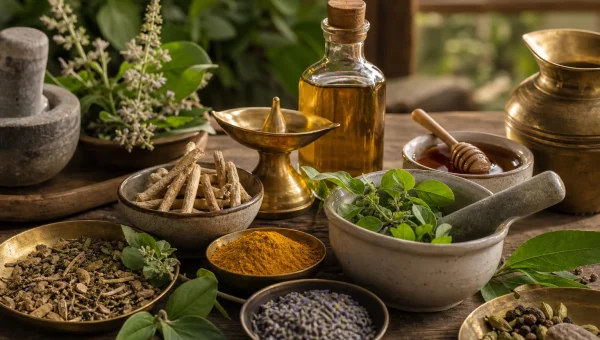
Medhya rasayana refers to rejuvenative substances and practices used to support intellect, memory, clarity, and mental steadiness. Charaka’s Rasayana section names four primary medhya rasayanas: Mandukaparni, Guduchi, Yastimadhu, and Shankhapushpi. In later clinical usage, herbs such as Bacopa monnieri, Ashwagandha, Jatamansi, and saffron are also commonly discussed in mental-health protocols, but plant identity and patient selection matter. The word “Brahmi,” for example, has been used regionally for both Bacopa monnieri and Centella asiatica, so a protocol should specify the botanical species.
Brahmi (Bacopa monnieri) for Cognitive Load and Anxious Rumination
Bacopa monnieri is best placed where anxiety is accompanied by cognitive load, learning pressure, forgetfulness, rumination, or mental fatigue. Human trials have commonly used standardized Bacopa extracts in the 300–450 mg daily range over several weeks, with effects assessed on memory, attention, and anxiety-related measures. It is not an instant sedative; it is a medhya-style support that fits gradual cognitive and nervous-system nourishment. Sensitive users may experience digestive discomfort, so it should be taken under guidance, especially when other medications or supplements are already being used.
Ashwagandha (Withania somnifera) for Stress Physiology and Depleted Resilience
Ashwagandha is a rasayana herb often chosen when stress presents with poor sleep, fatigue, nervous depletion, and vata-type instability. Clinical trials have used preparations in a range that often falls around 240–600 mg daily of extract, and contemporary clinical summaries describe its role in stress, anxiety, cortisol response, and sleep support. In traditional practice it may be taken with warm milk or food when suitable, but it is not appropriate for everyone. It should be avoided or used only with medical supervision in pregnancy, liver disease, thyroid disorders, autoimmune conditions, and when taking sedatives, thyroid medication, immunosuppressants, or other interacting drugs.
Shankhapushpi (Convolvulus pluricaulis) for Racing Mind and Sleep-Onset Restlessness
Shankhapushpi is one of Charaka’s medhya rasayanas and is identified in the Ayurvedic Pharmacopoeia of India as Convolvulus pluricaulis. It is traditionally used where the mind is scattered, easily overstimulated, and difficult to settle at night. In practice it may appear as powder, syrup, paste, ghrita, or compound formulations, with the dose and vehicle selected according to agni, age, constitution, sleep pattern, and concurrent medicines. Its best clinical role is not as a stand-alone cure but as part of a wider calming, vata-pacifying, sleep-supportive plan.
Jatamansi (Nardostachys jatamansi) for Agitation and Disturbed Sleep
Jatamansi is an aromatic Himalayan rhizome used in Ayurveda for calming, sleep support, and disturbed mental states. Modern pharmacological literature describes central nervous system activity involving calming, GABA-related, and monoamine-related pathways, while traditional use places it in presentations of agitation, emotional overwhelm, and disturbed sleep. Because it may add to the effects of sedatives, anticonvulsants, antidepressants, or other nervous-system medicines, it is best reserved for supervised use rather than casual self-dosing.
Practitioner-Mapped Herb Protocols by Presentation
The following patterns are educational blueprints, not prescriptions. Ayurveda individualizes herbs according to prakriti, vikriti, agni, bowel pattern, sleep, strength, age, season, medication use, and severity of symptoms. Acute panic, suicidal thoughts, psychosis, mania, substance withdrawal, severe depression, or treatment-resistant illness require prompt care from an appropriate healthcare professional.
Saffron for Mild to Moderate Low Mood
Saffron, known as Kesar or Kumkuma, is the dried stigma and style of Crocus sativus and is included in Ayurvedic materia medica. It is also one of the better-studied botanicals in integrative mood support. Controlled clinical literature has evaluated saffron in mild to moderate depression, commonly around 30 mg daily in divided doses, including comparisons with standard antidepressant medicines in selected trial populations. This does not make saffron a replacement for psychiatric care; it makes it a serious adjunct candidate when the presentation is mild to moderate, safety has been reviewed, and the patient is under appropriate supervision.
Saffron needs caution at high doses and in pregnancy, and it should be reviewed carefully when a person is already using antidepressants, mood stabilizers, sedatives, anticoagulants, antiplatelet medicines, or multiple supplements. Possible adverse effects include headache, nausea, appetite changes, and anxiety in some users.
Agni, Ama, and Manovaha Srotas
Ayurveda does not isolate mental health from digestion, sleep, sensory intake, or daily conduct. Manovaha srotas describes the channels through which mind and body interact, and this is why a good Ayurvedic plan often begins with agni, bowel rhythm, food timing, sleep rhythm, and reduction of ama-producing habits before adding medhya herbs. Modern gut–brain literature gives this old clinical priority a familiar physiological language, but Ayurveda’s practical point remains simple: a mind-support plan is weaker when digestion, sleep, and daily rhythm are ignored.
| Herb | Professional-Use Range or Form | Primary Ayurvedic Role | Best Matched Presentation |
|---|---|---|---|
| Brahmi (Bacopa monnieri) | 300–450 mg/day standardized extract is common in human trials | Medhya support for memory and clarity | Cognitive load, learning stress, anxious rumination |
| Ashwagandha | 240–600 mg/day extract range appears in clinical literature | Rasayana and stress-resilience support | Stress, poor sleep, fatigue, vata depletion |
| Saffron | About 30 mg/day in many mood trials | Mood-support adjunct | Mild to moderate low mood under care |
| Shankhapushpi | Powder, syrup, paste, ghrita, or compound form; individualized | Charaka medhya rasayana | Racing mind, sleep-onset restlessness |
| Jatamansi | Individualized supervised use | Calming aromatic nervine | Agitation, overwhelm, disturbed sleep |
| Guduchi | Juice, decoction, powder, or compound form; individualized | Charaka medhya rasayana and rasayana support | Low vitality with agni and ama involvement |
Satvavajaya and Achara Rasayana
Herbs are only one part of the Ayurvedic mental-health model. Satvavajaya focuses on restraining the mind from harmful objects and patterns, while achara rasayana emphasizes truthful conduct, calmness, compassion, self-restraint, cleanliness, appropriate sleep, and meditative discipline. This keeps meditation in its proper place: not as a stand-alone cure for clinical illness, but as an important component of a broader, supervised plan that also addresses body, digestion, routine, behavior, and medicine when needed.
Important Clinical Boundaries
Ayurvedic herbs are not a replacement for psychiatric care in severe, complex, or treatment-resistant conditions. They may be useful as adjuncts or practitioner-guided supports in mild to moderate presentations, but red-flag symptoms require medical attention. People taking antidepressants, anxiolytics, sedatives, antiepileptics, thyroid medication, blood thinners, immunosuppressants, or multiple supplements should not combine herbs casually. Product quality also matters, because some Ayurvedic products have been found to contain unsafe levels of heavy metals or undeclared substances.
Nothing in this article diagnoses, treats, or cures a medical condition. Use it as educational information and consult a qualified Ayurvedic practitioner, physician, or mental-health professional before starting herbs, supplements, detoxes, or therapeutic protocols, especially if pregnant, breastfeeding, managing a medical or psychiatric condition, or taking medication.
References
- NCCIH
- Nimh (nimh.nih.gov)
- World Health Organization
- Charaka Samhita — Katidhapurusha Sharira
- Charaka Samhita — Dosha
- Charaka Samhita — Sattva
- Charaka Samhita — Unmada Nidana
- Charaka Samhita — Rasayana
- NCBI
- Effects of 12-Week Bacopa monnieri Consumption on Attention, Cognitive Processing, Working Memory, and Functions of Both Cholinergic and Monoaminergic Systems in Healthy Elderly Volunteers (2012), PubMed Central
- NIH Office of Dietary Supplements
- Ayurvedic Pharmacopoeia of India
- Phytochemical Profile, Pharmacological Attributes and Medicinal Properties of Convolvulus prostratus – A Cognitive Enhancer Herb for the Management of Neurodegenerative Etiologies (2020), PubMed Central
- An important Indian traditional drug of ayurveda jatamansi and its substitute bhootkeshi: chemical profiling and antioxidant activity (2013), PubMed Central
- Anxiolytic actions of Nardostachys jatamansi via GABA benzodiazepine channel complex mechanism and its biodistribution studies (2018), PubMed
- Ayurvedic Pharmacopoeia of India
- Saffron (Crocus sativus L.) and major depressive disorder: a meta-analysis of randomized clinical trials (2013), PubMed Central
- Comparative efficacy and safety of Crocus sativus L. for treating mild to moderate major depressive disorder in adults: a meta-analysis of randomized controlled trials (2018), PubMed Central
- Charaka Samhita — Manovaha srotas
- The gut microbiota in anxiety and depression – A systematic review (2021), PubMed
- Gut Microbiota in Anxiety and Depression: Unveiling the Relationships and Management Options (2023), PubMed Central
- NCCIH
Been using anxiety for about 3 months now and the difference in how I feel is real. My practitioner said the same things this article covers so good to have it spelled out.
This helped me understand Ayurveda and Mental Health without too much jargon. The safety notes could be expanded a little.
I want to emphasize strongly what the article says: these are complementary approaches, not replacements for psychiatric care. I have bipolar disorder and Brahmi has been helpful alongside my medication. But it’s always alongside.
The Shirodhara for anxiety I did this once and the 45 minutes of warm oil on the forehead produced a deep calm that lasted 3 days. I don’t know what the mechanism is but the subjective effect is unlike anything else I’ve tried.
The herb-drug interaction section is the most responsible part of this article. Jatamansi and SSRIs, Brahmi and acetylcholinesterase inhibitors these interactions need to be managed by a practitioner. The article flags this appropriately.
Is there a specific Ayurvedic protocol for panic attacks? The Vata-aggravation pattern fits panic disorder almost exactly but the acute treatment question what to do in the moment of an attack isn’t addressed.
As a clinical psychologist I’m cautiously optimistic about integrating some of these approaches. The Prana-mind-body interaction framework resonates with polyvagal-informed therapy principles. The herbs need much more evidence but the lifestyle framework is sound.
The Kapha-depression protocol with stimulating herbs and movement is different from the standard advice to rest and take it easy. The idea that Kapha-type depression needs activation not sedation changed my understanding of why some depression protocols work better for me than others.
My GP dismissed Brahmi when I mentioned it. My psychiatrist looked at the mechanism data and said he had no objection to trying it. The difference in receptivity based on understanding the pharmacology is significant.
I have treatment-resistant depression and have been working with an integrative psychiatrist for 2 years. The Ayurvedic herbs, particularly Brahmi and Jatamansi, have made a noticeable difference in my treatment response. Not cured, but shifted enough to make my therapy more productive.
The framing of mental illness as excess or deficiency of doshas rather than as pathology deserving treatment is something I’d push back on. For severe mental illness, this framing can minimize the seriousness of the condition in a way that delays appropriate care.
The breakdown of doshas and mental qualities really clarifies how Ayurveda links to modern neuroinflammation findings.
Does the article mention any safety concerns for combining saffron with antidepressants?
Seeing the protocol for burnout with Ashwagandha, Shatavari, and Triphala makes me want to try a gentler approach.
It’s helpful that the piece distinguishes when to use these herbs as adjuncts rather than replacements for psychiatric care.
The reference to Charaka Samhita’s view of manas as the 26th element gave me a fresh perspective on mind-body integration.
Good reminder on Ayurveda and Mental Health. The main idea is clear even if someone is new to Ayurveda.
probably best to check with a qualified vaidya on the clinical herb section
For someone with Pitta imbalance, does Brahmi for major depression question need to be modified?
Not dismissing Medhya Rasayana classification entirely but it didn’t do much for me. My constitution might be different.
I notice you don’t mention any contraindications for Brahmi for major depression question. That feels like an important omission.
Sorry off-topic but does anyone have experience with Ayurvedic treatment for hair thinning? ❤️
bookmarked. the combining herbs with therapy section saved me so much confusion
finally tried Medhya Rasayana classification after reading this. no miracle cure but genuinely helpful
What’s the difference between the Jatamansi vs SSRIs claim approach for acute vs chronic conditions?
totally agree on Brahmi for major depression question. i reduced the dose initially too. ✨
I’m a bit skeptical of the claims around combining herbs with therapy. The mechanism you describe sounds plausible but where’s the data?
My grandmother used to do exactly what you described for Medhya Rasayana classification. Never had a name for it until now.
Where are the actual studies on Jatamansi vs SSRIs claim? A few citations would strengthen this considerably.
picked up a bottle of combining herbs with therapy last week but wasn’t sure about timing. Your dosege section helped.
interesting but i disagree with the the clinical herb section approach. my experience was the opposite
shared this with my mom, shes been asking about Jatamansi vs SSRIs claim forever
I have a personal practice around Medhya Rasayana classification that’s slightly different from what you’ve outlined here.
How long before you start seeing results with Brahmi for major depression question? My practitioner said 90 days.
Started with the beginner dose mentioned in the Medhya Rasayana classification section. Two weeks in and digestion is smoother.
Brahmi for major depression question protocol gave me headaches the first week. had to reduce the dose significantly
How often should Medhya Rasayana classification be repeated? Once a year or can it be done more frequently?
The the clinical herb section schedule in section 2 , is that for all three doshas or specifically for Kapha?
The evidence base for Brahmi for major depression question seems thin. Are there actual RCTs or just observational studies?
How long before you start seeing results with Medhya Rasayana classification? My practitioner said 90 days.
The evidence base for the clinical herb section seems thin. Are there actual RCTs or just observational studies?
interesting but i disagree with the Medhya Rasayana classification approach. my experience was the opposite
Reading this later and the Ayurveda and Mental Health advice still feels relevant. The practical details matter more than people think.